China Top Restringing Rackets Machine Manufacturers?
Choosing among China’s top Restringing Rackets Machine manufacturers requires more than comparing prices. Buyers need evidence, testing, and practical knowledge. A reliable machine should deliver stable tension, secure mounting, smooth clamps, and repeatable results across different racket frames.
Roman Prokes, a respected professional racquet technician, has often stressed a simple principle: “Consistency is the key to good racquet stringing.” That principle matters when reviewing Chinese manufacturers. A machine may look impressive in photographs, yet its real value appears during daily workshop use. Does the tension head remain accurate after hundreds of pulls? Do the clamps hold thin strings without slipping? Can technicians calibrate the system without unnecessary downtime?
Small details matter.
This guide examines manufacturers through an E-E-A-T-focused lens. It considers engineering experience, factory quality control, technical documentation, and after-sales support. It also looks at visible evidence, such as calibration reports, production testing, warranty terms, and user feedback from professional stringers. Some suppliers may offer attractive features but limited service networks. Others may provide strong hardware while leaving manuals unclear. That weakness should not be ignored.
The best Restringing Rackets Machine is not always the most expensive model. It is the machine that performs consistently, supports accurate work, and remains practical over time. Buyers should request demonstrations, verify specifications, and question untested claims. No shortlist is perfect. Manufacturing quality can vary between batches, and even experienced buyers may overlook maintenance requirements. Careful comparison remains essential.
Classify Chinese Racket-Stringing Machines by Mechanism and Use Case
China Top Restringing Rackets Machine Manufacturers?
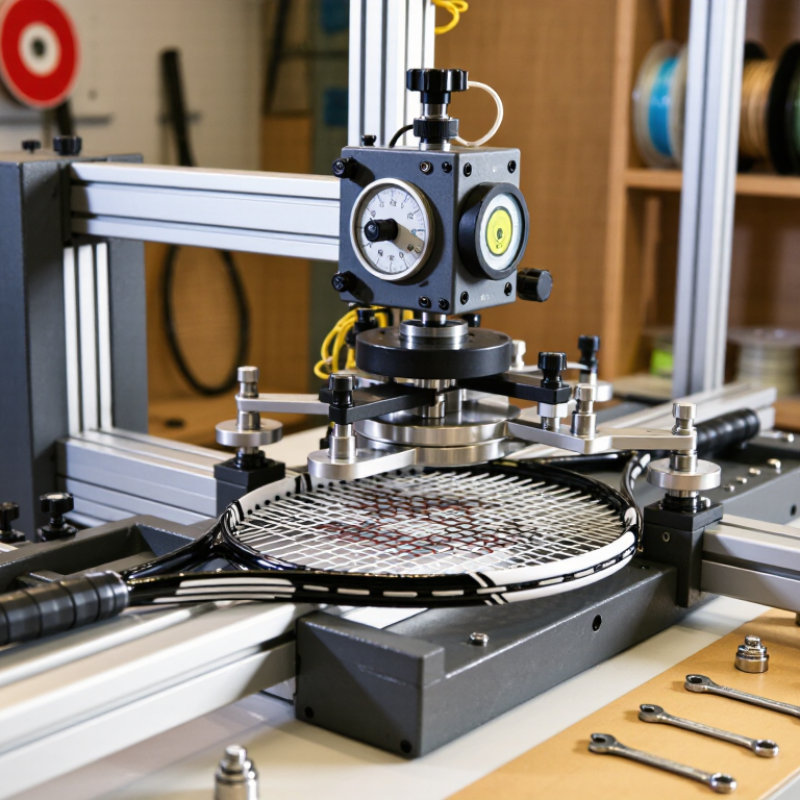
Chinese racket-stringing machines are easier to compare by mechanism than by appearance. Drop-weight models use gravity, offering simple calibration and low maintenance for home users and small clubs. Crank systems add faster tension setting, but their locking accuracy needs regular checking. Electronic constant-pull machines use a motor and load cell, supporting tighter control in busy workshops. They cost more. They also require cleaner power and better technical support.
The ITF Global Tennis Report 2021 recorded about 87 million tennis players worldwide. BWF participation research has reported more than 300 million badminton players globally. These figures explain the demand for different machine classes, not one universal design. Portable manual machines suit coaches, schools, and tournament travel. Semi-automatic units fit club rooms handling repeated restringing. Commercial electronic machines suit service centers where speed, repeatability, and digital tension records matter.
When assessing Chinese manufacturers, buyers should inspect calibration certificates, clamp movement, turntable rigidity, spare-part access, and response time from the technical team. Test ten identical rackets, then compare tension consistency after 24 hours. A machine may display 28 pounds while delivering uneven results. That is a practical warning. Reported market growth figures also vary between research firms, often because “stringing equipment” includes different product categories. Treat forecasts carefully. Hands-on testing remains more reliable than a polished specification sheet.
Set Ranking Criteria: 10–90 lb Range and ±0.1 kg Tension Accuracy
China Top Restringing Rackets Machine Manufacturers?
A credible ranking should begin with measurable tension performance, not showroom design. The core requirement is a 10–90 lb range, equal to approximately 4.5–40.8 kg. Accuracy should remain within ±0.1 kg across that full range. This equals roughly ±0.22 lb, a demanding benchmark for badminton and tennis service work.
A practical workshop test should use a calibrated load cell at 10, 30, 50, 70, and 90 lb. Each point needs repeated measurements, not one lucky reading. Check both constant-pull stability and adjustment speed. A machine may display the correct number while pulling inconsistently. That difference matters near the racket frame.
The ITF Global Tennis Report 2024 recorded more than 106 million tennis players across 199 countries, showing strong demand for dependable restringing services. The SFIA 2024 Topline Participation Report also reported about 23.8 million tennis participants in the United States during 2023. These figures support ranking manufacturers by service reliability, calibration records, after-sales training, and spare-part access.
Accuracy claims still require caution. Some testing results use factory calibration only. They may not represent performance after months of daily use. A stronger ranking would publish test conditions, sample size, load-cell certification, and error results at every tension point. That evidence is more valuable than a polished specification sheet.
Compare Leading Manufacturers by Output, Exports, Warranty, and CE/ISO 9001
A credible comparison of racket restringing machine manufacturers should separate factory output from marketing claims. UN Comtrade and ITC Trade Map provide useful export signals, but customs data often groups stringing equipment with broader machinery categories. Therefore, export totals need cautious interpretation. Ask suppliers for annual production, shipment destinations, and recent inspection records. A factory producing 2,000 machines yearly may still offer stronger consistency than a larger, less specialized producer. That distinction matters.
Certification also needs careful checking. The ISO Survey 2023 recorded 1,265,216 ISO 9001 certificates across 189 economies, showing wide adoption of quality systems. However, ISO 9001 does not prove machine accuracy. Request the certificate scope, issuing body, and valid dates.
For CE compliance, the European Commission’s Blue Guide 2022 explains that manufacturers remain responsible for conformity assessment and technical documentation. A CE mark alone is not independent performance evidence. Look for documented electrical tests, calibration procedures, and traceable serial numbers.
Warranty terms deserve equal attention. Compare coverage length, replacement parts, response time, and repair responsibility. Two years sounds attractive. Hidden exclusions can change the value.
In practical trials, check clamp stability, tension repeatability, noise, and service access. I would not rank suppliers by output alone. Public data remains incomplete, and some export figures are difficult to verify.
Verify Performance Through Calibration, Pull-Speed, and Clamp Tests
China Top Restringing Rackets Machine Manufacturers?
A credible restringing machine manufacturer should welcome measurable testing, not rely on polished claims. Before ordering, request a calibration record for the tension head. It should show the tested range, instrument used, date, and operator. A calibrated reference gauge can reveal whether a displayed 60 pounds is actually 58 or 62. Small errors matter. They change string response and player feedback.
Pull-speed testing adds practical evidence. Run repeated pulls at slow, medium, and fast settings with the same string and reference tension. Record the time to reach target tension, overshoot, and recovery after several cycles. Watch the reading, not only the final number. A stable machine should return consistently without harsh jerks or audible strain. Yet speed can expose weaknesses. Fast pulling may increase vibration, heat, or tension drift. Ask for data from a loaded machine, because an empty demonstration proves little.
Clamp tests should examine grip, release, alignment, and surface wear. Place the same string under controlled tension, then inspect slippage marks after repeated pulls. Fixed clamps must hold firmly without crushing delicate string coatings. I would also check turntable play and mounting stability. These details are easy to overlook. Request a sample inspection video and independent test records where possible. Factory quality can vary between production batches, so one successful sample should not end the evaluation. A neat certificate can still hide poor daily maintenance.
Assess Pricing, Spare Parts, and Badminton/Tennis Market Compatibility
Selecting a Chinese restringing-machine manufacturer requires more than comparing the lowest quote. The ITF Global Tennis Report 2024 estimates 106 million tennis players worldwide. Meanwhile, SFIA’s 2024 Topline Report recorded 23.8 million US tennis participants in 2023. These figures indicate steady service demand. However, badminton shops need different clamps, mounting clearance, and tension control. A tennis-focused machine may not perform well with delicate badminton frames.
Compare the landed cost, not only the factory price. Include freight, calibration tools, mounting supports, clamps, and replacement parts. Request a written price list for the tension head, brake, turntable, power board, and sensors. Ask how many days each part normally takes to ship. A low-cost machine becomes expensive when one small component stops production. I would also request repair videos and calibration records. Photos alone are weak evidence.
Badminton strings commonly use about 20–35 pounds, while tennis services often use 45–70 pounds. Verify accuracy across both ranges. The machine should provide stable pulling, smooth gripper movement, and frame supports that fit smaller badminton heads. A common buying mistake is trusting maximum tension figures without testing low-tension consistency. I would test three badminton frames and three tennis frames before final approval. Results can still vary between operators. That uncertainty deserves a written acceptance standard.





