


Top Automobile Bushing Manufacturers in China for Global Buyers

Choosing an Automobile Bushing manufacturer in China involves more than comparing unit prices. These components help manage vibration, movement, and contact between vehicle parts. Their performance can affect ride comfort, noise, and service life. Small details matter. A rubber compound that suits one application may not suit another. Buyers should clarify the intended vehicle, operating conditions, dimensions, hardness, and expected production volume before requesting quotations.

This guide introduces key considerations for global buyers exploring Chinese manufacturers. It focuses on practical checks, including material selection, engineering support, sample evaluation, production consistency, and quality documentation. Ask how a supplier controls critical dimensions and tests finished bushings. Request relevant drawings, inspection records, and samples where appropriate. A polished catalog is useful, but it cannot replace verification. Neither can a low price. Supplier capabilities and lead times can change, so confirm current details directly and compare responses against your own specifications.

Some sourcing choices remain uncertain. A sample may perform well while a larger production batch reveals variation. Buyers should discuss acceptable tolerances, packaging, communication, and corrective-action processes before placing substantial orders. This overview is intended to support careful evaluation, not to declare one manufacturer suitable for every project. The best fit depends on the application, evidence provided, and the buyer’s requirements.
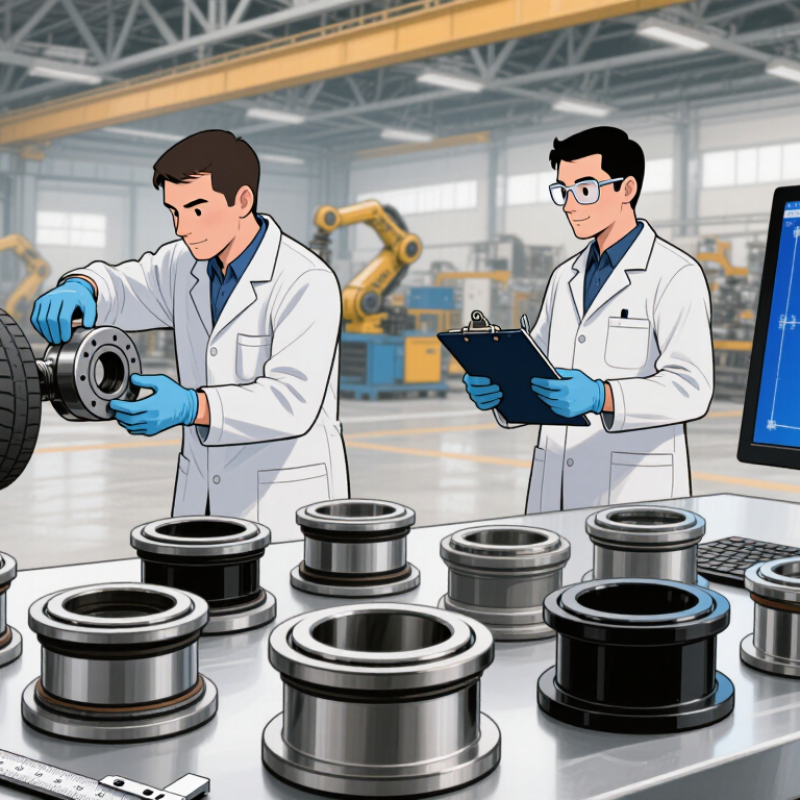
Top Automobile Bushing Manufacturers in China for Global Buyers

Automotive Bushings: Types, Materials, and Core Functions

Top Automobile Bushing Manufacturers in China for Global Buyers

Automotive Bushings: Types, Materials, and Core Functions

Automotive bushings sit between moving or vibrating components, such as a control arm and its mounting point. Their job is not simply to soften impacts. They also help maintain suspension geometry, reduce cabin noise, and allow controlled movement under load. Common designs include bonded rubber-metal bushings, cylindrical sleeves, and spherical bushings. Each handles motion differently, so the right type depends on its location and operating forces.

Rubber remains widely used because it absorbs vibration and works quietly. Natural rubber can provide flexibility and resilience, while synthetic compounds such as EPDM may suit applications exposed to heat and weather. Oil-resistant compounds may be preferable near fluid exposure. Polyurethane can offer firmer support, but may transmit more road harshness. No material is best in every position. A bushing’s hardness, shape, bonding quality, and temperature range all affect performance. On a workbench, two parts may look similar; under repeated braking and cornering, they can behave quite differently.

Tips: Check the specified dimensions, hardness, and working conditions before comparing suppliers. Ask how samples are tested for compression, bonding, and durability. A useful specification still needs real-vehicle validation. Even careful selection can miss a detail.


China’s Automotive Bushing Manufacturing Landscape

China’s automotive bushing manufacturing landscape includes large production centers and smaller specialist workshops. Factories commonly produce rubber, rubber-to-metal, and polyurethane components for passenger cars and commercial vehicles. Many suppliers can adjust dimensions, compounds, and hardness to match a buyer’s drawings. The range is broad. That matters.

Production quality depends on more than molding equipment. Rubber mixing, metal-sleeve preparation, bonding, curing, and inspection each affect durability. Skilled teams may check dimensions with gauges and test samples for adhesion or compression. Yet process control can vary between suppliers, and a polished sample does not guarantee consistent batches. Buyers should review inspection records and ask how production changes are controlled.

When evaluating a manufacturer, request material specifications, tolerance data, and test methods before approving samples. Ask how the supplier handles tooling maintenance and identifies defects during production. Small details matter, such as clean bond surfaces and consistent sleeve alignment. Still, gaps remain. Communication about drawings or test limits can be imperfect, so written requirements and sample approval help reduce avoidable misunderstandings.

Top Automobile Bushing Manufacturers in China for Global Buyers - China’s Automotive Bushing Manufacturing Landscape

Manufacturing Segment Typical Bushing Products Common Materials Typical Manufacturing Processes Common Vehicle Applications Buyer Evaluation Points
Rubber-to-metal components Suspension bushings, control-arm bushings, stabilizer bushings, and bonded mounts Natural rubber and synthetic elastomers; steel sleeves or inserts where the design requires them Rubber compounding, metal-part preparation, rubber-to-metal bonding, molding, and curing Passenger-car suspension and chassis systems; selected commercial-vehicle assemblies Request drawings and material specifications; check bond integrity, dimensions, hardness, and test conditions.
Elastomer bushing specialists Solid, voided, and profile-shaped rubber bushings for vibration isolation and articulation Natural rubber, EPDM, and other elastomers selected according to the operating environment and design Compression, transfer, or injection molding; trimming; dimensional and visual inspection Suspension, steering, engine support, and other vehicle systems, depending on the part design Confirm the compound’s temperature, fluid, ozone, and aging requirements against the intended application.
Polyurethane component producers Polyurethane suspension bushings and other elastomeric components Cast or molded polyurethane formulations in application-specific hardness ranges Metering and mixing, casting or molding, curing, finishing, and inspection Aftermarket and specialized vehicle applications where polyurethane is specified Compare hardness, geometry, load and deflection data, and compatibility with the mating components.
Metal sleeve and insert suppliers Inner sleeves, outer shells, spacers, and inserts used in bushing assemblies Steel and other specified metals; surface finishes depend on design and corrosion requirements Tube cutting, stamping, machining, forming, welding where required, and surface treatment Rubber-metal bushings and related chassis or mounting assemblies Verify material grade, critical dimensions, weld requirements, corrosion protection, and traceability.
Integrated bushing assembly manufacturers Finished bonded assemblies combining elastomer, sleeves, and other specified components Application-specific rubber or polyurethane compounds, metal parts, and bonding systems In-house or coordinated metal preparation, bonding, molding, curing, assembly, and testing Original-equipment and replacement-part supply programs, subject to customer qualification Assess process control, change management, batch traceability, inspection plans, and production capacity.
Custom and low-volume production Prototype, service, or limited-run bushings made to customer drawings or approved samples Materials defined by the drawing, specification, or agreed validation plan Tooling development, sample molding, dimensional checks, and production ramp-up as required Development projects, legacy vehicles, special-purpose vehicles, and replacement requirements Agree on tooling ownership, sample approval criteria, minimum order quantities, lead times, and revision control.

The entries describe common product and process categories, not specific companies or brands. Actual capabilities, certifications, test methods, and production capacity should be confirmed directly with each supplier and against the applicable customer specification.

Leading Chinese Automobile Bushing Manufacturers for Global Buyers

Leading Chinese Automobile Bushing Manufacturers for Global Buyers

China produced about 30.2 million motor vehicles in 2023, according to OICA’s 2023 production statistics. That scale supports a broad supply base, but output volume alone does not prove a bushing supplier is reliable. Global buyers should assess production controls, engineering support, and repeatability. Ask for dimensional inspection records, rubber compound specifications, and evidence of metal-to-rubber bond testing. For a suspension bushing, even a small change in hardness can affect vibration, noise, and service life. Request samples from regular production, not only hand-finished prototypes. A polished sample can hide process variation.

One detail buyers sometimes miss: matching a drawing is not the same as matching performance. Confirm the operating temperature, load direction, and expected movement with the supplier. Then check whether its fatigue tests reflect those conditions. OICA’s figures describe vehicle production, not bushing quality; treat them as market context, not a supplier scorecard. Some sourcing decisions still depend on clear communication, and that can be difficult across technical teams.

Tips: Share a controlled drawing and application data before requesting a quote. Compare test methods, tolerances, and packaging—not just unit price. Ask how changes to tooling or compound are documented. Small gaps matter.

How to Evaluate Chinese Bushing Suppliers and Their Products

A reliable bushing supplier should explain how its product fits your application, not just quote a unit price. Share the drawing, load range, operating temperature, and exposure to oil, water, or ozone. Ask how the proposed rubber compound and metal sleeve address those conditions. A hardness value, such as Shore A, is useful, but it does not describe the whole part.

Ask for dimensional inspection records, material specifications, and test results for compression, bonding, or durability. Ask for evidence. Sample parts can reveal details that a catalogue misses: uneven rubber edges, rough sleeve surfaces, or dimensions that make installation difficult. Check whether the supplier can trace samples and production batches to the same approved specifications. Small details matter.

A factory audit or live production review can help confirm equipment, inspection steps, and actual capacity. A neat certificate is not proof that every batch will match it. I would still compare documents against physical samples, and I would clarify who handles changes to drawings or materials. Send the same technical questions to each supplier. Compare response quality, lead time, packaging, and inspection plans alongside price. Some early answers may be vague; that is a reason to ask for clearer records before placing an order.

Export, Certification, and Quality Considerations for International Buyers

For global buyers, export readiness means more than a competitive quotation. UNCTAD’s Review of Maritime Transport 2023 reports that shipping carries over 80% of world trade by volume, so packaging and shipment planning matter. Ask for confirmed lead times, carton dimensions, pallet details, and lot-level traceability before approving an order. For rubber-metal bushings, poor storage or loose packing can damage bonded surfaces before the parts reach your plant. Paperwork matters.

Check that any quality certificate covers the actual manufacturing site and product scope. IATF 16949 and ISO 9001 can indicate structured quality systems, but neither guarantees every batch will meet your drawing. Request inspection records for rubber hardness, dimensions, bond strength, and compression set. For a new supplier, agree on sample testing, acceptance limits, and corrective-action procedures in writing. A third-party laboratory can verify critical results when the application is safety-sensitive. This adds cost, and it may slow approval; that trade-off deserves honest discussion. Some buyers focus heavily on certificates and miss basic details, such as whether the shipped part matches the approved sample. Check both.

Certification Standards Buyers May Check for Automobile Bushing Suppliers

Edition year of selected international management-system standards commonly relevant to automotive manufacturing and supplier reviews.

Edition years identify the versions shown, not a supplier’s certification status. International buyers should verify each certificate’s validity, scope, and covered manufacturing site.

Powder Coat Booths

For those larger-sized parts, or smaller quantity runs, we have 2 independent powder coat booths and ovens. The quality, durability and affordability of today’s powder coating finishes make this the process of choice for world-class companies.

Powder coating advantages over other forms of coating are many. Materials used in the Powder coating process can be metals and non-metals that come in a multitude of thicknesses, textures, colors, etc. Another of Powder coating’s biggest advantages over conventional coatings is its ability to create finishes in many different textures. Powder Coating Booths allow us the ability to apply these advantages to large products.

Wet Paint Line

Tri-State Fabricators runs a full-service conveyor line for painting. Wet painting can provide protection or decoration to many different part styles. From start to finish, every project is easier to undergo random and point-based inspection by our skilled painting team.

Advantages to our Wet Paint Line are these lines start with product prep and ends with a thorough inspection of a high quality finished product. Our ability to complete large and small projects with a superior finish and doing so in a timely and economical fashion. This passes along the savings in production to our customers. When powder coating ins not an option, our Wet Paint Line gets the job done right the first time.

Wet Paint Booths

When the parts get big and heavy we roll-out our custom paint racks and oversize booth. By utilizing our partnerships with all the major paint brands, we can match virtually any color with wet paint.

The advantages of having access to a Wet Paint Booth are many. Large projects of many different shapes can be loaded into the booth. The Wet Paint Booth offers an environment that is much more controlled than a typical parts painting operation.

Not only are they used because of their controlled environment, but they’re are also advantageous when it comes to applying paint to parts that are needed in industries that require specialty coatings such as medical, aerospace, etc.

Military CARC

Our military forces have some very high standards when it comes to the finish of their vehicles and equipment. From the first pre-treatment step to final coat, it takes a great deal of knowledge and experience to protect the men and women of our armed forces. They deserve only the best, and Tri-State Fabricators provides it.

All of our processes are closely monitored by our staff and management teams. Both of which are highly trained in the processes of metal fabrication and finishing. Tri-State Fabricators’ goal is to always fully satisfy each and every customer, including the military. We will always put a 110% into what we do.

Glass-Bead Blasting

Abrasive media blasting is an excellent way to remove old paint, rust, and increase the paint/powder adhesion. Glass beads produce a much smoother and brighter finish than angular abrasives; leaving the part clean yet without any dimensional change. Chemically inert and environmentally friendly, we can recycle our beads approximately 30 times; making them a more preferred method of metal cleaning or surface finishing.

Advantages to Glass Bead Blasting are many. Glass bead blast media is used when a project is needing rough surfaces need to become smooth for applications of coatings such as paint. It is typically used to clean paint and rust from a product surface without deforming the surface it is being used on. Overall, compared to many other blasting media, Glass Bead Blasting is a very economical choice and those savings are always passed on to our customers.

Part Washing

Tri-State Fabricators utilize a zinc phosphate wash to clean and etch the material to ensure the best paint adhesion possible. The unique design of our 3-stage wash system does the work like a 5-stage. From Cleaning and rinsing to conversion coating and post-treatment, Our Part Washing process is a complete service and works throughout the fabrication service and the finishing service.

Along with the previously mentioned benefits, Curing is a vital chemical reaction that leaves the product finish hard and relatively safe from mild abrasion and aggressive corrosion. This process can be done in more than one way; ambient air-dry or in curing ovens at temps that exceed 240°.

Burn-Off Oven

From fixing paint mistakes (someone else’s of course) to simply cleaning our paint line hooks, our burn-off oven is put to good use. After a quick burn-off, a little clean up, and a fresh coat of paint, your parts will look better than new.

Why does our Burn-Off Oven work so well? Because super heating the air around parts turns the materials into ashes. From paint and powder coatings to rubber and machining oils, high temps do the job without degrading the integrity of the part.

Masking

Masking is a vital part of producing high quality products. We have die-cut masking patterns to protect machined surfaces as well as a wide range of plugs and caps to protect threaded holes and bolts. We provide permanent and temporary masking.

Masking allows the selected sections of a product to be protected from a fabrication or finishing service. This can be with both chemicals when etching and tapes, paints when only finishing just a section of the product. Masking is great in aiding the customization process of a project.

Screen Printing

Screen printing is a photographic process that transfers artwork onto a porous nylon screen which allows colored ink to flow through the screen and be deposited on an aluminum or plastic component. We can generally have just about any design created onto a screen for your parts.

Some of the advantages of Screen Printing are, brand recognition for your business displaying on your products, assembly instructions, product warnings/hazards, etc. Tri-State Fabricators produces Screen Printing of the highest quality so you know it’s durable.

Metal Finishing

Metal Finishing is the art of treating the exterior portion of product, often metal but can also be made of other materials, so that the surface is clean and free of any debris. Then the process of applying coats or either paint of powder coat takes place. This coating process improves the quality of the product in both appearance and resistance to wear and corrosion.

Tri-State Fabricators, Inc., understands that a project typically isn’t complete until a high-quality finish has been added to your product. This is why our painting and powder coating teams continuously inspect the products throughout the Metal Finishing process.
