


China Best Industrial Curtain Wall Suppliers

Industrial Curtain Walls are more than a glass-and-frame package. In factories, warehouses, and large commercial buildings, they must handle wind pressure, rain, temperature changes, and repeated use. A supplier’s brochure may show a clean façade; the details behind it matter more. Look for clear specifications on framing, glazing, seals, drainage paths, and installation tolerances.

The 2023 Global Status Report for Buildings and Construction, published by UNEP and the Global Alliance for Buildings and Construction, estimates that buildings and construction account for 37% of global energy- and process-related carbon dioxide emissions. That figure covers the wider sector, not curtain walls alone. Still, it explains why thermal performance and careful material selection deserve attention. For buyers comparing China’s suppliers, useful evidence includes tested system data, traceable materials, quality-control records, and project references. A photograph cannot prove a curtain wall’s performance.

Building-science expert John Straube’s published guidance can be paraphrased as a practical reminder: enclosure components must work together to control heat, air, and moisture. Small details matter. A poorly drained sill or uneven sealant joint can undermine an otherwise strong design. No supplier should be judged by claims alone. Ask how test results relate to the proposed system, and whether installation methods match the tested configuration. This comparison is not always straightforward; I would treat missing documentation as a reason to ask more questions, not as proof of poor quality.
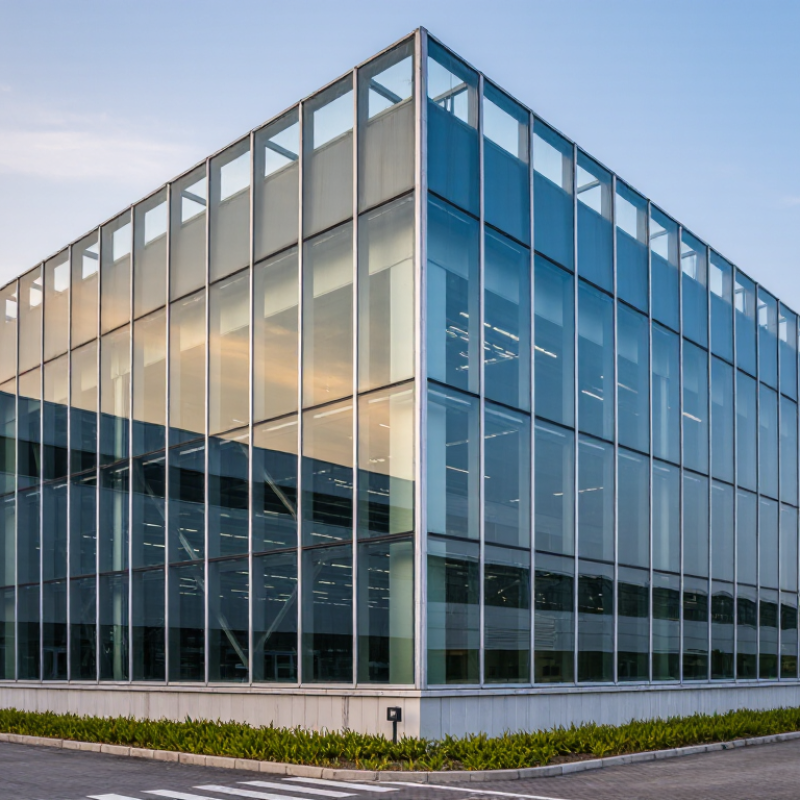
China Best Industrial Curtain Wall Suppliers

Understanding Industrial Curtain Wall Systems

Understanding Industrial Curtain Wall Systems

An industrial curtain wall is a non-load-bearing outer skin attached to a building’s structural frame. Its aluminum or steel framing holds glass, metal panels, or insulated spandrels. Anchors transfer wind loads to the structure; they do not support floors or roofs. That distinction matters. A wall that looks solid can still leak air or water at joints.

Performance depends on the whole assembly: glazing, thermal breaks, gaskets, drainage paths, and installation quality. The U.S. Department of Energy’s Energy Saver guidance estimates that heat gain and loss through windows account for 25–30% of residential heating and cooling energy use. This is useful fenestration context, not a direct prediction for industrial curtain walls. Factory façades differ in size, exposure, and operating schedules. A specification may look complete, yet overlook local wind pressure or maintenance access. Small details count.

Tips: Ask for tested air, water, and structural performance for the proposed assembly. Check how water drains from frame cavities, and inspect sample joints before installation. A neat drawing is not proof of a reliable façade.


China’s Industrial Curtain Wall Supplier Landscape

China’s industrial curtain wall supplier landscape includes manufacturers of aluminum frames, steel-and-glass systems, insulated panels, and custom façade assemblies. Some suppliers focus on fabrication; others also coordinate design development, testing, and site installation. Capabilities vary. A polished catalogue alone says little about production control or project experience.

The 2023 Global Status Report for Buildings and Construction, published by UNEP and GlobalABC, estimates that buildings accounted for 34% of global energy demand and 37% of energy- and process-related CO₂ emissions in 2022. These are sector-wide figures, not curtain-wall measurements, but they underline why envelope performance matters. Compare documented thermal, air, water, and wind-pressure results for the proposed assembly. Check that reports match the actual panel dimensions and materials. One awkward reality: bespoke specifications can improve fit, yet extend lead times. Supplier claims should be checked against samples and project records.

Tips: Request a recent production sample, assembly drawings, test documentation, and a clear schedule. Confirm who handles installation coordination. Details matter. A supplier may be capable, but one missed interface can still cause trouble.

China Best Industrial Curtain Wall Suppliers - China’s Industrial Curtain Wall Supplier Landscape
Supplier segment Typical scope and strengths Common project fit Relevant standards and checks Buyer verification points
Integrated façade fabricators May coordinate engineering, fabrication, glazing, unit assembly, packing, and installation support as one package. Projects requiring coordinated façade engineering and a defined interface between design, production, and site work. For projects in China, check the applicable requirements of GB/T 21086-2007, Curtain Wall, together with project-specific building codes and specifications. Confirm which activities are performed in-house, which are subcontracted, and who is responsible for design coordination and site installation.
Unitized system specialists Focus on factory-assembled façade units designed for transport and installation as prefabricated panels. Projects where panelized installation, repetitive floor layouts, or reduced on-site assembly are priorities. Ask for project-relevant air, water, and structural test reports. ASTM E283/E283M addresses air leakage; ASTM E331 addresses water penetration under static pressure; ASTM E330/E330M addresses structural performance under uniform static air pressure. Check that tested specimens represent the proposed unit joints, anchors, glass build-up, seals, and design pressures—not merely a similar system.
Stick-built system fabricators Supply or fabricate mullions, transoms, infill, and related components that are commonly assembled on site. Projects with varied façade geometry, phased construction, or site-specific assembly requirements. Use the project specification to define air leakage, water penetration, structural loading, and test conditions; ASTM E283/E283M, E331, and E330/E330M are commonly referenced test methods. Review installation tolerances, connection details, drainage paths, sealant joints, and the proposed field quality-control plan.
Industrial and performance-envelope specialists May develop façade packages around particular requirements such as large spans, impact resistance, acoustic control, or demanding exposure conditions. Factories, logistics facilities, public buildings, and other projects where envelope performance must be matched to the site and building use. For European projects, EN 13830 is the product standard for curtain walling. Confirm the edition, conformity route, and project jurisdiction with the design team. Request performance evidence for the actual configuration, including any special infill, opening units, corners, and transitions to adjacent construction.
Component-focused suppliers Provide defined parts or services, such as aluminium framing, glass processing, hardware, gaskets, anchors, or engineering assistance. Projects where the façade contractor or project team manages system integration and procurement across multiple packages. Component specifications and test evidence should be assessed against the complete façade design and applicable project requirements. Confirm material grades, finish, dimensional tolerances, compatibility with adjacent materials, traceability, and responsibility for system-level performance.
Cross-segment procurement criteria Supplier capability is best compared through scope, technical evidence, production controls, delivery planning, and after-sales obligations—not category name alone. Applicable to both domestic Chinese projects and export projects, subject to local codes and contract requirements. Set project-specific targets for air and water performance, structural loads, thermal and acoustic performance, fire requirements, and durability; do not treat a test method as a performance rating. Compare like-for-like drawings, bill of materials, test scope, warranty terms, quality records, capacity, lead time, packaging, and installation responsibilities.

Key Criteria for Evaluating Curtain Wall Suppliers

China Best Industrial Curtain Wall Suppliers

Key Criteria for Evaluating Curtain Wall Suppliers

Choosing a curtain wall supplier requires more than comparing quotes and finish samples. Ask for project references with similar building height, exposure, and panel size. Request documented results for air leakage, water penetration, and structural loading. ASTM E283, E331, and E330 describe commonly used test methods. Check that reports identify the tested assembly, not just individual components. Small details matter.

Performance affects more than comfort. UNEP’s 2023 Global Status Report for Buildings and Construction estimated that buildings and construction used 34% of global energy and produced 37% of energy- and process-related CO2 emissions in 2022. Ask suppliers for thermal calculations, glazing specifications, and, where available, verified environmental product declarations. These figures describe the wider sector, not the impact of any single curtain wall.

Factory quality is equally important. Review inspection records, material traceability, sealant controls, and sample-unit procedures. A site visit can reveal how frames are stored and whether finished units are protected from scratches and moisture. A polished brochure is not proof. The lowest bid may omit testing, installation support, or replacement parts; compare those items line by line. Even then, paperwork cannot guarantee careful workmanship.

Comparing Supplier Capabilities and Product Offerings

When comparing industrial curtain wall suppliers, buyers should look beyond sample panels and polished catalogs. The useful comparison is how each team handles engineering, fabrication, testing, and site coordination. Some suppliers focus on unitized panels for faster installation; others provide stick-built systems suited to irregular façades. Neither option is automatically better. Review maximum panel dimensions, glass build-ups, thermal breaks, drainage paths, and available finishes against project drawings. Ask for test reports, fabrication tolerances, installation guidance, and clear records of material changes. Details matter.

Production capacity also deserves scrutiny: monthly output, inspection stages, packaging methods, and realistic delivery windows can affect site sequencing. A factory visit or live video walkthrough may show how profiles are stored and finished panels are protected. A supplier’s response to a difficult corner detail can reveal more than a broad promise of customization. Request a sample corner or mock-up, then compare sealant joints, alignment, and finish under daylight. One weakness in many comparisons is treating quoted price as a complete measure of value. Freight, replacement procedures, and technical support after delivery can change the real cost. Documents alone cannot guarantee smooth installation; crews and site conditions matter, too. Leave room for questions.

How to Select a Supplier for Your Project

China Best Industrial Curtain Wall Suppliers
How to Select a Supplier for Your Project

Choosing an industrial curtain wall supplier starts with the building, not the brochure. Share drawings, opening dimensions, site exposure, and performance targets before requesting a quote. Ask how the proposed system handles wind pressure, water drainage, thermal movement, and maintenance access. Details matter. A supplier should explain assumptions in its calculations and identify what still needs confirmation by the project team.

Review evidence, not just promises. Request test reports for comparable systems, material specifications, quality-control records, and references from projects with similar conditions. Check how glass, aluminum profiles, seals, and finishes are inspected and traced. Ask whether a full-size mock-up is available before production. It can reveal awkward joints or drainage issues that drawings miss. Ask for evidence.

Compare lead times, packaging, delivery planning, and technical support during installation. Clarify who answers site questions and how damaged or incorrect components are handled. A low initial price may exclude important testing, customization, or after-sales support, so compare the complete scope. I would not assume the largest supplier is automatically the safest choice; fit, communication, and documented experience matter more. Some project details will change, and a reliable supplier should discuss those risks openly.

China Best Industrial Curtain Wall Suppliers: How to Select a Supplier for Your Project

Suggested evaluation weighting for comparing suppliers. Adjust the percentages to match your project requirements; these are planning weights, not market survey results.

How to use it: Score each supplier against the same criteria, then apply these weights to compare technical fit, compliance, delivery capability, and total project value.

Powder Coat Booths

For those larger-sized parts, or smaller quantity runs, we have 2 independent powder coat booths and ovens. The quality, durability and affordability of today’s powder coating finishes make this the process of choice for world-class companies.

Powder coating advantages over other forms of coating are many. Materials used in the Powder coating process can be metals and non-metals that come in a multitude of thicknesses, textures, colors, etc. Another of Powder coating’s biggest advantages over conventional coatings is its ability to create finishes in many different textures. Powder Coating Booths allow us the ability to apply these advantages to large products.

Wet Paint Line

Tri-State Fabricators runs a full-service conveyor line for painting. Wet painting can provide protection or decoration to many different part styles. From start to finish, every project is easier to undergo random and point-based inspection by our skilled painting team.

Advantages to our Wet Paint Line are these lines start with product prep and ends with a thorough inspection of a high quality finished product. Our ability to complete large and small projects with a superior finish and doing so in a timely and economical fashion. This passes along the savings in production to our customers. When powder coating ins not an option, our Wet Paint Line gets the job done right the first time.

Wet Paint Booths

When the parts get big and heavy we roll-out our custom paint racks and oversize booth. By utilizing our partnerships with all the major paint brands, we can match virtually any color with wet paint.

The advantages of having access to a Wet Paint Booth are many. Large projects of many different shapes can be loaded into the booth. The Wet Paint Booth offers an environment that is much more controlled than a typical parts painting operation.

Not only are they used because of their controlled environment, but they’re are also advantageous when it comes to applying paint to parts that are needed in industries that require specialty coatings such as medical, aerospace, etc.

Military CARC

Our military forces have some very high standards when it comes to the finish of their vehicles and equipment. From the first pre-treatment step to final coat, it takes a great deal of knowledge and experience to protect the men and women of our armed forces. They deserve only the best, and Tri-State Fabricators provides it.

All of our processes are closely monitored by our staff and management teams. Both of which are highly trained in the processes of metal fabrication and finishing. Tri-State Fabricators’ goal is to always fully satisfy each and every customer, including the military. We will always put a 110% into what we do.

Glass-Bead Blasting

Abrasive media blasting is an excellent way to remove old paint, rust, and increase the paint/powder adhesion. Glass beads produce a much smoother and brighter finish than angular abrasives; leaving the part clean yet without any dimensional change. Chemically inert and environmentally friendly, we can recycle our beads approximately 30 times; making them a more preferred method of metal cleaning or surface finishing.

Advantages to Glass Bead Blasting are many. Glass bead blast media is used when a project is needing rough surfaces need to become smooth for applications of coatings such as paint. It is typically used to clean paint and rust from a product surface without deforming the surface it is being used on. Overall, compared to many other blasting media, Glass Bead Blasting is a very economical choice and those savings are always passed on to our customers.

Part Washing

Tri-State Fabricators utilize a zinc phosphate wash to clean and etch the material to ensure the best paint adhesion possible. The unique design of our 3-stage wash system does the work like a 5-stage. From Cleaning and rinsing to conversion coating and post-treatment, Our Part Washing process is a complete service and works throughout the fabrication service and the finishing service.

Along with the previously mentioned benefits, Curing is a vital chemical reaction that leaves the product finish hard and relatively safe from mild abrasion and aggressive corrosion. This process can be done in more than one way; ambient air-dry or in curing ovens at temps that exceed 240°.

Burn-Off Oven

From fixing paint mistakes (someone else’s of course) to simply cleaning our paint line hooks, our burn-off oven is put to good use. After a quick burn-off, a little clean up, and a fresh coat of paint, your parts will look better than new.

Why does our Burn-Off Oven work so well? Because super heating the air around parts turns the materials into ashes. From paint and powder coatings to rubber and machining oils, high temps do the job without degrading the integrity of the part.

Masking

Masking is a vital part of producing high quality products. We have die-cut masking patterns to protect machined surfaces as well as a wide range of plugs and caps to protect threaded holes and bolts. We provide permanent and temporary masking.

Masking allows the selected sections of a product to be protected from a fabrication or finishing service. This can be with both chemicals when etching and tapes, paints when only finishing just a section of the product. Masking is great in aiding the customization process of a project.

Screen Printing

Screen printing is a photographic process that transfers artwork onto a porous nylon screen which allows colored ink to flow through the screen and be deposited on an aluminum or plastic component. We can generally have just about any design created onto a screen for your parts.

Some of the advantages of Screen Printing are, brand recognition for your business displaying on your products, assembly instructions, product warnings/hazards, etc. Tri-State Fabricators produces Screen Printing of the highest quality so you know it’s durable.

Metal Finishing

Metal Finishing is the art of treating the exterior portion of product, often metal but can also be made of other materials, so that the surface is clean and free of any debris. Then the process of applying coats or either paint of powder coat takes place. This coating process improves the quality of the product in both appearance and resistance to wear and corrosion.

Tri-State Fabricators, Inc., understands that a project typically isn’t complete until a high-quality finish has been added to your product. This is why our painting and powder coating teams continuously inspect the products throughout the Metal Finishing process.
