


What Are the Top Chicken House Cage Types for Poultry Farms?

Choosing a Chicken House Cage is not simply a matter of comparing frame designs. It means matching bird numbers, available floor space, labor, ventilation, and farm goals. A small laying unit may prioritize efficient egg collection, while a larger operation may need reliable manure removal and easy inspection access. Details matter.

The main systems include conventional cages, enriched cages, colony-style cages, and cage-free housing such as floor or aviary systems. Each has trade-offs. Cage dimensions, perch access, nest areas, feeder space, and cleaning routines affect daily work and bird comfort. A label alone cannot tell you how well a house will perform. No system corrects weak management.

Poultry housing researcher Dr. Hongwei Xin studies housing environments and their effects on poultry. A fair paraphrase of the principle behind this work is: “Good housing decisions consider birds, air quality, and daily management together.” This is a paraphrase, not a verbatim quotation. The sections ahead compare common cage types, explain their practical features, and identify questions farm managers should ask before choosing. They also consider ventilation, stocking plans, maintenance, and welfare monitoring. These are not minor details. A promising design can still disappoint if drinker lines leak, air becomes stale, or inspections are rushed. The best choice depends on the farm’s conditions, and some trade-offs deserve a second look.
What Are the Top Chicken House Cage Types for Poultry Farms?

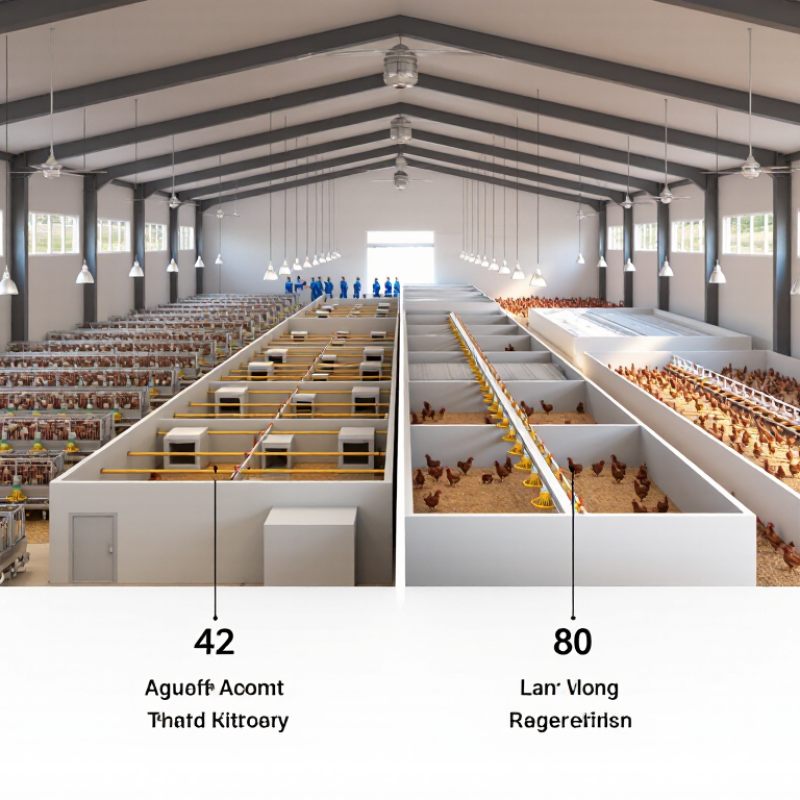
Map poultry cage systems: conventional, enriched, colony and rearing designs

Poultry cage systems differ in space, equipment, and the way birds use the house. Conventional cages have a compact layout, with feeders and drinkers placed along the cage front. Their simple arrangement can make daily checks straightforward, but offers fewer opportunities for nesting, perching, and scratching. Small details matter. A blocked drinker or uneven feed line can affect an entire row.

Enriched systems add features such as nest areas, perches, and scratch zones. These give hens more ways to move and express natural behaviors, while requiring careful layout and maintenance. Colony systems house larger groups and often combine similar features in shared spaces. The term can cover different designs, so compare usable floor area, group size, nest access, and inspection routes rather than relying on the label alone. A crowded nest entrance can create avoidable competition.

Rearing designs are intended for pullets before they enter the laying phase. Perches, ramps, and tiered levels can help young birds learn to move through a multi-level house. Match the rearing setup to the later laying system where possible; otherwise, birds may need time to adapt. Check that staff can reach birds, remove manure, and spot wet litter during routine rounds. No layout is perfect. Airflow and daily care still shape the outcome.

What Are the Top Chicken House Cage Types for Poultry Farms?

Cage type Typical bird stage Layout and features Space and equipment benchmarks Practical considerations
Conventional (unenriched) cage Adult laying hens, where permitted Small groups in wire enclosures, commonly arranged in rows or tiers. Feeders and drinkers are provided; nest boxes, perches, and litter areas are generally absent. Space allowances depend on the applicable law. As a historical reference, the EU’s former conventional-cage minimum was 550 cm² of cage area per hen; conventional cages have been prohibited for laying hens in the EU since 2012. Compact and straightforward to manage, but provides fewer opportunities for nesting, perching, dust bathing, and other natural behaviours. Legal status varies by country and region.
Enriched cage Adult laying hens Group cage with added facilities such as a nest area, perches, and litter or scratching area. Feed and water are accessible within the cage. Under EU rules, each hen must have at least 750 cm² of cage area, including at least 600 cm² of usable area. The rules also specify a nest, litter, and at least 15 cm of perch per hen. Includes more behavioural resources than a conventional cage. Requirements and permitted housing systems differ between jurisdictions; check current local standards.
Colony cage Usually adult laying hens A larger group enclosure, often designed with enriched features such as perches, nest areas, and litter space. The term commonly describes a larger-scale group cage rather than one universal technical specification. Group size, usable area per bird, and equipment vary by design and local regulations. There is no single internationally uniform “colony cage” standard. Larger groups can change flock management and inspection needs. Confirm the stocking density, equipment layout, and legal classification for the specific system.
Rearing cage Growing pullets before transfer to the laying house Designed for young birds, with age-appropriate feeding and drinking equipment. Depending on the system, it may include perches, platforms, or other structures to support movement and development. Space allowances and required features depend on bird age, housing method, and local regulations. Pullets should be reared in a system that prepares them for the facilities and equipment they will encounter as layers. Good transfer planning helps birds adapt to the laying environment. Monitor growth, uniformity, access to feed and water, and the condition of feet and feathers.

Note: Cage terminology and legal requirements vary by jurisdiction. The EU figures shown are regulatory benchmarks, not universal recommendations; always verify current local animal-welfare and housing rules.


Conventional layer cages: EU rules set 550 cm² per hen before 2012

Before the EU phase-out took effect on 1 January 2012, conventional layer cages had to provide at least 550 cm² of cage area per hen. That is roughly the area of a 23.5 cm square. The number looks clear on paper. In a poultry house, however, each bird shared a confined space with other hens.

This figure was a minimum, not a guarantee of good welfare. It did not give each hen a separate square or describe how easily birds could move, perch, or reach feed and water. Farm records should be checked carefully: cage dimensions and bird numbers both affect the calculation. Small differences in measurement can change the stated allowance.

The 550 cm² standard is historical, not a current EU requirement for conventional cages. EU rules ended the use of conventional cages from 1 January 2012, with different requirements applying to enriched cages. The old figure can still help explain how housing standards changed. But area alone says little about feather condition, behavior, or daily comfort. A tidy number can hide a cramped reality.

Enriched cages: EU Directive 1999/74/EC requires 750 cm² per hen

Enriched cages are designed for laying hens, not broilers. Council Directive 1999/74/EC sets a minimum of 750 cm² of cage area per hen, including at least 600 cm² of usable area. It also requires a nest, litter for pecking and scratching, and at least 15 cm of perch space per hen. These figures are legal minimums, not a guarantee of good welfare. Details matter.

In practice, the usable floor area must accommodate hens moving around feeders, drinkers, and perches without blocking one another. The European Food Safety Authority’s 2023 scientific opinion on laying-hen welfare identifies restricted movement and limited opportunities for natural behaviors as concerns in cage systems. A compliant layout can still feel crowded when resources are poorly positioned. Farm managers should check actual bird access, not just the plan’s measurements.

Tip: Measure usable area carefully; nest space does not count toward it. Check perch access and litter condition during routine inspections, and record problems before making layout changes.

Check enrichment details: 600 cm² usable space and 15 cm perch per hen

What Are the Top Chicken House Cage Types for Poultry Farms?

When comparing poultry housing, look beyond the cage label. Measure what each hen can actually use. In enriched cages, usable floor area and perch length are practical checks. The details matter.

Council Directive 1999/74/EC specifies at least 600 cm² of usable cage area and 15 cm of perch per hen in enriched cages. These are European requirements, not universal design rules. EFSA’s 2023 scientific opinion on laying-hen welfare also highlights restricted movement and limited behavioral opportunities as concerns in cage systems. A number on a plan does not show how hens use the space. Watch whether birds can reach perches without crowding, and whether feeders or drinkers create bottlenecks. Small layout flaws can matter.

Tips: Check usable dimensions on the installed system, not just the brochure. Observe hens at busy times, especially around feed and perches. Keep notes for several days. One inspection can miss a pattern. And if birds avoid a perch, ask why before assuming the design works.

Compare cage layouts by flock size, welfare compliance, labor and biosecurity

Conventional battery cages fit many birds into a compact footprint, but offer limited space for movement and natural behaviors. Enriched colony cages add features such as perches, nesting areas, and scratching surfaces. Their larger groups can reduce equipment cost per bird, yet they require careful observation: crowded nest areas may cause competition. Small details matter.

For welfare compliance, compare usable floor area, group size, and access to nests and perches against the rules where the farm operates. Requirements vary by location and may change, so confirm them with qualified local advisers before choosing a layout. A system that looks spacious on a plan may feel crowded at bird level. That deserves a second look.

Labor and biosecurity depend on more than cage style. Manure belts and automated egg collection can reduce routine handling, while accessible service lanes make inspection and repairs easier. Larger flocks often benefit from repeatable workflows, but one blocked conveyor can affect many birds. Smaller units may be easier to monitor closely, though cleaning takes more trips. Keep clean and dirty routes separate, limit unnecessary entry, and check that workers can reach drinkers, birds, and equipment without climbing over barriers.

Powder Coat Booths

For those larger-sized parts, or smaller quantity runs, we have 2 independent powder coat booths and ovens. The quality, durability and affordability of today’s powder coating finishes make this the process of choice for world-class companies.

Powder coating advantages over other forms of coating are many. Materials used in the Powder coating process can be metals and non-metals that come in a multitude of thicknesses, textures, colors, etc. Another of Powder coating’s biggest advantages over conventional coatings is its ability to create finishes in many different textures. Powder Coating Booths allow us the ability to apply these advantages to large products.

Wet Paint Line

Tri-State Fabricators runs a full-service conveyor line for painting. Wet painting can provide protection or decoration to many different part styles. From start to finish, every project is easier to undergo random and point-based inspection by our skilled painting team.

Advantages to our Wet Paint Line are these lines start with product prep and ends with a thorough inspection of a high quality finished product. Our ability to complete large and small projects with a superior finish and doing so in a timely and economical fashion. This passes along the savings in production to our customers. When powder coating ins not an option, our Wet Paint Line gets the job done right the first time.

Wet Paint Booths

When the parts get big and heavy we roll-out our custom paint racks and oversize booth. By utilizing our partnerships with all the major paint brands, we can match virtually any color with wet paint.

The advantages of having access to a Wet Paint Booth are many. Large projects of many different shapes can be loaded into the booth. The Wet Paint Booth offers an environment that is much more controlled than a typical parts painting operation.

Not only are they used because of their controlled environment, but they’re are also advantageous when it comes to applying paint to parts that are needed in industries that require specialty coatings such as medical, aerospace, etc.

Military CARC

Our military forces have some very high standards when it comes to the finish of their vehicles and equipment. From the first pre-treatment step to final coat, it takes a great deal of knowledge and experience to protect the men and women of our armed forces. They deserve only the best, and Tri-State Fabricators provides it.

All of our processes are closely monitored by our staff and management teams. Both of which are highly trained in the processes of metal fabrication and finishing. Tri-State Fabricators’ goal is to always fully satisfy each and every customer, including the military. We will always put a 110% into what we do.

Glass-Bead Blasting

Abrasive media blasting is an excellent way to remove old paint, rust, and increase the paint/powder adhesion. Glass beads produce a much smoother and brighter finish than angular abrasives; leaving the part clean yet without any dimensional change. Chemically inert and environmentally friendly, we can recycle our beads approximately 30 times; making them a more preferred method of metal cleaning or surface finishing.

Advantages to Glass Bead Blasting are many. Glass bead blast media is used when a project is needing rough surfaces need to become smooth for applications of coatings such as paint. It is typically used to clean paint and rust from a product surface without deforming the surface it is being used on. Overall, compared to many other blasting media, Glass Bead Blasting is a very economical choice and those savings are always passed on to our customers.

Part Washing

Tri-State Fabricators utilize a zinc phosphate wash to clean and etch the material to ensure the best paint adhesion possible. The unique design of our 3-stage wash system does the work like a 5-stage. From Cleaning and rinsing to conversion coating and post-treatment, Our Part Washing process is a complete service and works throughout the fabrication service and the finishing service.

Along with the previously mentioned benefits, Curing is a vital chemical reaction that leaves the product finish hard and relatively safe from mild abrasion and aggressive corrosion. This process can be done in more than one way; ambient air-dry or in curing ovens at temps that exceed 240°.

Burn-Off Oven

From fixing paint mistakes (someone else’s of course) to simply cleaning our paint line hooks, our burn-off oven is put to good use. After a quick burn-off, a little clean up, and a fresh coat of paint, your parts will look better than new.

Why does our Burn-Off Oven work so well? Because super heating the air around parts turns the materials into ashes. From paint and powder coatings to rubber and machining oils, high temps do the job without degrading the integrity of the part.

Masking

Masking is a vital part of producing high quality products. We have die-cut masking patterns to protect machined surfaces as well as a wide range of plugs and caps to protect threaded holes and bolts. We provide permanent and temporary masking.

Masking allows the selected sections of a product to be protected from a fabrication or finishing service. This can be with both chemicals when etching and tapes, paints when only finishing just a section of the product. Masking is great in aiding the customization process of a project.

Screen Printing

Screen printing is a photographic process that transfers artwork onto a porous nylon screen which allows colored ink to flow through the screen and be deposited on an aluminum or plastic component. We can generally have just about any design created onto a screen for your parts.

Some of the advantages of Screen Printing are, brand recognition for your business displaying on your products, assembly instructions, product warnings/hazards, etc. Tri-State Fabricators produces Screen Printing of the highest quality so you know it’s durable.

Metal Finishing

Metal Finishing is the art of treating the exterior portion of product, often metal but can also be made of other materials, so that the surface is clean and free of any debris. Then the process of applying coats or either paint of powder coat takes place. This coating process improves the quality of the product in both appearance and resistance to wear and corrosion.

Tri-State Fabricators, Inc., understands that a project typically isn’t complete until a high-quality finish has been added to your product. This is why our painting and powder coating teams continuously inspect the products throughout the Metal Finishing process.
