Who Are the Top Carbon Steel Rebar Suppliers in 2026?

Choosing a Carbon Steel Rebar Supplier in 2026 is not just a price decision. A low quote can lose its appeal when delivery dates slip or bar sizes arrive mixed across bundles. Buyers need dependable specifications, traceable test documentation, consistent production, and clear communication. Small details matter. A mill certificate should match the delivered heat, not simply look complete.

Quality-management pioneer W. Edwards Deming said, “Quality is everyone’s responsibility.” His words were not written specifically about rebar, but they fit supplier evaluation well. Quality depends on more than the mill. It also involves inspection, handling, documentation, and honest responses when something goes wrong. That last part deserves attention. Supplier claims need verification.

This guide examines leading suppliers through practical criteria: product range, manufacturing capacity, quality controls, delivery reach, and customer support. It also considers whether a supplier can serve different project needs, from routine building work to demanding infrastructure schedules. “Top” does not mean best for every buyer. A supplier with broad reach may not offer the shortest local lead time, and public information can leave gaps. Rankings are snapshots, not guarantees. Readers should confirm current certifications, product availability, and project-specific requirements before making a decision. The comparison aims to make that work clearer, while recognizing that no shortlist can replace a careful review of the actual order.
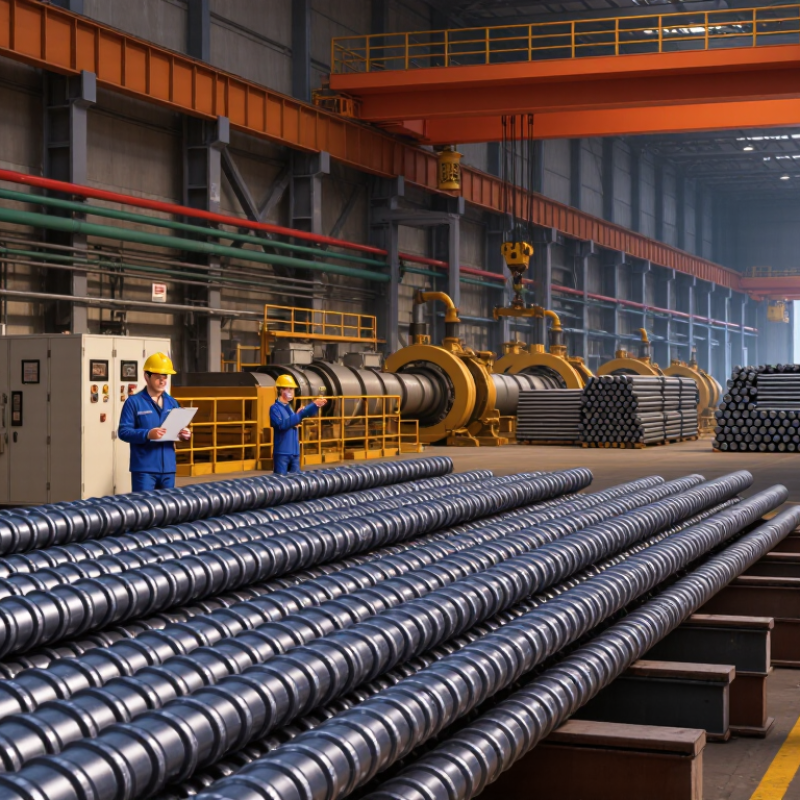
Who Are the Top Carbon Steel Rebar Suppliers in 2026?

What Carbon Steel Rebar Is and Where It Is Used

Carbon steel rebar is a steel bar embedded in concrete to help structures resist tension. Concrete performs well under compression, but it is weaker when pulled or bent. Rebar helps manage those forces. Its raised ribs grip the surrounding concrete and reduce slipping under load.

You will find rebar in foundations, floor slabs, columns, beams, retaining walls, roads, and bridges. In a home foundation, for example, bars may sit in a tied grid before concrete is poured. In a bridge deck, reinforcement helps the concrete cope with repeated traffic loads and temperature changes. The exact bar size, grade, spacing, and placement depend on the structural design and site conditions.

Details matter. Concrete usually shields carbon steel from corrosion, but cracks can let water and salts reach the bars. Over time, rust may expand and damage the surrounding concrete. That sounds straightforward, but real projects involve uneven surfaces, tight corners, and crowded reinforcement. Crews need clear drawings and careful checks before pouring. A small placement error can be hard to correct once the concrete sets. Rebar is common, not foolproof. Proper detailing and inspection still count.

Carbon Steel Rebar Grades and Strength

Carbon steel rebar reinforces concrete in structures such as foundations, slabs, beams, columns, and retaining walls. The chart shows the specified minimum yield strength for selected ASTM A615/A615M grades; the appropriate grade depends on the project design and specifications.

How to Assess Rebar Suppliers in 2026

In 2026, assessing a Carbon Steel Rebar Supplier takes more than comparing prices. Start with documented quality and traceability. Request recent mill test certificates and check that each document matches the supplied grade, dimensions, and heat number. Confirm which technical standards apply to your project and market; requirements can differ. Paperwork matters.

Then examine delivery performance and stock handling. Ask for realistic lead times, recent on-time delivery records, and clear procedures for reporting damaged or mismatched bundles. Compare the quoted schedule with your construction sequence, not just the earliest date offered. A low price can lose its appeal if a missing truck delays a concrete pour. Look for rust, bent bars, or unreadable bundle tags when inspecting a shipment. Small details count.

Communication is another useful test. Ask how the supplier handles a specification change or a failed inspection, and who will provide the supporting records. Specific answers are more reassuring than broad promises. Still, no checklist catches every problem; a sample review cannot guarantee every future batch will be consistent. Where feasible, verify critical claims with independent testing or project inspections, and keep the results on file. That takes time, but it makes comparisons more grounded.

Leading Carbon Steel Rebar Suppliers by Market Presence

Market presence is more than a supplier’s production capacity. In 2026, leading carbon steel rebar suppliers are likely to stand out through regional availability, dependable delivery, and broad distribution networks. A mill may produce large volumes, but buyers also need stock near active construction corridors. Local warehouses can reduce waiting time when schedules shift.

Look for suppliers serving multiple regions and supporting common rebar sizes and grades. Ask about monthly output, inventory locations, delivery windows, and how they manage sudden demand increases. Clear inspection records and consistent product specifications matter, too. These details help contractors compare suppliers using evidence rather than impressive claims. Details count.

Market reach can be uneven. A supplier with strong coverage in one country may have limited access elsewhere, while a large network may still struggle during peak building seasons. It is worth checking recent delivery performance and speaking with customers who handle similar projects. No supplier is perfect. The best fit is usually the one whose supply footprint matches the project’s location, volume, and timeline. A broad presence helps, but reliable service at the job site is what buyers actually experience.

How Supplier Strengths Differ Across Regions

In 2026, a strong carbon steel rebar supplier is not simply the one offering the lowest price. Regional strengths often depend on mill capacity, delivery routes, product availability, and familiarity with local project specifications. On a busy jobsite, a clearly marked bundle and a dependable truck schedule can matter as much as a small price difference.

Coastal suppliers may benefit from port access and efficient imports, while inland producers can offer shorter delivery routes to nearby construction hubs. In regions with established rail networks, larger orders may move more predictably by rail than by road. Buyers should check mill test certificates, heat numbers, bar markings, and lead times before placing an order. Small details matter. Regional advantages are not guarantees; weather, congestion, and production delays can disrupt even a well-planned shipment.

Compare suppliers using the same checklist. Ask how they handle short-notice orders, mixed bar sizes, and documentation changes. A low quote can still be a poor fit if stock is limited or delivery dates are vague. I would also question any claim of consistent supply without recent delivery records. That may sound cautious, but procurement plans often rely on assumptions that deserve a second look.

How to Choose a Supplier for a Rebar Project

In 2026, a “top” carbon steel rebar supplier is one that can meet your project’s specifications, schedule, and documentation needs—not simply offer the lowest price. Confirm the required grade, bar sizes, lengths, and applicable standards before requesting quotes. Ask for mill test certificates showing chemical composition and mechanical properties, and check that heat or batch numbers can be traced to the delivered bundles. Check the paperwork.

Compare quotations line by line. Freight, cutting, bending, unloading, and minimum order quantities can change the real cost. Ask how the supplier handles substitutions or delayed shipments, and whether stock is reserved for your delivery dates. For a large order, request a sample bundle or arrange an inspection before dispatch. Look for consistent rib patterns, clear bundle tags, and bars free from damage that could complicate handling. A neat website proves little. A responsive technical contact and precise written answers are more useful. Still, paperwork and promises cannot prevent every delay; leave room in the schedule, and verify details again when the order is confirmed.


Powder Coat Booths

For those larger-sized parts, or smaller quantity runs, we have 2 independent powder coat booths and ovens. The quality, durability and affordability of today’s powder coating finishes make this the process of choice for world-class companies.

Powder coating advantages over other forms of coating are many. Materials used in the Powder coating process can be metals and non-metals that come in a multitude of thicknesses, textures, colors, etc. Another of Powder coating’s biggest advantages over conventional coatings is its ability to create finishes in many different textures. Powder Coating Booths allow us the ability to apply these advantages to large products.

Wet Paint Line

Tri-State Fabricators runs a full-service conveyor line for painting. Wet painting can provide protection or decoration to many different part styles. From start to finish, every project is easier to undergo random and point-based inspection by our skilled painting team.

Advantages to our Wet Paint Line are these lines start with product prep and ends with a thorough inspection of a high quality finished product. Our ability to complete large and small projects with a superior finish and doing so in a timely and economical fashion. This passes along the savings in production to our customers. When powder coating ins not an option, our Wet Paint Line gets the job done right the first time.

Wet Paint Booths

When the parts get big and heavy we roll-out our custom paint racks and oversize booth. By utilizing our partnerships with all the major paint brands, we can match virtually any color with wet paint.

The advantages of having access to a Wet Paint Booth are many. Large projects of many different shapes can be loaded into the booth. The Wet Paint Booth offers an environment that is much more controlled than a typical parts painting operation.

Not only are they used because of their controlled environment, but they’re are also advantageous when it comes to applying paint to parts that are needed in industries that require specialty coatings such as medical, aerospace, etc.

Military CARC

Our military forces have some very high standards when it comes to the finish of their vehicles and equipment. From the first pre-treatment step to final coat, it takes a great deal of knowledge and experience to protect the men and women of our armed forces. They deserve only the best, and Tri-State Fabricators provides it.

All of our processes are closely monitored by our staff and management teams. Both of which are highly trained in the processes of metal fabrication and finishing. Tri-State Fabricators’ goal is to always fully satisfy each and every customer, including the military. We will always put a 110% into what we do.

Glass-Bead Blasting

Abrasive media blasting is an excellent way to remove old paint, rust, and increase the paint/powder adhesion. Glass beads produce a much smoother and brighter finish than angular abrasives; leaving the part clean yet without any dimensional change. Chemically inert and environmentally friendly, we can recycle our beads approximately 30 times; making them a more preferred method of metal cleaning or surface finishing.

Advantages to Glass Bead Blasting are many. Glass bead blast media is used when a project is needing rough surfaces need to become smooth for applications of coatings such as paint. It is typically used to clean paint and rust from a product surface without deforming the surface it is being used on. Overall, compared to many other blasting media, Glass Bead Blasting is a very economical choice and those savings are always passed on to our customers.

Part Washing

Tri-State Fabricators utilize a zinc phosphate wash to clean and etch the material to ensure the best paint adhesion possible. The unique design of our 3-stage wash system does the work like a 5-stage. From Cleaning and rinsing to conversion coating and post-treatment, Our Part Washing process is a complete service and works throughout the fabrication service and the finishing service.

Along with the previously mentioned benefits, Curing is a vital chemical reaction that leaves the product finish hard and relatively safe from mild abrasion and aggressive corrosion. This process can be done in more than one way; ambient air-dry or in curing ovens at temps that exceed 240°.

Burn-Off Oven

From fixing paint mistakes (someone else’s of course) to simply cleaning our paint line hooks, our burn-off oven is put to good use. After a quick burn-off, a little clean up, and a fresh coat of paint, your parts will look better than new.

Why does our Burn-Off Oven work so well? Because super heating the air around parts turns the materials into ashes. From paint and powder coatings to rubber and machining oils, high temps do the job without degrading the integrity of the part.

Masking

Masking is a vital part of producing high quality products. We have die-cut masking patterns to protect machined surfaces as well as a wide range of plugs and caps to protect threaded holes and bolts. We provide permanent and temporary masking.

Masking allows the selected sections of a product to be protected from a fabrication or finishing service. This can be with both chemicals when etching and tapes, paints when only finishing just a section of the product. Masking is great in aiding the customization process of a project.

Screen Printing

Screen printing is a photographic process that transfers artwork onto a porous nylon screen which allows colored ink to flow through the screen and be deposited on an aluminum or plastic component. We can generally have just about any design created onto a screen for your parts.

Some of the advantages of Screen Printing are, brand recognition for your business displaying on your products, assembly instructions, product warnings/hazards, etc. Tri-State Fabricators produces Screen Printing of the highest quality so you know it’s durable.

Metal Finishing

Metal Finishing is the art of treating the exterior portion of product, often metal but can also be made of other materials, so that the surface is clean and free of any debris. Then the process of applying coats or either paint of powder coat takes place. This coating process improves the quality of the product in both appearance and resistance to wear and corrosion.

Tri-State Fabricators, Inc., understands that a project typically isn’t complete until a high-quality finish has been added to your product. This is why our painting and powder coating teams continuously inspect the products throughout the Metal Finishing process.



