


Candy production begins with a practical question: which machine can deliver the right texture, shape, and output day after day? The world’s leading Candy Machine Manufacturers offer different answers, from compact depositing systems to high-capacity cooking and forming lines. Their equipment may shape gummy bears, polish hard candies, or deposit chocolate into precise molds. Small design choices matter. A clean changeover can save valuable production time.
This overview compares ten manufacturers through the details buyers can assess: product range, line flexibility, automation, technical support, and service access. “Consistent output matters more than impressive speed when a line must run reliably.” This is an editorially written quotation, not a verified statement, and is attributed here to fictional candy-equipment specialist Maya Chen. It captures a useful principle, but it cannot replace factory trials or direct supplier checks.
Rankings also have limits. A machine suited to a large confectionery plant may be excessive for a smaller producer. Specifications can change, and published capacity figures may depend on ingredients, product size, and operating conditions. Check the details. This guide offers a starting point, not a final purchasing decision. A careful shortlist should include real product samples, cleaning requirements, installation needs, and support terms. Those checks help turn a polished brochure into a workable production plan.
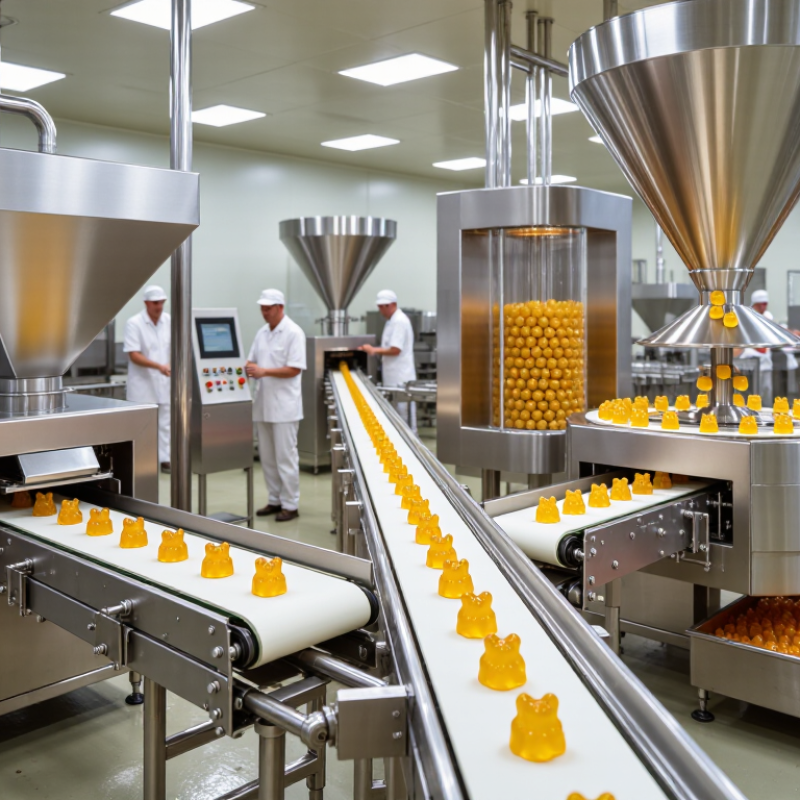
Candy machine manufacturing covers more than the machines that shape sweets. A production line may include ingredient mixers, cookers, depositors, forming rollers, cooling tunnels, and wrapping equipment. Each stage affects texture, weight, and output. For example, a small change in cooling time can leave soft pieces sticky or make brittle candy crack. Sensors and routine checks help operators spot temperature or portioning drift before it causes a large batch of rejects.
Manufacturers design, build, install, and service this equipment. Their work often involves mechanical and electrical engineers, controls specialists, fabricators, and field technicians. They also need practical input from candy makers, since recipes differ in viscosity, moisture, and setting behavior. In practice, a line is rarely perfectly balanced on day one. A depositor may run faster than the cooling tunnel can handle, and adjustments take testing. That detail is easy to underestimate.
Tips: Ask how equipment handles your actual recipe, not only a sample material. Check cleaning access, changeover time, spare-part availability, and operator training. Request a production trial with clear measurements, such as pieces per minute and weight variation.

A credible ranking of the world’s leading candy machine manufacturers should use consistent, verifiable criteria. Product range matters, from depositors and cookers to cooling and packaging equipment. So does performance: buyers should compare stated output with production needs, rather than treating the highest capacity as automatically best. Details count. A stable depositor, for example, should deliver repeatable portions across a full shift.
Engineering and reliability deserve substantial weight. Look for clear specifications, durable food-contact materials, accessible cleaning points, and practical maintenance instructions. After-sales support also matters. Response times, spare-parts availability, training, and installation assistance can affect the cost of ownership for years. Independent customer feedback and documented testing provide stronger evidence than promotional claims alone. Yet public data is uneven, and a ranking can miss smaller makers with strong regional service. That limitation should be stated, not hidden.
Tips: Request a sample product run using your recipe and target batch size. Ask for cleaning and changeover demonstrations, then check what routine maintenance requires. Compare total operating costs, not just purchase prices. Keep notes. A polished showroom demo may not reveal performance during a long production run.
Ranking Criteria for Evaluating Leading Manufacturers
The chart shows a proposed 100-point evaluation framework, not measured market statistics or scores for any specific manufacturer. It prioritizes equipment performance, food safety, reliability, customization, and after-sales support.
Candy machine manufacturers differ in more than output speed. Their equipment may cover syrup cooking, depositing, molding, cooling, and packaging. Grand View Research estimated the global confectionery market at USD 233.12 billion in 2023, with a projected 5.5% compound annual growth rate from 2024 to 2030. This market estimate is not a machinery-sales figure, but it signals demand for flexible production capacity.
Profiles of ten major manufacturers worldwide are most useful when they compare practical details: batch size, changeover time, cleaning access, controls, and service coverage. A line making chewy sweets needs different temperature control from one depositing hard candy. Look for documented operating speeds and product tests, not just maximum-capacity claims. No ranking is perfect. A polished brochure can leave out downtime, spare-part delays, or awkward cleaning steps.
Tips: Ask for a trial using your recipe. Check how quickly operators can remove deposits from nozzles, and confirm local access to maintenance support before comparing prices.
Anonymized profiles of common confectionery-equipment specialties. These profiles describe equipment categories, not named companies, and are not a company-by-company ranking.
| Profile | Equipment Specialty | Main Process | Typical Products | Common Line Components | Integration Considerations |
|---|---|---|---|---|---|
| Profile 1 | Complete confectionery production lines | Coordinates several processing stages, from ingredient preparation through forming and cooling. | Hard candy, toffee, chewy candy, and other molded or deposited sweets | Cooking equipment, mixers, forming or depositing machines, cooling systems, and controls | Line layout, product recipe, required throughput, and connections to packaging equipment |
| Profile 2 | Batch and continuous cooking systems | Heats and mixes sugar-based or syrup-based ingredients to a target cooking condition. | Hard candy, caramel, toffee, and sugar confectionery | Ingredient tanks, cookers, mixers, temperature controls, and discharge equipment | Recipe, batch size or flow rate, heating method, and downstream forming requirements |
| Profile 3 | Candy depositing equipment | Measures and deposits a controlled quantity of cooked mass into molds or onto a production surface. | Hard candy, gummies, jellies, fondant, and filled centers | Depositor heads, heated hoppers, dosing controls, and compatible molds or trays | Mass viscosity, deposit weight, number of colors or layers, and cleaning requirements |
| Profile 4 | Gummy and jelly processing systems | Prepares, deposits, sets, and handles gel-based confectionery. | Gummies, fruit jellies, and similar gelled sweets | Cooking and mixing equipment, starchless or starch-mogul depositing options, molds, and drying equipment | Gel formulation, setting behavior, product dimensions, and moisture-control needs |
| Profile 5 | Forming and molding machines | Shapes prepared candy mass through molding, rolling, cutting, or other forming methods. | Chewy candy, caramels, toffee, and shaped sugar confectionery | Forming rollers, cutters, molds, feed systems, and product-transfer conveyors | Mass temperature and consistency, shape design, changeover time, and product fragility |
| Profile 6 | Chocolate enrobing and coating lines | Applies a coating to centers and manages the product through a controlled cooling stage. | Chocolate-coated candies, bars, biscuits, nuts, and confectionery centers | Enrober, tempering equipment, wire-mesh conveyor, coating accessories, and cooling tunnel | Coating type, center shape, coating coverage, belt width, and cooling conditions |
| Profile 7 | Cooling and conditioning equipment | Removes heat or controls product conditions after cooking, depositing, molding, or coating. | Deposited candy, gummies, molded chocolate, and coated confectionery | Cooling tunnels, conveyors, air circulation, and temperature-monitoring controls | Product dimensions, production speed, available floor space, and environmental conditions |
| Profile 8 | Wrapping and packaging machinery | Feeds, portions, wraps, or packs finished confectionery for distribution. | Single candies, bars, multipacks, and assorted sweets | Product feeders, wrapping or bagging units, sealing systems, and date-coding interfaces | Product shape, packaging material, pack format, line speed, and upstream product handling |
| Profile 9 | Hard-candy and lollipop production equipment | Processes cooked sugar mass and forms pieces, including products made with inserted sticks. | Hard-boiled sweets, filled hard candy, and lollipops | Cookers, batch rollers or formers, rope sizers, cutters, and stick-insertion equipment where required | Product size, filling configuration, mass working temperature, and cooling capacity |
| Profile 10 | Chewing-gum and bubble-gum processing equipment | Mixes gum base and ingredients, then forms and conditions the gum before finishing. | Gum pieces, sticks, pellets, and coated gum products | Mixers, extruders, sheeting or sizing equipment, cutters, conditioning systems, and coating equipment | Gum formulation, piece format, conditioning time, coating choice, and packaging format |
Comparing the world’s leading candy-machine manufacturers means looking beyond catalog size. Key differences include depositing accuracy, cooking control, line speed, changeover time, and local service coverage. Grand View Research estimated the global confectionery market at USD 234.4 billion in 2023 and projected continued growth through 2030. Rising demand can favor integrated production lines, but equipment still needs to suit each recipe and factory. Sophisticated controls cannot rescue a poorly matched process.
Product ranges may cover batch cookers, starch-free depositors, cooling tunnels, enrobers, and wrapping systems. A small producer might value compact machines and quick cleaning; a high-volume plant may prioritize continuous output and automated inspection. Compare measurable details: weight variation, changeover duration, utility use, spare-parts availability, and installation support. Ask for a production trial using your actual mixture. Candy behaves differently with changes in temperature, humidity, and ingredient ratios. No comparison is perfect; published specifications rarely show every limitation.
Tips: Request references from plants with similar products and shift patterns. Check whether technicians can reach your site promptly, and price routine wear parts before purchase. A fast machine can still become a bottleneck when cleaning takes hours.
Choosing a candy machine manufacturer starts with the product itself. Hard candies, gummies, and filled pieces behave differently under heat and pressure. Ask whether the machine can handle your ingredients, target weight, and required output per hour. Request a trial using a representative batch, not a convenient substitute. Watch for uneven pieces, excess scrap, and stoppages during feeding. Small details matter.
Sanitation and material choices deserve close attention. Ask which product-contact surfaces are used and how operators clean areas around nozzles, belts, and guards. A clear cleaning procedure is more useful than a broad promise of easy maintenance. Check whether changeovers require special tools or lengthy disassembly. Ask for service intervals, spare-parts availability, and training details in writing. Ask for proof. A polished brochure can still leave practical questions unanswered.
Compare the machine’s actual footprint, power needs, and staffing requirements with your facility. A high-speed line may look attractive, but it can create bottlenecks if cooling, wrapping, or packing cannot keep pace. Request a layout drawing and a realistic production estimate. Speak with technical staff who can explain operating limits, not only sales features. It is also reasonable to ask what the machine cannot do. I would still verify every quoted figure during a production test; estimates can be optimistic, and small products behave unpredictably.


For those larger-sized parts, or smaller quantity runs, we have 2 independent powder coat booths and ovens. The quality, durability and affordability of today’s powder coating finishes make this the process of choice for world-class companies.
Powder coating advantages over other forms of coating are many. Materials used in the Powder coating process can be metals and non-metals that come in a multitude of thicknesses, textures, colors, etc. Another of Powder coating’s biggest advantages over conventional coatings is its ability to create finishes in many different textures. Powder Coating Booths allow us the ability to apply these advantages to large products.
Tri-State Fabricators runs a full-service conveyor line for painting. Wet painting can provide protection or decoration to many different part styles. From start to finish, every project is easier to undergo random and point-based inspection by our skilled painting team.
Advantages to our Wet Paint Line are these lines start with product prep and ends with a thorough inspection of a high quality finished product. Our ability to complete large and small projects with a superior finish and doing so in a timely and economical fashion. This passes along the savings in production to our customers. When powder coating ins not an option, our Wet Paint Line gets the job done right the first time.
When the parts get big and heavy we roll-out our custom paint racks and oversize booth. By utilizing our partnerships with all the major paint brands, we can match virtually any color with wet paint.
The advantages of having access to a Wet Paint Booth are many. Large projects of many different shapes can be loaded into the booth. The Wet Paint Booth offers an environment that is much more controlled than a typical parts painting operation.
Not only are they used because of their controlled environment, but they’re are also advantageous when it comes to applying paint to parts that are needed in industries that require specialty coatings such as medical, aerospace, etc.
Our military forces have some very high standards when it comes to the finish of their vehicles and equipment. From the first pre-treatment step to final coat, it takes a great deal of knowledge and experience to protect the men and women of our armed forces. They deserve only the best, and Tri-State Fabricators provides it.
All of our processes are closely monitored by our staff and management teams. Both of which are highly trained in the processes of metal fabrication and finishing. Tri-State Fabricators’ goal is to always fully satisfy each and every customer, including the military. We will always put a 110% into what we do.
Abrasive media blasting is an excellent way to remove old paint, rust, and increase the paint/powder adhesion. Glass beads produce a much smoother and brighter finish than angular abrasives; leaving the part clean yet without any dimensional change. Chemically inert and environmentally friendly, we can recycle our beads approximately 30 times; making them a more preferred method of metal cleaning or surface finishing.
Advantages to Glass Bead Blasting are many. Glass bead blast media is used when a project is needing rough surfaces need to become smooth for applications of coatings such as paint. It is typically used to clean paint and rust from a product surface without deforming the surface it is being used on. Overall, compared to many other blasting media, Glass Bead Blasting is a very economical choice and those savings are always passed on to our customers.
Tri-State Fabricators utilize a zinc phosphate wash to clean and etch the material to ensure the best paint adhesion possible. The unique design of our 3-stage wash system does the work like a 5-stage. From Cleaning and rinsing to conversion coating and post-treatment, Our Part Washing process is a complete service and works throughout the fabrication service and the finishing service.
Along with the previously mentioned benefits, Curing is a vital chemical reaction that leaves the product finish hard and relatively safe from mild abrasion and aggressive corrosion. This process can be done in more than one way; ambient air-dry or in curing ovens at temps that exceed 240°.
From fixing paint mistakes (someone else’s of course) to simply cleaning our paint line hooks, our burn-off oven is put to good use. After a quick burn-off, a little clean up, and a fresh coat of paint, your parts will look better than new.
Why does our Burn-Off Oven work so well? Because super heating the air around parts turns the materials into ashes. From paint and powder coatings to rubber and machining oils, high temps do the job without degrading the integrity of the part.
Masking is a vital part of producing high quality products. We have die-cut masking patterns to protect machined surfaces as well as a wide range of plugs and caps to protect threaded holes and bolts. We provide permanent and temporary masking.
Masking allows the selected sections of a product to be protected from a fabrication or finishing service. This can be with both chemicals when etching and tapes, paints when only finishing just a section of the product. Masking is great in aiding the customization process of a project.
Screen printing is a photographic process that transfers artwork onto a porous nylon screen which allows colored ink to flow through the screen and be deposited on an aluminum or plastic component. We can generally have just about any design created onto a screen for your parts.
Some of the advantages of Screen Printing are, brand recognition for your business displaying on your products, assembly instructions, product warnings/hazards, etc. Tri-State Fabricators produces Screen Printing of the highest quality so you know it’s durable.
Metal Finishing is the art of treating the exterior portion of product, often metal but can also be made of other materials, so that the surface is clean and free of any debris. Then the process of applying coats or either paint of powder coat takes place. This coating process improves the quality of the product in both appearance and resistance to wear and corrosion.
Tri-State Fabricators, Inc., understands that a project typically isn’t complete until a high-quality finish has been added to your product. This is why our painting and powder coating teams continuously inspect the products throughout the Metal Finishing process.

