


Who Are the Top Beacon Light With Siren Suppliers in China? The answer depends on the vehicle, worksite, and conditions the equipment must handle. A warning unit for a roadside service truck may need a different beam pattern, mounting base, and sound output from one used on a factory vehicle. Buyers should compare more than catalog photos.
For this guide, Lin Wei is presented as a composite sourcing specialist, not a quoted real-world authority. His editorial principle is: “A dependable warning system is judged by what it does in the field, not by its brightest product image.” That distinction matters. A lamp may look vivid on a screen but be difficult to see in rain, glare, or a crowded work area. Small details count.
The supplier review should examine product range, customization, documented testing, production consistency, and responsiveness to technical questions. Ask for clear specifications, including voltage, light pattern, sound options, dimensions, and mounting details. Request product samples where practical. Check whether the supplier explains quality-control steps and can provide relevant test records, rather than relying on broad promises. For exported products, confirm that documentation matches the model being quoted.
No shortlist is perfect. Product pages can leave important questions unanswered, and a polished sales response does not prove field performance. This comparison therefore focuses on verifiable information and practical fit. The goal is to identify Chinese suppliers worth evaluating—not to treat any company as the right choice for every buyer. Start with the application, then compare the evidence.
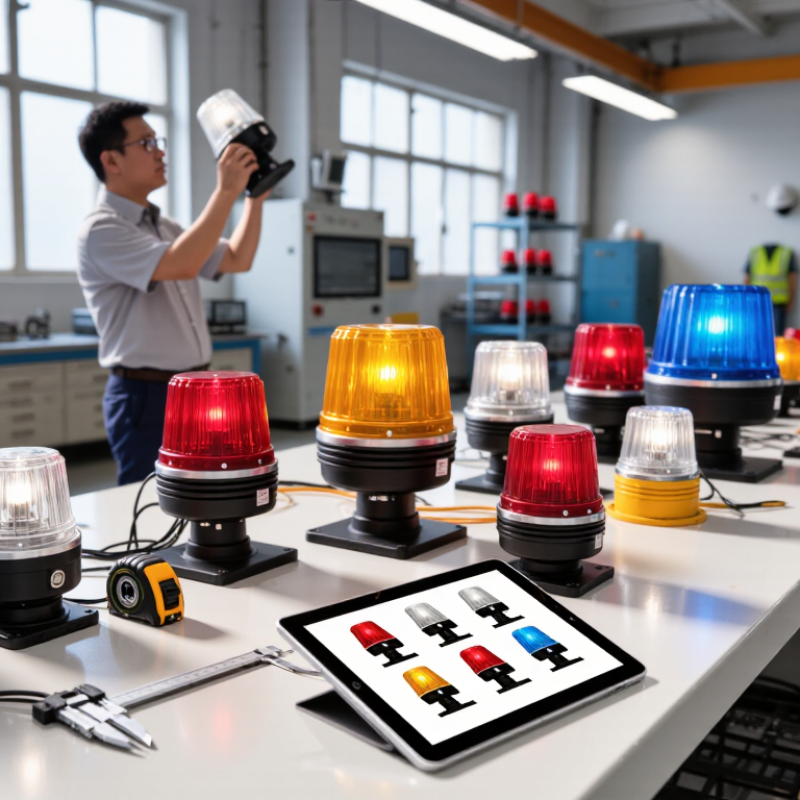
A beacon light with a siren combines a flashing visual signal with an audible warning. The light helps people notice a vehicle or work area, especially in rain, dust, or dim conditions. The siren adds an alert when visibility is poor or nearby activity is noisy. Designs may use rotating or LED lights, with different flash patterns and sound levels. That matters.
These units are commonly fitted to emergency-response vehicles, utility trucks, road-maintenance equipment, and industrial vehicles. Fixed installations may also mark access points or restricted work zones in warehouses and construction yards. Choosing a unit requires more than comparing brightness. Check its voltage, mounting method, weather resistance, and whether its sound can be heard over site machinery. Local requirements for warning equipment can differ, so confirm them before installation. A brighter lamp is not automatically safer; glare can distract workers or drivers. Not always.
Tips: Match the light color and siren output to the task and setting. Test the unit after mounting, with the vehicle or equipment operating. Ask suppliers for clear specifications and test records, rather than relying on broad claims. Keep the controls accessible, and make sure users know when the signal should be activated.

China’s beacon-light-and-siren supply market is a layered manufacturing network, not a single supplier list. Component makers produce LED modules, acoustic drivers, circuit boards, lenses, housings, and wiring harnesses. Assemblers combine these parts into vehicle-mounted or fixed-site warning units. Some firms focus on standard products; others handle custom specifications, OEM assembly, or export packaging. Not every supplier controls every stage.
The National Bureau of Statistics reported that China’s manufacturing value added grew 6.1% in 2024. This reflects a broad industrial base, not growth in the beacon category alone. The China Association of Automobile Manufacturers reported 31.28 million vehicles produced and 31.44 million sold that year. Those figures show the scale of the downstream vehicle ecosystem, but they do not measure warning-device demand. The distinction matters.
In practice, procurement often runs from component suppliers to assemblers, then through distributors or equipment integrators to end users. Buyers compare light output, sound level, voltage, connector layout, housing durability, and batch consistency. The boundaries blur. A product sheet may look complete, yet pinouts or lens tint can vary between batches. Factory audits and sample testing help, though they add time and cost. The market is organized efficiently in places, but not always neatly.
Chinese beacon-light and siren suppliers generally stand out in three areas: focused assembly, in-house electrical production, and export-oriented customization. The first group often offers compact warning lamps with options for flashing patterns, mounting bases, and operating voltage. More integrated factories may pair lights with sirens, letting buyers compare sound output and light visibility in one sample. Ask for the actual datasheet, not just a catalogue image. Details matter.
The market context is growing: Fortune Business Insights’ 2023 Industrial Automation Market report valued the global market at USD 205.86 billion in 2022 and projected USD 395.09 billion by 2029. That is not a beacon-specific forecast, but it reflects expanding demand for factory signaling components. When comparing Chinese suppliers, check voltage tolerance, housing material, ingress-protection rating, sound-level test conditions, and production lead time. Request a sample and inspect its lens, cable entry, and mounting holes. I would not choose on price alone; I have seen specification sheets leave practical installation questions unanswered. Also ask whether testing records apply to the exact model being quoted.
When comparing Chinese suppliers of beacon lights with sirens, assess both the unit and the process behind it. Ask for a production sample, not just a polished catalog image. Check lens uniformity, housing seams, connector fit, and whether labels stay readable after handling. Details matter. Request test records for brightness, sound output, vibration, and water resistance when relevant to your installation. Confirm that the records cover the exact model and configuration you plan to buy.
Compliance documents should match the destination market and product version. Ask which standards apply, then request current certificates or reports from the issuing laboratory. Verify model numbers, dates, and tested options; a report for a similar light may not cover its siren or mounting bracket. Ask for evidence. A supplier that explains limitations clearly is often more dependable than one promising universal approval. Avoid relying on screenshots without traceable documentation.
Support becomes visible when a sample fails or a shipment arrives with a damaged lens. Ask about response times, spare housings, wiring diagrams, warranty terms, and defect-correction procedures. Compare answers in writing. Support counts. Keep notes on sample findings, document revisions, and agreed inspection points. Packaging is easy to overlook: freight vibration can loosen a connector even when a product passed bench testing. No checklist catches everything. Test pilot units at the intended vehicle or site before placing a large order.
Who Are the Top Beacon Light With Siren Suppliers in China?
What to Check Before Choosing a Chinese Supplier
A supplier’s product page can show bright lights and loud sirens, but it rarely tells the whole story. Check the operating voltage, current draw, flash patterns, sound level, and mounting dimensions against your actual equipment. Ask how sound output was measured and at what distance. Test a sample under realistic conditions, including extended operation and vibration. Test the sample. A polished brochure is not proof; the test details matter.
Request recent inspection records and confirm that they match the exact model you plan to order. Ask about enclosure materials, sealing, cable length, connector options, and performance across the temperatures your equipment may face. Clarify production lead times, minimum order quantities, spare-part availability, and how defects are handled. A factory visit or live video walkthrough can help verify production and quality checks, though it cannot replace sample testing. Comparisons can feel repetitive, but vague answers are worth noticing.
Tips: Put agreed specifications in the purchase documents, not only in chat messages. Keep a signed sample or clear reference photos. Ask the supplier to explain any differences between sample and mass production. If a report lacks model numbers or test conditions, request clarification before placing an order.
| Evaluation Area | What to Check | Evidence to Request | How to Verify | Warning Sign |
|---|---|---|---|---|
| Product range and application | Confirm whether the supplier offers the required beacon type, siren function, mounting method, operating environment, and intended application. | Current product catalog, model-specific datasheets, installation instructions, and a written confirmation of the proposed configuration. | Match the exact model and options in the quotation, datasheet, sample, and purchase order. | Specifications are supplied only as general statements, with no model-specific documentation. |
| Electrical compatibility | Check rated input voltage, current draw, polarity, wiring, protection, and whether the light and siren can operate together as required. | Electrical datasheet, wiring diagram, connector details, and test information for the exact configuration. | Compare the documents with the intended vehicle or system requirements; test a sample using the specified supply. | The supplier cannot confirm the electrical configuration or changes it between documents. |
| Light output and visibility | Ask how light output, flash pattern, viewing angle, and visibility are specified and measured. | Model-specific performance data and, where applicable, a test report identifying the tested model and test method. | Check that reported results relate to the quoted configuration; assess a sample in the intended installation environment. | Claims such as “high brightness” are not supported by measurable specifications or test details. |
| Siren performance | Clarify available tones, sound-pressure measurement conditions, operating modes, and any applicable local limits or requirements. | Siren datasheet and test results stating the measurement distance, environment, and tested model, where available. | Compare the test conditions with the intended use and confirm local rules before ordering or installing. | A sound-level figure is provided without its measurement distance or conditions. |
| Ingress protection and durability | Confirm the required resistance to dust and water, operating temperature, vibration, and other environmental conditions. | Test report or certificate identifying the product and the applicable test standard. For ingress protection, check whether testing references IEC 60529. | Verify the report issuer, scope, model number, and test level; do not treat a general company certificate as proof of product testing. | An IP rating is claimed, but no product-specific supporting evidence is available. |
| Applicable standards and market access | Identify the destination market and determine which product rules and standards apply to the particular beacon and siren configuration. | Relevant declarations, test reports, and technical documentation for the destination market and product model. | Check the scope and validity of each document. CE marking relates to applicable EU legislation and conformity obligations; it is not a general quality certification. | A supplier presents a generic certificate as proof that every model meets every market requirement. |
| Quality management and production control | Ask how incoming materials, assembly, calibration, inspection, and nonconforming products are controlled. | Quality procedures, inspection records, sample production records, and any relevant quality-management-system certificate. | Confirm the certificate’s scope and validity. ISO 9001 concerns a quality management system, not certification of a specific product’s performance. | The supplier relies on a certificate alone and cannot explain product-level inspections. |
| Supplier and factory verification | Determine whether the contracting entity is the manufacturer, a trading company, or both, and establish where production takes place. | Business registration details, factory address, production overview, and written identification of any subcontracted processes. | Cross-check the legal entity and address against the quotation and contract; consider a live factory video call or independent audit. | The supplier will not identify the production location or clarify who is responsible for manufacturing. |
| Sample testing and approval | Evaluate fit, finish, operation, sound, light patterns, wiring, and installation before approving bulk production. | Pre-production sample, sample specification, and a written approval record tied to the final model and revision. | Test the sample under representative conditions and keep an approved reference sample where practical. | The supplier asks for bulk approval before providing a sample or complete specifications. |
| Customization and change control | Clarify options such as housing, colors, wiring, connectors, labels, packaging, and firmware or operating modes. | Final drawings, approved artwork, bill of materials or configuration list, and a documented change-approval process. | Put approved details and revision numbers in the purchase order; require notice and approval before substitutions. | Custom requirements are agreed only through informal messages and are absent from the order documents. |
| Warranty and after-sales support | Review warranty duration, coverage, exclusions, troubleshooting support, and the process for defective units. | Written warranty terms, service contact details, and a documented returns or corrective-action procedure. | Confirm who pays shipping and handling for warranty claims and how replacement or repair decisions are made. | Warranty promises are verbal, vague, or inconsistent with the sales contract. |
| Quotation, lead time, and export terms | Compare the full configuration, tooling or setup charges, minimum order quantity, production lead time, packaging, and shipping terms. | Itemized quotation, pro forma invoice, lead-time estimate, packing details, and agreed delivery terms. | Ensure the quotation, invoice, and purchase order describe the same model, quantity, options, and delivery responsibilities. | The price is unusually low but excludes required accessories, testing, packaging, or clearly defined delivery costs. |


For those larger-sized parts, or smaller quantity runs, we have 2 independent powder coat booths and ovens. The quality, durability and affordability of today’s powder coating finishes make this the process of choice for world-class companies.
Powder coating advantages over other forms of coating are many. Materials used in the Powder coating process can be metals and non-metals that come in a multitude of thicknesses, textures, colors, etc. Another of Powder coating’s biggest advantages over conventional coatings is its ability to create finishes in many different textures. Powder Coating Booths allow us the ability to apply these advantages to large products.
Tri-State Fabricators runs a full-service conveyor line for painting. Wet painting can provide protection or decoration to many different part styles. From start to finish, every project is easier to undergo random and point-based inspection by our skilled painting team.
Advantages to our Wet Paint Line are these lines start with product prep and ends with a thorough inspection of a high quality finished product. Our ability to complete large and small projects with a superior finish and doing so in a timely and economical fashion. This passes along the savings in production to our customers. When powder coating ins not an option, our Wet Paint Line gets the job done right the first time.
When the parts get big and heavy we roll-out our custom paint racks and oversize booth. By utilizing our partnerships with all the major paint brands, we can match virtually any color with wet paint.
The advantages of having access to a Wet Paint Booth are many. Large projects of many different shapes can be loaded into the booth. The Wet Paint Booth offers an environment that is much more controlled than a typical parts painting operation.
Not only are they used because of their controlled environment, but they’re are also advantageous when it comes to applying paint to parts that are needed in industries that require specialty coatings such as medical, aerospace, etc.
Our military forces have some very high standards when it comes to the finish of their vehicles and equipment. From the first pre-treatment step to final coat, it takes a great deal of knowledge and experience to protect the men and women of our armed forces. They deserve only the best, and Tri-State Fabricators provides it.
All of our processes are closely monitored by our staff and management teams. Both of which are highly trained in the processes of metal fabrication and finishing. Tri-State Fabricators’ goal is to always fully satisfy each and every customer, including the military. We will always put a 110% into what we do.
Abrasive media blasting is an excellent way to remove old paint, rust, and increase the paint/powder adhesion. Glass beads produce a much smoother and brighter finish than angular abrasives; leaving the part clean yet without any dimensional change. Chemically inert and environmentally friendly, we can recycle our beads approximately 30 times; making them a more preferred method of metal cleaning or surface finishing.
Advantages to Glass Bead Blasting are many. Glass bead blast media is used when a project is needing rough surfaces need to become smooth for applications of coatings such as paint. It is typically used to clean paint and rust from a product surface without deforming the surface it is being used on. Overall, compared to many other blasting media, Glass Bead Blasting is a very economical choice and those savings are always passed on to our customers.
Tri-State Fabricators utilize a zinc phosphate wash to clean and etch the material to ensure the best paint adhesion possible. The unique design of our 3-stage wash system does the work like a 5-stage. From Cleaning and rinsing to conversion coating and post-treatment, Our Part Washing process is a complete service and works throughout the fabrication service and the finishing service.
Along with the previously mentioned benefits, Curing is a vital chemical reaction that leaves the product finish hard and relatively safe from mild abrasion and aggressive corrosion. This process can be done in more than one way; ambient air-dry or in curing ovens at temps that exceed 240°.
From fixing paint mistakes (someone else’s of course) to simply cleaning our paint line hooks, our burn-off oven is put to good use. After a quick burn-off, a little clean up, and a fresh coat of paint, your parts will look better than new.
Why does our Burn-Off Oven work so well? Because super heating the air around parts turns the materials into ashes. From paint and powder coatings to rubber and machining oils, high temps do the job without degrading the integrity of the part.
Masking is a vital part of producing high quality products. We have die-cut masking patterns to protect machined surfaces as well as a wide range of plugs and caps to protect threaded holes and bolts. We provide permanent and temporary masking.
Masking allows the selected sections of a product to be protected from a fabrication or finishing service. This can be with both chemicals when etching and tapes, paints when only finishing just a section of the product. Masking is great in aiding the customization process of a project.
Screen printing is a photographic process that transfers artwork onto a porous nylon screen which allows colored ink to flow through the screen and be deposited on an aluminum or plastic component. We can generally have just about any design created onto a screen for your parts.
Some of the advantages of Screen Printing are, brand recognition for your business displaying on your products, assembly instructions, product warnings/hazards, etc. Tri-State Fabricators produces Screen Printing of the highest quality so you know it’s durable.
Metal Finishing is the art of treating the exterior portion of product, often metal but can also be made of other materials, so that the surface is clean and free of any debris. Then the process of applying coats or either paint of powder coat takes place. This coating process improves the quality of the product in both appearance and resistance to wear and corrosion.
Tri-State Fabricators, Inc., understands that a project typically isn’t complete until a high-quality finish has been added to your product. This is why our painting and powder coating teams continuously inspect the products throughout the Metal Finishing process.

