Top Automotive CNC Machining Parts Manufacturers in China
Automotive CNC Machining Parts are essential to components that must fit, move, and perform reliably under demanding conditions. Their production can involve aluminum housings, steel shafts, brackets, and prototype components. Buyers also need to assess material control, machining capability, inspection records, and communication—not just a supplier’s quoted price.
Demand is evolving. The International Energy Agency’s Global EV Outlook 2024 reports that electric car sales reached nearly 14 million worldwide in 2023, about 18% of new car sales. Meanwhile, OICA reported global motor-vehicle production of approximately 93.5 million units that year. These figures point to a large, changing manufacturing base, though they do not predict demand for any individual part.
China has a substantial automotive supply network, but a location alone does not prove quality. This guide to leading Chinese manufacturers considers practical evidence: equipment suited to the part, documented quality controls, material traceability, and the ability to support production changes. A polished website is not enough. Ask how a supplier measures a critical bore, manages a revised drawing, or handles a rejected batch. Those answers reveal more than broad claims about precision.
No shortlist is perfect. Supplier rankings can miss context, and the right partner depends on the component, order volume, and required verification. Use this overview as a starting point, then confirm capabilities directly with each manufacturer.
Automotive CNC Machining: Core Processes, Materials, and Part Categories
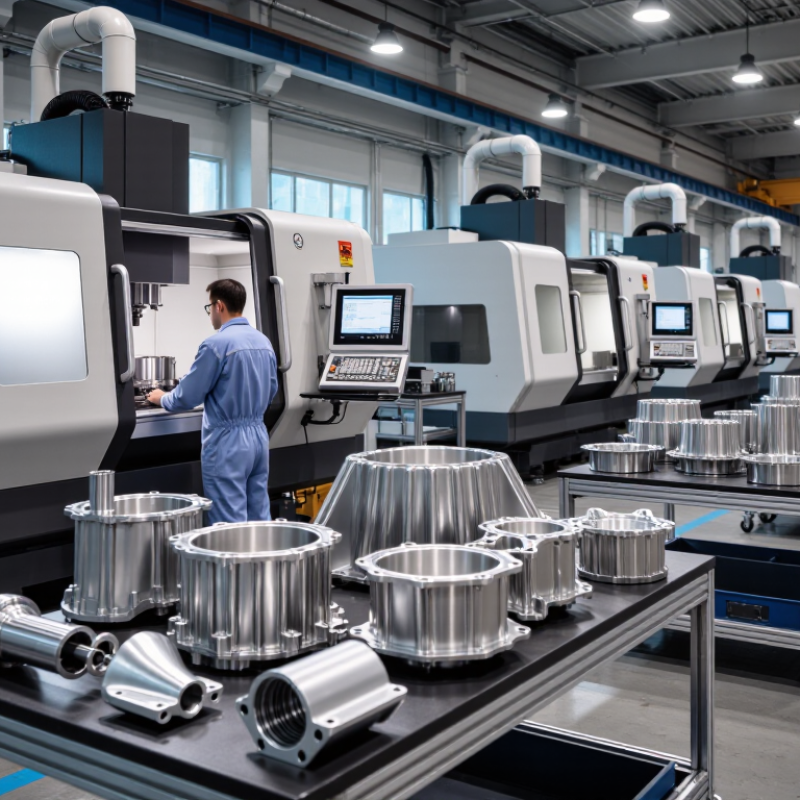
Automotive CNC machining converts digital drawings into components with controlled dimensions and repeatable surfaces. Milling creates pockets, mounting faces, and complex contours, while turning produces round shafts, sleeves, and bushings. Drilling and tapping add accurate holes for fasteners and fluid passages. Five-axis machining can reach angled features with fewer setups, but it still depends on stable fixturing and clear tool access. Small details matter. A poorly supported part may vibrate, leaving chatter marks or inconsistent dimensions.
Aluminum alloys are common in lightweight housings, brackets, and motor components. Steel suits shafts and steering parts that need strength; stainless steel can serve corrosion-exposed fittings. Material choice affects cutting speed, tool wear, heat, and final performance. Typical machined categories include transmission housings, brake components, sensor mounts, and battery-system fittings. Inspection may use in-process probes, gauges, and coordinate measuring machines. Burr removal matters, especially around fluid channels and mating faces. Chips need room. A very tight tolerance can look reassuring on a drawing, yet add cost without improving function. The practical balance depends on how each surface fits, moves, or carries load.
Automotive CNC Machining: Core Processes, Materials, and Part Categories
Typical Density of Materials Used for Machined Automotive Parts
Material choice affects component weight and design. Aluminum is commonly used for lightweight housings and brackets, while steel and stainless steel suit parts requiring strength or corrosion resistance. The values shown are typical approximate densities in grams per cubic centimeter.
CAAM: China Built 30.16M Vehicles, Including 9.587M NEVs in 2023
China’s automotive output reached 30.16 million vehicles in 2023, according to the China Association of Automobile Manufacturers. New energy vehicle production accounted for 9.587 million units. That scale places steady demands on component makers, from repeatable dimensions to consistent delivery. It does not mean every vehicle part is CNC-machined. Rather, machining is useful where geometry, material choice, or fit requires close control.
For automotive CNC machining parts manufacturers in China, the figures point to a broad industrial workload. Aluminum housings, steering components, brackets, and precision shafts may require milling or turning, followed by careful inspection. In practice, stable results depend on more than machine speed. Tool wear, fixture alignment, and measurement routines all matter. Small errors can affect assembly.
The numbers are impressive, but incomplete. Vehicle output alone cannot show how many parts are machined, nor how well individual suppliers perform. Buyers still need to review drawings, tolerances, material certificates, and sample inspection records. A neat finish helps. It is not proof of accuracy. Reliable production comes from documented processes and checks repeated across batches.
How to Evaluate Chinese Suppliers: Capacity, Traceability, and Lead Times
Evaluating Chinese automotive CNC machining suppliers starts with capacity, not a polished factory profile. Ask how many CNC machines are available for your part family, and whether the quoted capacity includes setup, inspection, and finishing. A shop may have many machines, yet only a few suitable fixtures or skilled operators for a complex aluminum housing. Request a sample production schedule and compare it with the proposed monthly volume. Numbers should connect to actual equipment and staffing.
Traceability matters when a dimension drifts or a batch needs review. Ask how raw material lots, machine settings, inspection results, and shipment records are linked. A useful example is a serial or batch number that leads back to a material certificate and measurement report. Check how often critical dimensions are recorded, not just whether an inspection sheet exists. Paperwork can look complete. It may still miss the detail you need.
Lead times should include more than cutting time. Clarify the duration for material sourcing, first-article approval, production, inspection, and packing. Ask what happens if a tool wears early or a measurement fails; the answer can reveal whether the schedule has realistic buffers. A supplier’s estimate is not a guarantee. I would compare several schedules, then leave room for one small surprise—because production rarely follows a perfect spreadsheet.
Leading Automotive CNC Parts Manufacturers in China and Their Specialties
China’s automotive CNC parts manufacturers often specialize by component type rather than offering identical capabilities. Some focus on transmission housings, valve bodies, and precision shafts, where concentricity and surface finish affect assembly. Their shops may use multi-axis milling and turning to machine several features in one setup. That reduces handling, though it does not guarantee consistent results.
Other manufacturers concentrate on structural brackets, suspension parts, and lightweight aluminum enclosures for electric vehicles. A useful supplier can explain its material grades, inspection routines, and process controls—not just list machine models. Ask how it checks bore dimensions, thread quality, and flatness on actual production parts. A coordinate-measuring machine or calibrated gauges may support inspection, depending on the geometry. Details matter.
Specialties vary even among factories serving the same market. One may handle prototypes and short runs well but struggle with stable high-volume output. Another may offer dependable batch production while requiring longer setup for design changes. That distinction is easy to miss. Buyers should review sample reports, tolerances, and change-control practices before approving parts. Supplier claims deserve verification; a polished capability sheet is not the same as repeatable machining.





