


Top 10 Types of Aluminum Profiles for Pergolas

Choosing the right aluminum profile can determine whether a pergola feels sturdy, elegant, and comfortable for years. In practical installations, profile shape affects span length, drainage, shading, wind resistance, and maintenance. A slender beam may look refined, yet it can flex under heavy rain or strong coastal winds. Appearance is only part of the decision.

This guide explores the Top 10 Types of Aluminum Profiles for Pergolas, including posts, beams, rafters, louvers, gutters, and concealed support sections. Each type serves a different structural or visual purpose. The Aluminum Profile For Pergola should match the roof system, local weather, installation method, and expected load. Powder-coated surfaces can improve durability, but coating quality and preparation still matter. Small details matter.

Professional fabricators usually check alloy grade, wall thickness, connection strength, and surface finish before production. They also consider water flow around joints, because a beautiful pergola can still leak at one poorly sealed corner. Regional building requirements and engineered load calculations should guide final selection. Product data from reputable manufacturers provides useful evidence, but it should not replace site-specific judgment. Some common recommendations sound convincing but remain incomplete without measurements. That is worth remembering.

The following overview compares practical profile options, their strengths, limitations, and suitable applications. It aims to support clearer decisions rather than promote one universal design. A well-chosen profile balances safety, appearance, cost, and long-term service. Even experienced installers revisit their assumptions when wind, span, or drainage conditions change. That humility often prevents expensive mistakes.
Top 10 Types of Aluminum Profiles for Pergolas

Defining the 10 Main Aluminum Profile Types by Shape and Function

Top 10 Types of Aluminum Profiles for Pergolas

Defining the 10 Main Aluminum Profile Types by Shape and Function

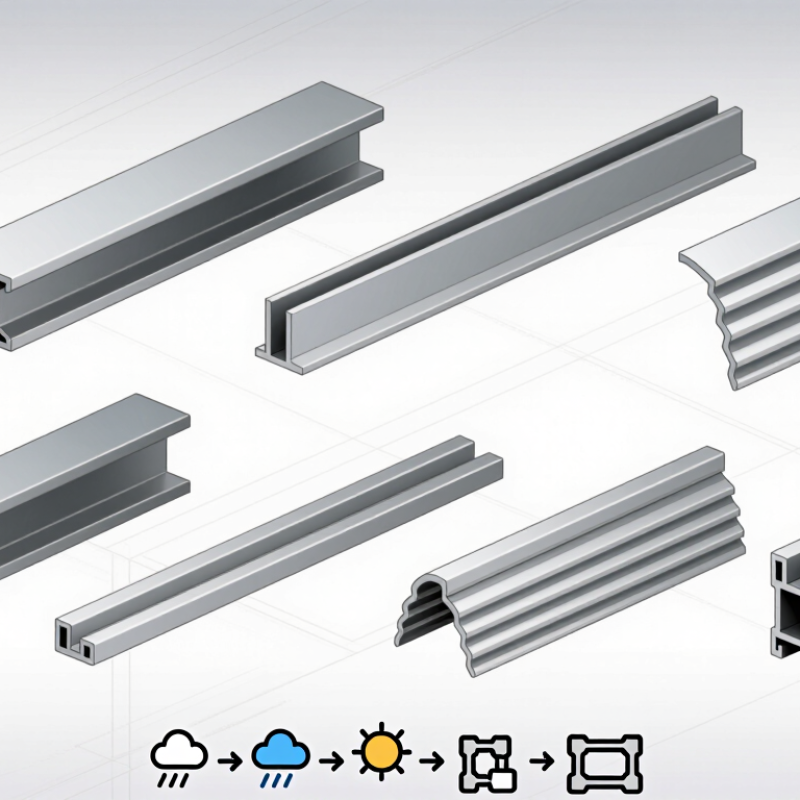
Pergola frames use profiles with different shapes and jobs. Square hollow posts carry vertical loads and create clean corner lines. Rectangular beams span between posts and support rafters. Hollow box sections add stiffness without excessive weight. Sloped rafters guide rainwater and create the roof pitch. T-slot extrusions accept brackets, screens, and adjustable fittings.

U-channels hold panels, seals, or sliding components along straight edges. L-angle profiles reinforce corners and protect exposed joints. Louver blades control sunlight while allowing air movement. Integrated gutter profiles collect water from the roof edge. Base channels connect posts to concrete or steel plates. Each profile needs a clear purpose.

On site, I check wall thickness, alloy condition, drainage paths, and connection spacing before installation. A 100-millimeter post may look strong, but its performance depends on height, wind exposure, anchoring, and joint design. Small channels can twist when installers over-tighten fasteners. It happens more often than expected. Sharp internal corners may also trap water or complicate sealing. A neat drawing can still hide practical problems. Structural calculations should guide final dimensions, especially for coastal areas, heavy louvers, or wide spans.

Top 10 Types of Aluminum Profiles for Pergolas - Defining the 10 Main Aluminum Profile Types by Shape and Function

No. Profile Type Typical Cross-Section Primary Pergola Function Common Installation Area Typical Wall Thickness Key Performance Benefit Important Design Consideration
1 Square Hollow Profile Square tube with a closed hollow section Main posts, beams, and structural frames Columns, perimeter beams, and roof supports Approximately 2–5 mm, depending on section size and load Good torsional resistance and efficient strength-to-weight ratio Long spans may require larger sections, internal reinforcement, or closer support spacing.
2 Rectangular Hollow Profile Rectangular closed tube, usually wider than it is deep Long-span beams and perimeter headers Roof edges, front beams, and side frames Approximately 2–6 mm Provides useful bending stiffness while maintaining a clean, low-profile appearance The deeper dimension should be oriented in the main bending direction.
3 I-Section Profile Two flanges connected by a central web High-stiffness beams for larger openings Primary roof beams and concealed structural members Approximately 3–8 mm in custom extrusions High bending efficiency because material is concentrated away from the neutral axis Can be visually bulky and may require careful connection detailing.
4 T-Slot Profile Extrusion with longitudinal T-shaped fastening channels Modular framing and accessory attachment Screens, louvers, lighting tracks, and adjustable brackets Approximately 2–5 mm, with thicker areas around slots Allows bolts and T-nuts to be positioned without extensive drilling or welding Open slots may collect water and debris unless capped or properly oriented.
5 L-Angle Profile Two perpendicular legs forming an angle Edge protection, trim, and corner reinforcement Roof perimeter, cladding edges, and internal corners Approximately 2–6 mm Protects exposed edges and provides a simple transition between perpendicular surfaces It is generally not a substitute for a properly designed primary beam or post.
6 U-Channel Profile Open channel with a base and two parallel sides Panel retention, drainage, and linear framing Roof panels, fabric edges, gutters, and screen tracks Approximately 1.5–4 mm Creates a neat receiving channel for panels, seals, clips, or removable infill Drainage outlets and compatible seals are needed to prevent trapped water.
7 C-Channel Profile Open channel with one short return flange Secondary framing, sliding tracks, and concealed fixing Sliding louvers, curtains, insect screens, and cover trims Approximately 2–5 mm Offers directional stiffness and a practical path for rollers, fasteners, or cables The opening must match the hardware clearance and expected movement.
8 Tapered or Sloped Profile Angled or wedge-shaped exterior with an internal hollow section Rainwater management and sloped roof transitions Gutter beams, roof fascias, and drainage channels Approximately 2–5 mm Directs water toward outlets while integrating the drainage path into the frame The slope, outlet capacity, and waterproofing details must be coordinated.
9 Louver Blade Profile Aerodynamic hollow, curved, or airfoil-shaped blade Adjustable control of sunlight, ventilation, and rain Retractable or adjustable pergola roofs and privacy screens Approximately 1.5–3 mm for formed or extruded blades Combines low weight with controlled shading and airflow Blade span, pivot hardware, wind pressure, and water-shedding overlap require careful design.
10 Multi-Channel Gutter Profile Custom extrusion combining gutters, seals, and fixing channels Integrated rain collection and concealed service routing Perimeter beams, roof junctions, and drainage corners Approximately 2–6 mm, with reinforced areas at fastener points Combines several functions in one profile, reducing visible parts and assembly steps Custom tooling, cleaning access, thermal movement, and sufficient drainage capacity must be considered.

Note: Wall thicknesses are typical indicative ranges for architectural aluminum extrusions. Final profile dimensions, alloy temper, span, fastener layout, wind load, snow load, drainage requirements, and local building codes should be verified by a qualified structural designer.


Comparing 6063-T5 and 6061-T6 Alloy Profiles for Pergola Structures

Top 10 Types of Aluminum Profiles for Pergolas

Pergola frames commonly use ten profile types: posts, beams, rafters, joists, louvers, gutters, brackets, base plates, screen tracks, and trim channels. Their performance depends heavily on alloy and temper. The Aluminum Association’s Aluminum Standards and Data identifies 6063 as an extrusion-friendly architectural alloy. It supports smooth surfaces, tight shapes, and reliable anodizing. That matters around visible posts and narrow louvers.

6063-T5 is often practical for decorative pergola members. Typical minimum strength values are about 30 ksi tensile and 25 ksi yield, depending on section thickness. ASTM B221 lists stronger 6061-T6 extrusions, commonly near 45 ksi tensile and 40 ksi yield. The difference is significant for long beams, concentrated loads, and bracket connections. Yet strength alone does not decide the design. A thick 6063-T5 beam may perform better than a thin 6061-T6 section.

Field experience shows another trade-off. 6061-T6 resists structural stress well, but it can be less forgiving during drilling, bending, and finishing. 6063-T5 usually produces cleaner profiles and more attractive surfaces. It is not automatically the safer choice. Wind exposure, span length, drainage, fastener spacing, and local snow loads require engineering checks. I have seen installations fail because the connector was weaker than the profile. The alloy received all the attention. That was a mistake. Designers should verify published section properties, temper certificates, and corrosion compatibility before cutting the first post.

Evaluating Posts and Beams Under ASTM B221 and EN 755 Requirements

Top 10 Types of Aluminum Profiles for Pergolas

Evaluating Posts and Beams Under ASTM B221 and EN 755 Requirements

Pergola posts and beams often use square, rectangular, round, T, U, I, angle, and custom hollow profiles. Multi-chamber sections can improve stiffness without adding excessive weight. However, profile shape alone does not confirm structural performance. A broad beam may twist when its wall thickness is poorly matched to the span.

ASTM B221 covers many extruded aluminum bars, profiles, and tubes. It helps verify alloy, temper, mechanical properties, dimensions, and testing requirements. EN 755 provides a related framework for extruded products, including mechanical properties and dimensional tolerances. Relevant parts should be checked carefully, especially those covering profiles and tolerances. The standards are not interchangeable by assumption.

Check the post’s outside dimensions, wall thickness, straightness, and corner geometry. For beams, review section modulus, deflection, connection zones, and local buckling risk. The selected alloy and temper must match the specified design values. Certificates should identify the alloy, temper, batch, and test results. Good documentation matters.

Small errors matter.

A practical inspection should compare measured dimensions with the ordered specification, not only the drawing. Drainage openings, fastener holes, and cut ends can weaken a section if placed carelessly. I have found that attractive profiles sometimes lack enough evidence for load decisions. That is an uncomfortable gap. Engineers should also account for wind, snow, span, surface finish, and thermal movement before approving a pergola frame.

Selecting Louvers, Rafters, Gutters, and Tracks for Roof Systems

Top 10 Types of Aluminum Profiles for Pergolas

Selecting Louvers, Rafters, Gutters, and Tracks for Roof Systems

A pergola roof depends on more than attractive aluminum sections. The ten main profile types include adjustable louvers, fixed louvers, rafters, gutters, downspout channels, tracks, posts, beams, fascia, and flashing profiles. Adjustable louvers need accurate pivot channels and enough clearance for rotation. Fixed louvers suit simpler roofs, but they provide less control over sunlight. Rafters carry roof loads between the beams, so their depth should match the span and expected weather conditions.

Gutters must guide water without collecting leaves at every joint. Downspout channels should align with the outlet and remain accessible for cleaning. Tracks need smooth surfaces, firm fasteners, and drainage holes where water may gather. Posts and beams should resist bending, while fascia profiles hide roof edges and protect internal channels. Flashing profiles help direct rain away from walls. Brackets also matter, even when they appear minor.

Check the roof slope carefully. Small errors can leave water behind. Allow space for thermal movement, especially on long aluminum runs. Coastal locations may need stronger corrosion protection and compatible fasteners. Structural sizing should follow local building requirements and verified load calculations. A neat drawing can still fail during installation. I have seen drainage paths blocked by decorative covers. Practical access often matters more than perfect symmetry. Test one roof bay before producing every profile.

Matching Profile Design to Wind Loads, Spans, Drainage, and AAMA 2604 Coatings

Top 10 Types of Aluminum Profiles for Pergolas

Pergola profiles should match the site, not only the appearance. Hollow box beams suit moderate spans and provide clean, rigid frames. Reinforced beams work better where wind pressure or longer spans increase deflection. Posts need enough wall thickness for anchor forces and connection hardware. Corner profiles help transfer loads without awkward external brackets. T-slot profiles simplify adjustable connections, but exposed slots can collect dirt and water.

Drainage needs equal attention. Gutter-integrated beams guide rainwater toward downspouts and protect nearby walls. Sloped fascia profiles reduce standing water at roof edges. Louver-support profiles must keep blades aligned under repeated movement. Channel profiles can conceal wiring or drainage tubes, although access may become difficult later. A small inspection opening is often worth the slight visual compromise.

Wind design should follow local engineering requirements, including uplift, lateral pressure, and foundation resistance. A profile that feels rigid by hand may still twist during a storm. Span tables require careful review because connections, fasteners, and temperature changes affect performance. For finishes, AAMA 2604 indicates enhanced exterior coating performance, including adhesion and weathering expectations. Specify documented testing, preparation, film thickness, and color limits. Do not treat the coating standard as a structural guarantee. Measure twice. Drainage details are frequently underestimated. A beautiful frame can still fail when water has nowhere to go.

Powder Coat Booths

For those larger-sized parts, or smaller quantity runs, we have 2 independent powder coat booths and ovens. The quality, durability and affordability of today’s powder coating finishes make this the process of choice for world-class companies.

Powder coating advantages over other forms of coating are many. Materials used in the Powder coating process can be metals and non-metals that come in a multitude of thicknesses, textures, colors, etc. Another of Powder coating’s biggest advantages over conventional coatings is its ability to create finishes in many different textures. Powder Coating Booths allow us the ability to apply these advantages to large products.

Wet Paint Line

Tri-State Fabricators runs a full-service conveyor line for painting. Wet painting can provide protection or decoration to many different part styles. From start to finish, every project is easier to undergo random and point-based inspection by our skilled painting team.

Advantages to our Wet Paint Line are these lines start with product prep and ends with a thorough inspection of a high quality finished product. Our ability to complete large and small projects with a superior finish and doing so in a timely and economical fashion. This passes along the savings in production to our customers. When powder coating ins not an option, our Wet Paint Line gets the job done right the first time.

Wet Paint Booths

When the parts get big and heavy we roll-out our custom paint racks and oversize booth. By utilizing our partnerships with all the major paint brands, we can match virtually any color with wet paint.

The advantages of having access to a Wet Paint Booth are many. Large projects of many different shapes can be loaded into the booth. The Wet Paint Booth offers an environment that is much more controlled than a typical parts painting operation.

Not only are they used because of their controlled environment, but they’re are also advantageous when it comes to applying paint to parts that are needed in industries that require specialty coatings such as medical, aerospace, etc.

Military CARC

Our military forces have some very high standards when it comes to the finish of their vehicles and equipment. From the first pre-treatment step to final coat, it takes a great deal of knowledge and experience to protect the men and women of our armed forces. They deserve only the best, and Tri-State Fabricators provides it.

All of our processes are closely monitored by our staff and management teams. Both of which are highly trained in the processes of metal fabrication and finishing. Tri-State Fabricators’ goal is to always fully satisfy each and every customer, including the military. We will always put a 110% into what we do.

Glass-Bead Blasting

Abrasive media blasting is an excellent way to remove old paint, rust, and increase the paint/powder adhesion. Glass beads produce a much smoother and brighter finish than angular abrasives; leaving the part clean yet without any dimensional change. Chemically inert and environmentally friendly, we can recycle our beads approximately 30 times; making them a more preferred method of metal cleaning or surface finishing.

Advantages to Glass Bead Blasting are many. Glass bead blast media is used when a project is needing rough surfaces need to become smooth for applications of coatings such as paint. It is typically used to clean paint and rust from a product surface without deforming the surface it is being used on. Overall, compared to many other blasting media, Glass Bead Blasting is a very economical choice and those savings are always passed on to our customers.

Part Washing

Tri-State Fabricators utilize a zinc phosphate wash to clean and etch the material to ensure the best paint adhesion possible. The unique design of our 3-stage wash system does the work like a 5-stage. From Cleaning and rinsing to conversion coating and post-treatment, Our Part Washing process is a complete service and works throughout the fabrication service and the finishing service.

Along with the previously mentioned benefits, Curing is a vital chemical reaction that leaves the product finish hard and relatively safe from mild abrasion and aggressive corrosion. This process can be done in more than one way; ambient air-dry or in curing ovens at temps that exceed 240°.

Burn-Off Oven

From fixing paint mistakes (someone else’s of course) to simply cleaning our paint line hooks, our burn-off oven is put to good use. After a quick burn-off, a little clean up, and a fresh coat of paint, your parts will look better than new.

Why does our Burn-Off Oven work so well? Because super heating the air around parts turns the materials into ashes. From paint and powder coatings to rubber and machining oils, high temps do the job without degrading the integrity of the part.

Masking

Masking is a vital part of producing high quality products. We have die-cut masking patterns to protect machined surfaces as well as a wide range of plugs and caps to protect threaded holes and bolts. We provide permanent and temporary masking.

Masking allows the selected sections of a product to be protected from a fabrication or finishing service. This can be with both chemicals when etching and tapes, paints when only finishing just a section of the product. Masking is great in aiding the customization process of a project.

Screen Printing

Screen printing is a photographic process that transfers artwork onto a porous nylon screen which allows colored ink to flow through the screen and be deposited on an aluminum or plastic component. We can generally have just about any design created onto a screen for your parts.

Some of the advantages of Screen Printing are, brand recognition for your business displaying on your products, assembly instructions, product warnings/hazards, etc. Tri-State Fabricators produces Screen Printing of the highest quality so you know it’s durable.

Metal Finishing

Metal Finishing is the art of treating the exterior portion of product, often metal but can also be made of other materials, so that the surface is clean and free of any debris. Then the process of applying coats or either paint of powder coat takes place. This coating process improves the quality of the product in both appearance and resistance to wear and corrosion.

Tri-State Fabricators, Inc., understands that a project typically isn’t complete until a high-quality finish has been added to your product. This is why our painting and powder coating teams continuously inspect the products throughout the Metal Finishing process.
