


In 2026, Airport Escalator Spare Parts will matter more as passenger volumes and terminal operating pressures continue rising. ACI World’s World Airport Traffic Forecast projects global passenger traffic to reach 18.4 billion by 2042. IATA’s 2024 passenger analysis also recorded a 10.4% annual increase in global demand. More travelers mean heavier step-chain loads, longer daily running hours, and less tolerance for unexpected shutdowns.
A reliable supplier must provide more than a replacement component. It should offer verified dimensions, material certificates, serial traceability, technical drawings, and responsive after-sales support. EN 115-1 requirements and local airport maintenance procedures should guide every purchasing decision. Dr. Albert So, a respected lift and escalator safety specialist, has emphasized: “Safety depends on the complete system, not one replacement part.” That principle is easy to overlook when a damaged handrail or worn step roller needs urgent replacement.
This guide compares the 2026 best Airport Escalator Spare Parts suppliers through practical criteria. These include product compatibility, certification evidence, stock availability, delivery reliability, customization, and field experience. A supplier with low prices may still create hidden costs. Poorly matched guide rollers can produce vibration, noise, and premature track wear. Delayed comb plates can keep a busy concourse partially closed.
No supplier is perfect. Airport teams should verify every claim. They should request sample documents, inspect tolerances, and confirm warranty terms before ordering. The strongest choice balances safety, engineering support, lifecycle value, and dependable delivery. That balance deserves closer examination.
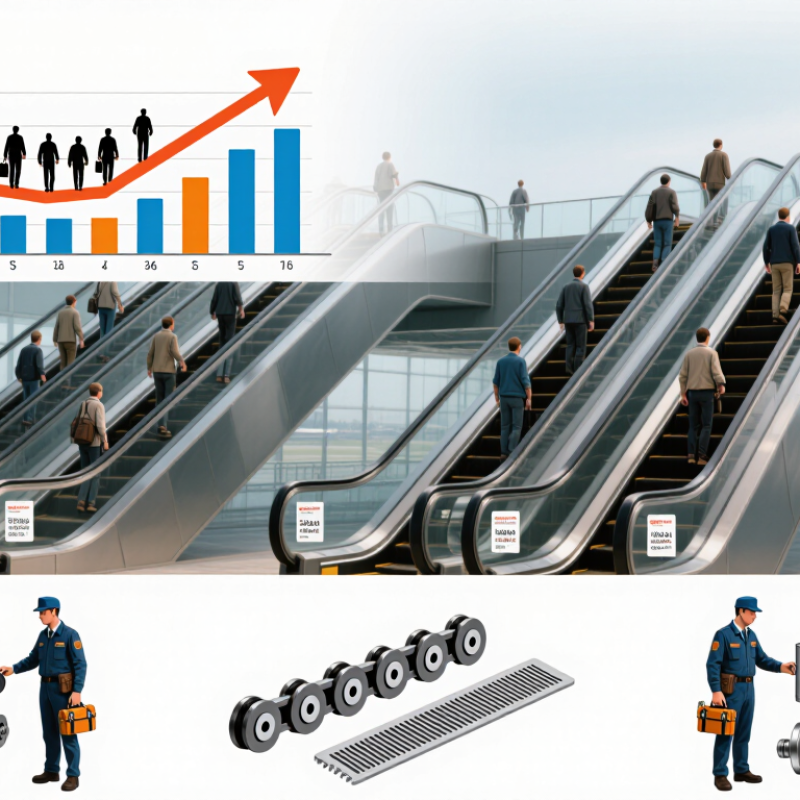
Airport escalators operate for long hours under heavy passenger traffic. Their spare parts must support safety, smooth movement, and predictable maintenance. Common mechanical parts include step chains, rollers, guide rails, bearings, drive sprockets, and handrail belts. Each part controls movement or reduces friction. Small components matter too. Comb plates, skirt brushes, fasteners, and sensor brackets protect passengers and equipment.
Electrical and safety parts perform different duties. Safety switches detect abnormal movement, missing steps, or open access panels. Brake components help stop the escalator during faults or emergency commands. Control relays, wiring assemblies, and position sensors support accurate operation. In airport terminals, technicians may replace worn rollers during overnight maintenance. They may also adjust handrail tension after temperature changes affect belt movement. Humidity, dust, luggage impact, and cleaning chemicals can shorten service life.
A capable supplier should provide clear dimensions, material details, load ratings, compatibility data, and inspection records. Traceable batches help maintenance teams investigate repeated failures. Correct packaging also matters. Bent brackets or contaminated bearings can create problems before installation. I have seen maintenance plans overlook fasteners and sensor mounts. That mistake can delay a repair. No inventory plan is perfect. Teams should review failure history, passenger volume, and access windows when selecting critical parts. A technically suitable component may still be unsuitable if delivery records, documentation, or after-sales support are weak.

Airport escalator parts must support safety, uptime, and traceability under heavy passenger loads. ACI World’s 2024 traffic outlook forecasts 9.5 billion air travelers globally. That volume increases pressure on every step chain, handrail, comb plate, and drive component. Suppliers should demonstrate compliance with EN 115-1 or applicable national safety codes. They should also provide material certificates, dimensional records, and batch identification. Documentation matters.
Reliable suppliers maintain controlled drawings and revision histories for every part. They should confirm compatibility with the existing escalator model, not only visual similarity. ISO 9001-based quality systems can support repeatable inspection and corrective actions. ISO 25745-3 is also relevant when buyers evaluate escalator energy performance. A replacement motor or controller can affect operating efficiency. Fit is not enough.
Airport maintenance teams should ask for factory test reports, inspection criteria, shelf-life details, and emergency delivery plans. IATA’s 2024 passenger demand report recorded a 10.4% annual increase in global demand. Consequently, shutdown windows may become shorter and more expensive. Suppliers need practical airport experience, including night work, customs documentation, and controlled access procedures. No supplier is flawless. A strong supplier admits design limits and investigates recurring failures instead of blaming installation. Spare-part availability should cover both common wear items and obsolete components. This balance is difficult, but essential.
Evaluating an airport escalator spare parts supplier requires more than comparing prices. Ask for evidence from airport or high-traffic transit projects. Request delivery records, inspection reports, and references you can contact. A reliable supplier should understand overnight maintenance windows, restricted access, and strict passenger safety procedures. Experience matters here. Ask how technicians identify worn step chains, damaged rollers, failed sensors, and unusual vibration.
Check technical control before accepting a quotation. Parts should match the escalator’s model, dimensions, material specifications, and safety requirements. Request drawings, certificates, traceability records, and test results for critical components. The supplier should explain its quality process clearly, from incoming materials to final inspection. Vague answers are a warning. So are generic replacement claims.
Reliable service includes realistic stock information and emergency communication. Confirm lead times for common parts and difficult components. Ask whether packaging protects machined surfaces during humid or dusty transport. A dependable contact should provide installation guidance without replacing qualified airport engineers. After delivery, inspect labels, measurements, surface finish, and documentation before installation. Keep records of defects, even minor ones. Small gaps in paperwork can become expensive delays. The cheapest quote may exclude testing, customs preparation, or technical support. Review every line carefully, and allow room for an imperfect assumption in your maintenance plan.
Choosing the best airport escalator spare parts supplier in 2026 requires more than comparing prices. ACI World’s 2024 Airport Traffic Forecast reported approximately 9.5 billion passenger journeys worldwide. That pressure makes reliable replacement parts essential. Ask suppliers for traceable material certificates, dimensional drawings, batch records, and documented compatibility with existing escalator systems.
Quality should be measurable. The ISO Survey 2023 recorded more than 1.2 million ISO 9001 certificates globally, but certification alone proves little. Review inspection plans, corrective-action records, and sample test results. Parts should align with relevant safety requirements, including EN 115-1 where applicable. Check step chains, handrail rollers, comb plates, and bearings under realistic load conditions. A quiet bearing is useful evidence.
Lead time needs practical proof. Request stock visibility, production capacity, shipping routes, and emergency replacement procedures. A supplier promising “fast delivery” is not enough. Service support matters during a midnight shutdown. Look for technical response targets, installation guidance, spare-part identification, and multilingual documentation. Ask whether support engineers can diagnose vibration, uneven step movement, or handrail slippage remotely.
Some suppliers offer low prices with vague drawings. That is a warning. My own review process would include a small trial order before approval. It may delay purchasing, but it exposes poor packaging, incorrect tolerances, and weak communication early. Mistakes still happen. The supplier’s response to them often reveals more than a polished sales presentation.
2026 Best Airport Escalator Spare Parts Suppliers?
Airport escalator procurement now demands more than low prices. ACI World reported about 9.5 billion global passenger journeys in 2024. That volume increases pressure on every step, chain, handrail, and comb plate. Procurement teams should build an asset register before requesting quotations. Record model details, part dimensions, operating hours, failure history, and required safety certifications. Supplier evaluation should include traceability, testing records, technical support, and realistic lead times. A cheaper component is not economical if it causes a terminal shutdown.
Maintenance planning should follow risk and condition, not only calendar dates. Inspect step rollers, drive chains, handrail guides, brakes, and safety switches during scheduled inspections. Monitor unusual noise, vibration, heat, and stopping distance. EN 115-1 provides important safety requirements for escalator design and operation, while ISO 25745-1 supports energy-performance assessment. Local regulations still control acceptance and inspection. Follow them carefully. One weakness remains common: teams often stock visible parts but overlook small safety-critical switches. That mistake deserves review.
Tips: Keep fast-moving parts near the maintenance workshop, but protect rubber and electronic components from heat and moisture. Use barcode records for installation dates and batch numbers. Maintain a practical emergency stock based on failure history, passenger volume, and supplier lead time. Review the list every quarter. Perfect forecasting is unrealistic. Better records usually produce better decisions.
Annual maintenance planning should combine daily operational checks, scheduled preventive service, periodic safety testing, and a formal annual inspection. These frequencies are practical planning benchmarks for one escalator and should be verified against the applicable local regulations, inspection authority requirements, asset condition, and manufacturer instructions.
Reference framework: EN 115-2 and ASME A17.1/CSA B44 principles for safe escalator inspection and maintenance planning. Critical spare parts should be qualified before purchase, traceable by part number and revision, and stocked according to equipment criticality and supplier lead time.


For those larger-sized parts, or smaller quantity runs, we have 2 independent powder coat booths and ovens. The quality, durability and affordability of today’s powder coating finishes make this the process of choice for world-class companies.
Powder coating advantages over other forms of coating are many. Materials used in the Powder coating process can be metals and non-metals that come in a multitude of thicknesses, textures, colors, etc. Another of Powder coating’s biggest advantages over conventional coatings is its ability to create finishes in many different textures. Powder Coating Booths allow us the ability to apply these advantages to large products.
Tri-State Fabricators runs a full-service conveyor line for painting. Wet painting can provide protection or decoration to many different part styles. From start to finish, every project is easier to undergo random and point-based inspection by our skilled painting team.
Advantages to our Wet Paint Line are these lines start with product prep and ends with a thorough inspection of a high quality finished product. Our ability to complete large and small projects with a superior finish and doing so in a timely and economical fashion. This passes along the savings in production to our customers. When powder coating ins not an option, our Wet Paint Line gets the job done right the first time.
When the parts get big and heavy we roll-out our custom paint racks and oversize booth. By utilizing our partnerships with all the major paint brands, we can match virtually any color with wet paint.
The advantages of having access to a Wet Paint Booth are many. Large projects of many different shapes can be loaded into the booth. The Wet Paint Booth offers an environment that is much more controlled than a typical parts painting operation.
Not only are they used because of their controlled environment, but they’re are also advantageous when it comes to applying paint to parts that are needed in industries that require specialty coatings such as medical, aerospace, etc.
Our military forces have some very high standards when it comes to the finish of their vehicles and equipment. From the first pre-treatment step to final coat, it takes a great deal of knowledge and experience to protect the men and women of our armed forces. They deserve only the best, and Tri-State Fabricators provides it.
All of our processes are closely monitored by our staff and management teams. Both of which are highly trained in the processes of metal fabrication and finishing. Tri-State Fabricators’ goal is to always fully satisfy each and every customer, including the military. We will always put a 110% into what we do.
Abrasive media blasting is an excellent way to remove old paint, rust, and increase the paint/powder adhesion. Glass beads produce a much smoother and brighter finish than angular abrasives; leaving the part clean yet without any dimensional change. Chemically inert and environmentally friendly, we can recycle our beads approximately 30 times; making them a more preferred method of metal cleaning or surface finishing.
Advantages to Glass Bead Blasting are many. Glass bead blast media is used when a project is needing rough surfaces need to become smooth for applications of coatings such as paint. It is typically used to clean paint and rust from a product surface without deforming the surface it is being used on. Overall, compared to many other blasting media, Glass Bead Blasting is a very economical choice and those savings are always passed on to our customers.
Tri-State Fabricators utilize a zinc phosphate wash to clean and etch the material to ensure the best paint adhesion possible. The unique design of our 3-stage wash system does the work like a 5-stage. From Cleaning and rinsing to conversion coating and post-treatment, Our Part Washing process is a complete service and works throughout the fabrication service and the finishing service.
Along with the previously mentioned benefits, Curing is a vital chemical reaction that leaves the product finish hard and relatively safe from mild abrasion and aggressive corrosion. This process can be done in more than one way; ambient air-dry or in curing ovens at temps that exceed 240°.
From fixing paint mistakes (someone else’s of course) to simply cleaning our paint line hooks, our burn-off oven is put to good use. After a quick burn-off, a little clean up, and a fresh coat of paint, your parts will look better than new.
Why does our Burn-Off Oven work so well? Because super heating the air around parts turns the materials into ashes. From paint and powder coatings to rubber and machining oils, high temps do the job without degrading the integrity of the part.
Masking is a vital part of producing high quality products. We have die-cut masking patterns to protect machined surfaces as well as a wide range of plugs and caps to protect threaded holes and bolts. We provide permanent and temporary masking.
Masking allows the selected sections of a product to be protected from a fabrication or finishing service. This can be with both chemicals when etching and tapes, paints when only finishing just a section of the product. Masking is great in aiding the customization process of a project.
Screen printing is a photographic process that transfers artwork onto a porous nylon screen which allows colored ink to flow through the screen and be deposited on an aluminum or plastic component. We can generally have just about any design created onto a screen for your parts.
Some of the advantages of Screen Printing are, brand recognition for your business displaying on your products, assembly instructions, product warnings/hazards, etc. Tri-State Fabricators produces Screen Printing of the highest quality so you know it’s durable.
Metal Finishing is the art of treating the exterior portion of product, often metal but can also be made of other materials, so that the surface is clean and free of any debris. Then the process of applying coats or either paint of powder coat takes place. This coating process improves the quality of the product in both appearance and resistance to wear and corrosion.
Tri-State Fabricators, Inc., understands that a project typically isn’t complete until a high-quality finish has been added to your product. This is why our painting and powder coating teams continuously inspect the products throughout the Metal Finishing process.

