


Choosing a Pastry Maker supplier can affect more than a bakery’s equipment budget. It can shape daily workflow, product consistency, maintenance needs, and the quality of finished pastries. This guide examines ten suppliers from different markets, comparing their product ranges, customization options, service support, and publicly available technical information. Small details matter. A mixer’s capacity, the reach of a service network, or the availability of replacement parts can change a busy morning.
Thomas Keller, the chef and restaurateur, is widely quoted as saying, “A recipe has no soul. You, as the cook, must bring soul to the recipe.” His words speak to the craft behind pastry making; reliable equipment and suppliers help skilled teams practise that craft consistently. Still, a supplier’s reputation alone is not enough. Buyers should check specifications, request clear warranty terms, and confirm local service availability before making a decision. No ranking can fit every bakery. A small patisserie may value compact machines, while a production kitchen may prioritize throughput and technical support. The comparisons ahead offer a practical starting point, not a substitute for testing equipment against real recipes, staff routines, and production demands. Some details may remain imperfect, because supplier information and service conditions can vary by region.
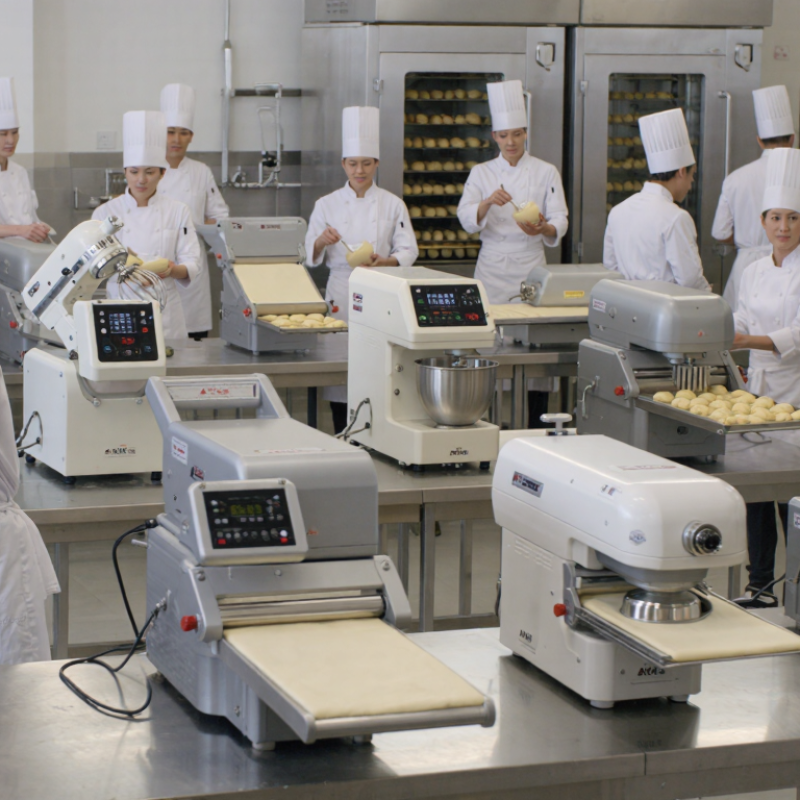
Pastry maker suppliers equip food plants to turn recipes into repeatable production. Their offerings can include spiral mixers, dough sheeters, depositors, proofers, ovens, cooling conveyors, and packaging systems. A supplier may also provide line layout, installation, operator training, maintenance plans, and replacement parts. These services matter when a small change in dough temperature or thickness affects finished texture.
The American Bakers Association’s 2023 Baking Industry Economic Impact Study estimated that the U.S. baking industry generates $186 billion in direct output. That scale helps explain why dependable equipment and service support are practical necessities, not decorative extras. Still, machine speed alone is a poor measure of value. Buyers should check whether equipment handles their actual dough range, cleans efficiently, and fits available floor space. Ask for a production trial using the intended recipe, not a convenient substitute.
Suppliers can also help reduce avoidable losses through accurate portioning, controlled baking, and monitoring systems. The UN Environment Programme’s Food Waste Index Report 2024 estimated that 1.05 billion tonnes of food were wasted in 2022 across households, food service, and retail. This figure is not specific to pastry factories, so it should not be treated as a factory benchmark. It does, however, make waste tracking worth discussing. A supplier’s promised efficiency may look persuasive; recorded product weights and reject rates are better evidence. Small details matter. A misaligned depositor can quietly spoil a shift.

Evaluating pastry maker suppliers takes more than comparing prices and polished product photos. Start with the machines themselves: ask for capacity per hour, temperature range, batch consistency, and cleaning requirements. Small details matter. A mixer that handles dough well at low speed may struggle with a heavy batch at peak production. Request a live demonstration using ingredients and recipes similar to your own. Watch for uneven mixing, excessive vibration, and awkward access to removable parts.
Ask for evidence. Request technical specifications, maintenance schedules, warranty terms, and references from businesses with comparable workloads. A supplier should explain which parts need regular replacement and how quickly they can provide them. Vague answers about service response times deserve follow-up. Check whether installation and operator training are included, and confirm what happens if a machine fails during a busy week. A low purchase price can become costly when repairs take days.
Compare samples under real working conditions, not just during a brief showroom test. Note product texture, output consistency, noise, and cleanup time. Keep a simple scorecard, but do not trust a single demonstration too much; it may not reflect months of daily use. This process is imperfect. Staff skill, ingredient variation, and room temperature can all affect results. Ask suppliers how they test machines under changing conditions, then verify key claims in writing before committing.
The global market for pastry-making equipment serves bakeries, hotels, food manufacturers, and independent pastry kitchens. Suppliers provide mixers, dough sheeters, proofers, ovens, and cooling systems for very different production needs. A small bakery may value a narrow machine that fits through a standard doorway. A factory may need consistent output across multiple shifts. That matters.
Demand is influenced by labor availability, energy costs, product variety, and the age of existing equipment. In many regions, buyers compare local service access as closely as machine capacity. A technically capable oven is less useful when replacement parts take weeks to arrive. Installation support and operator training can also affect production quality. These details are easy to overlook.
Equipment specifications need careful reading. Tray dimensions, batch size, temperature stability, and cleaning access all shape daily use. Energy efficiency matters, but published figures may not reflect a bakery’s actual workload. This is an imperfect comparison. Suppliers can help assess requirements, though buyers should verify claims with clear test conditions and references. A practical evaluation may include a sample bake, noise checks, and a review of maintenance intervals. Not every upgrade pays off. In some kitchens, better workflow design may solve more problems than a larger machine.
A useful supplier profile goes beyond a product list. It explains what a maker builds, how equipment fits a bakery’s output, and what support is available after installation. These ten regional profiles highlight different strengths, rather than claiming a fixed ranking.
A northern European manufacturer may focus on automated pastry lines, with timed conveyors and precise filling controls. An Italian equipment maker often serves artisan and mid-sized bakeries with mixers, sheeters, and compact ovens. A Japanese supplier can emphasize accurate portioning and repeatable dough handling. A North American producer may offer modular lines that scale from one shift to several. A Turkish workshop may specialize in durable stainless-steel equipment and custom layouts.
A Chinese supplier may provide a broad range of machinery at varied production capacities. An Indian maker can serve smaller bakeries with practical mixers and forming machines. A Brazilian manufacturer may focus on pastry shaping for regional recipes and local service needs. An Australian supplier may prioritize energy use and heat consistency in commercial ovens. A South African equipment provider can support bakeries seeking regional installation and maintenance. Details matter. Buyers should compare capacity, cleaning access, spare-part availability, and test results using their own dough. Fit matters. A sales brochure rarely shows every production constraint, and even a strong machine may need adjustments before full-scale use.
These are anonymized supplier profiles based on established equipment-manufacturing regions and common product categories. They are not named companies, and the order does not indicate a verified ranking.
| Profile | Manufacturing region | Typical equipment focus | Common buyer segment | Typical supply capability |
|---|---|---|---|---|
| Profile 1 | Italy | Planetary and spiral mixers, dough sheeters, and bakery preparation equipment | Artisan bakeries, pastry shops, and food-service kitchens | Stand-alone machines and configurable equipment for small and medium production lines |
| Profile 2 | Germany and neighboring Central European markets | Industrial mixers, dough-processing machinery, and automated bakery lines | Large bakeries and industrial pastry producers | Integrated systems, controls, and production-line engineering |
| Profile 3 | France | Laminating, dough handling, pastry forming, and bakery ovens | Retail bakeries, patisseries, and frozen-pastry manufacturers | Process-specific machinery, with options for refrigerated dough handling |
| Profile 4 | United States and Canada | Commercial mixers, deck and rack ovens, proofers, and bakery equipment packages | Independent bakeries, restaurant groups, and regional manufacturers | Equipment supply supported by local installation, parts, and service networks |
| Profile 5 | Japan | Precision baking equipment, compact ovens, proofers, and dough-processing machines | Urban bakeries, hotel kitchens, and space-conscious food businesses | Compact configurations and equipment designed for controlled, repeatable operation |
| Profile 6 | China | Mixers, ovens, sheeters, dividers, and general bakery production machinery | Small businesses, distributors, and cost-conscious commercial buyers | Broad equipment ranges, with specifications and export support varying by manufacturer |
| Profile 7 | Taiwan | Commercial mixers, dough sheeters, baking ovens, and compact bakery machines | Small and medium bakeries, resellers, and food-service operators | Export-oriented supply and a mix of standard and configurable machines |
| Profile 8 | Turkey | Bakery ovens, mixers, dough-processing equipment, and production-line components | Commercial bakeries, regional distributors, and growing food manufacturers | Equipment supply serving domestic demand and nearby export markets |
| Profile 9 | Spain | Pastry-making machinery, dough laminators, depositors, and bakery ovens | Pastry producers, industrial bakeries, and specialist food manufacturers | Specialized machines and line components for pastry processing |
| Profile 10 | Netherlands and wider Northern Europe | Automated dough handling, pastry forming, depositors, and production-line systems | Industrial bakeries and high-volume pastry manufacturers | Process integration and automation for continuous or high-throughput production |
Equipment availability, certifications, production capacity, and after-sales coverage vary by supplier and should be confirmed directly before procurement.
Choosing among the top pastry maker suppliers worldwide requires more than comparing machine prices. Equipment should match the products, batch sizes, and floor space a bakery actually has. For example, a small shop producing croissants may need precise dough sheeting and reliable temperature control, while a central kitchen may prioritize automated forming and easy cleaning. Ask suppliers for specifications, operating limits, and a live demonstration using similar dough. A polished brochure is not enough.
Service can determine whether equipment remains useful after installation. Check technician availability, spare-part delivery times, training, and warranty exclusions. A supplier with broad market reach may support several regions, but its response can still vary by location. Request references from bakeries with comparable production volumes. I would also ask how service calls are handled during peak season. Details are easy to overlook.
Tips: Compare total operating costs, not just purchase prices. Ask for cleaning and changeover steps, then time them during a demonstration. Confirm which parts are stocked locally and what training operators receive. If a supplier cannot explain a maintenance task clearly, treat that as a point to investigate. Even strong equipment may disappoint when support is distant or workflows were never tested in the bakery’s real conditions.


For those larger-sized parts, or smaller quantity runs, we have 2 independent powder coat booths and ovens. The quality, durability and affordability of today’s powder coating finishes make this the process of choice for world-class companies.
Powder coating advantages over other forms of coating are many. Materials used in the Powder coating process can be metals and non-metals that come in a multitude of thicknesses, textures, colors, etc. Another of Powder coating’s biggest advantages over conventional coatings is its ability to create finishes in many different textures. Powder Coating Booths allow us the ability to apply these advantages to large products.
Tri-State Fabricators runs a full-service conveyor line for painting. Wet painting can provide protection or decoration to many different part styles. From start to finish, every project is easier to undergo random and point-based inspection by our skilled painting team.
Advantages to our Wet Paint Line are these lines start with product prep and ends with a thorough inspection of a high quality finished product. Our ability to complete large and small projects with a superior finish and doing so in a timely and economical fashion. This passes along the savings in production to our customers. When powder coating ins not an option, our Wet Paint Line gets the job done right the first time.
When the parts get big and heavy we roll-out our custom paint racks and oversize booth. By utilizing our partnerships with all the major paint brands, we can match virtually any color with wet paint.
The advantages of having access to a Wet Paint Booth are many. Large projects of many different shapes can be loaded into the booth. The Wet Paint Booth offers an environment that is much more controlled than a typical parts painting operation.
Not only are they used because of their controlled environment, but they’re are also advantageous when it comes to applying paint to parts that are needed in industries that require specialty coatings such as medical, aerospace, etc.
Our military forces have some very high standards when it comes to the finish of their vehicles and equipment. From the first pre-treatment step to final coat, it takes a great deal of knowledge and experience to protect the men and women of our armed forces. They deserve only the best, and Tri-State Fabricators provides it.
All of our processes are closely monitored by our staff and management teams. Both of which are highly trained in the processes of metal fabrication and finishing. Tri-State Fabricators’ goal is to always fully satisfy each and every customer, including the military. We will always put a 110% into what we do.
Abrasive media blasting is an excellent way to remove old paint, rust, and increase the paint/powder adhesion. Glass beads produce a much smoother and brighter finish than angular abrasives; leaving the part clean yet without any dimensional change. Chemically inert and environmentally friendly, we can recycle our beads approximately 30 times; making them a more preferred method of metal cleaning or surface finishing.
Advantages to Glass Bead Blasting are many. Glass bead blast media is used when a project is needing rough surfaces need to become smooth for applications of coatings such as paint. It is typically used to clean paint and rust from a product surface without deforming the surface it is being used on. Overall, compared to many other blasting media, Glass Bead Blasting is a very economical choice and those savings are always passed on to our customers.
Tri-State Fabricators utilize a zinc phosphate wash to clean and etch the material to ensure the best paint adhesion possible. The unique design of our 3-stage wash system does the work like a 5-stage. From Cleaning and rinsing to conversion coating and post-treatment, Our Part Washing process is a complete service and works throughout the fabrication service and the finishing service.
Along with the previously mentioned benefits, Curing is a vital chemical reaction that leaves the product finish hard and relatively safe from mild abrasion and aggressive corrosion. This process can be done in more than one way; ambient air-dry or in curing ovens at temps that exceed 240°.
From fixing paint mistakes (someone else’s of course) to simply cleaning our paint line hooks, our burn-off oven is put to good use. After a quick burn-off, a little clean up, and a fresh coat of paint, your parts will look better than new.
Why does our Burn-Off Oven work so well? Because super heating the air around parts turns the materials into ashes. From paint and powder coatings to rubber and machining oils, high temps do the job without degrading the integrity of the part.
Masking is a vital part of producing high quality products. We have die-cut masking patterns to protect machined surfaces as well as a wide range of plugs and caps to protect threaded holes and bolts. We provide permanent and temporary masking.
Masking allows the selected sections of a product to be protected from a fabrication or finishing service. This can be with both chemicals when etching and tapes, paints when only finishing just a section of the product. Masking is great in aiding the customization process of a project.
Screen printing is a photographic process that transfers artwork onto a porous nylon screen which allows colored ink to flow through the screen and be deposited on an aluminum or plastic component. We can generally have just about any design created onto a screen for your parts.
Some of the advantages of Screen Printing are, brand recognition for your business displaying on your products, assembly instructions, product warnings/hazards, etc. Tri-State Fabricators produces Screen Printing of the highest quality so you know it’s durable.
Metal Finishing is the art of treating the exterior portion of product, often metal but can also be made of other materials, so that the surface is clean and free of any debris. Then the process of applying coats or either paint of powder coat takes place. This coating process improves the quality of the product in both appearance and resistance to wear and corrosion.
Tri-State Fabricators, Inc., understands that a project typically isn’t complete until a high-quality finish has been added to your product. This is why our painting and powder coating teams continuously inspect the products throughout the Metal Finishing process.

