


Choosing a Vintage Shoe Cabinet means balancing storage, craftsmanship, and the character of an older design. For buyers comparing Chinese manufacturers, attractive catalog photos are only a starting point. Details matter. Ask about solid wood, veneer, engineered panels, drawer runners, hinge quality, and finish options. A cabinet may look convincingly aged, yet still need dependable construction for daily use.
Furniture designer William Morris offered a useful design principle: “Have nothing in your houses that you do not know to be useful, or believe to be beautiful.” His words capture the appeal of vintage-inspired storage: practical furniture can also bring warmth to an entryway. In this guide, we look at ten China-based manufacturers through product range, customization, materials, production information, and communication. These points help buyers form better questions; they do not replace sample checks or direct supplier verification.
Consider the small details. Measure the available wall space, check cabinet depth, and ask how many pairs each model can hold. Ventilation, stable shelves, and an easy-to-clean interior can matter as much as carved trim or distressed color. Looks can mislead. Finish samples may differ from a full production run, and “vintage style” can describe very different levels of craftsmanship. A careful comparison should make those differences visible, while admitting that no single maker suits every home, budget, or order size.
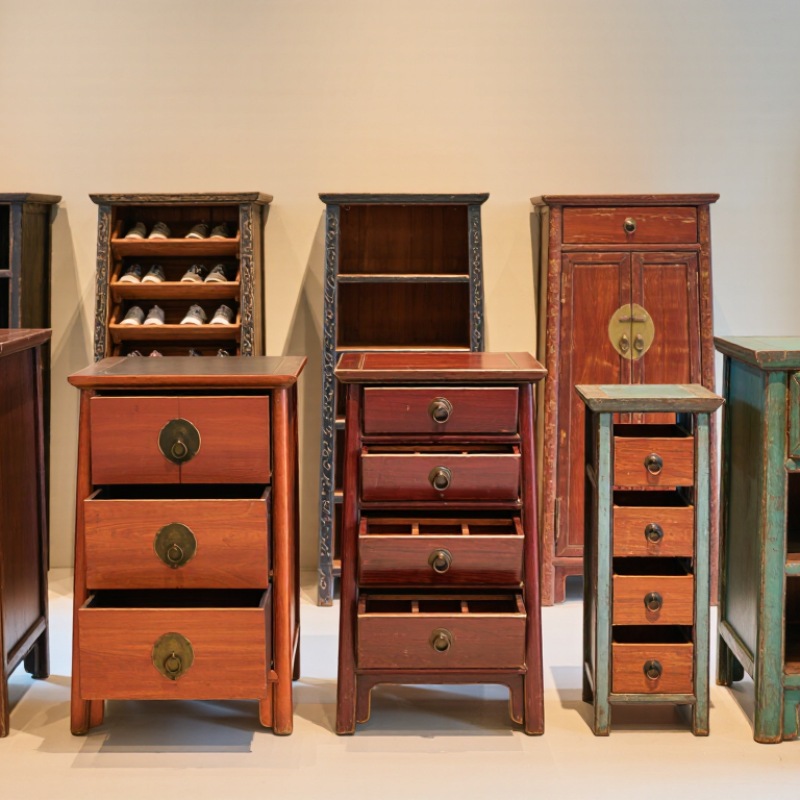
Vintage shoe cabinets are compact storage pieces designed to keep footwear out of sight while adding character to an entryway or bedroom. “Vintage” can describe genuinely older furniture or newer cabinets inspired by earlier designs. That distinction matters: age alone does not guarantee sturdy construction. Traditional styles may feature carved trim, dark wood tones, and small metal handles, while mid-century-inspired pieces often have clean lines and tapered legs. Rustic designs favor visible grain and worn-looking finishes. Some look charming but offer little usable space.
Key features include adjustable shelves, tilt-out compartments, solid hinges, and a stable base. Measure your largest shoes before choosing a cabinet; boots may not fit behind shallow doors. Check that doors open freely and that shelf edges feel secure. A ventilated back or small gaps can help reduce trapped odors, though ventilation is not a substitute for dry footwear. For daily use, a wipeable interior is practical. Finish matters too. Distressed paint can conceal marks, but it may also make scratches harder to assess. A cabinet should suit both the room and the shoes it actually needs to hold.

China’s vintage shoe cabinet manufacturing sits within a much larger furniture industry. There is no widely reported national category for vintage shoe cabinets alone. That matters: broad furniture figures cannot confirm demand for aged finishes or narrow hallway units. According to the China National Light Industry Council’s 2023 industry performance report, furniture manufacturers above designated size recorded 655.7 billion yuan in operating revenue and 34.7 billion yuan in profit. These figures indicate industrial scale, not sales of any specific cabinet style.
Production typically combines panel processing, solid-wood components, metal hardware, surface finishing, and final assembly. Vintage appearance may come from distressed paint, visible grain, muted colors, or antique-style pulls. The details are practical, too: ventilated backs help shoes dry, while adjustable shelves fit different footwear. Buyers should check board thickness, edge sealing, hinge durability, and finish consistency. Ask for cabinet dimensions and loading information; appearance alone tells little about daily performance. The category is not perfectly measured. That remains a real limitation when comparing manufacturers or estimating demand.
Selecting a leading Chinese vintage shoe cabinet manufacturer starts with evidence, not catalog styling. Request a current factory profile, product specifications, and clear photos of the workshop and finished units. A sample should show how doors align, how hinges hold under repeated use, and whether the finish looks even around corners. Check cabinet depth against common adult footwear, then confirm shelf spacing and ventilation openings. Small details matter. Ask how panels, solid wood, or mixed materials are identified, and whether material claims can be documented. I once overvalued a convincing surface finish; it revealed little about the cabinet’s internal construction.
Reliable manufacturers can explain quality checks at each stage, from cutting and edge sealing to final packing. Ask for inspection criteria, transit-protection procedures, and recent production photos tied to the same model—not generic images. Confirm customization limits, minimum order quantities, lead times, and how defects are recorded and resolved. Ask for proof. These details help assess whether a supplier can reproduce a design, not merely build one attractive prototype. Compare quotations line by line, including hardware, packaging, and sample charges. A low price may reflect efficiency or a thinner back panel; verify before deciding. No checklist removes uncertainty, and even careful reviews can miss a flaw hidden until assembly.
This table is a supplier-selection framework, not a verified ranking of individual manufacturers. Compare suppliers using documented, product-specific evidence.
| No. | Selection criterion | What to assess | Evidence to request | Why it matters |
|---|---|---|---|---|
| 01 | Vintage-style product experience | Experience producing shoe cabinets with requested vintage-inspired finishes, proportions, storage layouts, and hardware. | Current product catalogue, dated production photos, and samples or references for comparable designs. | A relevant production history helps assess design fit and execution capability. |
| 02 | Customization and design control | Ability to work to agreed dimensions, storage configuration, finish, handle, and packaging specifications. | A sample specification sheet, approval drawings, finish samples, and a documented change-approval process. | Clear approvals reduce the risk of differences between the approved design and delivered goods. |
| 03 | Materials and construction specification | Specified board or wood materials, surface finish, edge treatment, joints, hinges, and other hardware. | A bill of materials, component specifications, finish details, and a reference sample approved for production. | Written specifications make product quality and permitted substitutions easier to check. |
| 04 | Product safety and emissions documentation | Whether the proposed materials and finished product meet requirements applicable in the destination market. | Relevant test reports or certificates, with product and material details that match the order; verify scope and validity with the issuing body where appropriate. | Requirements vary by market and material, so documentation should be checked against the actual product and destination. |
| 05 | Quality-control process | Checks for incoming materials, production workmanship, dimensions, finish consistency, and final packing. | Written inspection procedures, sample inspection records, and an agreed method for handling nonconforming products. | Documented checks provide a repeatable way to identify and address defects. |
| 06 | Production capacity and delivery planning | Capacity for the required order quantity, current production commitments, and ability to provide a realistic schedule. | A written production plan, stated lead time, and updates tied to agreed order milestones. | Delivery planning helps buyers coordinate purchasing, shipping, and inventory. |
| 07 | Sampling and pre-production approval | Ability to provide a representative sample and obtain written approval before bulk production. | Sample terms, a sample inspection checklist, approved finish swatches, and a signed or otherwise documented approval record. | A retained, approved reference helps clarify expectations for the production order. |
| 08 | Packaging and transport protection | Protection suited to the cabinet’s construction, shipping route, handling conditions, and agreed packing method. | Packaging specifications, carton markings, packing photos, and any relevant transit-test evidence available for the proposed packaging. | Suitable packaging can reduce the risk of damage during storage and transport. |
| 09 | Export and order documentation | Ability to prepare the commercial and shipping documents required for the agreed transaction and destination. | A sample document set, packing-list format, product descriptions, and written confirmation of responsibilities under the agreed shipping terms. | Consistent order documentation supports shipment coordination and customs processing. |
| 10 | Commercial transparency and after-sales support | Clarity on quotation scope, payment terms, warranty conditions, spare parts, and the process for reporting defects. | An itemized quotation, written warranty and claims terms, response contacts, and a documented method for tracking production batches or orders. | Written terms make costs, responsibilities, and remedies clearer if problems arise. |
Profiles of China’s top ten vintage shoe cabinet manufacturers are most useful when they show how each workshop turns an old-fashioned look into practical storage. One may focus on solid-wood frames, while another offers compact cabinets for narrow entryways. Other profiles may highlight modular sizing, mixed wood-and-metal construction, hand-applied distressed finishes, or made-to-measure options. Ask how shelves are supported and whether doors have adjustable hinges. Small details matter.
A reliable profile also describes materials, finish samples, production checks, and protective packing. Moisture-resistant panels can suit humid rooms, while textured paint may create a worn appearance without using reclaimed wood. Buyers should compare cabinet dimensions, ventilation openings, load guidance, and care instructions—not just photographs. Requesting a sample finish can reveal color variation under ordinary indoor light. That is easy to overlook. Supplier descriptions may leave questions unanswered, so confirm specifications in writing before ordering. Vintage style is subjective, and distressed surfaces can look uneven in person. That may be part of the charm, or a drawback. The best manufacturer profile makes those trade-offs clear.
Illustrative planning ranges for common household shoe-cabinet dimensions. These are general sizing guidelines, not measured data from specific manufacturers.
When comparing vintage-style cabinets, check the available space and the depth of the shoes you plan to store. Actual product dimensions vary by design and manufacturer.
Vintage-style shoe cabinets often combine engineered wood, solid timber frames, metal hardware, and distressed finishes. Ask what sits beneath the aged surface. A convincing worn look should not hide uneven panels, loose joints, or sharp edges. Request material samples and inspect them under natural light. Veneer grain can shift between batches.
Production details matter. Some makers use CNC cutting for consistent panels, then assemble and finish cabinets by hand. That mix can improve fit while preserving small surface variations. Check door alignment, shelf spacing, and ventilation openings on a finished sample. Open and close each door. Listen for rubbing. Finish durability also deserves a practical test, such as wiping a sample with a damp cloth and checking for color transfer. One test is not enough.
For sourcing, compare production capacity, quality checks, packaging, and realistic lead times across suppliers. Ask how timber and boards are specified, and whether hardware can be replaced locally. Confirm carton dimensions and protective corner details; distressed finishes can still be scratched in transit. Review a written inspection checklist before production starts, including acceptable color variation and cabinet measurements. Photos help, but they cannot show odor, weight, or a wobbly shelf. I would not treat a polished sample as proof that every unit will match. Batch differences happen. Keep expectations specific, and document them.


For those larger-sized parts, or smaller quantity runs, we have 2 independent powder coat booths and ovens. The quality, durability and affordability of today’s powder coating finishes make this the process of choice for world-class companies.
Powder coating advantages over other forms of coating are many. Materials used in the Powder coating process can be metals and non-metals that come in a multitude of thicknesses, textures, colors, etc. Another of Powder coating’s biggest advantages over conventional coatings is its ability to create finishes in many different textures. Powder Coating Booths allow us the ability to apply these advantages to large products.
Tri-State Fabricators runs a full-service conveyor line for painting. Wet painting can provide protection or decoration to many different part styles. From start to finish, every project is easier to undergo random and point-based inspection by our skilled painting team.
Advantages to our Wet Paint Line are these lines start with product prep and ends with a thorough inspection of a high quality finished product. Our ability to complete large and small projects with a superior finish and doing so in a timely and economical fashion. This passes along the savings in production to our customers. When powder coating ins not an option, our Wet Paint Line gets the job done right the first time.
When the parts get big and heavy we roll-out our custom paint racks and oversize booth. By utilizing our partnerships with all the major paint brands, we can match virtually any color with wet paint.
The advantages of having access to a Wet Paint Booth are many. Large projects of many different shapes can be loaded into the booth. The Wet Paint Booth offers an environment that is much more controlled than a typical parts painting operation.
Not only are they used because of their controlled environment, but they’re are also advantageous when it comes to applying paint to parts that are needed in industries that require specialty coatings such as medical, aerospace, etc.
Our military forces have some very high standards when it comes to the finish of their vehicles and equipment. From the first pre-treatment step to final coat, it takes a great deal of knowledge and experience to protect the men and women of our armed forces. They deserve only the best, and Tri-State Fabricators provides it.
All of our processes are closely monitored by our staff and management teams. Both of which are highly trained in the processes of metal fabrication and finishing. Tri-State Fabricators’ goal is to always fully satisfy each and every customer, including the military. We will always put a 110% into what we do.
Abrasive media blasting is an excellent way to remove old paint, rust, and increase the paint/powder adhesion. Glass beads produce a much smoother and brighter finish than angular abrasives; leaving the part clean yet without any dimensional change. Chemically inert and environmentally friendly, we can recycle our beads approximately 30 times; making them a more preferred method of metal cleaning or surface finishing.
Advantages to Glass Bead Blasting are many. Glass bead blast media is used when a project is needing rough surfaces need to become smooth for applications of coatings such as paint. It is typically used to clean paint and rust from a product surface without deforming the surface it is being used on. Overall, compared to many other blasting media, Glass Bead Blasting is a very economical choice and those savings are always passed on to our customers.
Tri-State Fabricators utilize a zinc phosphate wash to clean and etch the material to ensure the best paint adhesion possible. The unique design of our 3-stage wash system does the work like a 5-stage. From Cleaning and rinsing to conversion coating and post-treatment, Our Part Washing process is a complete service and works throughout the fabrication service and the finishing service.
Along with the previously mentioned benefits, Curing is a vital chemical reaction that leaves the product finish hard and relatively safe from mild abrasion and aggressive corrosion. This process can be done in more than one way; ambient air-dry or in curing ovens at temps that exceed 240°.
From fixing paint mistakes (someone else’s of course) to simply cleaning our paint line hooks, our burn-off oven is put to good use. After a quick burn-off, a little clean up, and a fresh coat of paint, your parts will look better than new.
Why does our Burn-Off Oven work so well? Because super heating the air around parts turns the materials into ashes. From paint and powder coatings to rubber and machining oils, high temps do the job without degrading the integrity of the part.
Masking is a vital part of producing high quality products. We have die-cut masking patterns to protect machined surfaces as well as a wide range of plugs and caps to protect threaded holes and bolts. We provide permanent and temporary masking.
Masking allows the selected sections of a product to be protected from a fabrication or finishing service. This can be with both chemicals when etching and tapes, paints when only finishing just a section of the product. Masking is great in aiding the customization process of a project.
Screen printing is a photographic process that transfers artwork onto a porous nylon screen which allows colored ink to flow through the screen and be deposited on an aluminum or plastic component. We can generally have just about any design created onto a screen for your parts.
Some of the advantages of Screen Printing are, brand recognition for your business displaying on your products, assembly instructions, product warnings/hazards, etc. Tri-State Fabricators produces Screen Printing of the highest quality so you know it’s durable.
Metal Finishing is the art of treating the exterior portion of product, often metal but can also be made of other materials, so that the surface is clean and free of any debris. Then the process of applying coats or either paint of powder coat takes place. This coating process improves the quality of the product in both appearance and resistance to wear and corrosion.
Tri-State Fabricators, Inc., understands that a project typically isn’t complete until a high-quality finish has been added to your product. This is why our painting and powder coating teams continuously inspect the products throughout the Metal Finishing process.

