


Global buyers often seek Toasted Garlic that delivers consistent flavor, safe handling, and dependable supply. This guide introduces ten suppliers serving different markets, production scales, and purchasing needs. The selection considers product quality, processing capabilities, export experience, packaging options, and communication standards.
A reliable supplier should explain garlic origin, roasting temperature, moisture control, and shelf-life testing. These details affect aroma, color, crunch, and performance in sauces, snacks, seasonings, and ready meals. Buyers should also review certifications, batch records, allergen controls, and traceability documents before placing large orders. A clean factory matters. So does a clear answer.
Some suppliers may offer whole cloves, granules, flakes, or customized blends. Others may focus on bulk cartons for industrial production. Samples can reveal uneven browning, burnt notes, excess oil, or weak packaging seals. Those small defects become expensive when multiplied across pallets. Pricing alone is not enough. Freight terms, minimum order quantities, lead times, and replacement policies deserve equal attention.
This list is a practical starting point, not a permanent verdict. Supplier performance can change with harvest conditions, equipment upgrades, staffing, or regional logistics. Buyers should verify current certificates and request recent samples. Even experienced purchasers can overlook a detail. Careful comparison remains essential when quality, compliance, and delivery reliability must work together.
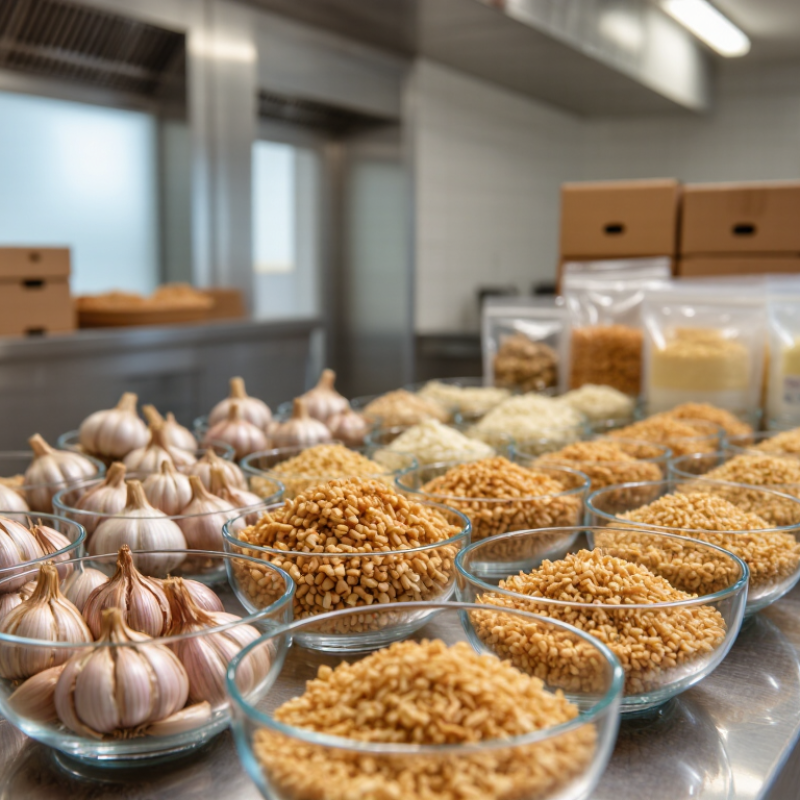
Top 10 Toasted Garlic Suppliers for Global Buyers
Toasted garlic is available as flakes, slices, granules, minced pieces, and fine powder. Each form suits a different production process. Flakes add visible texture to noodles, sauces, and bakery toppings. Granules disperse evenly in marinades, seasoning blends, and prepared meals. Powder delivers fast flavor, but it can clump when moisture control is weak. Some buyers prefer lightly toasted garlic for a clean aroma. Others need deeper color and stronger roasted notes.
Global demand comes from food manufacturers, restaurants, catering companies, and retail seasoning brands. Toasted garlic is used in soups, snacks, frozen meals, meat rubs, and dipping sauces. Buyers should compare suppliers by moisture level, particle size, oil content, color consistency, and microbial test results. Packaging also matters. Multi-layer bags, sealed cartons, and cool storage help protect crispness during long shipments. A reliable supplier should provide batch records, ingredient specifications, origin details, and export documentation.
In practical sourcing, darker garlic is not always better. Excessive heat may create bitterness and fragile pieces. No lot is perfectly identical, especially across different harvest periods. This is where clear tolerance ranges become useful. Small samples should be tested in the buyer’s actual recipe, not only judged by appearance. I have found that aroma can fade after opening, even when the laboratory report looks acceptable. Better suppliers discuss this risk openly and adjust roasting, packing, or shipment timing when needed. Cost still matters, but unstable flavor can create larger production losses.

Garlic production is the primary supply indicator for toasted garlic flakes, granules, minced garlic, and powder. The chart shows leading producing origins, using rounded 2022 figures reported by FAOSTAT.
Source: FAOSTAT crop and livestock products data, 2022; production values are rounded estimates in million metric tonnes. Garlic production is used as a supply-context indicator and does not represent toasted garlic output.
The shortlist combines production evidence, food safety records, and practical sample testing. FAOSTAT reported more than 28 million metric tons of garlic production worldwide in 2022. That scale makes volume easy to claim, but consistency harder to prove. Each supplier was checked for export experience, traceable raw garlic, stable roasting capacity, and documented quality controls. Public trade data helped confirm market activity, while supplier records received greater weight.
Samples came first.
Each toasted garlic sample was assessed for color uniformity, crispness, aroma, moisture, and visible scorching. Moisture matters. Excess moisture can reduce shelf life and create texture problems during transport. Laboratory documents were reviewed for microbiological testing, foreign material controls, and allergen management. The Codex General Principles of Food Hygiene, revised in 2022, guided the review of sanitation and hazard-control practices.
Records matter.
Suppliers scored higher when they provided batch codes, certificates of analysis, process temperatures, and corrective-action reports. On-site audit evidence was preferred over polished marketing claims. No ranking is perfectly objective. A strong factory audit may not predict every seasonal crop variation. Packaging performance also needs longer observation than a single shipment allows. Therefore, the final ten were selected through weighted scoring, buyer references, and repeat sample comparisons, not price alone.
Profiles of the Top 10 Toasted Garlic Suppliers Worldwide
Global buyers should view supplier rankings as working profiles, not permanent labels. FAOSTAT reported approximately 28 million tonnes of garlic production worldwide in 2022, while UN Comtrade data shows strong cross-border trade in dried garlic products. However, trade codes rarely separate toasted garlic. That limitation matters.
The leading profiles include a Chinese dehydrator offering large-volume flakes, a Spanish processor focused on Mediterranean varieties, and an Indian spice mill serving private-label orders. Other strong profiles include a Turkish exporter, an Egyptian drying facility, a South American ingredient producer, a European seasoning specialist, a North American contract packer, a Southeast Asian processor, and a small-batch organic supplier. Their strengths differ sharply. Some provide deep roasted flavor. Others prioritize stable color, fine granulation, or flexible packaging.
A reliable buyer should request recent certificates, allergen statements, pesticide results, moisture data, and microbiological reports. HACCP and ISO 22000 systems are useful, but certificates alone prove little. BRCGS guidance also emphasizes traceability, supplier approval, and documented food-safety controls. In practical sourcing, I would test aroma after six weeks in sealed packaging. Oxidation can quietly flatten the flavor. A supplier may pass inspection yet fail a cooking trial. That is an uncomfortable gap. Buyers should compare three production lots, verify origin documents, and confirm whether the product contains oil, salt, or anti-caking agents. The best profile is not always the largest exporter. It is the supplier that repeats the same crisp texture, toasted aroma, and clean label under real shipping conditions.
| Profile | Primary Origin | Toasted Garlic Formats | Typical Particle Sizes | Common Moisture Range | Typical Export Packaging | Common Buyer Markets | Frequently Requested Compliance |
|---|---|---|---|---|---|---|---|
| Supplier Profile 01 | China | Slices, minced, granules, powder | 0.5–8 mm; 16–80 mesh powder | Usually 5–8% | 10–25 kg multiwall bags; bulk cartons | North America, Europe, Asia-Pacific, Middle East | HACCP, ISO 22000, BRCGS, Kosher or Halal where required |
| Supplier Profile 02 | Spain | Diced, sliced, flakes, granules | 1–10 mm; custom sieve cuts | Usually 6–9% | 5–20 kg bags; food-service cartons | European Union, United Kingdom, North America | HACCP, IFS or BRCGS, EU food-safety requirements |
| Supplier Profile 03 | Argentina | Toasted flakes, minced garlic, granules | 1–6 mm; food-manufacturing grades | Usually 5–8% | 10–20 kg export bags; lined cartons | Brazil, North America, Europe, Latin America | HACCP, GMP, allergen controls, phytosanitary documentation |
| Supplier Profile 04 | India | Minced, flakes, granules, roasted powder | 0.5–5 mm; 20–100 mesh powder | Usually 5–8% | 15–25 kg laminated bags; drums for powder | Middle East, Europe, North America, Southeast Asia | FSSAI compliance, HACCP, ISO 22000, Halal |
| Supplier Profile 05 | Egypt | Slices, chips, granules, minced garlic | 1–8 mm; screened commercial grades | Usually 6–9% | 10–25 kg polypropylene or paper bags | Middle East, Africa, Europe, Mediterranean markets | HACCP, ISO 22000, Halal, export inspection certificates |
| Supplier Profile 06 | Mexico | Toasted granules, flakes, minced garlic | 1–6 mm; custom food-service cuts | Usually 5–8% | 10–20 kg bags; retail-ready pouches by request | United States, Canada, Latin America | HACCP, FDA-related U.S. import requirements, Kosher or Halal |
| Supplier Profile 07 | United States | Flakes, granules, minced, powder | 0.5–10 mm; application-specific grades | Usually 5–8% | 5–20 kg bags; lined fiber drums | North America, food manufacturers, food-service distributors | FSMA controls, HACCP, SQF or BRCGS, allergen management |
| Supplier Profile 08 | Peru | Diced, flakes, granules, toasted powder | 1–8 mm; fine powder available | Usually 5–9% | 10–25 kg export bags; bulk cartons | Latin America, North America, Europe | HACCP, GMP, sanitary certificates, traceability records |
| Supplier Profile 09 | Türkiye | Slices, flakes, granules, minced garlic | 1–10 mm; standard and custom cuts | Usually 6–9% | 10–20 kg bags; palletized export cartons | Europe, Middle East, North Africa, Central Asia | HACCP, ISO 22000, BRCGS or IFS, Halal |
| Supplier Profile 10 | South Africa | Toasted flakes, granules, minced garlic | 1–6 mm; food-service and industrial grades | Usually 5–8% | 10–20 kg bags; lined cartons | Southern Africa, Europe, Middle East, regional food service | HACCP, ISO 22000, local food-safety approvals, Halal where required |
Product specifications are representative commercial ranges for toasted garlic ingredients; exact particle size, moisture, packaging, certification, and export availability should be confirmed directly with each qualified supplier.
For global buyers, the top ten toasted garlic suppliers should be compared by measurable evidence, not catalogue claims. FAOSTAT recorded more than 28 million tonnes of garlic production worldwide in 2022, creating a broad raw-material base. However, toasted garlic quality varies with bulb variety, moisture, slicing size, and roasting temperature. Ask each supplier for recent moisture, microbiological, pesticide-residue, and sensory reports. A warm, nutty aroma matters, but it is difficult to score consistently.
Capacity also needs practical verification. Request monthly output, minimum order quantity, lead time, and backup processing locations. A supplier producing 20 tonnes monthly may suit a specialty importer, while industrial buyers may require 100 tonnes or more. Certifications such as HACCP, ISO 22000, BRCGS, and valid organic approval strengthen traceability. FDA registration is useful for United States shipments, but it is not a food-safety certification. Check certificate scope and expiry dates. Small details matter.
Pricing should be compared on a landed-cost basis. Include roasting loss, packaging, testing, freight, duties, and payment terms. UN Comtrade trade data can help benchmark dried-garlic import values, although product codes often combine several garlic forms. That limitation deserves attention. The cheapest quotation may hide higher breakage or inconsistent color. I would request three retained samples from different production lots before ranking suppliers. One sample is not enough. Even a polished audit can miss seasonal variation, so buyers should review performance after delivery, not only before purchase.
Global buyers sourcing toasted garlic need more than a supplier list. They need evidence from farms, processors, and shipping records. FAOSTAT reports global garlic production above 28 million tonnes in recent years, showing a deep raw-material base. However, toasted garlic is not separately classified in most trade databases. UN Comtrade usually groups it under dried or processed vegetables, making supplier comparisons imperfect.
A practical top-ten shortlist should examine moisture, slice size, colour, oil content, and microbial results. Ask for three recent laboratory reports, not one attractive sample. The product should arrive crisp, evenly browned, and free from burnt edges.
Request batch traceability from harvest through roasting. Codex food hygiene principles and ISO 22000-based systems provide useful reference points for factory controls. Still, certification alone is not proof of consistent performance.
Check the supplier’s annual capacity against your forecast, then test production-scale samples. A small trial can hide uneven roasting. Packaging also deserves attention. High-barrier bags, oxygen control, and dry storage help protect aroma during long sea transit.
Review UN Comtrade shipment patterns, port reliability, and lead-time records before signing. I would also inspect allergen controls, cleaning logs, pest prevention, and recall procedures. These details often separate dependable processors from clever traders.
Price remains important, but the lowest quotation may create higher rejection costs. My own weakness is trusting polished documents too quickly. An independent pre-shipment inspection is safer. Fresh evidence matters.


For those larger-sized parts, or smaller quantity runs, we have 2 independent powder coat booths and ovens. The quality, durability and affordability of today’s powder coating finishes make this the process of choice for world-class companies.
Powder coating advantages over other forms of coating are many. Materials used in the Powder coating process can be metals and non-metals that come in a multitude of thicknesses, textures, colors, etc. Another of Powder coating’s biggest advantages over conventional coatings is its ability to create finishes in many different textures. Powder Coating Booths allow us the ability to apply these advantages to large products.
Tri-State Fabricators runs a full-service conveyor line for painting. Wet painting can provide protection or decoration to many different part styles. From start to finish, every project is easier to undergo random and point-based inspection by our skilled painting team.
Advantages to our Wet Paint Line are these lines start with product prep and ends with a thorough inspection of a high quality finished product. Our ability to complete large and small projects with a superior finish and doing so in a timely and economical fashion. This passes along the savings in production to our customers. When powder coating ins not an option, our Wet Paint Line gets the job done right the first time.
When the parts get big and heavy we roll-out our custom paint racks and oversize booth. By utilizing our partnerships with all the major paint brands, we can match virtually any color with wet paint.
The advantages of having access to a Wet Paint Booth are many. Large projects of many different shapes can be loaded into the booth. The Wet Paint Booth offers an environment that is much more controlled than a typical parts painting operation.
Not only are they used because of their controlled environment, but they’re are also advantageous when it comes to applying paint to parts that are needed in industries that require specialty coatings such as medical, aerospace, etc.
Our military forces have some very high standards when it comes to the finish of their vehicles and equipment. From the first pre-treatment step to final coat, it takes a great deal of knowledge and experience to protect the men and women of our armed forces. They deserve only the best, and Tri-State Fabricators provides it.
All of our processes are closely monitored by our staff and management teams. Both of which are highly trained in the processes of metal fabrication and finishing. Tri-State Fabricators’ goal is to always fully satisfy each and every customer, including the military. We will always put a 110% into what we do.
Abrasive media blasting is an excellent way to remove old paint, rust, and increase the paint/powder adhesion. Glass beads produce a much smoother and brighter finish than angular abrasives; leaving the part clean yet without any dimensional change. Chemically inert and environmentally friendly, we can recycle our beads approximately 30 times; making them a more preferred method of metal cleaning or surface finishing.
Advantages to Glass Bead Blasting are many. Glass bead blast media is used when a project is needing rough surfaces need to become smooth for applications of coatings such as paint. It is typically used to clean paint and rust from a product surface without deforming the surface it is being used on. Overall, compared to many other blasting media, Glass Bead Blasting is a very economical choice and those savings are always passed on to our customers.
Tri-State Fabricators utilize a zinc phosphate wash to clean and etch the material to ensure the best paint adhesion possible. The unique design of our 3-stage wash system does the work like a 5-stage. From Cleaning and rinsing to conversion coating and post-treatment, Our Part Washing process is a complete service and works throughout the fabrication service and the finishing service.
Along with the previously mentioned benefits, Curing is a vital chemical reaction that leaves the product finish hard and relatively safe from mild abrasion and aggressive corrosion. This process can be done in more than one way; ambient air-dry or in curing ovens at temps that exceed 240°.
From fixing paint mistakes (someone else’s of course) to simply cleaning our paint line hooks, our burn-off oven is put to good use. After a quick burn-off, a little clean up, and a fresh coat of paint, your parts will look better than new.
Why does our Burn-Off Oven work so well? Because super heating the air around parts turns the materials into ashes. From paint and powder coatings to rubber and machining oils, high temps do the job without degrading the integrity of the part.
Masking is a vital part of producing high quality products. We have die-cut masking patterns to protect machined surfaces as well as a wide range of plugs and caps to protect threaded holes and bolts. We provide permanent and temporary masking.
Masking allows the selected sections of a product to be protected from a fabrication or finishing service. This can be with both chemicals when etching and tapes, paints when only finishing just a section of the product. Masking is great in aiding the customization process of a project.
Screen printing is a photographic process that transfers artwork onto a porous nylon screen which allows colored ink to flow through the screen and be deposited on an aluminum or plastic component. We can generally have just about any design created onto a screen for your parts.
Some of the advantages of Screen Printing are, brand recognition for your business displaying on your products, assembly instructions, product warnings/hazards, etc. Tri-State Fabricators produces Screen Printing of the highest quality so you know it’s durable.
Metal Finishing is the art of treating the exterior portion of product, often metal but can also be made of other materials, so that the surface is clean and free of any debris. Then the process of applying coats or either paint of powder coat takes place. This coating process improves the quality of the product in both appearance and resistance to wear and corrosion.
Tri-State Fabricators, Inc., understands that a project typically isn’t complete until a high-quality finish has been added to your product. This is why our painting and powder coating teams continuously inspect the products throughout the Metal Finishing process.

