


Top 10 SMC Slice Material Press Manufacturers Worldwide?

The global demand for lightweight, corrosion-resistant components is reshaping composite manufacturing. The International Energy Agency reported nearly 14 million electric car sales in 2023, representing about 18% of global car sales. This shift increases interest in structural plastics, including sheet molding compound (SMC). It also raises the need for reliable compression equipment.

This guide examines the Top 10 Smc Slice Material Press Manufacturers Worldwide. The phrase “Smc Slice Material Press” is used here for presses designed to shape pre-cut SMC charges into consistent components. These systems typically combine controlled heating, high closing force, programmable pressure, and repeatable cycle timing. Small details matter. A stable mold temperature can influence surface quality, fiber distribution, and scrap rates.

Market forecasts support this direction, although their figures vary. MarketsandMarkets has projected strong growth for the broader composites market through 2028. Grand View Research also identifies automotive, electrical, and construction applications as major demand areas. These reports are useful, but they do not measure every SMC press manufacturer consistently. That limitation matters.

Our comparison considers press capacity, platen accuracy, automation, energy management, after-sales service, and experience with SMC production. We also examine practical factors, such as loading access, mold-change time, safety controls, and support for multi-cavity tooling. Manufacturer claims require careful checking. A polished brochure is not factory evidence. Buyers should verify cycle data, maintenance records, and customer references before investing. The final ranking is therefore informative, not absolute. Regional service quality can change the result.
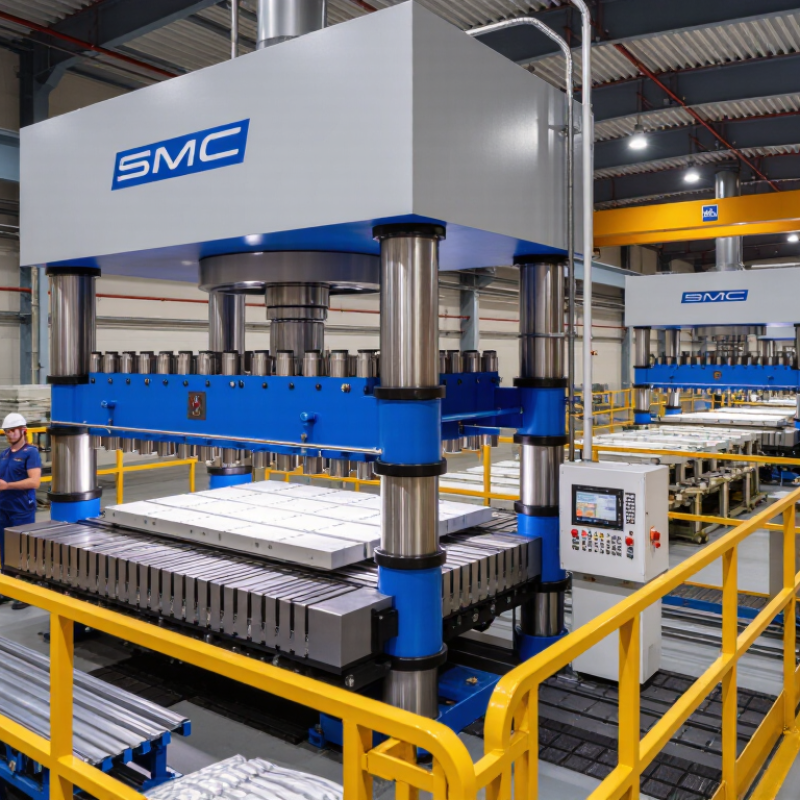
Top 10 SMC Slice Material Press Manufacturers Worldwide?

What Is an SMC Slice Material Press?

An SMC slice material press is a hydraulic compression-molding machine for sheet molding compound. It converts measured SMC charges into rigid composite parts. The charge usually contains thermoset resin, chopped glass fibers, fillers, and additives. Operators place it between heated mold halves. Pressure then spreads the material across the cavity.

The term “slice material press” is not perfectly standardized. Some suppliers mean an SMC cutting and charging system. Others mean the complete compression press. That difference matters when comparing manufacturers. A practical system should control platen parallelism, closing speed, molding temperature, and pressure stability. Typical production temperatures range from 140°C to 170°C, depending on the resin formulation. Press capacity may range from several hundred to several thousand tonnes.

MarketsandMarkets estimated the global SMC market at about USD 3.1 billion in 2023, with continued growth through 2028. Its research identifies transportation, electrical equipment, and construction as important application sectors. A separate Lucintel industry analysis also reports strong demand for lightweight composite components in vehicles. These figures support careful investment, but they should not replace plant trials. Material flow can change with fiber length, storage time, mold geometry, and humidity. Even a well-specified press may produce inconsistent edges if charging patterns are poorly designed. Manufacturers should therefore compare recorded cycle data, mold trials, maintenance response, and energy use rather than relying on headline tonnage alone.

Top 10 SMC Slice Material Press Manufacturers Worldwide? - What Is an SMC Slice Material Press?
Rank Anonymous Manufacturer Profile Primary Manufacturing Region Typical Press Force Range Typical Platen Size Range SMC Processing Capability Common Automation Features Typical End-Use Applications
1 Large-scale hydraulic press specialist Western Europe 1,000–5,000 metric tons 1,500 × 1,500 mm to 3,000 × 3,000 mm Compression molding of large SMC panels, structural parts, and automotive components Automatic loading, mold shuttle, robotic unloading, recipe control, and process data logging Automotive body panels, battery covers, industrial housings, and infrastructure components
2 High-speed composite molding equipment builder East Asia 500–3,000 metric tons 1,000 × 1,000 mm to 2,500 × 2,500 mm Short-cycle SMC compression molding with programmable pressure and temperature profiles Servo-hydraulic control, automatic charge placement, mold temperature monitoring, and cycle alarms Electrical enclosures, automotive interior parts, covers, and appliance components
3 Custom engineered composite press manufacturer North America 600–4,000 metric tons 1,200 × 1,200 mm to 3,000 × 2,000 mm Custom compression presses for thermoset composites, including SMC and BMC materials Multi-zone mold heating, programmable dwell control, safety interlocks, and production monitoring Transportation, electrical distribution, construction, and industrial equipment
4 Medium- and large-tonnage hydraulic press producer Central Europe 400–2,500 metric tons 900 × 900 mm to 2,200 × 2,200 mm SMC molding for medium-sized parts requiring consistent pressure and parallel platen movement Four-column guidance, digital pressure control, automatic mold opening, and thermal monitoring Electrical cabinets, vehicle components, pump housings, and machine covers
5 Cost-efficient industrial press integrator South Asia 250–2,000 metric tons 800 × 800 mm to 2,000 × 2,000 mm General-purpose SMC compression molding with configurable heating and ejection systems PLC control, hydraulic proportional valves, automatic ejectors, and operator safety guarding Electrical accessories, sanitary products, automotive parts, and general molded components
6 Precision press and automation manufacturer Japan 300–2,000 metric tons 700 × 700 mm to 1,800 × 1,800 mm Precision molding of SMC parts with emphasis on repeatability, dimensional stability, and low scrap Servo-driven controls, closed-loop pressure regulation, automated charge handling, and traceability software Automotive electrical parts, precision covers, mobility components, and electronic housings
7 Modular composite press system supplier Southern Europe 300–1,500 metric tons 800 × 800 mm to 1,800 × 1,500 mm Modular SMC compression molding cells for small and medium production volumes Interchangeable tooling, mold carts, automatic demolding, recipe storage, and remote diagnostics Lighting housings, electrical components, transportation interiors, and consumer products
8 Heavy-duty press manufacturer for industrial composites Greater China 500–3,500 metric tons 1,000 × 1,000 mm to 2,800 × 2,500 mm Large-part SMC compression molding with high daylight and customized mold-space dimensions Automatic mold exchange, hydraulic synchronization, centralized lubrication, and production counters Utility boxes, transportation structures, renewable-energy components, and industrial panels
9 Turnkey thermoset molding-cell provider South Korea 400–2,500 metric tons 900 × 900 mm to 2,200 × 2,000 mm Integrated SMC molding cells combining the press, material handling, mold heating, and trimming processes Robotic part handling, vision inspection, automatic trimming interface, and manufacturing execution connectivity Automotive exterior parts, battery-related components, electrical equipment, and appliance parts
10 Special-purpose press engineering company Southeast Asia 200–1,200 metric tons 600 × 600 mm to 1,600 × 1,400 mm Compact SMC presses for pilot production, replacement parts, and medium-volume manufacturing Manual or semi-automatic loading, programmable heating, digital pressure display, and basic data recording Electrical fittings, small vehicle components, industrial covers, and molded panels
An SMC slice material press is a hydraulic compression-molding machine used to heat and press pre-cut Sheet Molding Compound charges between matched molds. The ranges shown are representative industry specifications for anonymous manufacturer categories; actual capacity, platen dimensions, automation, and cycle time depend on the mold, part geometry, material formulation, and production requirements.

How SMC Slice Material Presses Work and Where They Are Used

SMC slice material presses shape pre-cut sheet molding compound into strong, lightweight components. The material usually contains resin, chopped glass fibers, fillers, and additives. Operators place measured slices inside a heated mold. The press then closes with controlled force, while heat softens the compound and starts curing.

Pressure pushes the material across the cavity. It fills ribs, corners, and mounting features before hardening. Modern systems monitor platen temperature, closing speed, pressure, and curing time. These controls help reduce voids, uneven thickness, and incomplete filling. Small changes matter. A few millimeters of misplaced charge can create a weak edge.

Manufacturers use these presses for vehicle body panels, battery covers, electrical enclosures, pump housings, and construction components. They also support industrial equipment that needs corrosion resistance and stable dimensions. In production, engineers select press capacity according to projected area, mold design, and material flow. They also inspect fiber distribution and surface quality after molding.

Reliable results depend on more than machine force. Clean mold vents, accurate heating, and regular calibration remain essential. A powerful press can still produce poor parts. That limitation is easy to overlook. Some defects come from storage conditions, charge temperature, or inconsistent slice weight rather than the press itself. Experienced teams record each cycle and adjust pressure or dwell time when the part shows warping, gloss changes, or trapped air.

Top 10 SMC Slice Material Press Manufacturers Worldwide? — How SMC Slice Material Presses Work and Where They Are Used

SMC compression molding presses form pre-cut Sheet Molding Compound charges between heated platens. The material is placed in the mold, compressed under high force, heated until the thermoset resin cures, and then demolded. The chart shows representative industry-typical cycle-stage durations for automotive, electrical, construction, and industrial composite parts.

Typical reference values: charge placement 1–3 minutes, mold closing 0.2–0.5 minutes, heated compression and cure 1–5 minutes, and demolding 0.2–0.5 minutes. Actual times depend on part thickness, formulation, mold temperature, press force, and automation level.

Key Criteria for Comparing Global Press Manufacturers

Comparing global SMC slice material press manufacturers requires more than checking maximum tonnage. A reliable evaluation begins with application fit. Review platen size, daylight, stroke length, and pressure stability. These details affect mold filling, edge quality, and cycle consistency. Ask for production records from similar SMC components, not only laboratory results. Real experience often reveals problems hidden in brochures.

Temperature control deserves close attention. Check the number of heating zones, sensor placement, and temperature deviation across the platen. A difference of only a few degrees can influence curing and surface appearance. Platen parallelism is equally important. Measure it under working load, using documented inspection methods. Vacuum options, material charging systems, and mold-change procedures should match the factory layout. Small handling delays can become expensive across thousands of cycles.

Service capability separates capable suppliers from merely attractive ones. Examine commissioning support, spare-part availability, software updates, and technician response times in your region. Request clear acceptance criteria for pressure, temperature, cycle time, and safety functions. Independent certification can support credibility, but certificates do not replace performance testing. Visit an operating installation when possible. Watch the operator load material, remove parts, and clean the mold area. No scorecard is perfect. My own comparisons would include maintenance access, energy consumption, and five-year operating costs. These figures are often estimated too loosely. A lower purchase price may conceal difficult repairs, longer setup work, or unstable quality. Reliable manufacturers provide traceable test data and explain limitations without avoiding uncomfortable questions.

Profiles of the Top 10 SMC Slice Material Press Manufacturers

Profiles of leading SMC slice material press manufacturers should begin with evidence, not rankings. The ten strongest suppliers serve different production realities. One focuses on high-tonnage presses for automotive panels. Another builds compact systems for electrical housings. A third specializes in servo-hydraulic control, reducing cycle variation. A fourth integrates automated loading and trimming. The fifth provides deep mold daylight and large worktables. One manufacturer emphasizes low-pressure forming for delicate surfaces. Another develops modular presses for easier maintenance. Details decide.

Two further profiles deserve close attention. One supplier designs heated platens with balanced temperatures across wide molds. Another supports laboratory and pilot lines, where recipes change weekly. The tenth profile belongs to a service-focused manufacturer offering installation, training, and rapid spare-part support.

Experienced buyers inspect platen parallelism, pressure repeatability, oil filtration, and safety interlocks. They also request acceptance-test records and local service coverage. A press may look impressive in a brochure. It can still disappoint during continuous production.

Reliable manufacturers provide material trials, mold data, training, spare-part plans, and documented response times. Their engineers discuss fiber orientation, charge placement, curing behavior, and demolding forces clearly.

Field references are valuable, though not perfect. A customer’s cycle time may not match yours. Even respected suppliers can miss a commissioning detail. Staged testing, measured samples, and clear change-control records remain essential when comparing these ten manufacturer profiles.

Industry Trends Shaping the Future of SMC Press Technology

Top 10 SMC Slice Material Press Manufacturers Worldwide

SMC press technology is moving from basic hydraulic force toward connected, data-driven production. Modern manufacturers increasingly install pressure, temperature, and mold-position sensors. These devices help operators detect uneven filling, curing delays, and excessive material waste. Real-time dashboards also support faster troubleshooting during demanding production cycles.

Energy efficiency is becoming a purchasing priority. Variable-speed pumps, improved heating zones, and standby controls can reduce unnecessary power consumption. However, efficiency claims need practical testing. A press may save energy but perform poorly during frequent mold changes. Experienced buyers should examine cycle records, maintenance access, safety systems, and long-term spare-part availability.

Automation is shaping the next generation of SMC manufacturing. Robotic loading, automated trimming, and vision inspection can improve repeatability. Digital simulation also helps engineers predict fiber flow and potential defects before production begins. Yet, not every digital feature improves output. Skilled operators still matter, especially when material batches behave differently. Manufacturers that combine software with practical training may deliver more reliable results.

Sustainability is influencing machine design as well. Better mold control can reduce scrap, while modular components may extend equipment life. Some factories are exploring recycled reinforcement and lower-emission resin systems. These materials can introduce processing challenges. Press builders must adapt heating profiles, clamping strategies, and control logic accordingly. A worldwide top-ten evaluation should therefore consider verified field performance, technical support, and honest limits, not only impressive specifications.

Powder Coat Booths

For those larger-sized parts, or smaller quantity runs, we have 2 independent powder coat booths and ovens. The quality, durability and affordability of today’s powder coating finishes make this the process of choice for world-class companies.

Powder coating advantages over other forms of coating are many. Materials used in the Powder coating process can be metals and non-metals that come in a multitude of thicknesses, textures, colors, etc. Another of Powder coating’s biggest advantages over conventional coatings is its ability to create finishes in many different textures. Powder Coating Booths allow us the ability to apply these advantages to large products.

Wet Paint Line

Tri-State Fabricators runs a full-service conveyor line for painting. Wet painting can provide protection or decoration to many different part styles. From start to finish, every project is easier to undergo random and point-based inspection by our skilled painting team.

Advantages to our Wet Paint Line are these lines start with product prep and ends with a thorough inspection of a high quality finished product. Our ability to complete large and small projects with a superior finish and doing so in a timely and economical fashion. This passes along the savings in production to our customers. When powder coating ins not an option, our Wet Paint Line gets the job done right the first time.

Wet Paint Booths

When the parts get big and heavy we roll-out our custom paint racks and oversize booth. By utilizing our partnerships with all the major paint brands, we can match virtually any color with wet paint.

The advantages of having access to a Wet Paint Booth are many. Large projects of many different shapes can be loaded into the booth. The Wet Paint Booth offers an environment that is much more controlled than a typical parts painting operation.

Not only are they used because of their controlled environment, but they’re are also advantageous when it comes to applying paint to parts that are needed in industries that require specialty coatings such as medical, aerospace, etc.

Military CARC

Our military forces have some very high standards when it comes to the finish of their vehicles and equipment. From the first pre-treatment step to final coat, it takes a great deal of knowledge and experience to protect the men and women of our armed forces. They deserve only the best, and Tri-State Fabricators provides it.

All of our processes are closely monitored by our staff and management teams. Both of which are highly trained in the processes of metal fabrication and finishing. Tri-State Fabricators’ goal is to always fully satisfy each and every customer, including the military. We will always put a 110% into what we do.

Glass-Bead Blasting

Abrasive media blasting is an excellent way to remove old paint, rust, and increase the paint/powder adhesion. Glass beads produce a much smoother and brighter finish than angular abrasives; leaving the part clean yet without any dimensional change. Chemically inert and environmentally friendly, we can recycle our beads approximately 30 times; making them a more preferred method of metal cleaning or surface finishing.

Advantages to Glass Bead Blasting are many. Glass bead blast media is used when a project is needing rough surfaces need to become smooth for applications of coatings such as paint. It is typically used to clean paint and rust from a product surface without deforming the surface it is being used on. Overall, compared to many other blasting media, Glass Bead Blasting is a very economical choice and those savings are always passed on to our customers.

Part Washing

Tri-State Fabricators utilize a zinc phosphate wash to clean and etch the material to ensure the best paint adhesion possible. The unique design of our 3-stage wash system does the work like a 5-stage. From Cleaning and rinsing to conversion coating and post-treatment, Our Part Washing process is a complete service and works throughout the fabrication service and the finishing service.

Along with the previously mentioned benefits, Curing is a vital chemical reaction that leaves the product finish hard and relatively safe from mild abrasion and aggressive corrosion. This process can be done in more than one way; ambient air-dry or in curing ovens at temps that exceed 240°.

Burn-Off Oven

From fixing paint mistakes (someone else’s of course) to simply cleaning our paint line hooks, our burn-off oven is put to good use. After a quick burn-off, a little clean up, and a fresh coat of paint, your parts will look better than new.

Why does our Burn-Off Oven work so well? Because super heating the air around parts turns the materials into ashes. From paint and powder coatings to rubber and machining oils, high temps do the job without degrading the integrity of the part.

Masking

Masking is a vital part of producing high quality products. We have die-cut masking patterns to protect machined surfaces as well as a wide range of plugs and caps to protect threaded holes and bolts. We provide permanent and temporary masking.

Masking allows the selected sections of a product to be protected from a fabrication or finishing service. This can be with both chemicals when etching and tapes, paints when only finishing just a section of the product. Masking is great in aiding the customization process of a project.

Screen Printing

Screen printing is a photographic process that transfers artwork onto a porous nylon screen which allows colored ink to flow through the screen and be deposited on an aluminum or plastic component. We can generally have just about any design created onto a screen for your parts.

Some of the advantages of Screen Printing are, brand recognition for your business displaying on your products, assembly instructions, product warnings/hazards, etc. Tri-State Fabricators produces Screen Printing of the highest quality so you know it’s durable.

Metal Finishing

Metal Finishing is the art of treating the exterior portion of product, often metal but can also be made of other materials, so that the surface is clean and free of any debris. Then the process of applying coats or either paint of powder coat takes place. This coating process improves the quality of the product in both appearance and resistance to wear and corrosion.

Tri-State Fabricators, Inc., understands that a project typically isn’t complete until a high-quality finish has been added to your product. This is why our painting and powder coating teams continuously inspect the products throughout the Metal Finishing process.


