China Top 10 Silica Tubing Manufacturers You Should Know

Silica Tubing supports demanding work in semiconductor processing, analytical laboratories, lighting, and high-temperature equipment. Buyers often focus on purity, dimensional consistency, thermal performance, and delivery reliability. Those details matter at the bench: a small bore variation can affect flow, while surface defects may complicate cleaning or assembly.

The U.S. Geological Survey’s Mineral Commodity Summaries 2024 estimated U.S. industrial sand and gravel output at about 120 million tons in 2023. This figure provides useful upstream context, but it does not measure silica tubing production or sales. That distinction matters. Public industry reports often group tubing with wider silica or quartz product categories, so precise supplier comparisons can be difficult.

This guide introduces ten manufacturers and considers their product range, stated material specifications, customization options, and quality information. Where available, buyers should verify composition, tolerances, inspection methods, and application suitability directly with each supplier. A polished catalog is helpful, but it cannot replace a technical datasheet or a sample evaluation. There is no single best tube for every process. The list is a starting point, not a certified ranking or endorsement, and supplier capabilities can change. One limitation remains: publicly available data may not reveal production capacity or independent defect rates.
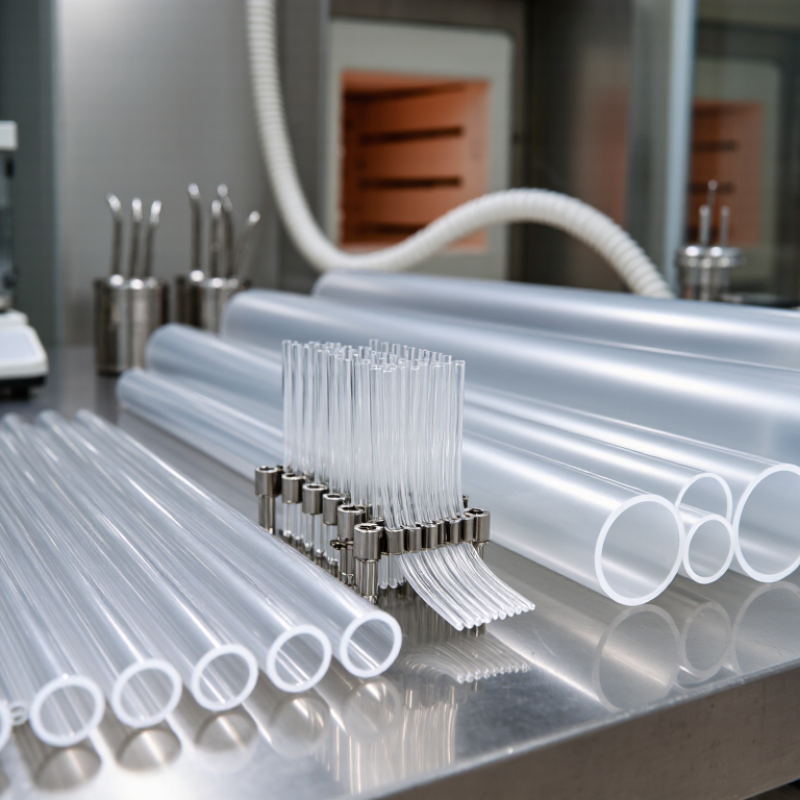
China Top 10 Silica Tubing Manufacturers You Should Know

What Silica Tubing Is and How It Is Used

Silica tubing is a hollow tube made from high-purity silicon dioxide, often in fused form. Unlike common glass, it can tolerate higher temperatures and expands very little when heated. Depending on its grade and wall thickness, it can also transmit ultraviolet light. It behaves differently. These properties matter when equipment needs heat resistance, optical access, or low contamination.

In laboratories, narrow silica tubes carry gases or liquids through analytical instruments and may serve as sample cells or furnace liners. Industrial systems use them to guide hot gases, protect sensors, or provide a clear path for light near a process. A technician may check a tube under a bench lamp for chips, cloudy patches, or rough ends before installation. Small details matter. Silica is hard but brittle, so a sharp bend or side load can cause a sudden break.

Selecting tubing involves checking its inner and outer diameters, wall thickness, operating temperature, chemical exposure, and bend radius. The right dimensions depend on flow and pressure, not appearance alone. A thinner wall may improve heat transfer but leave less room for handling errors. In practice, a specification sheet rarely tells the whole story: connectors, thermal cycling, and installation stress can affect service life. Testing the assembly under realistic conditions can reveal problems early.

How China’s Silica Tubing Manufacturers Are Evaluated

China Top 10 Silica Tubing Manufacturers You Should Know

How China’s Silica Tubing Manufacturers Are Evaluated

Evaluating a silica tubing manufacturer starts with the material, not the catalog. Buyers should ask about silica purity, production methods, and how each batch is checked. Request dimensional data, including inner diameter, outer diameter, and wall thickness. Small variations can affect flow, fitting, and performance in heated equipment.

Performance claims need context. Ask for test conditions, such as temperature range, thermal cycling, and chemical exposure. A tube tested under one condition may behave differently in another application. Look for batch records and inspection reports that connect measurements to actual production lots. A neat brochure is not proof. Samples can help, but they should represent routine output, not specially prepared pieces.

Production capacity, packaging, and technical communication also matter. Check whether the supplier can maintain consistent tolerances across repeat orders and protect tubing from dust, impact, and moisture during shipping. Clear answers about lead times and defect handling are useful evidence of operational discipline. No scorecard is perfect. Buyers may still overlook a detail, so document application requirements before comparing suppliers. A careful evaluation balances verified test data with practical questions from the people who will install and use the tubing.

Ten Chinese Silica Tubing Manufacturers to Know

Ten Chinese silica tubing manufacturers to know should be compared by process control, not catalogue breadth alone. Silica tubing serves demanding applications where wall thickness, bore diameter, purity, and thermal stability matter. Ask for tolerances and batch inspection records. Small variations can complicate assembly.

The U.S. Geological Survey’s Mineral Commodity Summaries 2024 estimated U.S. industrial sand and gravel production at about 120 million metric tons in 2023. This is a useful raw-material indicator, not a measure of tubing output. That distinction matters. Supplier checks should include material traceability, dimensional reports, and sample testing under the intended temperature cycle. Request clear data on breakage rates and packaging, too. A polished sample tells only part of the story. Comparisons remain imperfect when manufacturers use different test methods; buyers should align specifications before reviewing quotes. A careful shortlist can reveal meaningful differences in consistency, lead times, and technical support.

How Their Products and Capabilities Compare

Comparing ten silica-tubing manufacturers means looking beyond headline purity claims. Check outside diameter, wall thickness, concentricity, and length tolerances against your process drawings. For high-temperature furnaces, thermal-shock resistance and consistent wall geometry matter at the hot zone, where uneven heating can cause premature failure. For fluid handling, inspect surface finish, bore cleanliness, and whether custom bends introduce stress. Ask how each supplier tests and documents these properties. That matters.

Capacity is another dividing line. Some producers focus on standard tubing and repeatable volume; others offer small-batch dimensions, drawn-to-order sections, or tighter inspection records. SEMI reported that global semiconductor-materials sales reached 67.5 billion dollars in 2024, reflecting strong demand across a sector that uses high-purity materials. This figure is not silica-tubing sales, so it should not be treated as a direct market ranking. Rankings can mislead. Catalogs rarely show real-world yield, lead-time variation, or how promptly a supplier resolves out-of-tolerance parts. Compare sample inspection reports, lot traceability, and delivery records alongside specifications. A slightly awkward point: the lowest stated impurity level may not improve performance if the tubing’s dimensions drift between batches. Request comparable test data before deciding.

China Top 10 Silica Tubing Manufacturers: Material Capability Benchmark

A material-level comparison of typical thermal expansion coefficients—not a manufacturer ranking. Lower expansion generally means less dimensional change during temperature shifts.

Typical approximate coefficients of thermal expansion (20–300°C): fused silica, 0.55; borosilicate glass, 3.3; soda-lime glass, 9.0 × 10⁻⁶/K. Actual values vary with glass composition and product specifications.

What to Consider When Choosing a Manufacturer

Choosing a silica tubing manufacturer requires more than comparing prices and lead times. Check the tube’s outer diameter, wall thickness, concentricity, and straightness against your application’s tolerances. Ask for batch-level inspection records, not just a sample certificate. Small differences matter. The USGS Mineral Commodity Summaries 2024 estimated U.S. industrial sand and gravel production at 120 million metric tons in 2023. That figure describes a broad feedstock market, not tubing quality; it is a reminder to verify the manufacturer’s silica grade and traceability directly.

Request material composition, operating-temperature limits, and test methods in writing. For thermal processes, NIST reference data place fused silica’s thermal expansion near 0.5 parts per million per kelvin at room temperature, but actual performance depends on material and conditions. Ask how each batch is measured, and whether the supplier can provide dimensional results and representative test data. Inspect packaging details too: capped ends and clean, separated tubes reduce the chance of chips or contamination during shipment. Ask for proof. A polished audit file can still miss variation between batches, so compare documents with trial samples and your own measurements before committing to volume orders.


Article Source:

Powder Coat Booths

For those larger-sized parts, or smaller quantity runs, we have 2 independent powder coat booths and ovens. The quality, durability and affordability of today’s powder coating finishes make this the process of choice for world-class companies.

Powder coating advantages over other forms of coating are many. Materials used in the Powder coating process can be metals and non-metals that come in a multitude of thicknesses, textures, colors, etc. Another of Powder coating’s biggest advantages over conventional coatings is its ability to create finishes in many different textures. Powder Coating Booths allow us the ability to apply these advantages to large products.

Wet Paint Line

Tri-State Fabricators runs a full-service conveyor line for painting. Wet painting can provide protection or decoration to many different part styles. From start to finish, every project is easier to undergo random and point-based inspection by our skilled painting team.

Advantages to our Wet Paint Line are these lines start with product prep and ends with a thorough inspection of a high quality finished product. Our ability to complete large and small projects with a superior finish and doing so in a timely and economical fashion. This passes along the savings in production to our customers. When powder coating ins not an option, our Wet Paint Line gets the job done right the first time.

Wet Paint Booths

When the parts get big and heavy we roll-out our custom paint racks and oversize booth. By utilizing our partnerships with all the major paint brands, we can match virtually any color with wet paint.

The advantages of having access to a Wet Paint Booth are many. Large projects of many different shapes can be loaded into the booth. The Wet Paint Booth offers an environment that is much more controlled than a typical parts painting operation.

Not only are they used because of their controlled environment, but they’re are also advantageous when it comes to applying paint to parts that are needed in industries that require specialty coatings such as medical, aerospace, etc.

Military CARC

Our military forces have some very high standards when it comes to the finish of their vehicles and equipment. From the first pre-treatment step to final coat, it takes a great deal of knowledge and experience to protect the men and women of our armed forces. They deserve only the best, and Tri-State Fabricators provides it.

All of our processes are closely monitored by our staff and management teams. Both of which are highly trained in the processes of metal fabrication and finishing. Tri-State Fabricators’ goal is to always fully satisfy each and every customer, including the military. We will always put a 110% into what we do.

Glass-Bead Blasting

Abrasive media blasting is an excellent way to remove old paint, rust, and increase the paint/powder adhesion. Glass beads produce a much smoother and brighter finish than angular abrasives; leaving the part clean yet without any dimensional change. Chemically inert and environmentally friendly, we can recycle our beads approximately 30 times; making them a more preferred method of metal cleaning or surface finishing.

Advantages to Glass Bead Blasting are many. Glass bead blast media is used when a project is needing rough surfaces need to become smooth for applications of coatings such as paint. It is typically used to clean paint and rust from a product surface without deforming the surface it is being used on. Overall, compared to many other blasting media, Glass Bead Blasting is a very economical choice and those savings are always passed on to our customers.

Part Washing

Tri-State Fabricators utilize a zinc phosphate wash to clean and etch the material to ensure the best paint adhesion possible. The unique design of our 3-stage wash system does the work like a 5-stage. From Cleaning and rinsing to conversion coating and post-treatment, Our Part Washing process is a complete service and works throughout the fabrication service and the finishing service.

Along with the previously mentioned benefits, Curing is a vital chemical reaction that leaves the product finish hard and relatively safe from mild abrasion and aggressive corrosion. This process can be done in more than one way; ambient air-dry or in curing ovens at temps that exceed 240°.

Burn-Off Oven

From fixing paint mistakes (someone else’s of course) to simply cleaning our paint line hooks, our burn-off oven is put to good use. After a quick burn-off, a little clean up, and a fresh coat of paint, your parts will look better than new.

Why does our Burn-Off Oven work so well? Because super heating the air around parts turns the materials into ashes. From paint and powder coatings to rubber and machining oils, high temps do the job without degrading the integrity of the part.

Masking

Masking is a vital part of producing high quality products. We have die-cut masking patterns to protect machined surfaces as well as a wide range of plugs and caps to protect threaded holes and bolts. We provide permanent and temporary masking.

Masking allows the selected sections of a product to be protected from a fabrication or finishing service. This can be with both chemicals when etching and tapes, paints when only finishing just a section of the product. Masking is great in aiding the customization process of a project.

Screen Printing

Screen printing is a photographic process that transfers artwork onto a porous nylon screen which allows colored ink to flow through the screen and be deposited on an aluminum or plastic component. We can generally have just about any design created onto a screen for your parts.

Some of the advantages of Screen Printing are, brand recognition for your business displaying on your products, assembly instructions, product warnings/hazards, etc. Tri-State Fabricators produces Screen Printing of the highest quality so you know it’s durable.

Metal Finishing

Metal Finishing is the art of treating the exterior portion of product, often metal but can also be made of other materials, so that the surface is clean and free of any debris. Then the process of applying coats or either paint of powder coat takes place. This coating process improves the quality of the product in both appearance and resistance to wear and corrosion.

Tri-State Fabricators, Inc., understands that a project typically isn’t complete until a high-quality finish has been added to your product. This is why our painting and powder coating teams continuously inspect the products throughout the Metal Finishing process.



