


China Top 10 Polyester Nonwoven Fabric Manufacturers

Polyester Nonwoven fabric is easy to overlook. It sits inside a car’s cabin filter, beneath a disposable medical drape, and behind the soft face of a hygiene product. Its performance depends on practical details: fiber choice, web formation, bonding method, weight, and consistent roll quality. For buyers, a low quoted price means little if the material varies from batch to batch.

Industry data helps explain why supplier selection deserves care. EDANA’s 2023 European nonwovens statistics reported production of about 2.87 million tonnes, roughly 5.6% below the prior year. That decline is a reminder: demand and capacity can shift, even in established markets. Smithers’ report, The Future of Nonwovens to 2028, provides a broader view of market development and end-use demand. As Texas Tech nonwovens researcher Seshadri Ramkumar has put it, “Nonwovens are everywhere.” The phrase is simple. The material specifications are not.

This guide introduces ten notable China-based Polyester Nonwoven manufacturers. It is intended as a starting point, not a universal ranking: companies differ in process capability, certification, export experience, and willingness to customize. Before requesting a quotation, buyers should confirm fiber composition, basis weight, tensile strength, bonding process, test methods, and production capacity. Ask for recent test reports and a sample from the intended production line. A catalog swatch can look convincing under bright showroom lights; a full roll may tell a less comfortable story. Supplier information also changes, so verify current facilities and product details directly.
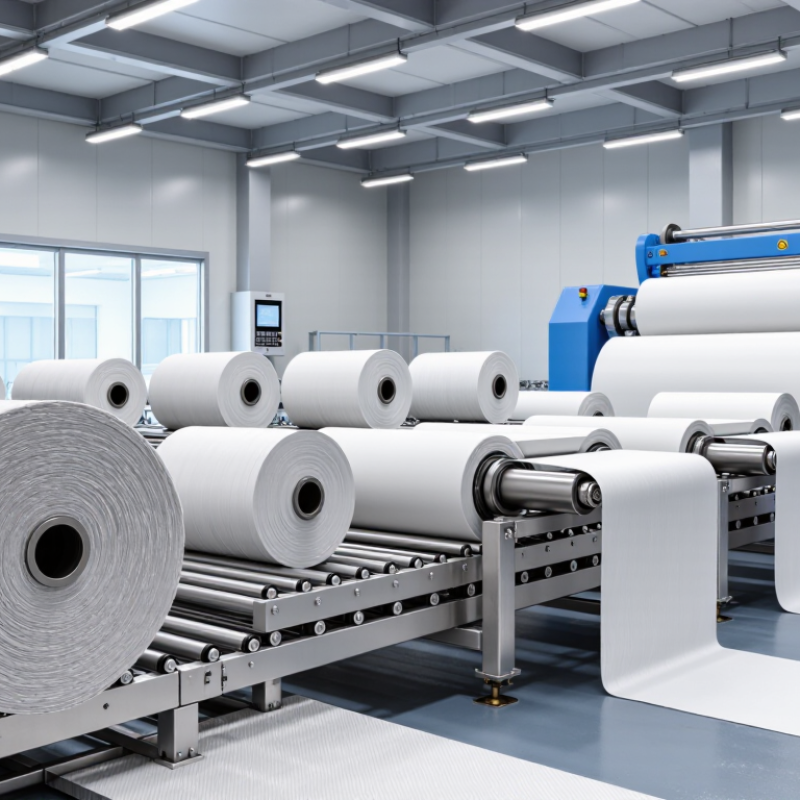
China Top 10 Polyester Nonwoven Fabric Manufacturers

What Is Polyester Nonwoven Fabric?

Polyester nonwoven fabric is a sheet of polyester fibers bonded without the interlacing used in woven cloth or the loops used in knitting. ISO 9092:2019 defines nonwovens by this fiber-web structure and its bonding process. The fibers may be arranged into a web, then joined through heat, pressure, mechanical entanglement, or binders. Spunbond and needle-punched fabrics are common examples. The method matters. It affects strength, thickness, surface feel, and airflow.

Polyester’s useful traits include durability, dimensional stability, and relatively low moisture absorption. A thin spunbond sheet may suit a disposable cover, while a dense needle-punched layer can provide cushioning or filtration support. These are not automatic outcomes; fiber size, web weight, bonding, and finishing all change performance. Smithers’ 2022 report, The Future of Global Nonwovens to 2027, forecast the worldwide nonwovens market would reach about US$68.9 billion by 2027, with 6.1% annual growth from 2022. That figure covers nonwovens broadly, not polyester alone. A useful reminder. “Nonwoven” does not mean one fixed material or quality grade. Polyester blends and surface treatments can also complicate recycling, so checking the actual fiber composition is worthwhile.


Polyester Nonwoven Fabric: Typical Basis Weight by Application

Basis weight is the mass of fabric per unit area, measured in grams per square meter (gsm). The ranges shown are indicative examples: actual specifications vary with the product design, manufacturing process, and end use.

How Polyester Nonwoven Fabric Is Made and Used

Polyester nonwoven fabric begins as polymer chips, which are melted and pushed through fine spinnerets. The resulting filaments form a loose web on a moving belt. In spunbond production, heat and pressure bond the fibers; needle punching mechanically entangles them. Meltblown methods create much finer fibers, useful for filtering small particles. The route matters. It shapes the fabric’s strength, softness, and pore size.

Textile Exchange’s Materials Market Report 2024 estimates that global fiber production reached 124 million tonnes in 2023, with polyester making up 57 percent. This figure covers all fiber uses, not nonwovens alone, but it shows polyester’s scale as a raw material. A finished web may also contain coatings or other fibers, so its performance cannot be judged by polymer type alone.

These fabrics appear in air and liquid filters, vehicle interiors, furniture backing, and geotextiles that help stabilize soil. A filter web needs controlled pores; a landscaping fabric needs enough strength to resist tearing. Polyester dries quickly and holds its shape, yet it is fossil-based. Blends, dyes, and finishes can complicate recycling. That detail gets missed. Manufacturers and buyers still need to weigh product life against end-of-life options.

China Top 10 Polyester Nonwoven Fabric Manufacturers - How Polyester Nonwoven Fabric Is Made and Used

This table summarizes ten common polyester nonwoven product segments and the manufacturing approaches used for them. It describes product types and applications, not a ranked list of companies.

Product Segment Typical Web Formation Common Bonding Method Indicative Basis Weight Typical Uses
Geotextiles Carded staple-fiber web or continuous-filament web Needle-punched; some products are spunbonded About 100–1,000 g/m² Soil separation, drainage, filtration, and protection in civil engineering projects
Air and liquid filter media Carded staple fibers or melt-spun filaments Thermal bonding, needle punching, or resin bonding About 20–300 g/m² Filter layers in HVAC systems, industrial dust collection, and liquid filtration
Automotive interior materials Carded staple-fiber web or spunbond web Needle punching, thermal bonding, or lamination About 50–500 g/m² Carpet backing, trunk liners, headliners, and interior trim components
Roofing and construction substrates Continuous-filament spunbond web Thermal bonding, often followed by coating or lamination About 40–200 g/m² Reinforcement and carrier layers in roofing membranes and building products
Cleaning wipes Carded staple-fiber web Hydroentanglement (spunlace) About 30–100 g/m² Dry and wet wipes for household, institutional, and industrial cleaning
Apparel interlinings Carded staple-fiber web or spunbond web Thermal bonding or resin bonding About 20–100 g/m² Fusible and sew-in support layers for garments, collars, and cuffs
Furniture and bedding components Carded staple-fiber web Needle punching or thermal bonding About 60–500 g/m² Upholstery backing, mattress layers, cushioning covers, and dust covers
Building insulation and acoustic layers Carded staple-fiber web Thermal bonding or needle punching About 100–800 g/m² Thermal insulation, sound absorption, and interior lining systems
Artificial-leather backing Carded staple-fiber web Needle punching, followed by coating or lamination About 80–300 g/m² Backing layers for coated fabrics used in footwear, bags, and upholstery
Lightweight packaging and protective covers Continuous-filament spunbond web Thermal bonding About 10–100 g/m² Protective wrapping, dust covers, and reusable or disposable packaging layers
How it is made: polyester fibers or polymer melt are formed into a web by processes such as carding or spinning. The web is then bonded mechanically, thermally, or with a bonding agent, and may receive finishing treatments. Basis-weight ranges are indicative examples; actual specifications vary by construction, performance requirements, and supplier.

How to Assess China’s Polyester Nonwoven Fabric Manufacturers

China Top 10 Polyester Nonwoven Fabric Manufacturers

How to Assess China’s Polyester Nonwoven Fabric Manufacturers

A supplier’s product page cannot prove consistent quality. Ask for recent test reports, production records, and samples from the same production line. Textile Exchange’s Materials Market Report 2024 estimates that polyester made up 57% of global fiber production in 2023. That scale makes clear specifications essential: “polyester nonwoven” alone says little about performance.

Check basis weight, thickness, tensile strength, elongation, and air permeability against your actual use. Request results from recognized test methods, such as relevant ISO 9073 procedures, and confirm units and conditioning before comparing suppliers. Then inspect a sample roll: look for uneven edges, visible holes, and changes in texture. Small details matter. Ask how the factory tracks batch variation and handles rejected rolls. A single passing sample is not enough.

Assess traceability and process control, not just quoted capacity. Request a recent certificate’s scope and validity, plus documentation for recycled content if claimed. Compare lead times against production schedules and ask whether finishing or testing is outsourced. A polished audit checklist can still miss an unstable process. I would treat that as a real limitation: remote checks cannot fully replace an independent factory visit or repeat testing. Keep the comparison practical, and record which claims you verified and which remain unconfirmed.

Profiles of 10 Leading Polyester Nonwoven Fabric Manufacturers in China

China’s polyester nonwoven sector includes producers with distinct processes and customer focuses. These ten profiles describe capability types, not a verified ranking. One coastal manufacturer specializes in spunbond rolls for packaging and furniture backing. Another makes needle-punched fabric for automotive liners, where thickness and abrasion resistance matter. A third focuses on thermal-bonded sheets for filtration. Pore consistency matters. A fourth supplies lightweight materials for hygiene products, while a fifth produces heavier fabrics for construction applications.

A sixth manufacturer combines several bonding methods and offers varied roll widths. A seventh emphasizes recycled polyester inputs, though buyers should verify fiber content and batch consistency. An eighth serves agricultural uses, including crop covers that must balance strength and airflow. A ninth focuses on custom colors and surface finishes for interior products. A tenth supports smaller orders and tailored specifications. Flexibility helps, but production capacity still needs checking.

When comparing suppliers, request technical data sheets and samples from the same production grade. Check basis weight, tensile strength, thickness, and roll-to-roll variation. Ask how defects are recorded and how changes in raw materials are communicated. Factory visits can clarify equipment and quality controls, but paperwork alone may not show everyday consistency. No profile replaces testing fabric under actual operating conditions.

How to Compare Manufacturers and Choose a Suitable Supplier

Choosing among the China top 10 polyester nonwoven fabric manufacturers starts with your application, not a ranking. Filtration, packaging, and furniture uses can require different fiber blends and performance targets. Write down the needed basis weight, web width, color, bonding method, and end-use conditions. Small details matter.

Compare technical data sheets carefully. Ask for measured tensile strength, elongation, air permeability, and thickness, with test conditions stated. A number without its method is hard to compare. Request samples from the production line, not only a specially prepared swatch. Check different points across each roll for loose edges, uneven texture, and weight variation. Then run a trial on your actual converting equipment.

Useful evidence includes recent inspection records, material traceability, and a clear process for handling defects. Ask how capacity changes during peak seasons, and request realistic lead times in writing. Communication counts too. Can the supplier explain a failed test and propose a correction? Price matters, but the cheapest quotation may involve wider tolerances or less consistent delivery. One limitation: a small sample cannot prove months of stable production. Consider a pilot order and review the results before scaling.

Powder Coat Booths

For those larger-sized parts, or smaller quantity runs, we have 2 independent powder coat booths and ovens. The quality, durability and affordability of today’s powder coating finishes make this the process of choice for world-class companies.

Powder coating advantages over other forms of coating are many. Materials used in the Powder coating process can be metals and non-metals that come in a multitude of thicknesses, textures, colors, etc. Another of Powder coating’s biggest advantages over conventional coatings is its ability to create finishes in many different textures. Powder Coating Booths allow us the ability to apply these advantages to large products.

Wet Paint Line

Tri-State Fabricators runs a full-service conveyor line for painting. Wet painting can provide protection or decoration to many different part styles. From start to finish, every project is easier to undergo random and point-based inspection by our skilled painting team.

Advantages to our Wet Paint Line are these lines start with product prep and ends with a thorough inspection of a high quality finished product. Our ability to complete large and small projects with a superior finish and doing so in a timely and economical fashion. This passes along the savings in production to our customers. When powder coating ins not an option, our Wet Paint Line gets the job done right the first time.

Wet Paint Booths

When the parts get big and heavy we roll-out our custom paint racks and oversize booth. By utilizing our partnerships with all the major paint brands, we can match virtually any color with wet paint.

The advantages of having access to a Wet Paint Booth are many. Large projects of many different shapes can be loaded into the booth. The Wet Paint Booth offers an environment that is much more controlled than a typical parts painting operation.

Not only are they used because of their controlled environment, but they’re are also advantageous when it comes to applying paint to parts that are needed in industries that require specialty coatings such as medical, aerospace, etc.

Military CARC

Our military forces have some very high standards when it comes to the finish of their vehicles and equipment. From the first pre-treatment step to final coat, it takes a great deal of knowledge and experience to protect the men and women of our armed forces. They deserve only the best, and Tri-State Fabricators provides it.

All of our processes are closely monitored by our staff and management teams. Both of which are highly trained in the processes of metal fabrication and finishing. Tri-State Fabricators’ goal is to always fully satisfy each and every customer, including the military. We will always put a 110% into what we do.

Glass-Bead Blasting

Abrasive media blasting is an excellent way to remove old paint, rust, and increase the paint/powder adhesion. Glass beads produce a much smoother and brighter finish than angular abrasives; leaving the part clean yet without any dimensional change. Chemically inert and environmentally friendly, we can recycle our beads approximately 30 times; making them a more preferred method of metal cleaning or surface finishing.

Advantages to Glass Bead Blasting are many. Glass bead blast media is used when a project is needing rough surfaces need to become smooth for applications of coatings such as paint. It is typically used to clean paint and rust from a product surface without deforming the surface it is being used on. Overall, compared to many other blasting media, Glass Bead Blasting is a very economical choice and those savings are always passed on to our customers.

Part Washing

Tri-State Fabricators utilize a zinc phosphate wash to clean and etch the material to ensure the best paint adhesion possible. The unique design of our 3-stage wash system does the work like a 5-stage. From Cleaning and rinsing to conversion coating and post-treatment, Our Part Washing process is a complete service and works throughout the fabrication service and the finishing service.

Along with the previously mentioned benefits, Curing is a vital chemical reaction that leaves the product finish hard and relatively safe from mild abrasion and aggressive corrosion. This process can be done in more than one way; ambient air-dry or in curing ovens at temps that exceed 240°.

Burn-Off Oven

From fixing paint mistakes (someone else’s of course) to simply cleaning our paint line hooks, our burn-off oven is put to good use. After a quick burn-off, a little clean up, and a fresh coat of paint, your parts will look better than new.

Why does our Burn-Off Oven work so well? Because super heating the air around parts turns the materials into ashes. From paint and powder coatings to rubber and machining oils, high temps do the job without degrading the integrity of the part.

Masking

Masking is a vital part of producing high quality products. We have die-cut masking patterns to protect machined surfaces as well as a wide range of plugs and caps to protect threaded holes and bolts. We provide permanent and temporary masking.

Masking allows the selected sections of a product to be protected from a fabrication or finishing service. This can be with both chemicals when etching and tapes, paints when only finishing just a section of the product. Masking is great in aiding the customization process of a project.

Screen Printing

Screen printing is a photographic process that transfers artwork onto a porous nylon screen which allows colored ink to flow through the screen and be deposited on an aluminum or plastic component. We can generally have just about any design created onto a screen for your parts.

Some of the advantages of Screen Printing are, brand recognition for your business displaying on your products, assembly instructions, product warnings/hazards, etc. Tri-State Fabricators produces Screen Printing of the highest quality so you know it’s durable.

Metal Finishing

Metal Finishing is the art of treating the exterior portion of product, often metal but can also be made of other materials, so that the surface is clean and free of any debris. Then the process of applying coats or either paint of powder coat takes place. This coating process improves the quality of the product in both appearance and resistance to wear and corrosion.

Tri-State Fabricators, Inc., understands that a project typically isn’t complete until a high-quality finish has been added to your product. This is why our painting and powder coating teams continuously inspect the products throughout the Metal Finishing process.
