


A Pallet Rack system does more than hold cartons above a warehouse floor. Its design affects how goods move, how much space remains for aisles, and how quickly workers can reach each load. A selective rack, for example, gives direct access to many pallet positions. A drive-in system can store more pallets in a smaller footprint, but access to individual loads may be less immediate. Small differences in daily order patterns can make that trade-off matter.
The Top 10 Types of Pallet Rack Systems introduces common options, including selective, double-deep, push-back, pallet-flow, and cantilever racks. Each type serves different storage needs. Product dimensions, pallet weight, inventory turnover, available floor space, and handling equipment all deserve attention before a layout is chosen. A forklift’s turning radius can change how useful a proposed aisle plan really is. So can an uneven mix of pallet sizes.
There is no single system that suits every warehouse. Even a well-planned installation may need adjustment as inventory changes. That detail is easy to overlook. This guide explains how the main rack types work, where they may fit, and what limitations to consider. It is a practical starting point, not a substitute for a site-specific assessment by qualified professionals.
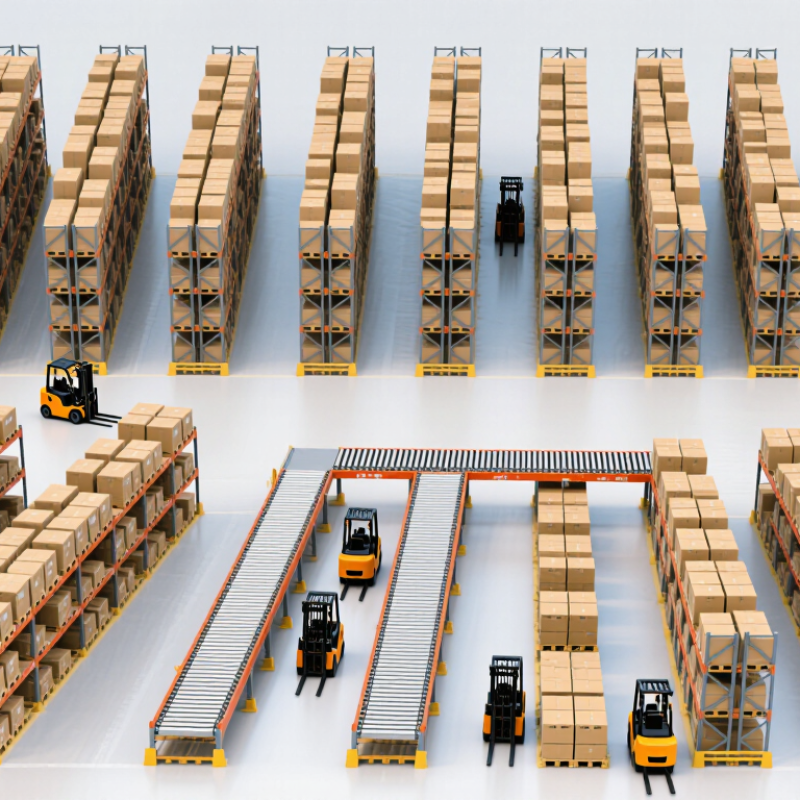
A pallet rack system is a steel structure that stores palletized goods above the floor, using upright frames and horizontal beams. It turns vertical space into accessible storage. In a typical warehouse, forklifts place pallets onto beam levels, while clear aisles let operators retrieve them. The arrangement can make stock easier to see and help teams use floor space more efficiently.
Different systems suit different work. Selective racks provide direct access to each pallet, while drive-in designs store more pallets in a smaller area but limit access to individual loads. The right choice depends on inventory turnover, pallet size, ceiling height, floor conditions, and forklift dimensions. Measure actual loads, including uneven or overhanging goods. Small details matter.
A rack should be treated as a working structure, not just shelving. Installers need to follow the system’s load ratings, and staff should know how to spot bent beams, loose connections, or impact damage. Keep aisles clear, and arrange inspections at regular intervals. No layout is perfect. Dense storage may slow picking, while wider access can use valuable space. Reviewing how stock moves through the building helps reveal which compromise is practical.
Pallet rack systems are structural storage frameworks that hold palletized goods and provide organized access for warehouse equipment. The right system depends on inventory rotation, pallet variety, available space, and the required level of access.
| Rack System | How It Stores Pallets | Access and Selectivity | Common Uses | Key Consideration |
|---|---|---|---|---|
| 1. Selective Pallet Rack | Pallets sit on horizontal beams in individual storage positions, with aisles between rack rows. | Direct access to each pallet; high selectivity. | Warehouses with many SKUs, mixed inventory, or frequent picking. | Aisles provide access but use floor space that could otherwise hold storage. |
| 2. Double-Deep Rack | Two pallet positions are placed one behind the other, typically on each side of an aisle. | Front pallets are directly accessible; rear pallets require a deep-reach truck. | Operations holding multiple pallets of the same SKU. | Access to rear pallets is less direct, so stock rotation and equipment compatibility matter. |
| 3. Drive-In Rack | A forklift enters a rack lane and places pallets on rails that support the pallet edges. | Typically accessed from one end; storage is commonly last-in, first-out (LIFO). | High quantities of similar products with relatively low SKU variety. | Forklifts travel inside the lanes, so careful operation and compatible pallets are important. |
| 4. Drive-Through Rack | A forklift enters a lane from one side and can exit from the opposite side. | Access from both ends can support first-in, first-out (FIFO) loading and retrieval when managed accordingly. | Bulk storage where product flow between two sides is useful. | Requires access aisles at both ends and suitable traffic planning. |
| 5. Push-Back Rack | Pallets rest on nested carts or rollers that move back along an inclined lane as new pallets are loaded. | Loaded and retrieved from the same aisle; generally operates on a LIFO basis. | Multiple pallets per SKU where greater storage density than selective rack is desired. | Pallet dimensions, load condition, and lane design affect smooth operation. |
| 6. Pallet Flow Rack | Pallets move by gravity along inclined roller or wheel lanes from the loading side to the picking side. | Separate loading and retrieval sides can support FIFO flow. | Goods needing stock rotation, including date-sensitive inventory. | Pallet quality, load stability, and flow-lane maintenance are important. |
| 7. Pallet Shuttle Rack | A powered shuttle travels along rack rails to move pallets into or out of deep storage lanes. | Forklifts place and retrieve pallets at lane openings; lane operation can be configured for different stock flows. | High-density storage of multiple pallets per SKU or product group. | Requires powered equipment, controls, and a plan for shuttle charging and maintenance. |
| 8. Mobile Pallet Rack | Rack rows are mounted on powered mobile bases that move to open an access aisle where needed. | Aisle access is created on demand; pallets can remain individually accessible within the opened aisle. | Facilities where storage density is important and access frequency can be managed. | Needs suitable flooring, safety controls, and coordination of aisle movements. |
| 9. Very Narrow Aisle (VNA) Rack | Rack is arranged with narrow operating aisles served by specialized turret or guided trucks. | Pallet positions can remain individually accessible, with aisle width reduced compared with conventional layouts. | Warehouses seeking to increase storage capacity while retaining selective access. | Requires compatible trucks and careful attention to floor flatness, guidance, and clearances. |
| 10. High-Bay Automated Storage and Retrieval System (AS/RS) | Automated cranes or other storage-and-retrieval machines place and retrieve pallet loads within tall rack aisles. | Access is directed by a control system rather than routine forklift travel within the storage aisles. | Operations with substantial throughput, consistent load units, and a need for automated inventory handling. | Requires significant systems planning, integration, and ongoing technical support. |
Note: Actual capacity, aisle requirements, and suitability depend on rack engineering, pallet and load specifications, handling equipment, building conditions, and applicable safety requirements.

Choosing a pallet rack system starts with the work your warehouse handles each day. Count pallet positions, measure load weights, and record the actual pallet dimensions, including overhang. A standard drawing may not match what arrives at the dock. Measure twice.
Selective racks offer direct access to each pallet, which helps operations with many different products. Drive-in systems store more pallets in less aisle space, but forklifts must enter the rack lanes. Push-back and pallet-flow racks can support higher-density storage, though their moving parts and loading rules need careful review. More density is not automatically better.
Check forklift turning space, ceiling height, floor conditions, and how quickly inventory must move. A narrow aisle on paper can become a daily bottleneck when trucks cannot turn comfortably. Consider stock rotation, too: last-in, first-out layouts may not suit every product. A simple test is to map your busiest pick routes and compare travel distance under each layout. Leave room for growth, but avoid paying for capacity you cannot use. Before installation, have a qualified rack professional verify the design, load ratings, anchoring, and applicable building and fire-safety requirements. Revisit the plan after a trial layout; real traffic often exposes assumptions that looked reasonable in a spreadsheet.
Top 10 Types of Pallet Rack Systems
The 10 Main Types of Pallet Rack Systems
Pallet rack systems differ in access, storage density, and how goods move. Selective racks give forklifts direct access to every pallet. Double-deep racks store pallets two positions deep, but need reach trucks. Drive-in racks suit large quantities of similar products. Drive-through racks allow forklifts to enter from either end. Push-back racks use carts to move pallets toward the aisle. Access matters.
Pallet-flow racks use gravity rollers to move pallets from loading to picking faces. Pallet shuttle systems use powered carts to place and retrieve loads in deep lanes. Cantilever racks hold long items, such as pipes or timber, on projecting arms. Mobile racks move along floor rails, opening an aisle where needed. Structural racks use heavy-duty steel components and can support demanding loads. Each design has limits. A high-density layout may reduce immediate access, and traffic patterns can change how well it works.
Tips: Check pallet size, load weight, forklift clearance, and inventory turnover before choosing a system. Leave room for safe turning and inspections. Measure the actual warehouse, not just the drawing; small obstructions can complicate installation. The best option is not always the densest one.
A qualitative comparison of typical storage density and pallet selectivity across common rack systems.
Scores use a relative 1–5 scale, where 1 is low and 5 is high. They are qualitative comparisons based on each system’s typical layout and access method, not standardized measurements; actual performance depends on the installation and operating requirements.
Pallet rack systems differ most in how easily operators reach each load and how much floor space storage consumes. Selective rack gives direct access to every pallet, but its wider forklift aisles reduce density. Double-deep rack stores pallets two positions deep, increasing capacity while requiring reach trucks and careful stock rotation. Narrow-aisle and very-narrow-aisle layouts also reclaim floor space, though equipment and operator training become more demanding. Access still matters.
Drive-in and drive-through racks place pallets several positions deep, making them useful for larger batches of similar goods. Drive-in typically uses one entry side; drive-through permits entry from both ends. Push-back rack loads pallets on nested carts, while pallet-flow rack uses rollers to move loads toward the picking face. Both increase density, but flow systems need compatible loads and routine inspection. Pallet shuttle systems use a powered cart to move pallets within deep lanes, reducing forklift travel inside the rack.
The best fit depends on more than maximum capacity. High-density storage can slow picking when products turn quickly or arrive in mixed batches. Selective rack may therefore outperform a denser layout for varied inventory. Cantilever rack serves long or awkward materials, rather than standard pallet loads. Measure aisle widths, pallet dimensions, load weights, and daily access needs before choosing. I would also check how replenishment works during a busy shift; that detail is easy to overlook.
Pallet racks are often treated as static equipment, yet forklifts, uneven loads, and repeated impacts change their condition daily. The U.S. Bureau of Labor Statistics reported 4.8 recordable injury and illness cases per 100 full-time workers in warehousing and storage in 2022. The rate across private industry was 2.7. That gap makes routine rack checks part of injury prevention, not housekeeping. Look for bent uprights, cracked welds, loose anchors, displaced beam locks, and damaged floor slabs. Compare load plaques with actual pallet weights and beam configurations. Small defects matter.
OSHA’s 29 CFR 1910.176(b) requires stored materials to remain stable and secure against sliding or collapse. Keep aisles clear, replace missing locks promptly, and isolate bays when damage may affect capacity. Record each inspection with the location, defect, and repair date; photographs help track changes. Never straighten a damaged upright by guesswork. Have a qualified rack professional assess structural damage and confirm repairs. Set inspection frequency according to traffic, load changes, and near misses. Often, it isn’t frequent enough. A checklist can still miss a slow bend hidden behind wrapped pallets, so inspect from more than one angle.


For those larger-sized parts, or smaller quantity runs, we have 2 independent powder coat booths and ovens. The quality, durability and affordability of today’s powder coating finishes make this the process of choice for world-class companies.
Powder coating advantages over other forms of coating are many. Materials used in the Powder coating process can be metals and non-metals that come in a multitude of thicknesses, textures, colors, etc. Another of Powder coating’s biggest advantages over conventional coatings is its ability to create finishes in many different textures. Powder Coating Booths allow us the ability to apply these advantages to large products.
Tri-State Fabricators runs a full-service conveyor line for painting. Wet painting can provide protection or decoration to many different part styles. From start to finish, every project is easier to undergo random and point-based inspection by our skilled painting team.
Advantages to our Wet Paint Line are these lines start with product prep and ends with a thorough inspection of a high quality finished product. Our ability to complete large and small projects with a superior finish and doing so in a timely and economical fashion. This passes along the savings in production to our customers. When powder coating ins not an option, our Wet Paint Line gets the job done right the first time.
When the parts get big and heavy we roll-out our custom paint racks and oversize booth. By utilizing our partnerships with all the major paint brands, we can match virtually any color with wet paint.
The advantages of having access to a Wet Paint Booth are many. Large projects of many different shapes can be loaded into the booth. The Wet Paint Booth offers an environment that is much more controlled than a typical parts painting operation.
Not only are they used because of their controlled environment, but they’re are also advantageous when it comes to applying paint to parts that are needed in industries that require specialty coatings such as medical, aerospace, etc.
Our military forces have some very high standards when it comes to the finish of their vehicles and equipment. From the first pre-treatment step to final coat, it takes a great deal of knowledge and experience to protect the men and women of our armed forces. They deserve only the best, and Tri-State Fabricators provides it.
All of our processes are closely monitored by our staff and management teams. Both of which are highly trained in the processes of metal fabrication and finishing. Tri-State Fabricators’ goal is to always fully satisfy each and every customer, including the military. We will always put a 110% into what we do.
Abrasive media blasting is an excellent way to remove old paint, rust, and increase the paint/powder adhesion. Glass beads produce a much smoother and brighter finish than angular abrasives; leaving the part clean yet without any dimensional change. Chemically inert and environmentally friendly, we can recycle our beads approximately 30 times; making them a more preferred method of metal cleaning or surface finishing.
Advantages to Glass Bead Blasting are many. Glass bead blast media is used when a project is needing rough surfaces need to become smooth for applications of coatings such as paint. It is typically used to clean paint and rust from a product surface without deforming the surface it is being used on. Overall, compared to many other blasting media, Glass Bead Blasting is a very economical choice and those savings are always passed on to our customers.
Tri-State Fabricators utilize a zinc phosphate wash to clean and etch the material to ensure the best paint adhesion possible. The unique design of our 3-stage wash system does the work like a 5-stage. From Cleaning and rinsing to conversion coating and post-treatment, Our Part Washing process is a complete service and works throughout the fabrication service and the finishing service.
Along with the previously mentioned benefits, Curing is a vital chemical reaction that leaves the product finish hard and relatively safe from mild abrasion and aggressive corrosion. This process can be done in more than one way; ambient air-dry or in curing ovens at temps that exceed 240°.
From fixing paint mistakes (someone else’s of course) to simply cleaning our paint line hooks, our burn-off oven is put to good use. After a quick burn-off, a little clean up, and a fresh coat of paint, your parts will look better than new.
Why does our Burn-Off Oven work so well? Because super heating the air around parts turns the materials into ashes. From paint and powder coatings to rubber and machining oils, high temps do the job without degrading the integrity of the part.
Masking is a vital part of producing high quality products. We have die-cut masking patterns to protect machined surfaces as well as a wide range of plugs and caps to protect threaded holes and bolts. We provide permanent and temporary masking.
Masking allows the selected sections of a product to be protected from a fabrication or finishing service. This can be with both chemicals when etching and tapes, paints when only finishing just a section of the product. Masking is great in aiding the customization process of a project.
Screen printing is a photographic process that transfers artwork onto a porous nylon screen which allows colored ink to flow through the screen and be deposited on an aluminum or plastic component. We can generally have just about any design created onto a screen for your parts.
Some of the advantages of Screen Printing are, brand recognition for your business displaying on your products, assembly instructions, product warnings/hazards, etc. Tri-State Fabricators produces Screen Printing of the highest quality so you know it’s durable.
Metal Finishing is the art of treating the exterior portion of product, often metal but can also be made of other materials, so that the surface is clean and free of any debris. Then the process of applying coats or either paint of powder coat takes place. This coating process improves the quality of the product in both appearance and resistance to wear and corrosion.
Tri-State Fabricators, Inc., understands that a project typically isn’t complete until a high-quality finish has been added to your product. This is why our painting and powder coating teams continuously inspect the products throughout the Metal Finishing process.

