


A compound wall does more than mark a boundary. At dusk, it frames the entrance, guides visitors, and can leave steps or gates hidden in shadow. The right Compound Wall Lights balance visibility with a welcoming appearance. Yet choosing by appearance alone is a common mistake. A bright fixture can create glare, while a poorly sealed one may struggle with rain and dust. Small details matter.
The U.S. Department of Energy reports that residential LEDs use at least 75% less energy and can last up to 25 times longer than incandescent lighting. That comparison is useful, but it does not guarantee that every LED fixture performs equally well outdoors. Check the product’s weather rating, light direction, color temperature, and installation requirements. DarkSky International’s outdoor-lighting guidance also emphasizes using light only where needed and directing it downward. A practical test is simple: picture the wall, gate, and nearby path after dark—not just the fixture in a product photo. Some designs look striking online but may feel harsh at home. This guide reviews ten options for different wall styles, budgets, and lighting needs, while weighing durability, beam control, and everyday upkeep. No single model suits every property. The best choice is the one that makes the entrance easier to use without turning the whole yard into a spotlight.
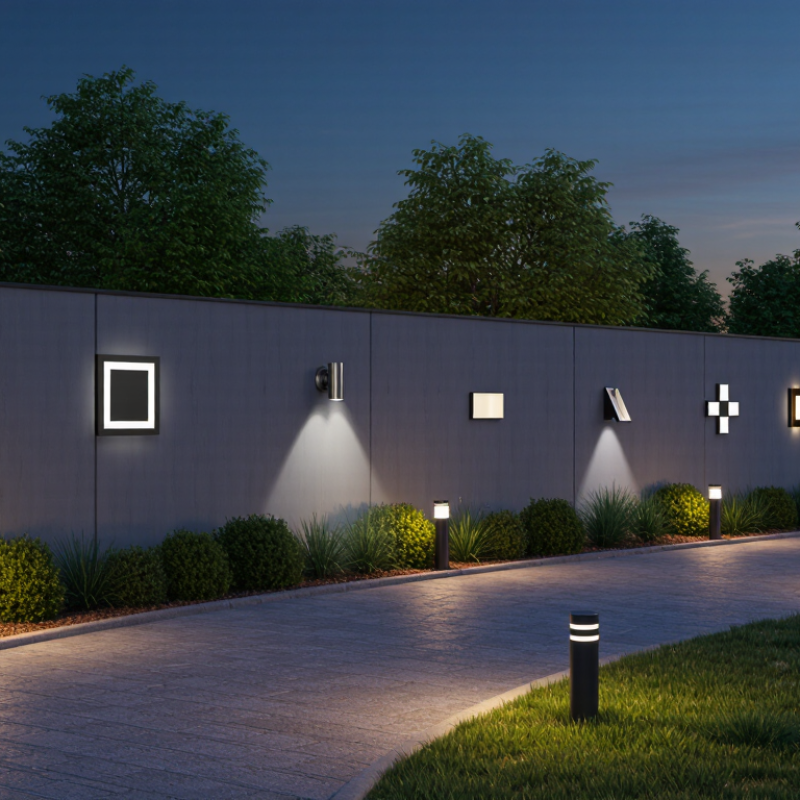
Compound wall lights are outdoor fixtures mounted on boundary walls to illuminate entrances, walkways, and property edges. They improve visibility and help people identify gates after dark. Unlike tall posts, wall-mounted fittings keep light close to the route and can reduce clutter in small yards.
Common materials include powder-coated aluminum, stainless steel, galvanized steel, and copper. Aluminum is lightweight, while stainless steel can resist corrosion when its grade and finish suit the local climate. Copper develops a changing surface patina. Lenses are often glass or impact-resistant polycarbonate; each handles weather and knocks differently. Check drainage, too. Look for sealed joints and an outdoor suitability rating appropriate to rain and dust exposure.
At gates, downward-facing fixtures can light keyholes and steps without shining directly into visitors’ eyes. Along a driveway, evenly spaced lights help reveal changes in paving; gaps can leave dark patches. Glare matters. For coastal or damp locations, inspect finishes and fasteners regularly, since small chips may expose vulnerable metal. Warm light often feels comfortable near seating, while a neutral tone can make path edges easier to distinguish. Solar models avoid wiring, but shade and short winter days can reduce their runtime. Even a careful layout may leave one corner dim, so check it after installation rather than assuming the drawing tells the whole story.

For compound wall lights, IP65 is a useful outdoor benchmark, not a promise of unlimited weather protection. Under IEC 60529, the first “6” means dust-tight; the second “5” indicates protection against water jets from any direction. Rain driven sideways across a boundary wall is a realistic test. Yet IP65 says nothing about corrosion, UV exposure, or years of temperature swings. A sealed fitting can still develop rust around screws or mounting plates.
Corrosion deserves attention. NACE International’s 2016 IMPACT study estimated global corrosion costs at US$2.5 trillion annually, about 3.4% of global GDP. That figure covers many industries, not wall lights specifically, but it shows why material choice matters. ISO 9223 classifies atmospheric corrosivity using environmental conditions and corrosion rates. Coastal air, road salts, and damp, shaded walls can be especially demanding. Even a good coating may be scratched during installation.
Tips: Check that the IP65 rating applies to the complete assembled fitting, including cable entries. Look for corrosion-resistant fasteners and a clear coating specification. Rinse salt deposits periodically, and inspect joints after the first wet season. Small details matter.
One limitation is easy to overlook: laboratory water-jet tests do not reproduce years of wind, grit, and maintenance neglect. Review the stated test conditions, then match materials to the actual site. A sheltered inland wall and a sea-facing wall are not equivalent.
IEC 60529 ingress-protection classifications: dust protection and water protection digits.
The chart compares IP20, IP23, IP44, IP54, IP55, IP65, IP66, IP67, IP68 and IP69. The digits are classification levels, not linear performance scores. IP65 means dust-tight and protection against water jets; higher water digits describe different test conditions, not a simple upgrade for every installation.
Corrosion resistance is separate from the IEC 60529 IP rating. Check the luminaire’s material, finish and documented corrosion-test results for the intended outdoor environment. Reference: IEC 60529.
Top 10 compound wall lights differ most in how they spread light and attach to a wall. Wall lanterns create a broad, decorative glow; up-and-down sconces cast two distinct beams. Shielded downlights direct light toward paths, while bulkhead fixtures spread a softer, wider pool. Recessed step lights sit low and reduce glare. Corner-mounted lights cover two sides. Cylinder sconces shape narrow beams, and adjustable spot heads let you aim at gates or planting. Linear wall bars give even coverage along long walls. Solar-integrated fixtures avoid wiring, but output can vary with shade and season. Light sources include replaceable LED lamps and integrated LEDs; check whether replacement parts are available.
Mounting height changes the result. A narrow beam can leave dark patches if fixtures sit too far apart, while a broad beam may spill into nearby windows. Match the beam to the task, then check the fixture’s outdoor rating and wall-box compatibility. Warm light often feels gentler near seating, though color preference is personal. One detail is easy to overlook: textured brick can break up an otherwise smooth beam.
Tips: Mark fixture positions with tape and test spacing after dark. Compare beam spread on the actual wall, not just in a product diagram. Reserve enough clearance for maintenance.
Lumens describe how much visible light a wall fixture produces, not how far it throws light. The U.S. Department of Energy’s solid-state lighting guidance separates light output from color appearance, a distinction worth keeping in mind when comparing compound wall lights. A modest lumen output can feel bright beside a pale wall, yet disappear against dark brick. Check the beam pattern, too. A narrow beam may leave the gate bright and the path oddly dim.
CCT describes whether light looks warm or cool. Around 2700 K, light usually appears warm and welcoming; near 4000 K, it looks cooler and clearer. For a home entrance, 2700–3000 K often softens stone and timber, while 3000–4000 K can help reveal steps and edges. The DOE identifies CCT as a way to describe a source’s color appearance, not its brightness. Small distinction. It matters.
CRI indicates how faithfully a light shows colors compared with a reference source. The International Commission on Illumination’s CIE 13.3 method sets out color-rendering measurement; CRI ≥80 is a practical baseline for seeing plants, paint, and parcel labels naturally. Still, one number cannot capture every color well. I have found that samples can look flatter under a high-CRI lamp than expected, especially beside greenery. Check the actual fixture outdoors, if possible, and avoid aiming light directly into approaching eyes.
Compare these ten common, brand-neutral fixture types as a planning guide for compound walls and outdoor boundaries. The lumen figures are indicative ranges for a single light, not universal product specifications; the right output depends on mounting height, spacing, wall finish, beam direction, and the amount of light needed.
| # | Light type | Typical output per fixture | Suggested CCT | Color rendering | Distribution / use | Outdoor protection to consider |
|---|---|---|---|---|---|---|
| 1 | Shielded downward wall light | 300–700 lm | 2700–3000 K | CRI ≥80 | Downward pool of light for a wall-side path; shielding helps limit glare and upward spill. | Choose an ingress-protection rating suited to the fixture’s exposure; IP44 is splash-resistant, while more exposed locations may need higher protection. |
| 2 | Up-and-down wall light | 400–900 lm | 2700–3000 K | CRI ≥80 | Decorative light above and below the fitting; aim and position it to avoid shining into neighboring properties. | Check the rating for rain and dust exposure, and confirm that the light’s openings and installation orientation match the manufacturer’s instructions. |
| 3 | Wide-beam wall washer | 600–1200 lm | 3000–3500 K | CRI ≥80 | Spreads light across a broader wall area; spacing and setback affect whether the wall looks evenly lit. | For locations exposed to water jets or heavy dust, consider a suitably rated sealed fixture, such as IP65, where appropriate. |
| 4 | Narrow-beam accent light | 200–500 lm | 2700–3000 K | CRI ≥80 | Highlights pillars, stonework, or architectural details; not usually a substitute for general path lighting. | Use an outdoor-rated fitting appropriate to its mounting position and direct exposure. |
| 5 | Opal-diffuser wall lantern | 400–800 lm | 2700–3000 K | CRI ≥80 | Soft, broadly distributed light near entrances and gates; diffuser size and brightness affect perceived glare. | Check seals, material suitability, and the stated IP rating for the site’s weather conditions. |
| 6 | Cut-off security wall light | 800–1500 lm | 3000–4000 K | CRI ≥80 | Higher-output option for boundary areas; a shielded, well-aimed beam can improve visibility while controlling spill. | For exposed installations, verify the complete fixture’s dust and water protection; IP65 indicates dust-tight construction and protection against water jets under test conditions. |
| 7 | Motion-sensor wall light | 500–1200 lm when on | 3000–4000 K | CRI ≥80 | Provides light when movement is detected; sensor range, detection angle, and timeout are installation-dependent. | Confirm that both the light and sensor are rated for their actual outdoor exposure. |
| 8 | Recessed wall step light | 50–200 lm | 2700–3000 K | CRI ≥80 | Low-level guidance for steps or changes in level; position to illuminate walking surfaces without direct eye glare. | Recessed fittings can collect water if installed incorrectly; follow drainage, sealing, and mounting instructions. |
| 9 | Linear wall light | 300–900 lm per fitting | 3000–3500 K | CRI ≥80 | Continuous or near-continuous visual line for modern boundary walls; output depends on fitting length and LED efficiency. | Check the rating for the whole installed fitting, including end caps, joints, and cable entries. |
| 10 | Solar wall light | 100–600 lm, mode-dependent | 2700–4000 K | CRI ≥80 where specified | Useful where wiring is impractical; runtime and brightness depend on sunlight, battery capacity, temperature, and operating mode. | Verify the stated weather-protection rating and allow for reduced charging in shade or during overcast weather. |
Metric guide: Lumens (lm) measure the total light output from a source; they do not by themselves describe how brightly a particular wall or path will be lit. CCT, expressed in kelvin (K), describes the appearance of white light: lower values such as 2700 K look warmer, while values near 4000 K look cooler. CRI indicates how faithfully colors appear under a light source; CRI ≥80 is a common baseline for outdoor general lighting. IP ratings describe tested protection against dust and water ingress, not resistance to every installation condition. Confirm local electrical requirements, mounting instructions, and site-specific exposure before choosing a fixture.
Compound wall lights can brighten a path, but safe installation starts with the electrical supply. Check the fixture label and instructions before connecting wires. The rated voltage must match the circuit. Low-voltage lights need a compatible transformer; never connect them directly to household voltage. Switch off the breaker, then use a suitable tester to confirm the wires are de-energized. A switch position alone is not proof. Do not guess.
Outdoor exposure matters, too. Choose a fixture and electrical box rated for the location, especially where rain can reach the wall. Connect the grounding conductor to the fixture’s grounding point and the circuit’s ground. Metal mounting hardware is not a substitute. Small details matter. If the cable has no clear ground, stop and ask a qualified electrician rather than improvising.
Local electrical codes may specify GFCI protection, approved boxes, wire methods, clearances, or permits. Requirements differ by location and installation type, so check with the local building department before work begins. Keep wire connections inside a listed, weather-suitable enclosure, and seal the wall opening as directed by the fixture instructions. I have seen tidy-looking installations fail because water found one small gap. A final check is worth the extra time: confirm secure mounting, intact insulation, and proper operation before leaving the light on.


For those larger-sized parts, or smaller quantity runs, we have 2 independent powder coat booths and ovens. The quality, durability and affordability of today’s powder coating finishes make this the process of choice for world-class companies.
Powder coating advantages over other forms of coating are many. Materials used in the Powder coating process can be metals and non-metals that come in a multitude of thicknesses, textures, colors, etc. Another of Powder coating’s biggest advantages over conventional coatings is its ability to create finishes in many different textures. Powder Coating Booths allow us the ability to apply these advantages to large products.
Tri-State Fabricators runs a full-service conveyor line for painting. Wet painting can provide protection or decoration to many different part styles. From start to finish, every project is easier to undergo random and point-based inspection by our skilled painting team.
Advantages to our Wet Paint Line are these lines start with product prep and ends with a thorough inspection of a high quality finished product. Our ability to complete large and small projects with a superior finish and doing so in a timely and economical fashion. This passes along the savings in production to our customers. When powder coating ins not an option, our Wet Paint Line gets the job done right the first time.
When the parts get big and heavy we roll-out our custom paint racks and oversize booth. By utilizing our partnerships with all the major paint brands, we can match virtually any color with wet paint.
The advantages of having access to a Wet Paint Booth are many. Large projects of many different shapes can be loaded into the booth. The Wet Paint Booth offers an environment that is much more controlled than a typical parts painting operation.
Not only are they used because of their controlled environment, but they’re are also advantageous when it comes to applying paint to parts that are needed in industries that require specialty coatings such as medical, aerospace, etc.
Our military forces have some very high standards when it comes to the finish of their vehicles and equipment. From the first pre-treatment step to final coat, it takes a great deal of knowledge and experience to protect the men and women of our armed forces. They deserve only the best, and Tri-State Fabricators provides it.
All of our processes are closely monitored by our staff and management teams. Both of which are highly trained in the processes of metal fabrication and finishing. Tri-State Fabricators’ goal is to always fully satisfy each and every customer, including the military. We will always put a 110% into what we do.
Abrasive media blasting is an excellent way to remove old paint, rust, and increase the paint/powder adhesion. Glass beads produce a much smoother and brighter finish than angular abrasives; leaving the part clean yet without any dimensional change. Chemically inert and environmentally friendly, we can recycle our beads approximately 30 times; making them a more preferred method of metal cleaning or surface finishing.
Advantages to Glass Bead Blasting are many. Glass bead blast media is used when a project is needing rough surfaces need to become smooth for applications of coatings such as paint. It is typically used to clean paint and rust from a product surface without deforming the surface it is being used on. Overall, compared to many other blasting media, Glass Bead Blasting is a very economical choice and those savings are always passed on to our customers.
Tri-State Fabricators utilize a zinc phosphate wash to clean and etch the material to ensure the best paint adhesion possible. The unique design of our 3-stage wash system does the work like a 5-stage. From Cleaning and rinsing to conversion coating and post-treatment, Our Part Washing process is a complete service and works throughout the fabrication service and the finishing service.
Along with the previously mentioned benefits, Curing is a vital chemical reaction that leaves the product finish hard and relatively safe from mild abrasion and aggressive corrosion. This process can be done in more than one way; ambient air-dry or in curing ovens at temps that exceed 240°.
From fixing paint mistakes (someone else’s of course) to simply cleaning our paint line hooks, our burn-off oven is put to good use. After a quick burn-off, a little clean up, and a fresh coat of paint, your parts will look better than new.
Why does our Burn-Off Oven work so well? Because super heating the air around parts turns the materials into ashes. From paint and powder coatings to rubber and machining oils, high temps do the job without degrading the integrity of the part.
Masking is a vital part of producing high quality products. We have die-cut masking patterns to protect machined surfaces as well as a wide range of plugs and caps to protect threaded holes and bolts. We provide permanent and temporary masking.
Masking allows the selected sections of a product to be protected from a fabrication or finishing service. This can be with both chemicals when etching and tapes, paints when only finishing just a section of the product. Masking is great in aiding the customization process of a project.
Screen printing is a photographic process that transfers artwork onto a porous nylon screen which allows colored ink to flow through the screen and be deposited on an aluminum or plastic component. We can generally have just about any design created onto a screen for your parts.
Some of the advantages of Screen Printing are, brand recognition for your business displaying on your products, assembly instructions, product warnings/hazards, etc. Tri-State Fabricators produces Screen Printing of the highest quality so you know it’s durable.
Metal Finishing is the art of treating the exterior portion of product, often metal but can also be made of other materials, so that the surface is clean and free of any debris. Then the process of applying coats or either paint of powder coat takes place. This coating process improves the quality of the product in both appearance and resistance to wear and corrosion.
Tri-State Fabricators, Inc., understands that a project typically isn’t complete until a high-quality finish has been added to your product. This is why our painting and powder coating teams continuously inspect the products throughout the Metal Finishing process.

