


Choosing among China’s top 10 Metal Cladding Sheets manufacturers requires more than comparing factory prices. Product quality can vary by alloy, coating system, thickness, and forming accuracy. This guide introduces leading Chinese suppliers through practical purchasing criteria. It considers manufacturing experience, technical capability, export performance, and customer support. Small details matter. A clean protective film can prevent visible scratches during installation.
The evaluation looks at aluminum, steel, and composite cladding sheet producers. It reviews product ranges, surface finishes, fire-performance documentation, and quality-control procedures. Factory capacity is also important, especially for large commercial projects with strict delivery schedules. We examine whether manufacturers provide samples, technical drawings, test reports, and installation guidance. These documents help buyers compare suppliers with greater confidence. Certification alone is not enough.
Reliable manufacturers usually explain their production process clearly. They can discuss coil preparation, coating thickness, panel tolerances, packaging, and replacement procedures. Their project records may also reveal how products perform in humid, coastal, or high-temperature environments. However, no supplier should be judged only by online claims. Independent verification remains valuable. Some rankings may change as factories expand, change equipment, or improve their quality systems. That is an unavoidable limitation.
This introduction is designed for architects, contractors, distributors, and procurement teams. It supports a more careful shortlist, not a rushed purchase decision. Request current samples and confirm specifications before signing any agreement. A lower quotation may hide weaker coatings or limited after-sales support. The best choice balances performance, compliance, appearance, lead time, and total project cost. Sometimes, the most impressive brochure is not the strongest evidence.
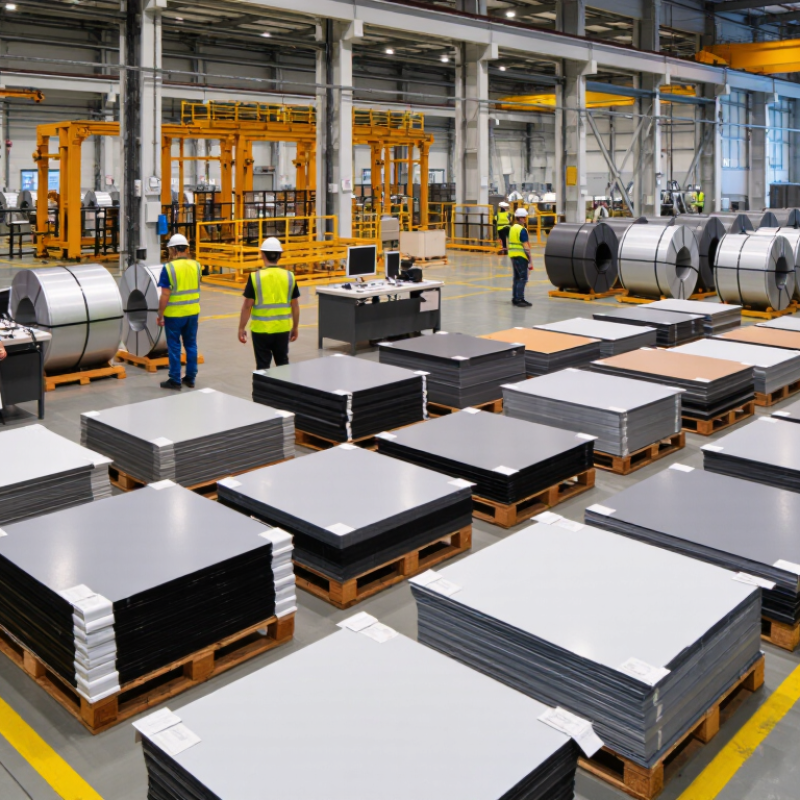
When comparing China’s top ten metal cladding sheet manufacturers, understand the product first.
Metal cladding sheets are protective outer panels fixed over a building envelope. They commonly use aluminum, galvanized steel, zinc, or copper. Some systems include insulated or mineral-based cores. The visible surface may be smooth, ribbed, perforated, or textured.
These sheets are used on office facades, warehouses, factories, airports, roofs, and residential buildings. They control rain, wind, sunlight, and surface wear. A ventilated rainscreen can also help release trapped moisture behind the facade.
This matters because the International Energy Agency reports that buildings consume about 30% of global final energy and create around 26% of energy-related emissions.
Better cladding can support insulation performance, but it cannot repair poor joints or weak installation.
In practice, specifications should cover thickness, coating durability, corrosion resistance, fire behavior, thermal movement, and fixing details. A common mistake is judging panels by color alone. Appearance can hide poor drainage. The choice is not always obvious.
Tips: Request test reports, coating information, and installation drawings before comparing suppliers. Check sample edges, corners, and fasteners, not only the flat panel. The cheapest sheet may create higher maintenance costs later.
Report references: IEA Buildings 2023 and UNEP Global Status Report for Buildings and Construction 2023.

China Top 10 Metal Cladding Sheets Manufacturers
Selecting China’s top 10 metal cladding sheet manufacturers requires more than checking production volume. A reliable review examines factory experience, engineering capacity, and material consistency. We verify whether manufacturers can provide traceable aluminum, steel, coatings, and core materials. Sample panels also matter. Their edges, color uniformity, flatness, and surface finish often reveal problems hidden in brochures.
Quality control receives close attention. Strong manufacturers usually maintain documented inspection procedures, coating thickness records, fire-performance reports, and dimensional checks. We also assess project experience across commercial, industrial, and transportation buildings. Export capability is another practical factor. Clear technical drawings, protective packaging, responsive communication, and realistic delivery schedules show operational maturity. However, no ranking is perfect. Factory conditions may change, and public information can remain incomplete.
Tips: Request recent test reports, not old certificates. Compare sample sheets under natural light. Ask how damaged panels are replaced. Check warranty language carefully. A useful evaluation should combine factory visits, independent verification, customer feedback, and direct technical questions. Price can guide a shortlist, but it should never decide quality alone. Mistakes still happen, even with experienced suppliers. That is why transparent evidence matters more than impressive claims.
China’s leading metal cladding sheet manufacturers differ by material focus, production scale, and project experience. The first profile represents large steel mills integrating coating, roll forming, and quality testing. The second focuses on aluminum panels for airports, stations, and commercial façades. A third specializes in insulated sandwich panels, serving warehouses and cold-chain buildings. Another concentrates on fire-resistant mineral-core systems.
Details matter here.
The remaining profiles cover corrosion-resistant roofing sheets, curved façade systems, perforated panels, cleanroom enclosures, export-oriented fabricators, and custom engineering suppliers. Their capabilities often include CNC cutting, automated coating lines, salt-spray testing, and sample approval before mass production.
World Steel Association data records China’s 2024 crude steel output at about 1,005 million tonnes, supporting a deep raw-material base.
However, steel availability does not guarantee reliable cladding performance.
The United Nations Environment Programme reported that buildings consumed roughly 32% of global energy in 2023. This increases demand for durable envelopes and better insulation.
Selection should therefore examine thermal conductivity, coating thickness, panel tolerances, fire-test evidence, and traceability records. Published capacity can mislead. Some factories outsource core materials or lack stable batch control.
A practical review should compare factory audits, third-party test reports, warranty terms, and completed projects.
The top ten list is useful, but not absolute. Regional climate exposure may change the ranking.
Comparing China’s top metal cladding sheet manufacturers requires more than checking production volume or export figures. Quality begins with the substrate, coating system, thickness tolerance, and edge protection. Reliable manufacturers provide mill certificates, coating test results, and clear standards for corrosion and color performance. Factory experience also matters. A supplier familiar with coastal buildings may recommend stronger protective layers than one serving dry inland projects.
Samples are useful, but they can mislead. The delivered batch may differ slightly in gloss, texture, or flatness. Ask for batch records and inspect finished panels before shipment. Independent testing adds confidence, especially for fire resistance, wind loads, and thermal movement. Some manufacturers communicate technical details well, while others rely on attractive catalogs. That difference becomes obvious during installation.
Service separates many capable producers. Strong suppliers respond with drawings, cutting plans, packing photos, and realistic production schedules. They also explain minimum order quantities and replacement procedures before receiving payment. Packaging deserves attention; damaged corners often create costs after arrival. Site support through video calls can help installers solve alignment problems quickly. Still, no supplier is perfect. Delayed replies, unclear revisions, or incomplete inspection reports should trigger careful questions. A practical comparison should include factory audits, reference projects, sample approval, and after-sales response time—not price alone.
When comparing China’s top 10 metal cladding sheet manufacturers, buyers should look beyond rankings. A “top-ten” label means little without clear evaluation criteria. Check production capacity, export experience, quality systems, and completed projects in similar climates. The World Steel Association reported 1.89 billion tonnes of crude steel production worldwide in 2023. This scale makes material traceability essential, not optional. Request heat numbers, mill certificates, coating specifications, and batch inspection records.
Environmental performance also deserves careful attention. The 2024 Global Status Report for Buildings and Construction found that buildings and construction consumed 32% of global energy and produced 34% of global carbon dioxide emissions in 2022. Ask whether the manufacturer can provide recycled-content data, environmental product declarations, and realistic service-life evidence. Thin sheets may reduce initial costs. They may also increase replacement risks in coastal or industrial areas. Corrosion resistance should be verified through recognized testing, not attractive catalog language.
Technical fit matters more than polished communication. Confirm yield strength, coating mass, paint adhesion, fire performance, thermal movement, and wind-load calculations. Require samples before signing a large contract. Inspect edge quality, flatness, protective film, and color consistency under daylight. ISO 9001 certification is useful, but it does not prove every shipment is reliable. No checklist is flawless. I would still verify independent test reports, factory inspection access, packaging details, and after-sales response times before choosing a manufacturer.
Buyer-focused industry benchmark; no company or brand names are included. Specifications must be confirmed against the supplier’s technical documents and project requirements.
| No. | Evaluation Dimension | Relevant Industry Benchmark | What Buyers Should Verify | Recommended Evidence |
|---|---|---|---|---|
| 1 | Substrate Material | Common options include galvanized steel, galvalume-coated steel, aluminum, and stainless steel. Galvanized and galvalume products require different corrosion-performance assessments. | Confirm the base-metal grade, coating type, nominal thickness, dimensional tolerances, and suitability for the project environment. | Mill test certificate, applicable material standard, thickness report, and independent verification when required. |
| 2 | Sheet Thickness and Profile | Metal cladding sheets are commonly specified by nominal thickness and profile geometry. Actual performance depends on span, rib height, support spacing, and wind loading. | Check whether quoted thickness is base-metal thickness or total coated thickness, and confirm effective cover width and panel depth. | Product drawings, tolerance data, load-span tables, and a project-specific structural calculation. |
| 3 | Metallic Coating Mass | Typical galvanized coating designations include Z275, while common aluminum-zinc coating designations include AZ150. The number generally refers to total coating mass on both sides in g/m². | Confirm the coating designation, test method, minimum local value, and whether the quoted figure applies to both sides. | Coating-mass test report, production specification, and compliance statement against the requested standard. |
| 4 | Paint System and Film Thickness | Common exterior systems include polyester, silicone-modified polyester, and PVDF. Typical nominal topcoat thicknesses vary by system and supplier; PVDF systems are often specified at approximately 25 μm. | Review resin type, primer and back-coat construction, total dry-film thickness, color-retention requirements, and warranty exclusions. | Coating technical data sheet, dry-film measurement records, accelerated-weathering results, and written warranty terms. |
| 5 | Corrosion Resistance | Performance depends on atmospheric exposure, salt concentration, humidity, cut edges, fasteners, drainage, and contact with incompatible metals. Coastal and industrial sites generally require more stringent protection. | Assess the site exposure category and verify that the substrate, coating, accessories, and installation details are compatible. | Corrosion-test data, exposure classification, edge-treatment details, and installation recommendations. |
| 6 | Fire Performance | Fire classification is affected by the complete wall or roof assembly, including insulation, membranes, cavities, joints, and fixings. A metal sheet alone does not establish the fire rating of the finished system. | Confirm the required national or project-specific classification and ensure the tested assembly matches the proposed construction. | Fire-test or classification report under the required standard, with assembly details and field-of-application limits. |
| 7 | Dimensional Accuracy | Width, length, squareness, flatness, camber, and profile tolerances influence installation speed, joint alignment, and water-tightness. | Determine inspection frequency and acceptance tolerances, particularly for long panels, concealed-fix systems, and visible façades. | Inspection and test plan, sample measurements, approved shop drawings, and pre-shipment inspection records. |
| 8 | Manufacturing and Quality Control | Reliable production control should cover incoming steel, roll forming, coating appearance, profile dimensions, cutting, labeling, and packaging. | Check whether quality inspections are documented for every batch and whether nonconforming products are traceable. | Quality manual, batch traceability procedure, inspection records, calibration certificates, and factory audit results. |
| 9 | Packaging and Export Logistics | Long and thin panels can be damaged by poor stacking, moisture retention, abrasion, forklift handling, and inadequate container loading. | Confirm seaworthy packaging, maximum bundle weight, loading method, moisture protection, labeling, and replacement procedures for transit damage. | Packing specification, loading photographs, shipping marks, commercial documents, and agreed damage-claim process. |
| 10 | Technical Support and Total Cost | The lowest unit price may not provide the lowest installed cost. Engineering support, accessories, waste, lead time, maintenance, and warranty conditions affect total project value. | Compare equivalent specifications, tooling charges, minimum order quantity, production lead time, spare quantities, and after-sales response. | Itemized quotation, technical submittal, installation guidance, sample approval, lead-time commitment, and written after-sales terms. |
Note: Standards, coating designations, fire classifications, warranties, and test requirements should be matched to the destination market and the specific roof or façade assembly.


For those larger-sized parts, or smaller quantity runs, we have 2 independent powder coat booths and ovens. The quality, durability and affordability of today’s powder coating finishes make this the process of choice for world-class companies.
Powder coating advantages over other forms of coating are many. Materials used in the Powder coating process can be metals and non-metals that come in a multitude of thicknesses, textures, colors, etc. Another of Powder coating’s biggest advantages over conventional coatings is its ability to create finishes in many different textures. Powder Coating Booths allow us the ability to apply these advantages to large products.
Tri-State Fabricators runs a full-service conveyor line for painting. Wet painting can provide protection or decoration to many different part styles. From start to finish, every project is easier to undergo random and point-based inspection by our skilled painting team.
Advantages to our Wet Paint Line are these lines start with product prep and ends with a thorough inspection of a high quality finished product. Our ability to complete large and small projects with a superior finish and doing so in a timely and economical fashion. This passes along the savings in production to our customers. When powder coating ins not an option, our Wet Paint Line gets the job done right the first time.
When the parts get big and heavy we roll-out our custom paint racks and oversize booth. By utilizing our partnerships with all the major paint brands, we can match virtually any color with wet paint.
The advantages of having access to a Wet Paint Booth are many. Large projects of many different shapes can be loaded into the booth. The Wet Paint Booth offers an environment that is much more controlled than a typical parts painting operation.
Not only are they used because of their controlled environment, but they’re are also advantageous when it comes to applying paint to parts that are needed in industries that require specialty coatings such as medical, aerospace, etc.
Our military forces have some very high standards when it comes to the finish of their vehicles and equipment. From the first pre-treatment step to final coat, it takes a great deal of knowledge and experience to protect the men and women of our armed forces. They deserve only the best, and Tri-State Fabricators provides it.
All of our processes are closely monitored by our staff and management teams. Both of which are highly trained in the processes of metal fabrication and finishing. Tri-State Fabricators’ goal is to always fully satisfy each and every customer, including the military. We will always put a 110% into what we do.
Abrasive media blasting is an excellent way to remove old paint, rust, and increase the paint/powder adhesion. Glass beads produce a much smoother and brighter finish than angular abrasives; leaving the part clean yet without any dimensional change. Chemically inert and environmentally friendly, we can recycle our beads approximately 30 times; making them a more preferred method of metal cleaning or surface finishing.
Advantages to Glass Bead Blasting are many. Glass bead blast media is used when a project is needing rough surfaces need to become smooth for applications of coatings such as paint. It is typically used to clean paint and rust from a product surface without deforming the surface it is being used on. Overall, compared to many other blasting media, Glass Bead Blasting is a very economical choice and those savings are always passed on to our customers.
Tri-State Fabricators utilize a zinc phosphate wash to clean and etch the material to ensure the best paint adhesion possible. The unique design of our 3-stage wash system does the work like a 5-stage. From Cleaning and rinsing to conversion coating and post-treatment, Our Part Washing process is a complete service and works throughout the fabrication service and the finishing service.
Along with the previously mentioned benefits, Curing is a vital chemical reaction that leaves the product finish hard and relatively safe from mild abrasion and aggressive corrosion. This process can be done in more than one way; ambient air-dry or in curing ovens at temps that exceed 240°.
From fixing paint mistakes (someone else’s of course) to simply cleaning our paint line hooks, our burn-off oven is put to good use. After a quick burn-off, a little clean up, and a fresh coat of paint, your parts will look better than new.
Why does our Burn-Off Oven work so well? Because super heating the air around parts turns the materials into ashes. From paint and powder coatings to rubber and machining oils, high temps do the job without degrading the integrity of the part.
Masking is a vital part of producing high quality products. We have die-cut masking patterns to protect machined surfaces as well as a wide range of plugs and caps to protect threaded holes and bolts. We provide permanent and temporary masking.
Masking allows the selected sections of a product to be protected from a fabrication or finishing service. This can be with both chemicals when etching and tapes, paints when only finishing just a section of the product. Masking is great in aiding the customization process of a project.
Screen printing is a photographic process that transfers artwork onto a porous nylon screen which allows colored ink to flow through the screen and be deposited on an aluminum or plastic component. We can generally have just about any design created onto a screen for your parts.
Some of the advantages of Screen Printing are, brand recognition for your business displaying on your products, assembly instructions, product warnings/hazards, etc. Tri-State Fabricators produces Screen Printing of the highest quality so you know it’s durable.
Metal Finishing is the art of treating the exterior portion of product, often metal but can also be made of other materials, so that the surface is clean and free of any debris. Then the process of applying coats or either paint of powder coat takes place. This coating process improves the quality of the product in both appearance and resistance to wear and corrosion.
Tri-State Fabricators, Inc., understands that a project typically isn’t complete until a high-quality finish has been added to your product. This is why our painting and powder coating teams continuously inspect the products throughout the Metal Finishing process.

