China Top 10 Mechanical Components Manufacturers
Mechanical Components are the working parts behind machines people rely on every day. Bearings guide rotating shafts, gears transfer torque, and couplings connect moving assemblies. Their performance depends on precise dimensions, suitable materials, and consistent production—not just an attractive catalogue.
China’s manufacturers serve a broad range of industries, from agricultural equipment to factory automation. This guide introduces ten companies producing components such as bearings, fasteners, gears, castings, and transmission parts. The comparison considers product range, manufacturing capability, quality controls, customization, and export support. A specification sheet can tell you a tolerance; it cannot always show how reliably a supplier holds it across repeated orders.
Taiichi Ohno, a leading manufacturing engineer, is widely credited with this principle: “Where there is no standard, there can be no improvement.” That idea matters when comparing Mechanical Components suppliers. A smooth bearing raceway or a gear tooth with consistent geometry reflects disciplined process control. Look beyond price and stated capacity. Ask about inspection methods, material traceability, sample testing, and lead times. Details matter.
No list can fit every buyer. Some companies may suit high-volume orders, while others offer greater flexibility for custom designs. Supplier information and capabilities can change, so verify current specifications directly. This overview is a practical starting point, not a substitute for technical review. A careful shortlist still requires questions—and sometimes a second look.
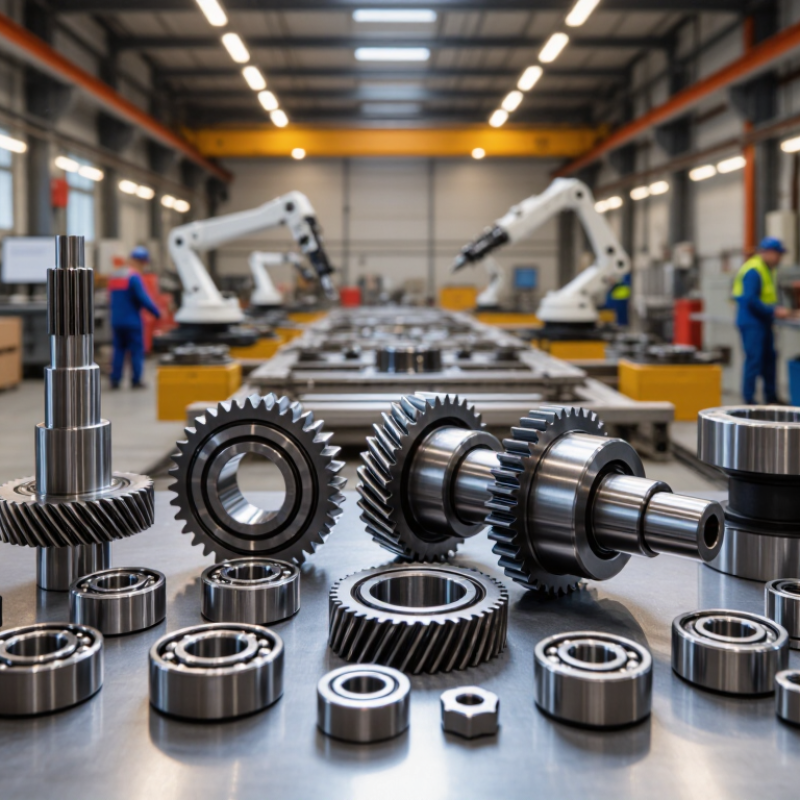
Mechanical Components: Definition, Scope, and Industrial Role
Mechanical components are the physical parts that support, guide, connect, or transmit motion and force in equipment. The scope ranges from bolts, bearings, shafts, and gears to couplings, springs, seals, and hydraulic elements. Some are standard parts; others are machined for a specific load, speed, or operating environment. The boundary is not always neat. A bearing housing, for example, may be treated as a component or as part of a larger assembly.
Their industrial role is practical and measurable: they help machines move accurately, carry loads, and withstand wear. A gear tooth transfers torque; a seal keeps lubricant inside a gearbox; a shaft must remain aligned under rotation. Small parts matter. A poor fit can cause vibration, heat, noise, or unplanned maintenance. Material choice, surface finish, dimensional tolerance, and inspection therefore affect both performance and service life.
The scale of modern production underscores this role. The World Bank’s World Development Indicators place manufacturing at roughly 16% of global GDP in 2022. The International Federation of Robotics reported 541,302 industrial robot installations worldwide in 2023, with an operating stock of about 4.28 million. Robots depend on mechanical interfaces, joints, transmissions, and supports to repeat precise movements. Yet component quality alone cannot guarantee reliability; installation, lubrication, and operating conditions matter too. That part is easy to underestimate.
China’s Mechanical Components Manufacturing Landscape
China’s mechanical components manufacturing landscape is broad, regional, and closely tied to industrial supply chains. Workshops and larger plants produce fasteners, castings, machined shafts, gears, and precision parts for machinery, vehicles, and automation equipment. Coastal manufacturing areas often benefit from dense supplier networks and established logistics. Other regions may offer different cost structures or specialized capabilities. The picture varies by process and product. Details matter.
Production strength is only part of the story. A capable supplier should explain material grades, machining tolerances, surface treatments, and inspection methods in clear terms. For a turned shaft, for example, buyers can review dimensional reports and check how the supplier controls runout between batches. Sample approval helps, but it cannot replace ongoing quality checks. Communication also deserves attention: unclear drawings or rushed specification changes can create avoidable defects. A factory visit may reveal clean equipment and orderly workstations, yet those signs alone do not prove consistent output. I would be cautious about treating any single metric as decisive; supplier records and repeat inspections can tell a less polished, more useful story.
Criteria for Selecting Leading Chinese Manufacturers
Selecting a Chinese mechanical components manufacturer starts with a clear drawing and realistic performance requirements. Specify material grade, critical dimensions, surface finish, and operating conditions before comparing quotations. A shaft that looks correct may still fail if its tolerance or heat treatment is wrong. Details matter.
Ask how the factory controls production, not only whether it holds quality certificates. Request inspection records, material traceability, and examples of measurement reports for similar parts. For tight tolerances, check whether the manufacturer uses calibrated gauges and suitable equipment, such as coordinate measuring machines. A sample run can reveal burrs, inconsistent finishes, or fit problems that a sales discussion may miss. Confirm production capacity, lead times, packaging, and how defects are handled. Clear answers are useful.
A site visit or independent audit can help verify the stated process, but neither guarantees every shipment will be flawless. No checklist is perfect. A small pilot order may expose issues, yet it may not represent a full production run. Compare several suppliers using the same specifications, and keep communication records when drawings or requirements change. Pay attention to how promptly technical questions receive precise answers; that often matters as much as the quoted price.
Criteria for Selecting Leading Chinese Mechanical Components Manufacturers
Suggested buyer-side evaluation weights for comparing manufacturers. These are a decision framework—not survey results or scores for specific companies—and should be adjusted to fit the component and application.
Quality and process control receive the greatest suggested weight, followed by manufacturing capability. Verify each criterion with relevant documentation, sample parts, audits, and quotations.
Profiles of Ten Notable Chinese Mechanical Components Manufacturers
These ten profiles focus on capabilities rather than company names or rankings. Bearing makers supply components for motors and conveyors, where heat and vibration expose quality gaps. Gear manufacturers serve reducers and transmission systems, often tailoring tooth geometry to load requirements. Fastener producers make bolts and studs for equipment assembly. Hydraulic-cylinder specialists build units for lifting and material handling. Pump and valve makers support fluid-control systems. China’s National Bureau of Statistics reported manufacturing value added of 33.6 trillion yuan in 2023, up 5.0% year on year. That broad scale is useful context, but it does not measure component quality.
The remaining profiles cover linear-motion components, precision shafts, industrial seals, metal castings, and drive-system parts. Linear guides need smooth travel; shafts need consistent runout; seals must resist wear and leakage. Casting makers balance material choice with dimensional accuracy. Drive-component suppliers must match torque and operating speed to the application. These distinctions matter more than a factory’s size alone. A polished catalogue is not proof of stable production. I would still want to inspect process controls and sample test records.
Tips: Compare tolerances, material certificates, lead times, and inspection methods across suppliers. Ask how a maker handles defects and changes in production. Small details count. A brief factory profile can miss uneven performance between product batches, so verify claims against recent test data and customer-specific requirements.
Products, Capabilities, and Applications Across the Top Ten
Across China’s leading ten mechanical-component manufacturers, product ranges often include castings, forgings, gears, shafts, bearings, fasteners, hydraulic parts, and precision-machined assemblies. Capabilities vary: one factory may excel at high-volume stamping, while another handles tight-tolerance CNC machining. Buyers should compare material traceability, dimensional inspection, heat-treatment control, and batch consistency—not just catalogue breadth. A polished sample is not proof of stable production.
Applications span construction equipment, agricultural machinery, industrial automation, and vehicle systems. The International Federation of Robotics reported about 541,000 industrial robots installed worldwide in 2023, a useful indicator of automation demand and the need for dependable motion components. Yet robot growth does not guarantee demand for every component type. A gear supplier’s fit depends on torque, duty cycle, lubrication, and operating temperature. Small mismatches matter.
Tips: Send a drawing with tolerances, material grade, finish, and annual volume. Ask for inspection records and a pilot batch. Check how the supplier handles nonconforming parts. Fit matters. A low unit price can become costly when rework or downtime follows.





