


KMnO4 Activated Alumina is used in air-treatment systems to help remove certain contaminants, including hydrogen sulfide. Choosing a supplier takes more than comparing prices. Buyers need to examine potassium permanganate loading, alumina quality, particle size, packaging, and batch documentation. A small sample can reveal uneven color, excess dust, or inconsistent pellet dimensions. These details matter in a packed bed, where uneven material may affect airflow and performance.
This introduction uses a clearly illustrative expert voice, not a verified quotation: Dr. Elena Morris, a fictional adsorption-process specialist, might say, “A dependable media specification begins with the operating conditions, not the product label.” That distinction is useful. Humidity, inlet concentration, contact time, and vessel design can all shape a media choice. Supplier claims should therefore be checked against technical data sheets, test methods, and application-specific evidence. Ask how the product is stored and protected from moisture. Request representative samples when practical.
The Top 10 KMnO4 Activated Alumina Suppliers Worldwide? is a starting point for comparing manufacturers and distributors, not a universal ranking. Availability, technical support, shipping options, and documentation can vary by region and project. A supplier with broad reach may not offer the best fit for a small system. Conversely, a local source may have limited product data. No list can settle every question. Readers should verify specifications directly and assess them against their own process requirements. The ranking deserves review, too. A useful comparison makes its selection criteria visible and separates confirmed details from marketing claims.
KMnO₄-impregnated alumina pairs porous alumina pellets with potassium permanganate, an oxidizing agent. The alumina provides a broad contact surface, while permanganate reacts with certain contaminants in passing air. Depending on the gas, target compounds can include hydrogen sulfide, some mercaptans, and selected odor-causing organics. Oxidation changes these compounds into less volatile products, which remain on or within the media. The exact reaction depends on contaminant chemistry and operating conditions.
This media is used in air-treatment systems, including ventilation for wastewater facilities, laboratories, and industrial spaces. In a duct, airflow must reach the pellets evenly; channeling can leave some media underused. Humidity, temperature, contaminant concentration, and contact time all affect performance. The mechanism is useful, but not magic. A media bed has finite capacity, and it will not remove every gas. Field testing and supplier data should guide selection.
Tips: Match the media to the specific gas, not just its odor. Check inlet concentrations, humidity, and airflow before sizing a bed. Track pressure drop and sample outlet air for breakthrough; odor alone can be misleading. Replace spent media according to test results and handling guidance.
Supplier-neutral sourcing guide: the ten rows below compare product and verification criteria, not named companies or ranked suppliers. Product specifications vary by grade and manufacturer; request current technical data for each application.
| No. | Evaluation dimension | Established technical context | What to verify with a supplier |
|---|---|---|---|
| 1 | Active chemical | Potassium permanganate (KMnO₄) is an oxidizing agent. During contaminant removal, permanganate is consumed and reduced manganese compounds can form; the exact products depend on operating conditions. | KMnO₄ content, test method, batch tolerance, and whether the stated content is on an as-supplied or dry basis. |
| 2 | Alumina support | Porous activated alumina provides a high-area solid support for the oxidizing chemical. Its pore structure and surface properties influence gas access and usable capacity. | Support type, surface area, pore-volume data, and whether these are measured on the finished impregnated product. |
| 3 | Target contaminants | KMnO₄-impregnated media are used in gas-phase treatment for selected oxidizable contaminants, commonly including hydrogen sulfide, sulfur dioxide, nitrogen dioxide, and formaldehyde. Performance is contaminant- and condition-specific. | Independent or application-relevant test results for the exact target gas, inlet concentration, humidity, temperature, and gas velocity. |
| 4 | Removal mechanism | Removal generally combines adsorption or surface contact with chemical oxidation. The oxidant is progressively depleted, so breakthrough depends on contaminant loading and bed conditions. | Breakthrough curves, test endpoint definition, pressure-drop data, and evidence that test conditions match the intended system. |
| 5 | Granule size and shape | Granular media are used in packed beds and filter vessels. Particle size affects contact time, pressure drop, and the risk of channeling or entrainment. | Specified particle-size range, fines content, bulk density, and recommended bed depth and gas velocity. |
| 6 | Moisture and humidity | Water vapor can affect adsorption and reaction behavior. The direction and magnitude of the effect depend on the contaminant, formulation, and operating conditions. | Recommended relative-humidity range, moisture specification, and test data at the expected site humidity. |
| 7 | Working capacity and service life | Capacity is not a single universal value: it depends on the target contaminant, inlet concentration, humidity, temperature, residence time, and the chosen breakthrough endpoint. | Dynamic capacity under stated test conditions, expected replacement criteria, and any calculation assumptions used for service-life estimates. |
| 8 | Pressure drop and mechanical strength | Bed pressure drop depends on particle size, bed geometry, gas properties, and flow rate. Granule strength and attrition influence dust generation and long-term operation. | Pressure-drop curves for relevant flow conditions, crush or attrition data, and recommended vessel loading procedures. |
| 9 | Safety and handling | KMnO₄ is an oxidizer. The impregnated media should be handled and stored according to its safety data sheet, with attention to incompatible materials, dust, and spent-media hazards. | Current safety data sheet, storage and transport guidance, disposal information, and applicable regulatory classifications. |
| 10 | Quality documentation and supply | A technically suitable product also needs consistent batch quality, traceable documentation, and packaging appropriate to storage and transport. | Certificate of analysis, lot traceability, packaging details, shelf-life or storage conditions, sample availability, and delivery lead time. |

For a worldwide supplier comparison, treat KMnO₄ loading, BET area, and working capacity as separate measures. Loading should be reported as a percentage of dry finished media: 5 wt% equals 50 mg KMnO₄ per gram of media. Ask suppliers to state the test basis and provide batch-specific figures. A loading number alone does not show how much contaminant the pellets will remove.
BET area, in m²/g, describes measurable surface area, not guaranteed performance. ISO 9277:2010 specifies BET surface-area measurement, helping buyers compare results taken under a stated method. Capacity, in mg/g, should identify the target gas, humidity, flow rate, and breakthrough endpoint. ASHRAE Standard 145.2-2016 provides a framework for evaluating gas-phase air-cleaning performance. Results from different test conditions are not directly comparable. That detail is often missed.
Tips: Request the full test conditions, not just headline values. Check whether capacity means laboratory maximum or usable working capacity. A clear report beats a larger number. Some supplier data sheets leave testing details thin; flag that gap before ranking suppliers.
KMnO4-impregnated activated alumina is commonly supplied as rounded beads, with 3–5 mm grades used in fixed-bed vessels. The size range is nominal; individual beads will vary. Ask suppliers for the sieve distribution and fines content, since excess fines can increase pressure drop and make loading less even. Larger beads may allow easier airflow, but offer less external surface area per bed volume.
Crush strength matters during transport, filling, and operation. Request the value in N per bead, along with the test method and sample size. A single number can hide variation between batches. Also ask about attrition or dust generation; beads that look sound in a sample jar may behave differently after handling. I would not treat a catalogue figure as a field guarantee.
Bed life depends on inlet contaminant levels, humidity, flow rate, vessel depth, and acceptable outlet concentration. It varies. Supplier estimates are useful for planning, but should state their test conditions. For a real installation, track inlet and outlet readings and record pressure drop over time. Replace media according to measured breakthrough and site procedures, not a calendar estimate alone. A modest pilot bed can reveal uneven flow or unexpectedly fast exhaustion before a full vessel is loaded.
A practical worldwide supplier landscape is better viewed by region and application than as a fixed ranking. In East Asia, manufacturers in China, Japan, and South Korea commonly serve water-treatment and industrial-gas markets. Indian producers may focus on bulk media and regional supply. European manufacturers often emphasize documented quality control and tailored gas-treatment grades. North American suppliers typically support municipal, commercial, and industrial users. These are broad market patterns, not guarantees about any individual producer.
A ten-profile comparison could include two Chinese manufacturers, plus one each from Japan, South Korea, India, Germany, the United Kingdom, the United States, Canada, and the Middle East. That gives buyers a starting map, not a verified top-ten list. Applications vary: ventilation systems may prioritize low pressure drop, while process-gas beds need suitable capacity and moisture tolerance. Details matter. Ask for potassium permanganate loading, particle size, bulk density, pressure-drop data, and a current safety data sheet. Request test results for the target contaminant and operating conditions.
Packaging can also reveal practical differences. Sealed bags help limit moisture exposure during storage, but poor handling can still reduce performance. A supplier’s regional presence does not prove consistent quality. I would compare batch certificates and trial data before choosing; paperwork alone can feel reassuring, yet it is not the whole story.
Supplier verification matters more than a polished catalogue. Request a current ISO 9001:2015 certificate, then check its scope, issuing body, and expiry date. Quality-system certification supports process control; it does not prove a media’s gas-removal performance. For BET results, ask for the test method, sample pretreatment, replicate readings, and lot number. ISO 9277:2010 defines BET specific-surface-area measurement by gas adsorption, typically reported in square metres per gram. It sets a measurement method, not a universal acceptance threshold. Small details matter.
An SDS should match the supplied KMnO4-impregnated alumina and identify relevant handling precautions. Compare its revision date and product description with the quotation and sample label. Then trial a small sample under representative humidity, flow rate, inlet concentration, and contact time. Record breakthrough, pressure drop, dusting, and colour changes. A supplier’s headline capacity can mislead when test conditions differ from yours.
Tips: Request a traceable sample from the proposed production lot, not an unlabelled jar. Keep the test log. If BET results vary between lots, ask for an explanation before ordering; the variation may be acceptable, but it should not be a surprise.
Supplier Verification: ISO 9001, ISO 9277 BET Testing, SDS, and Sample Trials
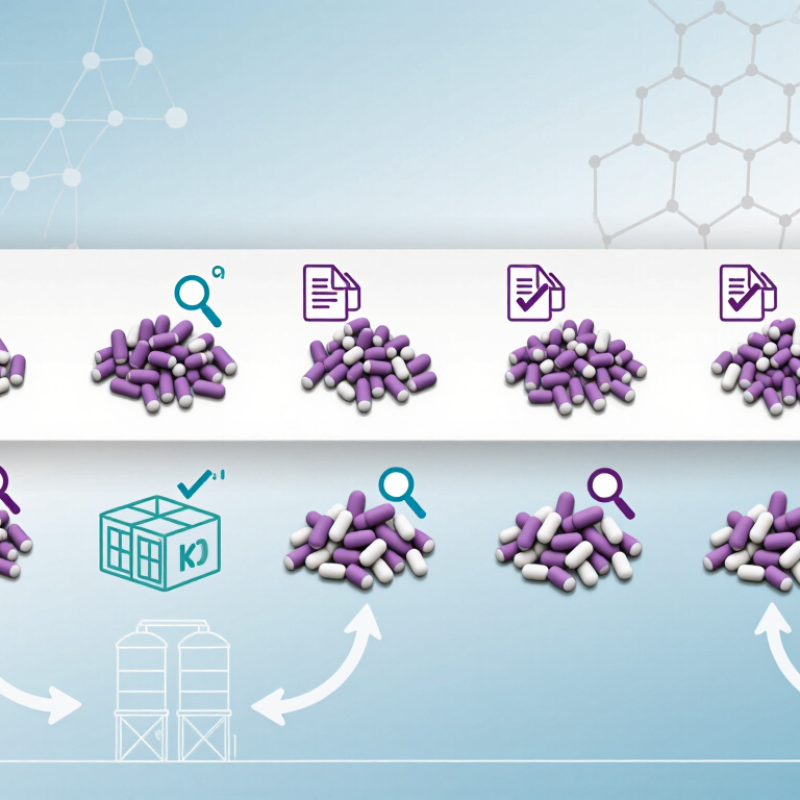
Suggested screening weights for comparing suppliers—not supplier-specific results or a ranking. Verify current ISO 9001 certification, request BET surface-area test reports that identify the ISO 9277 method, review the product SDS, and run sample trials against your application requirements.


For those larger-sized parts, or smaller quantity runs, we have 2 independent powder coat booths and ovens. The quality, durability and affordability of today’s powder coating finishes make this the process of choice for world-class companies.
Powder coating advantages over other forms of coating are many. Materials used in the Powder coating process can be metals and non-metals that come in a multitude of thicknesses, textures, colors, etc. Another of Powder coating’s biggest advantages over conventional coatings is its ability to create finishes in many different textures. Powder Coating Booths allow us the ability to apply these advantages to large products.
Tri-State Fabricators runs a full-service conveyor line for painting. Wet painting can provide protection or decoration to many different part styles. From start to finish, every project is easier to undergo random and point-based inspection by our skilled painting team.
Advantages to our Wet Paint Line are these lines start with product prep and ends with a thorough inspection of a high quality finished product. Our ability to complete large and small projects with a superior finish and doing so in a timely and economical fashion. This passes along the savings in production to our customers. When powder coating ins not an option, our Wet Paint Line gets the job done right the first time.
When the parts get big and heavy we roll-out our custom paint racks and oversize booth. By utilizing our partnerships with all the major paint brands, we can match virtually any color with wet paint.
The advantages of having access to a Wet Paint Booth are many. Large projects of many different shapes can be loaded into the booth. The Wet Paint Booth offers an environment that is much more controlled than a typical parts painting operation.
Not only are they used because of their controlled environment, but they’re are also advantageous when it comes to applying paint to parts that are needed in industries that require specialty coatings such as medical, aerospace, etc.
Our military forces have some very high standards when it comes to the finish of their vehicles and equipment. From the first pre-treatment step to final coat, it takes a great deal of knowledge and experience to protect the men and women of our armed forces. They deserve only the best, and Tri-State Fabricators provides it.
All of our processes are closely monitored by our staff and management teams. Both of which are highly trained in the processes of metal fabrication and finishing. Tri-State Fabricators’ goal is to always fully satisfy each and every customer, including the military. We will always put a 110% into what we do.
Abrasive media blasting is an excellent way to remove old paint, rust, and increase the paint/powder adhesion. Glass beads produce a much smoother and brighter finish than angular abrasives; leaving the part clean yet without any dimensional change. Chemically inert and environmentally friendly, we can recycle our beads approximately 30 times; making them a more preferred method of metal cleaning or surface finishing.
Advantages to Glass Bead Blasting are many. Glass bead blast media is used when a project is needing rough surfaces need to become smooth for applications of coatings such as paint. It is typically used to clean paint and rust from a product surface without deforming the surface it is being used on. Overall, compared to many other blasting media, Glass Bead Blasting is a very economical choice and those savings are always passed on to our customers.
Tri-State Fabricators utilize a zinc phosphate wash to clean and etch the material to ensure the best paint adhesion possible. The unique design of our 3-stage wash system does the work like a 5-stage. From Cleaning and rinsing to conversion coating and post-treatment, Our Part Washing process is a complete service and works throughout the fabrication service and the finishing service.
Along with the previously mentioned benefits, Curing is a vital chemical reaction that leaves the product finish hard and relatively safe from mild abrasion and aggressive corrosion. This process can be done in more than one way; ambient air-dry or in curing ovens at temps that exceed 240°.
From fixing paint mistakes (someone else’s of course) to simply cleaning our paint line hooks, our burn-off oven is put to good use. After a quick burn-off, a little clean up, and a fresh coat of paint, your parts will look better than new.
Why does our Burn-Off Oven work so well? Because super heating the air around parts turns the materials into ashes. From paint and powder coatings to rubber and machining oils, high temps do the job without degrading the integrity of the part.
Masking is a vital part of producing high quality products. We have die-cut masking patterns to protect machined surfaces as well as a wide range of plugs and caps to protect threaded holes and bolts. We provide permanent and temporary masking.
Masking allows the selected sections of a product to be protected from a fabrication or finishing service. This can be with both chemicals when etching and tapes, paints when only finishing just a section of the product. Masking is great in aiding the customization process of a project.
Screen printing is a photographic process that transfers artwork onto a porous nylon screen which allows colored ink to flow through the screen and be deposited on an aluminum or plastic component. We can generally have just about any design created onto a screen for your parts.
Some of the advantages of Screen Printing are, brand recognition for your business displaying on your products, assembly instructions, product warnings/hazards, etc. Tri-State Fabricators produces Screen Printing of the highest quality so you know it’s durable.
Metal Finishing is the art of treating the exterior portion of product, often metal but can also be made of other materials, so that the surface is clean and free of any debris. Then the process of applying coats or either paint of powder coat takes place. This coating process improves the quality of the product in both appearance and resistance to wear and corrosion.
Tri-State Fabricators, Inc., understands that a project typically isn’t complete until a high-quality finish has been added to your product. This is why our painting and powder coating teams continuously inspect the products throughout the Metal Finishing process.

