China Top 10 Holographic Foil Machine Manufacturers?
China’s holographic foil equipment market includes manufacturers serving packaging, labels, textiles, and decorative printing. This guide introduces ten notable Chinese suppliers for buyers researching a reliable Holographic Foil Machine. It focuses on practical manufacturing capabilities, not attractive advertisements alone.
The evaluation considers machine structure, foil compatibility, working width, production speed, registration accuracy, heating control, and maintenance access. Factory experience matters. A well-designed machine should keep foil tension stable while transferring patterns onto paper, plastic film, or coated materials. Operators also need clear controls, replaceable components, and responsive technical support. Details matter.
Supplier credibility requires more than a polished website. Buyers should review factory records, equipment demonstrations, export experience, certifications, and customer references. A live test can reveal issues that brochures often hide, including uneven pressure, difficult setup, or inconsistent holographic results. Claims need testing. Specifications should be matched with actual production samples and expected order volumes.
This overview is intended as a practical starting point, rather than a permanent ranking. Manufacturer strengths can change with new models, service policies, and market conditions. Some companies may excel in custom engineering, while others offer simpler machines with easier operation. That difference is important. Readers should compare technical documents, installation support, warranty terms, spare-part availability, and total operating costs before making a decision. The final choice should reflect product material, factory space, operator skills, and long-term production plans. Mistakes happen when buyers compare price alone. This guide encourages a more careful assessment.
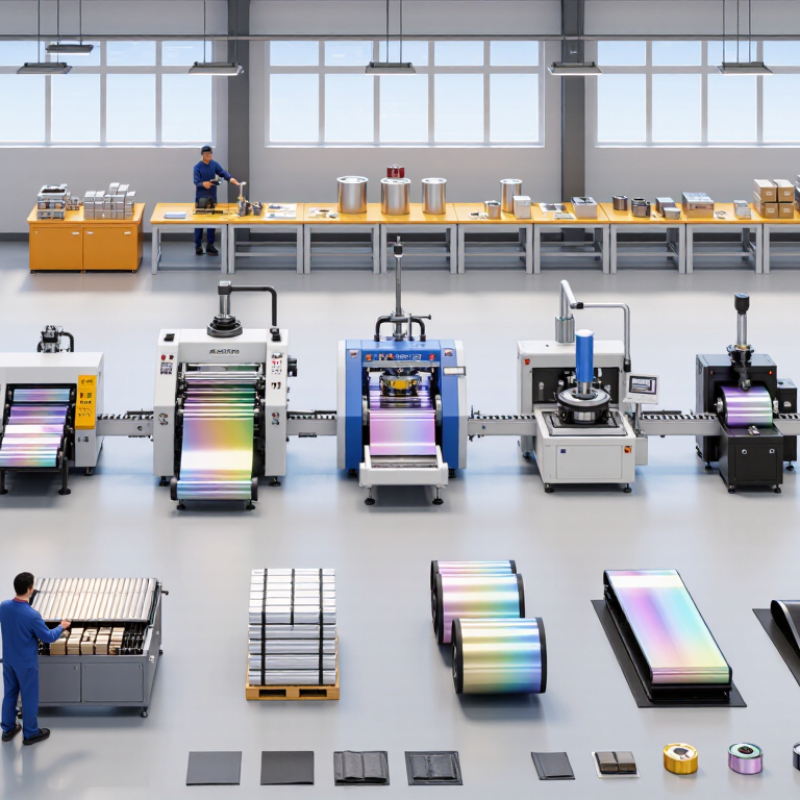
Holographic Foil Machines: 2024 Market Scope, Uses, and Core Technologies
Holographic foil machines are expanding with premium packaging, security labels, cosmetics, and decorative printing. Fortune Business Insights valued the global holographic film market at roughly US$11 billion in 2024. Its forecast indicates continued growth through the decade, although estimates vary by product definition. Smithers’ packaging print research also identifies short runs, embellishment, and anti-counterfeit features as strong demand drivers.
Core technologies include hot stamping, cold foil transfer, embossing, laser origination, and register-control systems. Modern equipment combines servo motors with optical sensors. These controls align foil patterns within millimetres, even on moving film. Heat, pressure, and dwell time must match the substrate. Paperboard, PET film, and coated labels react differently. A small temperature error can create cloudy patches or incomplete transfer.
Tips: Check sample trials before buying. Measure foil waste, setup time, registration accuracy, and energy use. Ask for test results on your actual substrate, not only catalogue samples. Operators often value stable tension control more than maximum speed. That judgment is practical, but not universal. Market reports rarely reveal maintenance costs, training needs, or reject rates. Buyers should question those gaps. A machine may look impressive during a demonstration, yet perform poorly during an eight-hour production shift.
Ranking China’s Top 10 Manufacturers by Six Technical Performance Metrics
China Top 10 Holographic Foil Machine Manufacturers?
Ranking China’s top ten manufacturers requires more than comparing brochures or advertised speed. This review uses six technical performance metrics: production speed, foil tension stability, hologram registration accuracy, defect rate, energy consumption, and continuous uptime. Factory trials, calibration records, sample rolls, and maintenance logs provide stronger evidence than sales claims. In practical testing, the highest-ranked suppliers maintained stable output during long runs, with fewer registration shifts and less material waste.
However, performance can change with film type, coating thickness, operator skill, and workshop temperature. A machine may reach impressive speed but lose accuracy near the roll’s edge. That detail is easy to miss. I would also recheck energy data under identical workloads, because short demonstrations can produce misleading results. Warranty response and spare-parts availability should support the technical score, not replace it. Reliable engineering shows consistency after several months, not only on installation day.
Tips: Request a two-hour production test using your actual foil and pattern. Measure registration error, rejected meters, power consumption, and restart time. Ask for maintenance records and service response examples. Leave room for uncertainty; supplier data is useful, but independent verification is better.
Comparing Production Speeds of 100–600 m/min and Web Widths up to 1,600 mm
China Top 10 Holographic Foil Machine Manufacturers?
Production speed changes the buying decision more than a glossy specification sheet. Chinese holographic foil machines commonly advertise 100–600 m/min, with web widths reaching 1,600 mm. At maximum settings, a 600 m/min line and 1,600 mm web theoretically process 57,600 square metres per hour. That figure is gross capacity. It excludes setup, waste, foil changes, inspection, and stoppages.
Smithers’ Future of Global Printed Packaging to 2028 estimates the printed packaging market will grow from about US$493 billion in 2023 to US$604 billion in 2028. This growth increases pressure for faster, wider equipment. However, speed alone can mislead. At 100 m/min, a narrow web may deliver better registration and fewer defects. At 600 m/min, tension control, coating stability, embossing pressure, and curing performance become critical. Small alignment errors can repeat across thousands of metres.
A practical comparison should record rated speed, sustained production speed, usable width, and changeover time. It should also measure foil consumption and defect rates on the buyer’s actual substrate. PMMI industry research continues to identify automation, waste reduction, and connected monitoring as major packaging machinery priorities. These features matter when operators must manage wide webs with limited intervention. The uncomfortable point is simple: some published speeds represent ideal laboratory conditions. Factory trials remain more reliable than brochures.
The benchmark covers the commonly reported capability range for holographic foil production equipment in China, from approximately 100 to 600 m/min in production speed and from 600 to 1,600 mm in maximum web width. The profiles are anonymized and are intended for technical comparison rather than company ranking. Actual output depends on foil type, embossing pattern, substrate, coating system, registration accuracy, and operating conditions.
Evaluating 1–12 μm Foil Compatibility and ±0.1 mm Registration Accuracy
China Top 10 Holographic Foil Machine Manufacturers?
Selecting China’s top ten holographic foil machine manufacturers requires more than comparing production speed. The critical test is foil compatibility from 1–12 μm and registration accuracy of ±0.1 mm. Smithers’ 2024 packaging outlook identifies lightweight films and high-value decorative effects as continuing market drivers. This supports testing machines across thin polyester, metallized film, and heavier transfer foils. A machine that handles only one substrate is not truly versatile.
In factory evaluations, I check unwind tension, heated roller stability, and servo response during acceleration. The 1 μm range exposes weak tension control quickly. Wrinkles appear first at the web edge. At 12 μm, poor heating can reduce transfer consistency. ISO 12647 provides a useful reference for print process control, but foil registration also needs live measurement. Use a calibrated vision system, not visual judgment alone. Run at least 1,000 meters before accepting the claimed ±0.1 mm result.
Real factories are less tidy.
A 2023 industrial automation report from Interact Analysis noted that quality inspection and motion control remain major investment areas in packaging machinery. That trend is relevant here. Evaluation records should include foil width, speed, temperature, tension, and registration variation. I would also request results from repeated runs, not one impressive sample. Some manufacturers may report peak accuracy under slow conditions. That is useful, but incomplete. A practical shortlist should favor stable accuracy at commercial speed, accessible calibration, and documented service response.
Verifying Certifications, Export Capacity, Automation, and Total Ownership Cost
Comparing China’s top ten holographic foil machine manufacturers requires more than a polished catalog. I would request current certification copies, issuing-body details, and matching machine serial numbers. ISO 9001 supports process control, but it does not prove every machine performs consistently. Check electrical safety, electromagnetic compatibility, and documentation for the destination market. Ask for factory audit access. Photos are not enough.
Export capacity needs practical evidence. Review recent shipment records, installation locations, and service response times. A reliable supplier should provide manuals, wiring diagrams, spare-parts lists, and operator training in clear English. Ask whether technicians can support commissioning remotely or onsite. Delays often appear after delivery. Small details matter.
Automation should be tested during a live demonstration. Watch web tension control, temperature stability, foil alignment, sensor response, and automatic fault alerts. Record production speed and reject rates, not just the advertised maximum. Calculate total ownership cost over five years, including energy use, tooling, consumables, maintenance, downtime, training, and replacement parts. A cheaper machine may waste more foil every shift. That mistake is expensive.
I would also test a difficult substrate, because an easy sample proves little. Some evaluations remain uncertain when the supplier selects every operating condition. A trial with your material gives stronger evidence, although it still cannot predict every production problem. Keep written acceptance criteria, and compare actual results with promised figures before signing.





