


Top 10 Heat Recovery Ventilator Manufacturers Worldwide

A Heat Recovery Ventilator brings fresh outdoor air into a building while transferring heat between incoming and outgoing air. In winter, this can help retain indoor warmth; in warmer conditions, it may reduce the load on cooling systems. The real result depends on climate, installation, airflow settings, and maintenance. A product brochure alone cannot tell the whole story.

This guide introduces ten manufacturers with a worldwide presence and considers the factors that matter to buyers. These include heat-exchange efficiency, airflow capacity, operating noise, filtration options, controls, product documentation, and access to technical support. Details matter. A quiet unit with sensible controls may suit a small home, while a larger commercial project may need higher airflow and more advanced monitoring. Certification and published performance data also help readers compare products on a consistent basis, though standards and availability can vary by market.

Manufacturer rankings are never completely universal. Not always. Product ranges change, distributors differ, and the best choice depends on the building rather than brand recognition alone. This overview is intended as a practical starting point, not a substitute for checking current specifications or consulting a qualified ventilation professional. It also leaves room for a useful question: how well does a system perform after years of real use, not just during a controlled test? That is harder to judge from public information, but worth considering before making a decision.
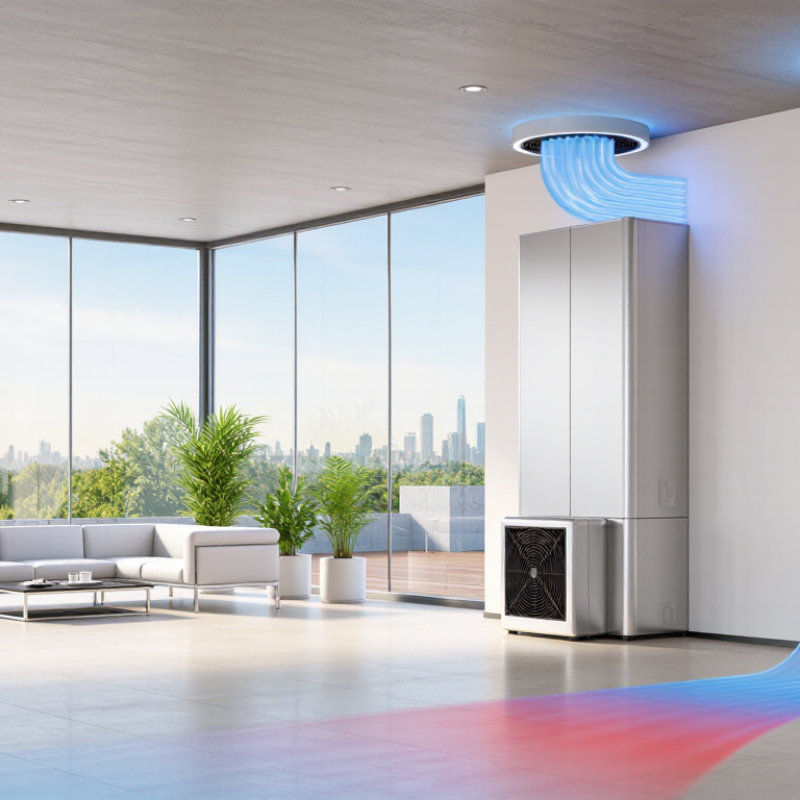
Top 10 Heat Recovery Ventilator Manufacturers Worldwide

What Heat Recovery Ventilators Are and How They Work

A heat recovery ventilator (HRV) brings outdoor air indoors while exhausting stale air. Two separate air streams pass through a heat-exchange core, often made of thin plates. In winter, outgoing warm air heats incoming cold air without deliberately mixing the streams. In summer, heat can move in the opposite direction.

The U.S. Department of Energy’s Energy Saver guidance puts typical heat recovery at about 70–80%. Treat this as a benchmark, not a guarantee: airflow, frost control, and installation affect real performance.

Most HRVs contain fans, filters, a core, and ventilation controls. Their main task is sensible heat transfer; an energy recovery ventilator also transfers some moisture. That distinction can matter in dry winters or humid climates.

For a reliable comparison, check Home Ventilating Institute certified ratings for airflow and Sensible Recovery Efficiency, rather than relying on a headline figure. A poorly balanced system may feel drafty. Maintenance matters, too.

Tips: Ask for measured supply and exhaust airflow during commissioning. Clean or replace filters as specified, and inspect the core each season. A quiet unit is not necessarily a well-balanced one.


Key Technologies Used in Modern Heat Recovery Ventilators

Modern heat recovery ventilators use a heat exchanger to transfer warmth between outgoing and incoming air streams. Many units use counterflow plates, where thin channels keep the streams separate while maximizing contact. Enthalpy membranes can also transfer some moisture, helping manage indoor humidity during dry or humid weather. Performance depends on airflow balance, not just the exchanger’s rated efficiency. Still, no core works perfectly in every climate. Small details matter.

Electronically commutated fans adjust speed with less wasted energy than many older motor designs. Variable-speed control can respond to changing ventilation needs, while temperature and humidity sensors help prevent uncomfortable swings. Frost protection may slow a fan, adjust airflow, or briefly use a defrost cycle in cold conditions. Filters capture dust before it reaches the core, but clogged filters raise resistance and reduce airflow. One limitation is easy to overlook: advanced controls cannot fix poor duct design or incorrect commissioning. A technician should check airflow at the grilles, not rely only on the display. Not always glamorous, but essential.

How to Compare Heat Recovery Ventilator Manufacturers

When comparing Heat Recovery Ventilator Manufacturers, look beyond headline efficiency. Ask for independently tested sensible heat recovery data at the airflow your building actually needs. AHRI Standard 1060 describes test methods for air-to-air energy recovery equipment, helping buyers compare ratings on a consistent basis. Check whether the published result reflects balanced airflow, realistic external pressure, and cold-weather operation. Numbers need context. A high laboratory rating may not translate directly to a quiet, comfortable room.

The European Commission’s Regulation (EU) No 1253/2014 set a 73% minimum thermal efficiency for residential bidirectional ventilation units from 2018. Treat this as a reference point, not proof of superior performance. Compare airflow delivery, fan power, sound levels, frost protection, filter access, and replacement-part availability. Request sound data at the intended operating speed, then check whether filters can be changed without tools. Ask how the unit behaves during prolonged freezing weather; brochures often leave that detail vague. I would also compare commissioning instructions and warranty terms, because installation quality can undo strong test results. A clear data sheet and accessible service guidance are useful signs of a manufacturer’s technical reliability.

Top 10 Heat Recovery Ventilator Manufacturers Worldwide - How to Compare Heat Recovery Ventilator Manufacturers

Comparison Dimension What to Compare Across Manufacturers Evidence or Unit to Request Why It Matters
1. Rated airflow Available airflow at the external static pressure required by the project; compare supply and exhaust airflow separately. Airflow in m³/h or L/s, paired with pressure in Pa; fan curves or certified performance data. A headline maximum airflow alone does not show whether the unit can deliver the required airflow through the installed duct system.
2. Heat recovery performance Compare temperature effectiveness under the same airflow, temperature, and test conditions. Check whether figures are dry or include condensation effects. Temperature-transfer effectiveness (%) and the stated test method and operating conditions. Recovery figures measured under different conditions are not directly comparable.
3. Fan energy use Compare electrical input at the project’s design airflow and pressure, including both fans where applicable. Input power in W and specific fan power in W/(m³/s), with the measurement conditions stated. Fan energy is part of ongoing operating cost and can differ substantially between operating points.
4. Pressure drop Review the pressure drop across the heat exchanger and filters at the selected airflow, including clean and loaded-filter conditions where available. Pressure drop in Pa at a specified airflow; filter loading or replacement guidance. Higher resistance can increase fan energy and reduce delivered airflow if the system is not sized accordingly.
5. Sound performance Compare sound data at equivalent airflow and pressure. Distinguish casing-radiated sound from sound transmitted through ducts. Sound power level in dB(A), measurement location, operating point, and any octave-band data. A single sound value without test conditions or measurement location may not predict noise at occupied rooms.
6. Frost protection Check the defrost or frost-control strategy, its operating temperature range, and whether it affects supply airflow or requires preheating. Control sequence, stated frost-protection conditions, and any preheater power in W. Cold-weather operation can affect ventilation balance, comfort, and energy consumption.
7. Filters and maintenance Compare filter grades, availability, replacement intervals, access, and whether filters can be changed without specialist tools. Filter classification (for example, ISO 16890 where applicable), dimensions, replacement part details, and maintenance instructions. Filter choice and upkeep affect air cleanliness, pressure drop, and continued system performance.
8. Controls and commissioning Compare available fan-speed control, demand-control inputs, schedules, alarms, balancing features, and integration options. Control documentation, supported input/output protocols, commissioning procedure, and available operating modes. Clear controls and commissioning support help the installed system achieve its intended airflow and operation.
9. Bypass and air leakage Check whether a summer bypass is provided, how it operates, and what data is available for internal leakage or transfer between air streams. Bypass operating description and leakage or carry-over test results, with the test method identified. Bypass behavior affects seasonal operation; leakage data helps assess separation of supply and exhaust air.
10. Testing, warranty, and support Verify independent performance testing, applicable regional requirements, warranty terms, spare-parts access, and technical support in the installation market. Test reports or certifications relevant to the product and region; written warranty and service documentation. Comparable documentation and local support make it easier to verify claims and maintain the unit over time.

For a fair manufacturer comparison, evaluate specific models at the same design airflow, external static pressure, test conditions, and required market standards. Performance and features vary by model.

Profiles of Ten Heat Recovery Ventilator Manufacturers Worldwide

A credible profile of ten heat recovery ventilator manufacturers should compare engineering choices, not just catalogue claims. Look at residential and commercial product ranges, airflow capacity, heat-exchange core design, frost protection, controls, noise, and service access. These details matter in practice: a unit installed above a hallway ceiling must be quiet, reachable, and sized for the actual duct layout. Details matter. The IEA’s Energy Efficiency 2023 report places buildings at roughly 30% of global final energy use, making ventilation efficiency a meaningful part of building performance.

The profiles can span manufacturers serving Northern Europe, North America, and Asian markets, while noting that climate and building codes shape product design. UNEP and the Global Alliance for Buildings and Construction reported in the 2023 Global Status Report that buildings and construction account for about 34% of global energy demand and 37% of energy- and process-related CO₂ emissions. Those figures describe the wider sector, not savings attributable to ventilators. That distinction is easy to miss. Compare independently tested heat-recovery efficiency and fan power where available, and check whether figures use comparable test conditions. A strong profile should also disclose filter replacement intervals, condensate handling, and maintenance needs. Published specifications rarely reveal every installation problem; real performance still depends on commissioning and upkeep.

Industry Trends Shaping the Global HRV Market

Heat recovery ventilators are becoming more common in energy-conscious homes and commercial buildings. Manufacturers are improving heat-exchange performance while working to reduce fan energy, casing losses, and noise. Quiet matters. Residents notice a low hum at night more readily than a specification sheet suggests. That practical test can be overlooked.

Demand-controlled ventilation is also gaining attention. Sensors can adjust airflow as occupancy or indoor conditions change, helping avoid unnecessary ventilation. But automation is not foolproof: sensors drift, filters clog, and occupants may override settings. Easier maintenance access and clear filter alerts can matter as much as advanced controls. Cold-climate designs also need dependable frost protection and condensate drainage, especially where winter temperatures remain low for weeks.

Market needs vary by region. Compact units suit apartments with limited mechanical space, while larger buildings may need systems that integrate with existing controls. Installers increasingly influence product choices because poor commissioning can undermine a well-designed unit. Manufacturers therefore face pressure to provide readable setup guidance, readily available replacement filters, and service support. Efficiency ratings help buyers compare products, but test conditions may not match every building. More transparent performance data would make comparisons more useful, though gathering it consistently remains a challenge.

Powder Coat Booths

For those larger-sized parts, or smaller quantity runs, we have 2 independent powder coat booths and ovens. The quality, durability and affordability of today’s powder coating finishes make this the process of choice for world-class companies.

Powder coating advantages over other forms of coating are many. Materials used in the Powder coating process can be metals and non-metals that come in a multitude of thicknesses, textures, colors, etc. Another of Powder coating’s biggest advantages over conventional coatings is its ability to create finishes in many different textures. Powder Coating Booths allow us the ability to apply these advantages to large products.

Wet Paint Line

Tri-State Fabricators runs a full-service conveyor line for painting. Wet painting can provide protection or decoration to many different part styles. From start to finish, every project is easier to undergo random and point-based inspection by our skilled painting team.

Advantages to our Wet Paint Line are these lines start with product prep and ends with a thorough inspection of a high quality finished product. Our ability to complete large and small projects with a superior finish and doing so in a timely and economical fashion. This passes along the savings in production to our customers. When powder coating ins not an option, our Wet Paint Line gets the job done right the first time.

Wet Paint Booths

When the parts get big and heavy we roll-out our custom paint racks and oversize booth. By utilizing our partnerships with all the major paint brands, we can match virtually any color with wet paint.

The advantages of having access to a Wet Paint Booth are many. Large projects of many different shapes can be loaded into the booth. The Wet Paint Booth offers an environment that is much more controlled than a typical parts painting operation.

Not only are they used because of their controlled environment, but they’re are also advantageous when it comes to applying paint to parts that are needed in industries that require specialty coatings such as medical, aerospace, etc.

Military CARC

Our military forces have some very high standards when it comes to the finish of their vehicles and equipment. From the first pre-treatment step to final coat, it takes a great deal of knowledge and experience to protect the men and women of our armed forces. They deserve only the best, and Tri-State Fabricators provides it.

All of our processes are closely monitored by our staff and management teams. Both of which are highly trained in the processes of metal fabrication and finishing. Tri-State Fabricators’ goal is to always fully satisfy each and every customer, including the military. We will always put a 110% into what we do.

Glass-Bead Blasting

Abrasive media blasting is an excellent way to remove old paint, rust, and increase the paint/powder adhesion. Glass beads produce a much smoother and brighter finish than angular abrasives; leaving the part clean yet without any dimensional change. Chemically inert and environmentally friendly, we can recycle our beads approximately 30 times; making them a more preferred method of metal cleaning or surface finishing.

Advantages to Glass Bead Blasting are many. Glass bead blast media is used when a project is needing rough surfaces need to become smooth for applications of coatings such as paint. It is typically used to clean paint and rust from a product surface without deforming the surface it is being used on. Overall, compared to many other blasting media, Glass Bead Blasting is a very economical choice and those savings are always passed on to our customers.

Part Washing

Tri-State Fabricators utilize a zinc phosphate wash to clean and etch the material to ensure the best paint adhesion possible. The unique design of our 3-stage wash system does the work like a 5-stage. From Cleaning and rinsing to conversion coating and post-treatment, Our Part Washing process is a complete service and works throughout the fabrication service and the finishing service.

Along with the previously mentioned benefits, Curing is a vital chemical reaction that leaves the product finish hard and relatively safe from mild abrasion and aggressive corrosion. This process can be done in more than one way; ambient air-dry or in curing ovens at temps that exceed 240°.

Burn-Off Oven

From fixing paint mistakes (someone else’s of course) to simply cleaning our paint line hooks, our burn-off oven is put to good use. After a quick burn-off, a little clean up, and a fresh coat of paint, your parts will look better than new.

Why does our Burn-Off Oven work so well? Because super heating the air around parts turns the materials into ashes. From paint and powder coatings to rubber and machining oils, high temps do the job without degrading the integrity of the part.

Masking

Masking is a vital part of producing high quality products. We have die-cut masking patterns to protect machined surfaces as well as a wide range of plugs and caps to protect threaded holes and bolts. We provide permanent and temporary masking.

Masking allows the selected sections of a product to be protected from a fabrication or finishing service. This can be with both chemicals when etching and tapes, paints when only finishing just a section of the product. Masking is great in aiding the customization process of a project.

Screen Printing

Screen printing is a photographic process that transfers artwork onto a porous nylon screen which allows colored ink to flow through the screen and be deposited on an aluminum or plastic component. We can generally have just about any design created onto a screen for your parts.

Some of the advantages of Screen Printing are, brand recognition for your business displaying on your products, assembly instructions, product warnings/hazards, etc. Tri-State Fabricators produces Screen Printing of the highest quality so you know it’s durable.

Metal Finishing

Metal Finishing is the art of treating the exterior portion of product, often metal but can also be made of other materials, so that the surface is clean and free of any debris. Then the process of applying coats or either paint of powder coat takes place. This coating process improves the quality of the product in both appearance and resistance to wear and corrosion.

Tri-State Fabricators, Inc., understands that a project typically isn’t complete until a high-quality finish has been added to your product. This is why our painting and powder coating teams continuously inspect the products throughout the Metal Finishing process.
