


Construction sites place unusual demands on batteries. A wheel loader may idle through cold mornings, while an electric excavator draws power through long, demanding shifts. The right Construction Equipment Battery depends on the machine, duty cycle, charging access, and operating climate. A battery suited to engine starting may not be suitable for traction or auxiliary systems. That distinction matters.
This guide examines ten manufacturers serving the construction equipment market. It considers product range, battery chemistry, published performance data, safety information, warranty terms, and service availability. Lead-acid options remain relevant for some starting and backup needs. Lithium-ion products can offer different advantages for electric machines, but buyers should check charging requirements, thermal controls, and compatibility with the equipment. Specifications deserve close attention. A high capacity number alone does not prove a battery will perform well on a jobsite.
The list is intended as a practical starting point, not a universal ranking. Manufacturer availability and product lines vary by region, and a model’s real-world performance depends on installation and use. Some details may be hard to compare directly; public data is not always presented in the same way. Buyers should confirm current specifications with manufacturers or authorized suppliers before making a decision. A little skepticism helps. The sections ahead introduce each company and highlight what equipment owners may want to verify, from dependable starts in freezing weather to charging support between shifts.
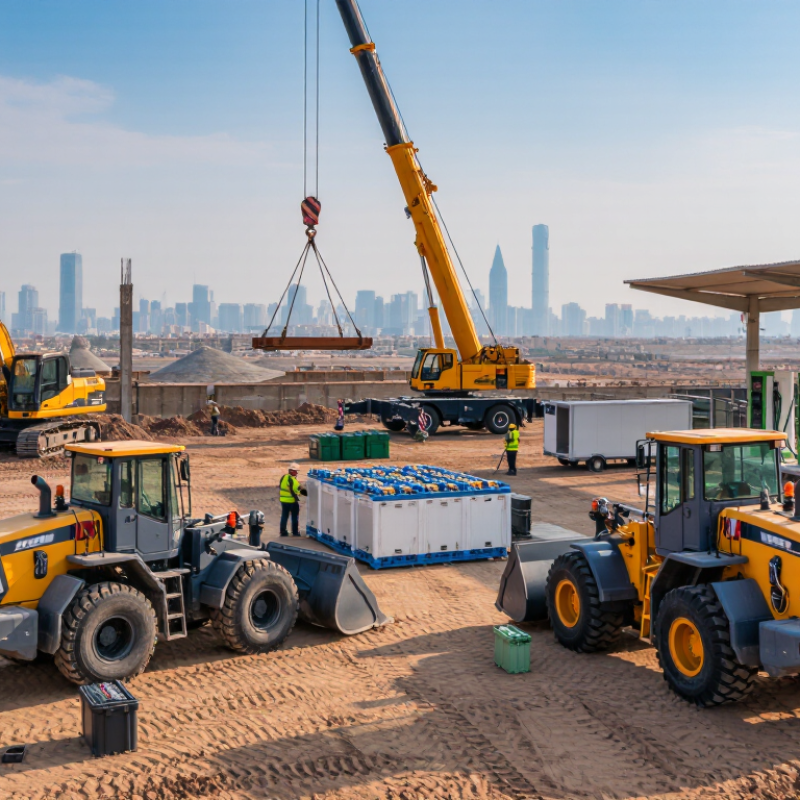
China’s construction equipment battery industry serves machines that start, move, lift, and operate far from fixed power supplies. Its scope includes starting batteries, auxiliary power systems, and battery packs for electric or hybrid equipment. Requirements differ sharply by machine. An excavator working through long shifts needs dependable starting and control power, while a compact electric loader depends on usable capacity and practical charging access.
Applications span excavators, wheel loaders, cranes, telehandlers, forklifts, and smaller site machines. Batteries also support lighting, displays, safety sensors, communication devices, and telematics when engines are off. On dusty sites, vibration-resistant housings and secure connections matter. Cold mornings can reduce available battery output, so rated capacity alone may not tell the full story. Real operating conditions do.
For buyers and equipment designers, the useful comparison is not simply lead-acid versus lithium-ion. Duty cycle, charging time, service access, thermal management, and replacement cost all shape suitability. A machine running short urban jobs may benefit from different specifications than one operating in a remote quarry. There is no universal answer. Battery data sheets can also look clearer than field performance; that gap deserves careful testing under actual workloads.

To identify China’s leading construction equipment battery manufacturers, a comparison should begin with evidence, not promotional claims. Review published capacity data, product specifications, quality certifications, and documented experience supplying machinery applications. Check whether each company provides clear information on battery chemistry, voltage options, operating temperature, and charging requirements. Evidence matters.
The manufacturers can then be compared against practical job-site needs. Useful measures include cycle-life test conditions, vibration resistance, enclosure protection, warranty terms, delivery capacity, and technical support. Numbers need context: a cycle-life figure means little unless its temperature, discharge depth, and test method are disclosed. Where possible, compare like with like, such as batteries designed for similar equipment and duty cycles. A lower price is not automatically better value.
A transparent ranking should explain how each measure is weighted and distinguish verified facts from company-reported information. Product documents, factory quality records, and customer references can help confirm claims, though public information may be incomplete. Not every buyer agrees. A contractor working in cold regions may value low-temperature performance more than a buyer focused on fast local service. The comparison should note these trade-offs rather than imply one manufacturer suits every machine. Even a careful scoring sheet can miss real-world differences, so buyers should verify specifications against their equipment before making a decision.
How the Top 10 Manufacturers Are Identified and Compared
The chart shows an illustrative evaluation framework, not measured company results or market rankings. Criteria and weightings are editorial; verify product specifications, certifications, production capacity, and service coverage against current, independently documented sources.
Profiles of China’s top ten construction equipment battery manufacturers should compare engineering capability, not just factory size. The IEA’s 2024 Batteries and Secure Energy Transitions report estimates that China held about 85% of global battery-cell manufacturing capacity in 2023. That scale matters, but it does not prove that every supplier can meet the shock, vibration, dust, and temperature demands of excavators or loaders.
The ten profiles should examine battery chemistry, pack design, thermal management, and field-service support. For example, a pack installed beneath a machine cab faces different cooling and maintenance needs from one used in a compact electric loader. Buyers should check usable capacity, continuous discharge output, cycle-life test conditions, and warranty limits. Ask whether published test results reflect construction duty cycles, not only laboratory use. Details matter.
Manufacturing scale can support stable supply, while application-specific testing shows whether a battery is ready for site work. Compare protection against water and dust, cell traceability, diagnostic tools, and replacement procedures. These are practical indicators, yet they are not always reported in comparable formats. That makes a clean ranking difficult. A profile should state what evidence is available and where claims remain unverified, rather than treating every specification sheet as equal.
Construction equipment batteries must handle more than repeated starts. Excavators and loaders face vibration, dust, long shifts, and sudden hydraulic loads. Lithium iron phosphate cells can offer strong cycle life and thermal stability, while nickel-rich chemistries may provide more energy in limited space. The trade-off is real. Pack design matters as much as cell chemistry.
BloombergNEF’s 2024 Lithium-Ion Battery Price Survey reported an average pack price of $115 per kilowatt-hour, down 20% from 2023. This is a broad market benchmark, not a construction-equipment quote. The International Energy Agency reported that electric-vehicle battery demand reached about 750 gigawatt-hours in 2023, up 40% year over year. Scale is growing. Yet jobsite duty cycles differ sharply from road use.
Useful product features include sealed enclosures, cell-level monitoring, thermal management, and charging controls that limit heat during fast charging. A battery-management system should flag voltage imbalance before it becomes a field failure. Operators also need clear state-of-charge readings and practical cold-weather performance. Test the full pack, not just its datasheet. A paper rating can miss rough-site reality. This is still an imperfect comparison: public reports rarely separate construction batteries from other industrial packs.
China Top 10 Construction Equipment Battery Manufacturers
How to Evaluate Manufacturers for Equipment and Project Requirements
For construction equipment, a battery must fit the machine’s real workload, not just its nameplate. Record voltage, capacity, starting current, operating hours, and charging access. A compact excavator working in cold mornings may need different performance from a loader running long shifts indoors. Confirm dimensions, terminal layout, mounting points, and the equipment maker’s specifications before requesting quotations. Small details matter.
Ask manufacturers for test data that matches your application. Check how cycle life was measured, including discharge depth, temperature, and charging conditions. Request protection details for vibration, dust, moisture, and high or low temperatures. For lithium batteries, review the battery management system’s limits and fault protections. Also assess production traceability, sample testing, warranty terms, and technical support. A polished datasheet can still leave gaps; I would compare the stated figures with a sample under realistic duty cycles.
Tips: Share the machine model, daily runtime, and site conditions. Ask for written answers, not just sales claims. Keep a record of test results and unresolved questions.


For those larger-sized parts, or smaller quantity runs, we have 2 independent powder coat booths and ovens. The quality, durability and affordability of today’s powder coating finishes make this the process of choice for world-class companies.
Powder coating advantages over other forms of coating are many. Materials used in the Powder coating process can be metals and non-metals that come in a multitude of thicknesses, textures, colors, etc. Another of Powder coating’s biggest advantages over conventional coatings is its ability to create finishes in many different textures. Powder Coating Booths allow us the ability to apply these advantages to large products.
Tri-State Fabricators runs a full-service conveyor line for painting. Wet painting can provide protection or decoration to many different part styles. From start to finish, every project is easier to undergo random and point-based inspection by our skilled painting team.
Advantages to our Wet Paint Line are these lines start with product prep and ends with a thorough inspection of a high quality finished product. Our ability to complete large and small projects with a superior finish and doing so in a timely and economical fashion. This passes along the savings in production to our customers. When powder coating ins not an option, our Wet Paint Line gets the job done right the first time.
When the parts get big and heavy we roll-out our custom paint racks and oversize booth. By utilizing our partnerships with all the major paint brands, we can match virtually any color with wet paint.
The advantages of having access to a Wet Paint Booth are many. Large projects of many different shapes can be loaded into the booth. The Wet Paint Booth offers an environment that is much more controlled than a typical parts painting operation.
Not only are they used because of their controlled environment, but they’re are also advantageous when it comes to applying paint to parts that are needed in industries that require specialty coatings such as medical, aerospace, etc.
Our military forces have some very high standards when it comes to the finish of their vehicles and equipment. From the first pre-treatment step to final coat, it takes a great deal of knowledge and experience to protect the men and women of our armed forces. They deserve only the best, and Tri-State Fabricators provides it.
All of our processes are closely monitored by our staff and management teams. Both of which are highly trained in the processes of metal fabrication and finishing. Tri-State Fabricators’ goal is to always fully satisfy each and every customer, including the military. We will always put a 110% into what we do.
Abrasive media blasting is an excellent way to remove old paint, rust, and increase the paint/powder adhesion. Glass beads produce a much smoother and brighter finish than angular abrasives; leaving the part clean yet without any dimensional change. Chemically inert and environmentally friendly, we can recycle our beads approximately 30 times; making them a more preferred method of metal cleaning or surface finishing.
Advantages to Glass Bead Blasting are many. Glass bead blast media is used when a project is needing rough surfaces need to become smooth for applications of coatings such as paint. It is typically used to clean paint and rust from a product surface without deforming the surface it is being used on. Overall, compared to many other blasting media, Glass Bead Blasting is a very economical choice and those savings are always passed on to our customers.
Tri-State Fabricators utilize a zinc phosphate wash to clean and etch the material to ensure the best paint adhesion possible. The unique design of our 3-stage wash system does the work like a 5-stage. From Cleaning and rinsing to conversion coating and post-treatment, Our Part Washing process is a complete service and works throughout the fabrication service and the finishing service.
Along with the previously mentioned benefits, Curing is a vital chemical reaction that leaves the product finish hard and relatively safe from mild abrasion and aggressive corrosion. This process can be done in more than one way; ambient air-dry or in curing ovens at temps that exceed 240°.
From fixing paint mistakes (someone else’s of course) to simply cleaning our paint line hooks, our burn-off oven is put to good use. After a quick burn-off, a little clean up, and a fresh coat of paint, your parts will look better than new.
Why does our Burn-Off Oven work so well? Because super heating the air around parts turns the materials into ashes. From paint and powder coatings to rubber and machining oils, high temps do the job without degrading the integrity of the part.
Masking is a vital part of producing high quality products. We have die-cut masking patterns to protect machined surfaces as well as a wide range of plugs and caps to protect threaded holes and bolts. We provide permanent and temporary masking.
Masking allows the selected sections of a product to be protected from a fabrication or finishing service. This can be with both chemicals when etching and tapes, paints when only finishing just a section of the product. Masking is great in aiding the customization process of a project.
Screen printing is a photographic process that transfers artwork onto a porous nylon screen which allows colored ink to flow through the screen and be deposited on an aluminum or plastic component. We can generally have just about any design created onto a screen for your parts.
Some of the advantages of Screen Printing are, brand recognition for your business displaying on your products, assembly instructions, product warnings/hazards, etc. Tri-State Fabricators produces Screen Printing of the highest quality so you know it’s durable.
Metal Finishing is the art of treating the exterior portion of product, often metal but can also be made of other materials, so that the surface is clean and free of any debris. Then the process of applying coats or either paint of powder coat takes place. This coating process improves the quality of the product in both appearance and resistance to wear and corrosion.
Tri-State Fabricators, Inc., understands that a project typically isn’t complete until a high-quality finish has been added to your product. This is why our painting and powder coating teams continuously inspect the products throughout the Metal Finishing process.

