


Choosing a wood drying system can shape product quality, energy use, and production schedules. Wood Drying Equipment ranges from conventional kiln systems to heat-pump and vacuum solutions. Each approach handles moisture differently. The right choice depends on species, board thickness, target moisture content, available space, and local energy costs. Details matter.
This guide introduces ten manufacturers serving the wood-drying market in China. It gives buyers a starting point, not a universal ranking. Company capabilities, product specifications, and service coverage can change, so verify current information directly with each supplier. Ask for kiln capacity, temperature controls, insulation details, and moisture-monitoring methods. Request operating references for materials similar to yours. A brochure is not proof of performance.
Practical evaluation should include installation support, spare-parts access, operator training, and expected maintenance. A kiln may look efficient on paper but perform differently under a real production load. That distinction is easy to miss. Compare quotations using the same drying requirements and check what each offer includes. Consider sample tests where feasible, especially for valuable or difficult-to-dry timber. There is no perfect shortlist for every factory. The manufacturers below are presented to support informed research, while final decisions should reflect measured needs and independently checked claims.
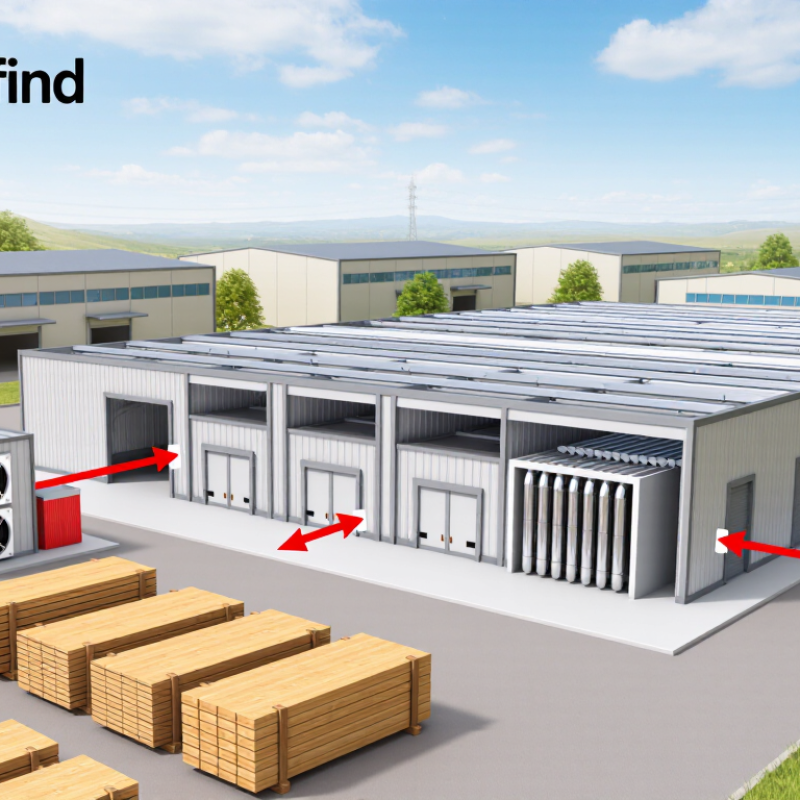
Wood drying equipment removes excess moisture from freshly sawn timber under controlled conditions. In a kiln, fans move warm air between stacked boards, while vents and sensors help regulate temperature and humidity. Operators monitor moisture readings, because the outside of a board can dry faster than its core. That difference matters. If drying moves too quickly, timber may develop checks, warping, or internal stress.
A suitable drying schedule depends on wood species, board thickness, and the timber’s intended use. Furniture stock may need a different final moisture level from framing lumber used indoors. Careful stacking with evenly spaced stickers helps air reach each board; blocked airflow can leave damp patches. Equipment also supports repeatable processing, but it cannot correct poor loading or inaccurate measurements. In practice, schedules are not perfectly tidy: operators may need to adjust them when readings drift or conditions change. That takes judgment. Regular checks of fans, sensors, seals, and heating components can help maintain consistent results and avoid needless energy use.

China’s wood-Drying Equipment industry has shifted from basic hot-air kilns toward systems that managetemperature, humidity, and airflow more precisely. The change reflects a larger, more demanding wood-processing sector. China’s National Forestry and Grassland Administration reported wood-based panel production of about 343 million cubic metres in 2023. That scale puts pressure on mills to dry timber and residues consistently, not just quickly. A stack of boards can look uniform from the aisle and still hold uneven moisture at its centre.
Manufacturers have responded with kiln controls, heat-recovery options, and monitoring tools that help reduce drying defects and energy waste. The direction matches the International Energy Agency’s broader finding that industrial efficiency depends on better process control and waste-heat recovery. Yet adoption is uneven: smaller plants may lack the technicians or investment needed to operate advanced systems well. More sensors do not automatically mean better drying. Operators still need to understand species, board thickness, and target moisture content. In practice, a reliable moisture reading can matter more than a polished control screen. Progress is real, but it is not neat.
Choosing a wood drying equipment manufacturer in China requires more than comparing quoted prices. Start with the intended wood species, board thickness, starting moisture, and target moisture content. A supplier should explain how its chamber design and control system address those conditions. Ask for operating data from comparable installations, not only a polished brochure. Details matter.
Inspect the technical proposal for airflow direction, fan capacity, heating method, insulation, and sensor placement. Ask how temperature and humidity are measured across the load. In a well-designed kiln, boards near the door should not dry very differently from those at the center. Request a sample drying schedule and clarify whether it can be adjusted for seasonal changes or different timber. A schedule is not a guarantee; actual results depend on loading and operation.
Evaluate manufacturing quality through drawings, component specifications, inspection records, and a clear warranty scope. If possible, review a working installation or speak with a customer using similar wood. Ask who handles commissioning, operator training, spare parts, and remote troubleshooting. These practical points can affect downtime as much as the equipment itself. Be cautious when a proposal promises unusually short drying times without stating the wood conditions. Even careful buyers may overlook service response times; I would put those commitments in writing.
China’s top 10 wood drying equipment manufacturers are best compared by capability, not ranking alone. The FAO’s Global Forest Products Facts and Figures 2022 reports global sawnwood production of roughly 444 million cubic metres. That scale keeps demand for dependable drying systems tied to furniture, construction, and panel production. Yet output figures do not reveal which kiln suits a particular mill.
At a glance, Chinese suppliers span conventional steam kilns, dehumidification systems, and vacuum dryers. Compare usable chamber volume, stated moisture uniformity, heat-source options, and control accuracy. Ask for operating data from timber similar to yours, not only catalogue capacity. A thick hardwood load behaves differently from thin softwood boards. Small details matter. Check sensor placement, door sealing, airflow paths, and access for maintenance. The International Energy Agency’s tracking reports identify industrial efficiency as an important route to lower energy demand, but kiln performance depends on loading and operation as much as equipment design. Request measured energy use per cubic metre and drying-cycle records. Some claims remain difficult to compare. That is worth admitting. A concise shortlist should therefore separate verified test results from manufacturer estimates and consider local service availability before purchase.
China’s top ten wood drying equipment manufacturers differ mainly in process control, chamber design, and target timber. Conventional steam kilns remain suitable for large sawmills needing stable batch production. Vacuum kilns reduce drying time and handle thick hardwood more gently, but their pumps and seals demand closer maintenance. Dehumidification kilns recover heat efficiently, making them attractive for smaller factories and energy-conscious operations. Solar-assisted systems can lower operating costs, although weather still affects output.
The USDA Forest Products Laboratory’s Wood Handbook commonly places indoor furniture timber near 6–8% moisture content. That target requires accurate sensors, airflow control, and uniform stacking. The FAO’s 2023 forestry statistics report shows global sawnwood production exceeding 450 million cubic metres in 2022. This scale explains the demand for high-capacity chambers, automated loading, and continuous moisture monitoring. Yet capacity alone is misleading. A 100-cubic-metre kiln may perform poorly with mixed species or uneven board thickness. Manufacturer specialties therefore matter: some focus on hardwood schedules, some on high-temperature softwood drying, and others on compact systems for custom workshops.
Independent testing should examine drying uniformity, energy use per cubic metre, cycle records, and after-sales response. Those details reveal more than catalogue output. I would also question impressive energy claims without a stated wood species and starting moisture level. Real factories are rarely perfect. Door leakage, overloaded fans, and inconsistent stacking can weaken otherwise advanced equipment.


For those larger-sized parts, or smaller quantity runs, we have 2 independent powder coat booths and ovens. The quality, durability and affordability of today’s powder coating finishes make this the process of choice for world-class companies.
Powder coating advantages over other forms of coating are many. Materials used in the Powder coating process can be metals and non-metals that come in a multitude of thicknesses, textures, colors, etc. Another of Powder coating’s biggest advantages over conventional coatings is its ability to create finishes in many different textures. Powder Coating Booths allow us the ability to apply these advantages to large products.
Tri-State Fabricators runs a full-service conveyor line for painting. Wet painting can provide protection or decoration to many different part styles. From start to finish, every project is easier to undergo random and point-based inspection by our skilled painting team.
Advantages to our Wet Paint Line are these lines start with product prep and ends with a thorough inspection of a high quality finished product. Our ability to complete large and small projects with a superior finish and doing so in a timely and economical fashion. This passes along the savings in production to our customers. When powder coating ins not an option, our Wet Paint Line gets the job done right the first time.
When the parts get big and heavy we roll-out our custom paint racks and oversize booth. By utilizing our partnerships with all the major paint brands, we can match virtually any color with wet paint.
The advantages of having access to a Wet Paint Booth are many. Large projects of many different shapes can be loaded into the booth. The Wet Paint Booth offers an environment that is much more controlled than a typical parts painting operation.
Not only are they used because of their controlled environment, but they’re are also advantageous when it comes to applying paint to parts that are needed in industries that require specialty coatings such as medical, aerospace, etc.
Our military forces have some very high standards when it comes to the finish of their vehicles and equipment. From the first pre-treatment step to final coat, it takes a great deal of knowledge and experience to protect the men and women of our armed forces. They deserve only the best, and Tri-State Fabricators provides it.
All of our processes are closely monitored by our staff and management teams. Both of which are highly trained in the processes of metal fabrication and finishing. Tri-State Fabricators’ goal is to always fully satisfy each and every customer, including the military. We will always put a 110% into what we do.
Abrasive media blasting is an excellent way to remove old paint, rust, and increase the paint/powder adhesion. Glass beads produce a much smoother and brighter finish than angular abrasives; leaving the part clean yet without any dimensional change. Chemically inert and environmentally friendly, we can recycle our beads approximately 30 times; making them a more preferred method of metal cleaning or surface finishing.
Advantages to Glass Bead Blasting are many. Glass bead blast media is used when a project is needing rough surfaces need to become smooth for applications of coatings such as paint. It is typically used to clean paint and rust from a product surface without deforming the surface it is being used on. Overall, compared to many other blasting media, Glass Bead Blasting is a very economical choice and those savings are always passed on to our customers.
Tri-State Fabricators utilize a zinc phosphate wash to clean and etch the material to ensure the best paint adhesion possible. The unique design of our 3-stage wash system does the work like a 5-stage. From Cleaning and rinsing to conversion coating and post-treatment, Our Part Washing process is a complete service and works throughout the fabrication service and the finishing service.
Along with the previously mentioned benefits, Curing is a vital chemical reaction that leaves the product finish hard and relatively safe from mild abrasion and aggressive corrosion. This process can be done in more than one way; ambient air-dry or in curing ovens at temps that exceed 240°.
From fixing paint mistakes (someone else’s of course) to simply cleaning our paint line hooks, our burn-off oven is put to good use. After a quick burn-off, a little clean up, and a fresh coat of paint, your parts will look better than new.
Why does our Burn-Off Oven work so well? Because super heating the air around parts turns the materials into ashes. From paint and powder coatings to rubber and machining oils, high temps do the job without degrading the integrity of the part.
Masking is a vital part of producing high quality products. We have die-cut masking patterns to protect machined surfaces as well as a wide range of plugs and caps to protect threaded holes and bolts. We provide permanent and temporary masking.
Masking allows the selected sections of a product to be protected from a fabrication or finishing service. This can be with both chemicals when etching and tapes, paints when only finishing just a section of the product. Masking is great in aiding the customization process of a project.
Screen printing is a photographic process that transfers artwork onto a porous nylon screen which allows colored ink to flow through the screen and be deposited on an aluminum or plastic component. We can generally have just about any design created onto a screen for your parts.
Some of the advantages of Screen Printing are, brand recognition for your business displaying on your products, assembly instructions, product warnings/hazards, etc. Tri-State Fabricators produces Screen Printing of the highest quality so you know it’s durable.
Metal Finishing is the art of treating the exterior portion of product, often metal but can also be made of other materials, so that the surface is clean and free of any debris. Then the process of applying coats or either paint of powder coat takes place. This coating process improves the quality of the product in both appearance and resistance to wear and corrosion.
Tri-State Fabricators, Inc., understands that a project typically isn’t complete until a high-quality finish has been added to your product. This is why our painting and powder coating teams continuously inspect the products throughout the Metal Finishing process.

