China Top 10 Stamping Press Manufacturers for Global Buyers?
Choosing a stamping press supplier in China requires more than comparing website prices. Global buyers need reliable equipment, responsive engineering support, and clear evidence of manufacturing quality. This guide introduces China Stamping Press manufacturers with practical evaluation criteria, including press capacity, frame construction, automation options, delivery experience, and after-sales service. A 160-ton mechanical press may suit small automotive brackets, while thicker steel parts may require higher force and stronger die protection. These details matter.
No ranking is perfect. Supplier capabilities can change, and published specifications may not tell the whole story. Therefore, buyers should request factory videos, inspection records, load-test results, and references from comparable customers. Ask how the manufacturer handles installation, operator training, spare parts, and emergency repairs. A dependable supplier should explain tolerances clearly, identify applicable certifications, and support compliance with the buyer’s local safety requirements. ISO 9001 certification can support confidence, but it should not replace independent verification.
Look beyond the brochure.
The manufacturers featured here are assessed through a buyer-focused lens. Their technical range, production experience, customization ability, communication quality, and export readiness all deserve attention. Some companies may excel in high-speed production, while others may offer stronger support for customized hydraulic systems. Buyers should still conduct their own due diligence before signing a contract. This introduction is a practical starting point, not a guarantee. It aims to help procurement teams compare China-based stamping press suppliers with greater confidence, fewer assumptions, and more useful questions.
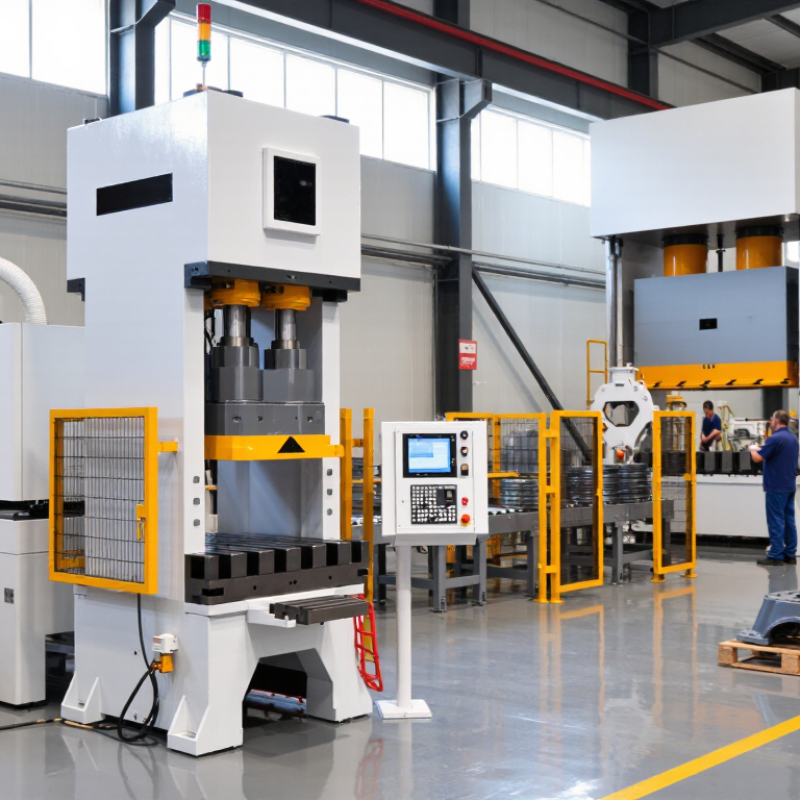
What Defines a Leading Stamping Press Manufacturer in China?
A leading stamping press manufacturer in China must offer more than competitive pricing. It should demonstrate repeatable performance, engineering depth, and dependable after-sales support. The World Steel Association reported 1.89 billion tonnes of global crude steel production in 2023. China produced about 1.02 billion tonnes, creating a substantial industrial base for press design, tooling, and automation.
Production evidence matters more than polished brochures. Buyers should request press accuracy records, load-test reports, maintenance schedules, and sample parts from comparable materials. A reliable manufacturer explains slide parallelism, shut height stability, stroke control, and overload protection in measurable terms. It also provides technical drawings, installation guidance, operator training, and spare-parts planning. These details reduce downtime on a real factory floor.
Quality systems deserve careful checking. The ISO Survey of Management System Standard Certifications shows that ISO 9001 remains widely adopted across global manufacturing, but certification alone proves little. Auditors should connect documented procedures with actual inspection records. Ask how rejected parts are traced. Ask who responds during a night-shift failure. The answer can reveal more than a certificate.
Energy performance is also becoming practical, not decorative. The International Energy Agency continues to identify industrial efficiency as essential for reducing manufacturing emissions. Servo-driven systems may lower idle energy use, although savings depend on cycle settings and production volume. No supplier is flawless. A serious manufacturer admits limits, reports tested tolerances honestly, and improves after field feedback. That transparency is often the clearest sign of reliability.
How China’s Top Stamping Press Manufacturers Compare
China Top 10 Stamping Press Manufacturers for Global Buyers?
Comparing China’s leading stamping press manufacturers requires more than ranking prices. Grand View Research valued the global metal stamping market at approximately USD 238.5 billion in 2023. Demand is growing steadily, but buyer needs differ sharply. Automotive suppliers may require 1,000-ton presses, while appliance factories often prefer compact mechanical systems.
The strongest Chinese manufacturers usually compete through tonnage accuracy, servo control, die compatibility, and automation integration. The International Federation of Robotics reported 276,288 industrial robot installations in China during 2023. That figure matters. Press suppliers with reliable robotic feeding can reduce handling delays and improve repeatability. Buyers should inspect cycle-time records, energy data, and sample parts, not only catalog specifications.
Price remains attractive. It is not the whole story. A lower quotation may exclude installation, operator training, spare tooling, or remote diagnostics. Experienced buyers should request factory acceptance tests and review ISO 9001 procedures. They should also confirm electrical standards for the destination market. Some suppliers communicate well before payment, then respond slowly after delivery. This risk deserves attention. No ranking stays permanent, either. A manufacturer with excellent hardware may still lack dependable local service, which can turn a minor sensor fault into several lost production days.
China Top 10 Stamping Press Manufacturers for Global Buyers? - How China’s Top Stamping Press Manufacturers Compare | Anonymous Supplier Profile | Main Press Category | Typical Force Range | Typical Speed Range | Custom Engineering | Automation Integration | Export Documentation | After-Sales Support | Best-Fit Buyer |
| Profile 01 | High-speed mechanical stamping presses | 25–400 metric tons | 80–600 strokes/min | High | Advanced | Comprehensive | Strong | Automotive and appliance component producers |
| Profile 02 | Servo mechanical stamping presses | 80–1,000 metric tons | 20–300 strokes/min | High | Advanced | Comprehensive | Strong | Flexible production lines requiring programmable motion |
| Profile 03 | Four-column hydraulic stamping presses | 100–2,000 metric tons | 5–40 strokes/min | High | Moderate | Comprehensive | Strong | Deep drawing, forming, and large-part applications |
| Profile 04 | Straight-side mechanical presses | 160–1,600 metric tons | 15–100 strokes/min | High | Advanced | Comprehensive | Strong | High-volume sheet-metal and structural parts |
| Profile 05 | C-frame power presses | 16–315 metric tons | 40–250 strokes/min | Moderate | Moderate | Standard | Standard | General fabrication, small parts, and maintenance workshops |
| Profile 06 | Progressive-die stamping systems | 45–500 metric tons | 100–500 strokes/min | High | Advanced | Comprehensive | Strong | High-volume terminals, connectors, and precision components |
| Profile 07 | Deep-drawing hydraulic presses | 200–2,500 metric tons | 3–25 strokes/min | High | Moderate | Comprehensive | Strong | Automotive panels, cookware, tanks, and complex formed shells |
| Profile 08 | Precision small-part stamping presses | 10–160 metric tons | 120–800 strokes/min | Moderate | Advanced | Standard | Standard | Electronic, electrical, and miniature hardware manufacturers |
| Profile 09 | Transfer press production lines | 400–2,500 metric tons | 10–35 strokes/min | High | Advanced | Comprehensive | Strong | Automotive body and large multi-stage forming operations |
| Profile 10 | Compact hydraulic workshop presses | 20–300 metric tons | 3–20 strokes/min | Moderate | Basic | Standard | Standard | Small and medium-sized manufacturers seeking cost-effective equipment |
| Buyer note: The specifications above are typical market ranges for comparable equipment categories supplied from China. Actual force, speed, bed dimensions, automation level, accuracy, certification, lead time, and service coverage should be confirmed against the supplier’s current technical proposal and factory acceptance test documents. |
How to Evaluate Quality, Capacity, and Export Readiness
China Top 10 Stamping Press Manufacturers for Global Buyers?
When evaluating stamping press manufacturers, inspect more than machine appearance. Ask for production records, material certificates, and recent quality inspection reports. A factory visit should include machining areas, assembly lines, and test stations. Look closely at weld quality, hydraulic leaks, electrical labeling, and guarding. Small details matter.
Request a live trial with your own material and tooling. Check stroke accuracy, pressure stability, cycle time, and noise levels. Confirm the rated tonnage under realistic working conditions. Review die space, table size, slide adjustment, and maintenance access. Ask how the manufacturer controls repeatability after long production runs. A polished showroom can still hide weak process control. I have seen specifications change between brochures and test reports.
Capacity also needs evidence. Verify monthly output, key component availability, and production scheduling. Export readiness includes safe packaging, clear manuals, spare-parts lists, and responsive technical support. Confirm experience with your destination’s documentation and electrical requirements. Check whether the supplier can provide installation guidance, remote troubleshooting, and operator training. Ask for references from comparable overseas projects, not only impressive photographs. Delivery promises should include inspection milestones and a written acceptance procedure. Sometimes the least expensive offer creates expensive delays. Look for transparent answers, even when the factory admits a limitation.
China Top 10 Stamping Press Manufacturers for Global Buyers
How to Evaluate Quality, Capacity, and Export Readiness
This buyer-oriented evaluation framework prioritizes measurable factors commonly used in industrial stamping press procurement. Quality and reliability cover frame rigidity, dimensional accuracy, control stability, and verified testing. Capacity includes press force, production throughput, factory capability, and delivery performance. Export readiness considers international certifications, documentation, installation support, spare parts availability, and overseas service capability.
Choosing the Right Chinese Supplier for Global Production Needs
China Top 10 Stamping Press Manufacturers for Global Buyers?
Choosing the Right Chinese Supplier for Global Production Needs
Selecting among China’s top ten stamping press manufacturers requires more than comparing prices. Match press capacity with your material, die size, stroke, and production volume. A 160-ton press may suit small brackets but fail on deeper automotive panels. Ask for load charts and tested cycle data. Small details matter.
Visit the factory when possible, or request a live video inspection. Check machining areas, assembly records, electrical cabinets, and final testing procedures. Experienced suppliers should explain frame rigidity, slide parallelism, overload protection, and spare-part availability clearly. Ask for evidence. Quality certificates help, but they cannot replace inspection records or operator training.
Global production also demands reliable communication. Confirm drawings, delivery terms, installation support, manuals, and response times before signing. Require acceptance testing with sample parts, measured tolerances, noise readings, and emergency-stop checks. Verify that the machine can meet your destination’s safety and electrical requirements. Some buyers focus too heavily on the initial quotation. That can be a costly mistake. I have seen projects delayed by unclear voltage specifications and missing die interfaces. A written technical agreement reduces such risks, although it will not prevent every misunderstanding. Leave room for trial runs, design changes, and honest discussion when the first test does not perform perfectly.





