


Air Cooling Chiller selection matters as cooling demand grows and energy costs remain a concern. The International Energy Agency’s 2018 report, The Future of Cooling, projects that global installed space-cooling capacity could more than triple by 2050. That trend puts greater pressure on buyers to compare efficiency, dependable operation, and service support—not just purchase price.
Energy-efficiency expert Amory Lovins is often quoted as saying, “The cheapest energy is the energy you don’t use.” For chiller buyers, that idea makes operating performance worth close attention. A unit serving a factory in a hot, dusty climate may face very different demands from one cooling a clean commercial building. Details matter. This guide to the top 10 Air Cooling Chiller manufacturers gives global buyers a practical starting point for comparing product ranges, application experience, and international support. Published efficiency figures are useful, but test conditions and system design can affect real-world results. No shortlist is perfect. Verify specifications, local service availability, and lifecycle costs against your project before choosing a supplier.
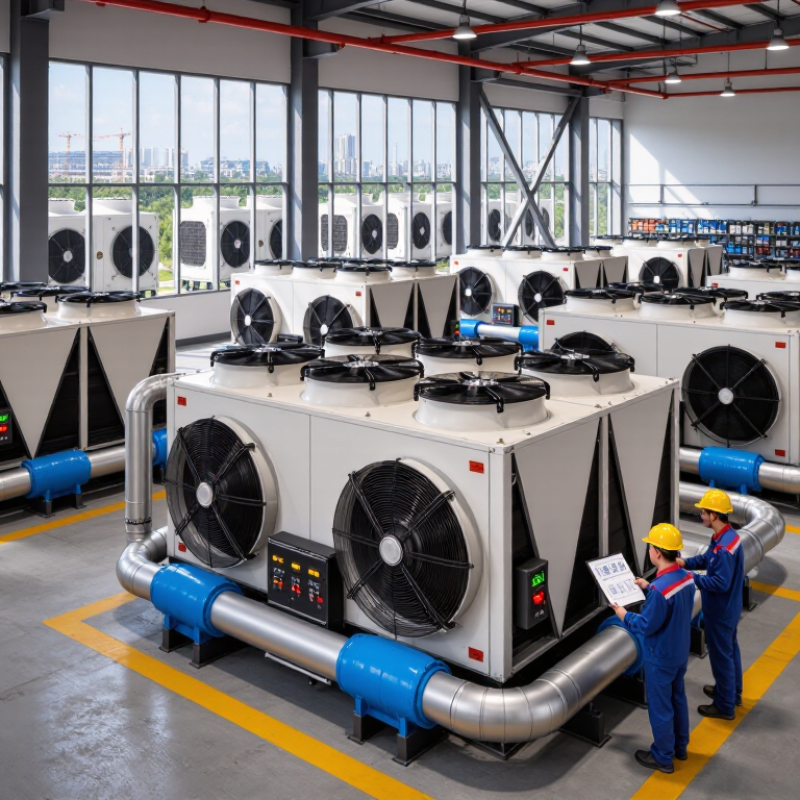
An air-cooled chiller removes heat from process water or glycol and rejects it through outdoor coils. Compressors circulate refrigerant, while fans pull air across the condenser. No cooling tower is needed. That simplifies installation, but the chiller still needs clear airflow and regular coil cleaning. Dust on the fins can reduce heat transfer, especially near busy roads or dusty production areas.
These systems serve data centers, food plants, plastics processing, and factories that cool machine tools. A stable leaving-water temperature matters when a production line depends on tight process tolerances. Yet high outdoor temperatures can lower capacity and raise power use, so local summer conditions belong in the design brief.
IEA’s The Future of Cooling (2018) projects global space-cooling electricity demand could reach 6,200 TWh by 2050, up from 2,020 TWh in 2016. The report covers space cooling broadly, not chillers alone.
UNEP’s Global Cooling Watch (2023) estimates that a sustainable cooling pathway could cut projected 2050 cooling emissions by 60%.
For buyers, compare performance at both peak and part load, not just a single rating point. Check ambient design temperature, required water temperature, sound limits, service access, and expected operating hours. A unit sized only for the hottest afternoon may cycle inefficiently during mild nights. That detail is easy to miss. A site load profile helps, though real production schedules can be messy.

Evaluate air-cooled chiller manufacturers against your actual operating conditions, not brochure claims. The IEA’s 2018 report, The Future of Cooling, projected global space-cooling electricity demand could rise from about 2,000 TWh in 2016 to 6,200 TWh by 2050. This covers space cooling broadly, not chillers alone, but it highlights why efficiency deserves close scrutiny. Ask for independently verified performance data, including capacity and power use at your specified outdoor and water temperatures.
Check whether the quoted model is certified under AHRI Standard 550/590, and compare full-load and part-load efficiency figures. Confirm that the test conditions match your project’s peak summer temperature. Also review sound levels, coil protection, warranty exclusions, spare-parts availability, and local service response times. A polished brochure is not proof; assumptions can be easy to miss. I would treat any comparison as provisional until operating conditions and scope align.
Tips: Request a sample selection sheet and a written list of included components. Ask who handles commissioning and what response time applies. Compare lifecycle costs, not just purchase prices. Small details matter. A low quoted price may still leave gaps.
Suggested procurement scoring weights for comparing suppliers. These are buyer-priority recommendations, not manufacturer ratings or market-survey results.
Score each supplier against the same evidence: independently verified performance data, lifecycle energy use, quality documentation, service coverage, operating limits, applicable compliance, and delivery commitments. Weights total 100% and can be adjusted to fit project priorities.
The ten profiles below describe different strengths buyers may find among air-cooled chiller manufacturers. They are comparison points, not a verified ranking.
A broad-line manufacturer may offer several capacities and configurations, making it useful for varied facilities.
A modular-system producer can help sites expand cooling in stages, though connections between units need careful planning.
A process-cooling specialist may support steadier temperature control for production equipment.
A compact-unit manufacturer targets rooftops and plant rooms where floor space is scarce.
A heat-recovery-focused supplier may help capture rejected heat for nearby uses; actual savings depend on operating conditions.
A noise-conscious manufacturer designs for sites near offices or residential areas, but published sound figures need context.
A cold-climate specialist emphasizes low-temperature operation and defrost strategies.
A retrofit-oriented producer prioritizes dimensions and piping that may fit older installations.
A controls-focused manufacturer offers monitoring and alarms that can reveal unusual operating patterns.
A service-led manufacturer may have local technicians and spare parts, which matter when downtime is costly.
Details matter. Buyers should compare capacity at stated outdoor temperatures, efficiency data, sound levels, warranty terms, and service coverage. One profile may not fit neatly; real projects often expose trade-offs between footprint, efficiency, noise, and maintenance access.
Air-cooled chiller manufacturers differ less by headline capacity than by how their product ranges fit real sites. A compact modular unit may suit a clinic or small factory, while a large process plant may need staged capacity, broad operating limits, and redundancy. Compare published cooling capacity at stated conditions, not just the maximum figure. Details matter. Check low-ambient controls, sound levels, refrigerant options, and whether the range includes free-cooling or heat-recovery configurations. These features can affect energy use and installation choices.
Market coverage is another useful comparison. Manufacturers serving hot, dusty regions may emphasize coil protection and high-ambient performance; those focused on dense urban sites may prioritize low noise and a smaller footprint. Neither profile is automatically better. Ask how local service teams handle commissioning, spare-parts availability, and warranty claims. Request references for applications with similar loads. Strong engineering documents help, but field support often determines downtime.
One caveat: catalog ranges rarely reveal part-load behavior or control quality. A site-specific load profile, measured across seasons, can expose gaps a brochure cannot. Even careful comparisons leave uncertainty; installation quality and maintenance habits still shape results.
Global buyers comparing air-cooled chiller manufacturers should look beyond rated capacity and purchase price. Ask for performance data at the entering-water and outdoor-air temperatures expected on site. A unit sized for a mild climate may struggle during a hot afternoon or under partial load. Check sound levels, electrical requirements, corrosion protection, and service clearances against the installation plan. Small details matter.
Before ordering, confirm how commissioning, remote diagnostics, and warranty claims work across borders. Ask who stocks common parts and how quickly they can ship them. Confirm that manuals and control interfaces are available in the required language. Request references from installations with similar weather, water quality, and operating schedules. A polished proposal is not proof of reliable support. Time-zone delays are easy to overlook, too.
Tips: Share site conditions and load profiles before requesting quotes. Ask for a written start-up checklist and a named service contact. Compare response commitments carefully; vague promises can mean costly downtime.


For those larger-sized parts, or smaller quantity runs, we have 2 independent powder coat booths and ovens. The quality, durability and affordability of today’s powder coating finishes make this the process of choice for world-class companies.
Powder coating advantages over other forms of coating are many. Materials used in the Powder coating process can be metals and non-metals that come in a multitude of thicknesses, textures, colors, etc. Another of Powder coating’s biggest advantages over conventional coatings is its ability to create finishes in many different textures. Powder Coating Booths allow us the ability to apply these advantages to large products.
Tri-State Fabricators runs a full-service conveyor line for painting. Wet painting can provide protection or decoration to many different part styles. From start to finish, every project is easier to undergo random and point-based inspection by our skilled painting team.
Advantages to our Wet Paint Line are these lines start with product prep and ends with a thorough inspection of a high quality finished product. Our ability to complete large and small projects with a superior finish and doing so in a timely and economical fashion. This passes along the savings in production to our customers. When powder coating ins not an option, our Wet Paint Line gets the job done right the first time.
When the parts get big and heavy we roll-out our custom paint racks and oversize booth. By utilizing our partnerships with all the major paint brands, we can match virtually any color with wet paint.
The advantages of having access to a Wet Paint Booth are many. Large projects of many different shapes can be loaded into the booth. The Wet Paint Booth offers an environment that is much more controlled than a typical parts painting operation.
Not only are they used because of their controlled environment, but they’re are also advantageous when it comes to applying paint to parts that are needed in industries that require specialty coatings such as medical, aerospace, etc.
Our military forces have some very high standards when it comes to the finish of their vehicles and equipment. From the first pre-treatment step to final coat, it takes a great deal of knowledge and experience to protect the men and women of our armed forces. They deserve only the best, and Tri-State Fabricators provides it.
All of our processes are closely monitored by our staff and management teams. Both of which are highly trained in the processes of metal fabrication and finishing. Tri-State Fabricators’ goal is to always fully satisfy each and every customer, including the military. We will always put a 110% into what we do.
Abrasive media blasting is an excellent way to remove old paint, rust, and increase the paint/powder adhesion. Glass beads produce a much smoother and brighter finish than angular abrasives; leaving the part clean yet without any dimensional change. Chemically inert and environmentally friendly, we can recycle our beads approximately 30 times; making them a more preferred method of metal cleaning or surface finishing.
Advantages to Glass Bead Blasting are many. Glass bead blast media is used when a project is needing rough surfaces need to become smooth for applications of coatings such as paint. It is typically used to clean paint and rust from a product surface without deforming the surface it is being used on. Overall, compared to many other blasting media, Glass Bead Blasting is a very economical choice and those savings are always passed on to our customers.
Tri-State Fabricators utilize a zinc phosphate wash to clean and etch the material to ensure the best paint adhesion possible. The unique design of our 3-stage wash system does the work like a 5-stage. From Cleaning and rinsing to conversion coating and post-treatment, Our Part Washing process is a complete service and works throughout the fabrication service and the finishing service.
Along with the previously mentioned benefits, Curing is a vital chemical reaction that leaves the product finish hard and relatively safe from mild abrasion and aggressive corrosion. This process can be done in more than one way; ambient air-dry or in curing ovens at temps that exceed 240°.
From fixing paint mistakes (someone else’s of course) to simply cleaning our paint line hooks, our burn-off oven is put to good use. After a quick burn-off, a little clean up, and a fresh coat of paint, your parts will look better than new.
Why does our Burn-Off Oven work so well? Because super heating the air around parts turns the materials into ashes. From paint and powder coatings to rubber and machining oils, high temps do the job without degrading the integrity of the part.
Masking is a vital part of producing high quality products. We have die-cut masking patterns to protect machined surfaces as well as a wide range of plugs and caps to protect threaded holes and bolts. We provide permanent and temporary masking.
Masking allows the selected sections of a product to be protected from a fabrication or finishing service. This can be with both chemicals when etching and tapes, paints when only finishing just a section of the product. Masking is great in aiding the customization process of a project.
Screen printing is a photographic process that transfers artwork onto a porous nylon screen which allows colored ink to flow through the screen and be deposited on an aluminum or plastic component. We can generally have just about any design created onto a screen for your parts.
Some of the advantages of Screen Printing are, brand recognition for your business displaying on your products, assembly instructions, product warnings/hazards, etc. Tri-State Fabricators produces Screen Printing of the highest quality so you know it’s durable.
Metal Finishing is the art of treating the exterior portion of product, often metal but can also be made of other materials, so that the surface is clean and free of any debris. Then the process of applying coats or either paint of powder coat takes place. This coating process improves the quality of the product in both appearance and resistance to wear and corrosion.
Tri-State Fabricators, Inc., understands that a project typically isn’t complete until a high-quality finish has been added to your product. This is why our painting and powder coating teams continuously inspect the products throughout the Metal Finishing process.

