


A 10g Sfp Copper module can look like a simple swap: insert it into an SFP+ port, connect an RJ45 cable, and bring a copper device onto a 10GbE network. The details matter. Reach, power draw, heat, and host compatibility can differ between modules, even when their product descriptions appear similar. Some 10GBASE-T SFP+ modules support distances up to 30 meters, but actual performance depends on the module, cabling, and equipment.
This guide compares ten options for global buyers, focusing on specifications that affect real deployments: supported link distance, power consumption, operating temperature, and compatibility information. A module that runs hot in a crowded switch may be a poor fit, even if its price is attractive. Check the switch vendor’s compatibility guidance, too.
No source article or verifiable expert quotation was supplied, so this introduction does not invent one. That is worth acknowledging: a confident-sounding quote is not evidence. Buyers should confirm claims against current manufacturer documentation and test compatibility in their own environment where possible. Small details count. A short copper link can still expose a mismatch. The comparison ahead is a starting point, not a substitute for checking the exact switch model, cable path, and operating conditions.
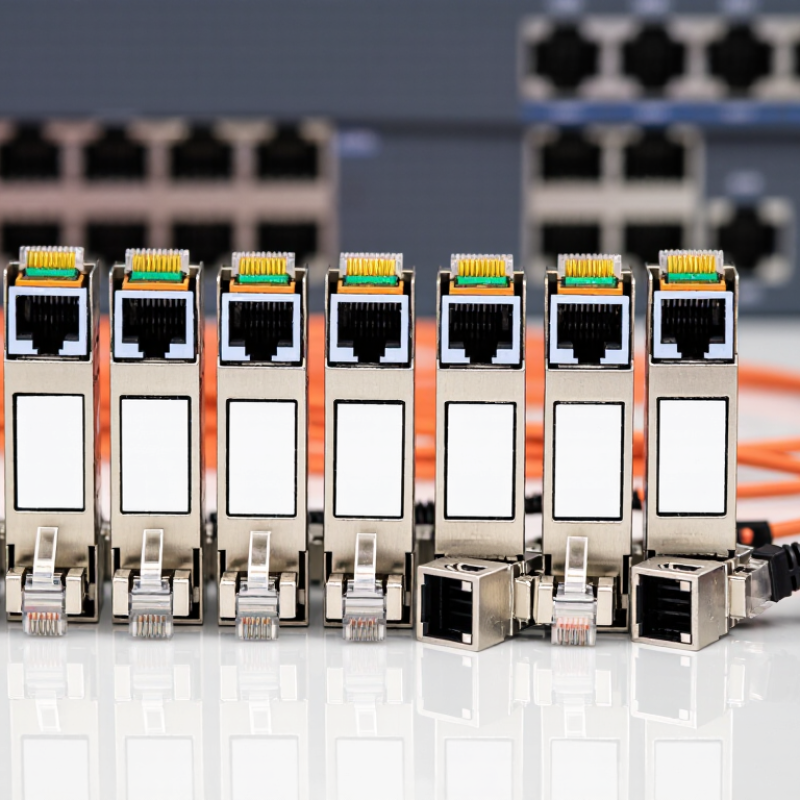
A 10G SFP+ copper module provides a 10-gigabit Ethernet connection through an RJ45 port. It converts the switch’s electrical interface for twisted-pair cabling, making it useful when existing copper runs must remain in place. It is not the same as a passive direct-attach cable. Small, but warm. Power draw and airflow matter, especially when several modules sit side by side.
A distance figure needs careful reading. IEEE 802.3an-2006 specifies 10GBASE-T operation over up to 100 metres of Category 6A cabling. That standard limit does not mean every SFP+ copper module reaches 100 metres. Many module specifications cap operation at 30 metres, reflecting the power and heat constraints of the compact form factor. Check the module’s stated cable category, reach, and supported switch platform before ordering. A neat-looking specification can still leave out a key compatibility detail.
For a rack link, a short Cat6A patch cable may be practical; for a longer building run, verify the exact module rating and installed cable grade. The Ethernet Alliance’s 2023 Ethernet Roadmap documents 10GbE as part of the broader Ethernet speed landscape, while IEEE defines the physical-layer reach. These sources answer different questions. I would not treat a standard’s maximum as a promise for every module. Check the actual datasheet, then test the link under normal rack temperatures.

A copper SFP+ module converts the switch’s electrical interface into 10GBASE-T, allowing a standard twisted-pair Ethernet cable to carry 10-Gigabit Ethernet. Inside, digital signal processing manages complex signaling across four cable pairs. That makes it useful when connecting a switch to a nearby server with existing copper cabling. No fiber patch cord is needed.
The Ethernet Alliance’s Ethernet Roadmap identifies 10GBASE-T operation over up to 100 meters of Category 6A cable, in line with the IEEE 802.3an standard. But that reach describes the cabling standard, not every SFP+ module. Many copper modules specify shorter distances, often because compact transceivers face power and heat limits. A warm module in a densely packed switch is worth checking. The trade-off is easy to miss.
Tips: Check the module’s stated reach, switch compatibility, and port power limits before installation. Use certified Category 6A cable for longer links, and inspect the cable route for tight bends or damaged connectors. For very short connections, a direct-attach copper cable may use less power. Measure the actual link, too. Standardized does not mean effortless.
A useful comparison starts with the link, not the “10G” label. IEEE 802.3an specifies 10GBASE-T over suitable twisted-pair cabling, with up to 100 metres on Category 6A. The Ethernet Alliance’s Ethernet Roadmap also tracks 10GbE as an established Ethernet speed. However, that 100-metre channel figure does not automatically apply to an SFP+ copper module. Many compact modules specify shorter reaches, often around 30 metres, because power and heat are limiting factors. Check the module’s own reach rating.
Compare supported data rate, cable category, maximum distance, power consumption, operating temperature, and host-device compatibility. Latency matters too, especially for storage or low-latency links; use the published module specification rather than assuming all copper transceivers behave alike. Heat matters. A module that works in an open test bench may run hotter inside a densely populated switch. I would not rely on the connector alone: an RJ45 fit does not prove the host supports that module’s power draw or coding.
A useful comparison of ten 10G SFP+ copper modules starts with the link, not the price. These modules connect an SFP+ port to a standard twisted-pair Ethernet cable, often with an RJ45 jack. They suit short connections to servers, switches, and test equipment. Many support up to 30 metres, but the stated reach depends on cable category and module design. Check the datasheet for supported 10GBASE-T operation, power draw, and temperature range. Small details matter.
When comparing ten options, match each module to the host switch and the cable route. Some ports restrict supported transceivers, and high power use can increase heat inside a crowded switch. A module that works on a bench may behave differently in a warm rack. For global purchasing, confirm the seller’s compatibility list, warranty terms, and delivery requirements for your destination. These checks are easy to skip. That can be costly.
Tips: Use certified Cat6A cable for demanding 10G links, keep cable runs within the module’s rated distance, and test the connection under normal rack temperatures. If a link drops, inspect cable quality and port settings before replacing hardware. The specification sheet is helpful, though real installations can still surprise you.
| No. | Module Buyer Profile | Network Interface | Copper Port and Cabling | Typical Reach Guidance | Speed Support | Key Compatibility Check | Best-Fit Use Case |
|---|---|---|---|---|---|---|---|
| 1 | Standard 10GBASE-T, 30 m class | SFP+ host interface; 10GBASE-T Ethernet | RJ-45; Category 6A or better recommended | Up to 30 m when specified for that module and installed channel | 10 Gbps | Confirm the switch or server supports 10GBASE-T SFP+ modules and their power and thermal requirements. | General-purpose 10G links in access and aggregation networks |
| 2 | Short-run rack connection | SFP+ host interface; 10GBASE-T Ethernet | RJ-45; Category 6A patch cabling is a practical choice | Use within the module's published limit; short rack links are well below 30 m | 10 Gbps | Check port-level compatibility and airflow, especially in densely populated switches. | Top-of-rack switches, nearby servers, and equipment in the same rack |
| 3 | Multi-rate 1G/10G option | SFP+ host interface; copper Ethernet | RJ-45; cabling category and channel length depend on negotiated speed | Follow the module datasheet for each supported speed | 1 Gbps and 10 Gbps only when explicitly supported | Both the module and host port must support the required rate; do not assume automatic multi-rate operation. | Networks migrating selected links from 1G to 10G |
| 4 | NBASE-T-capable option | SFP+ host interface; multi-rate copper Ethernet | RJ-45; Category 6A is suitable for demanding 10G channels | Reach varies by negotiated rate, cable category, and module design | 2.5G or 5G, and possibly 1G/10G, only if listed in the datasheet | Verify rate support end-to-end, including the host port, module firmware, and connected device. | Wi-Fi access points and other devices using intermediate Ethernet rates |
| 5 | Commercial-temperature option | SFP+ host interface; 10GBASE-T Ethernet | RJ-45; Category 6A or better recommended for 10G links | Use the rated reach stated for the selected module | 10 Gbps | Commercial temperature ratings commonly start at 0°C; verify the exact operating range and equipment environment. | Climate-controlled offices, server rooms, and data centers |
| 6 | Extended-temperature option | SFP+ host interface; 10GBASE-T Ethernet | RJ-45; cabling must meet the specified Ethernet channel requirements | Use the rated reach stated for the selected module | 10 Gbps | Some models offer extended ranges such as −40°C to 85°C; confirm the rating for the exact product and host. | Outdoor cabinets and facilities with wider temperature variation |
| 7 | Power-conscious deployment option | SFP+ host interface; 10GBASE-T Ethernet | RJ-45; Category 6A or better recommended | Reach is model-specific and should not be inferred from power rating | 10 Gbps | 10GBASE-T SFP+ modules can draw more power and produce more heat than many optical modules; check the host's per-port limits. | Deployments where switch power budgets and cooling capacity are limited |
| 8 | High-density switch deployment option | SFP+ host interface; 10GBASE-T Ethernet | RJ-45; cable routing should preserve access and airflow | Stay within the module's published reach, typically up to 30 m for this module class | 10 Gbps | Check whether the switch restricts copper-module placement or simultaneous use because of heat or power. | Switches with many populated SFP+ ports |
| 9 | Structured-cabling upgrade option | SFP+ host interface; 10GBASE-T Ethernet | RJ-45; Category 6A or better is recommended for reliable 10GBASE-T channel performance | Channel performance depends on the complete installed cabling system and module rating | 10 Gbps | Check cable certification, patch panels, connectors, and total channel length—not just the horizontal cable. | Buildings standardizing copper Ethernet links at 10G |
| 10 | Interoperability-focused option | SFP+ host interface; 10GBASE-T Ethernet | RJ-45; Category 6A or better recommended | Confirm the module's reach rating for the intended cable and operating conditions | 10 Gbps; additional rates are model-dependent | Check the equipment compatibility list, supported coding, firmware requirements, and return policy before purchase. | Global buyers sourcing modules for mixed-vendor network environments |
Buyer note: These are representative buyer profiles, not a product test ranking. Specifications vary by module. Confirm the exact datasheet, host-device compatibility, cabling channel, operating temperature, power budget, and applicable regional requirements before ordering.
A 10G SFP copper module can connect an SFP+ switch port to familiar RJ45 cabling, but physical fit alone does not guarantee compatibility. Check the device’s supported module list, port mode, and firmware notes before ordering. Some ports accept only specific electrical and thermal profiles. That detail gets missed. A module may also draw more power and generate more heat than an optical transceiver, especially in a densely populated switch.
Cable choice shapes the usable link. Cat6A is a practical option for runs up to 100 metres when the module supports that distance and the installation meets cable specifications. Cat6 may work over shorter distances, but performance depends on cable quality, termination, and interference. Keep patch leads away from power cables where possible. Test the installed channel, not just the cable on its spool.
Plan around the actual distance and airflow. A copper module’s supported reach can be shorter than the cable standard’s maximum, so verify its data sheet before deployment. Monitor port temperature and link stability after installation. Not always. A link that comes up during a bench test may behave differently in a warm, fully loaded rack. Leave room for airflow, label both cable ends, and record the module type and negotiated speed for later troubleshooting.


For those larger-sized parts, or smaller quantity runs, we have 2 independent powder coat booths and ovens. The quality, durability and affordability of today’s powder coating finishes make this the process of choice for world-class companies.
Powder coating advantages over other forms of coating are many. Materials used in the Powder coating process can be metals and non-metals that come in a multitude of thicknesses, textures, colors, etc. Another of Powder coating’s biggest advantages over conventional coatings is its ability to create finishes in many different textures. Powder Coating Booths allow us the ability to apply these advantages to large products.
Tri-State Fabricators runs a full-service conveyor line for painting. Wet painting can provide protection or decoration to many different part styles. From start to finish, every project is easier to undergo random and point-based inspection by our skilled painting team.
Advantages to our Wet Paint Line are these lines start with product prep and ends with a thorough inspection of a high quality finished product. Our ability to complete large and small projects with a superior finish and doing so in a timely and economical fashion. This passes along the savings in production to our customers. When powder coating ins not an option, our Wet Paint Line gets the job done right the first time.
When the parts get big and heavy we roll-out our custom paint racks and oversize booth. By utilizing our partnerships with all the major paint brands, we can match virtually any color with wet paint.
The advantages of having access to a Wet Paint Booth are many. Large projects of many different shapes can be loaded into the booth. The Wet Paint Booth offers an environment that is much more controlled than a typical parts painting operation.
Not only are they used because of their controlled environment, but they’re are also advantageous when it comes to applying paint to parts that are needed in industries that require specialty coatings such as medical, aerospace, etc.
Our military forces have some very high standards when it comes to the finish of their vehicles and equipment. From the first pre-treatment step to final coat, it takes a great deal of knowledge and experience to protect the men and women of our armed forces. They deserve only the best, and Tri-State Fabricators provides it.
All of our processes are closely monitored by our staff and management teams. Both of which are highly trained in the processes of metal fabrication and finishing. Tri-State Fabricators’ goal is to always fully satisfy each and every customer, including the military. We will always put a 110% into what we do.
Abrasive media blasting is an excellent way to remove old paint, rust, and increase the paint/powder adhesion. Glass beads produce a much smoother and brighter finish than angular abrasives; leaving the part clean yet without any dimensional change. Chemically inert and environmentally friendly, we can recycle our beads approximately 30 times; making them a more preferred method of metal cleaning or surface finishing.
Advantages to Glass Bead Blasting are many. Glass bead blast media is used when a project is needing rough surfaces need to become smooth for applications of coatings such as paint. It is typically used to clean paint and rust from a product surface without deforming the surface it is being used on. Overall, compared to many other blasting media, Glass Bead Blasting is a very economical choice and those savings are always passed on to our customers.
Tri-State Fabricators utilize a zinc phosphate wash to clean and etch the material to ensure the best paint adhesion possible. The unique design of our 3-stage wash system does the work like a 5-stage. From Cleaning and rinsing to conversion coating and post-treatment, Our Part Washing process is a complete service and works throughout the fabrication service and the finishing service.
Along with the previously mentioned benefits, Curing is a vital chemical reaction that leaves the product finish hard and relatively safe from mild abrasion and aggressive corrosion. This process can be done in more than one way; ambient air-dry or in curing ovens at temps that exceed 240°.
From fixing paint mistakes (someone else’s of course) to simply cleaning our paint line hooks, our burn-off oven is put to good use. After a quick burn-off, a little clean up, and a fresh coat of paint, your parts will look better than new.
Why does our Burn-Off Oven work so well? Because super heating the air around parts turns the materials into ashes. From paint and powder coatings to rubber and machining oils, high temps do the job without degrading the integrity of the part.
Masking is a vital part of producing high quality products. We have die-cut masking patterns to protect machined surfaces as well as a wide range of plugs and caps to protect threaded holes and bolts. We provide permanent and temporary masking.
Masking allows the selected sections of a product to be protected from a fabrication or finishing service. This can be with both chemicals when etching and tapes, paints when only finishing just a section of the product. Masking is great in aiding the customization process of a project.
Screen printing is a photographic process that transfers artwork onto a porous nylon screen which allows colored ink to flow through the screen and be deposited on an aluminum or plastic component. We can generally have just about any design created onto a screen for your parts.
Some of the advantages of Screen Printing are, brand recognition for your business displaying on your products, assembly instructions, product warnings/hazards, etc. Tri-State Fabricators produces Screen Printing of the highest quality so you know it’s durable.
Metal Finishing is the art of treating the exterior portion of product, often metal but can also be made of other materials, so that the surface is clean and free of any debris. Then the process of applying coats or either paint of powder coat takes place. This coating process improves the quality of the product in both appearance and resistance to wear and corrosion.
Tri-State Fabricators, Inc., understands that a project typically isn’t complete until a high-quality finish has been added to your product. This is why our painting and powder coating teams continuously inspect the products throughout the Metal Finishing process.

