


Choosing reliable Bait Bayonet Rigs starts with more than comparing prices. A rig may look suitable in a product photo, yet details such as hook size, bait-stop length, and component material determine whether it fits your fishing setup. Check the specifications carefully. If a listing omits them, ask the seller before placing an order.
This guide introduces ten practical checks for sourcing rigs from dependable suppliers. Look for clear product descriptions, consistent measurements, secure packaging, and responsive customer support. A close-up image can help you inspect the bait bayonet and hook connection; it cannot confirm durability on its own. Read recent buyer feedback, but treat broad claims like “works for every bait” with caution. Bait size, texture, and presentation can vary, so compatibility is not always universal.
Small details matter. A loose swivel or uneven finish may be easy to miss in a crowded listing. Compare samples when possible, and keep notes on what performs well in your conditions. One honest caveat: the cheapest option is not always poor quality, and the most polished listing is not proof of better construction. There is room for judgment. Use these tips to ask sharper questions, verify what you can, and choose Bait Bayonet Rigs that match your intended use rather than relying on marketing alone.
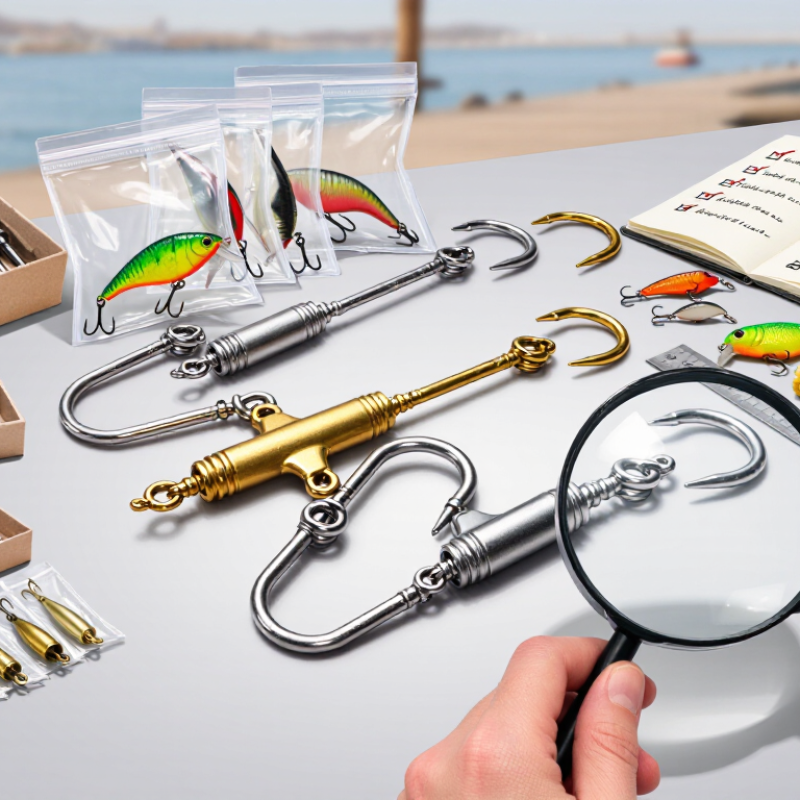
A bait bayonet rig has a few small parts, and each affects how the bait sits. The hook carries the load; its point must remain exposed after the bait is mounted. A short bayonet, fixed beside the hook shank, pierces firm boilies or similar baits. Match its length to the bait: too short, and the bait may slip; too long, and it can wobble. Add a bait stop to keep it in place. Simple, but important.
The hooklink connects the hook to the swivel or main-line connection. Its material and stiffness influence how the hook turns and settles on the bottom.
The American Sportfishing Association’s 2023 Special Report on Fishing estimated that 57.7 million Americans fished in 2022. NOAA’s 2022 National Survey of Fishing, Hunting, and Wildlife-Associated Recreation recorded 39.9 million freshwater anglers and 14.4 million saltwater anglers. Those different settings call for different rig choices; one setup is not ideal everywhere.
Check the finished rig over a damp mat or tray. Pull the bait gently, inspect the knot, and make sure the hook point is clear. A swivel can reduce line twist, but extra hardware may also make a compact rig clumsy. That trade-off deserves a second look. Test the rig with the actual bait, since buoyancy and shape change its balance.

Choosing a bait bayonet rig starts with the fish you hope to catch. For carp, match the hook size and gape to the bait’s diameter, so the bait does not crowd the hook point. A short bayonet can hold a firm boilie neatly; softer baits may slip or tear during casting. Check that the hook sits freely beside the bait. Small details matter.
Tip: For wary fish feeding on small baits, choose a compact rig with a fine, sharp hook. Test it beside the bank before casting. The hook should turn when gently drawn across your palm, but avoid forcing the test. Water clarity, bottom debris, and fish behavior can change what works. I have found that one setup rarely suits every session.
Tip: For larger target species or heavier cover, prioritize a suitably strong hook and abrasion-resistant rig materials. Keep the bait size proportional, and inspect the bayonet after each cast. If the bait spins or masks the hook, adjust its position or try another size. A tidy presentation helps, though it is not a guarantee. I still sometimes choose the wrong bait first; checking the rig early saves wasted casts.
When sourcing bait bayonet rigs, check the hook’s stated steel grade and coating, not just a “rust-resistant” claim. Ask suppliers for material specifications and batch-level inspection records. A smooth, even coating matters: look for bare spots near the eye, rough edges, or flakes around the bend. Small defects can become weak points after repeated use.
Hook geometry should suit the bait and target species. Compare point alignment, barb size, and wire thickness across samples; a point that catches fabric easily may still be poorly aligned. Bayonets should hold bait securely without splitting it. Check their length, tip shape, and attachment under a gentle pull. FAO’s The State of World Fisheries and Aquaculture 2024 reports 223.2 million tonnes of global aquatic animal and algae production in 2022. That figure shows the scale of the sector, not a performance measure for rigs. Keep that distinction clear. I would also test samples in the water conditions they will face, since paper specifications cannot reveal every coating weakness. Ask how defects are handled before placing a large order.
A practical checklist for evaluating materials, hooks, and bayonet design.
Suggested evaluation priorities on a 1–5 scale, where 5 is most important. Check corrosion resistance and hook sharpness and strength first; then assess bayonet fit, bait retention, and rig alignment. Scores are a practical checklist, not laboratory test results.
For bait bayonet rigs, a clear specification beats a polished catalogue photo. Record hook size, wire diameter, bayonet length, coating, and dimensional tolerances. Ask suppliers to state how each measurement is checked and how many units are sampled per production lot. Small details matter. A bayonet that sits crooked can tear soft bait; an oversized barb may split a small boilie.
Request a current quality-system certificate, its scope, and the inspection records for the actual production site. The ISO Survey of Management System Standard Certifications reported more than 1.26 million ISO 9001 certificates worldwide in 2022. Certification indicates a documented system, not that every rig is defect-free. Ask for lot traceability, a defined pull-test method, and the pass limit. If rigs may be used in brackish water, specify the corrosion test conditions too.
The U.S. Fish and Wildlife Service’s 2022 National Survey counted 39.9 million anglers aged 16 and older. That broad participation figure makes consistency commercially relevant, but it does not prove demand for any particular rig. Compare production samples with the approved specification: measure several bayonets, inspect hook points under bright light, and check coatings for bare patches. I would also keep one sample from each accepted lot. It is a slightly fussy habit, and occasionally the notes are incomplete; that is a reason to improve the record, not ignore the mismatch.
When comparing bait bayonet rig suppliers, check what each quoted price actually covers. A low unit cost may exclude hooks, swivels, sleeves, or protective packaging. Ask for an itemized quote, then compare identical rig lengths, line strengths, and component materials. Small details matter. Request photos or a sample if the finish or knot quality is unclear. It is tempting to rank offers by unit price alone; that shortcut can mislead. I would still double-check whether the specifications match before judging value.
Minimum order quantities can change the real cost. A large first order may lower the price per rig but leave you with stock that sells slowly. Ask whether suppliers allow mixed sizes or a smaller trial batch, and confirm any setup fees. Delivery needs the same attention. Compare standard and expedited options, estimated dispatch dates, tracking, packaging, and shipping charges. Ask what happens if production runs late. A cheaper offer with an uncertain delivery window may not suit a seasonal launch. I might overlook that timing detail when comparing spreadsheets, so it helps to record total cost and expected arrival side by side.


For those larger-sized parts, or smaller quantity runs, we have 2 independent powder coat booths and ovens. The quality, durability and affordability of today’s powder coating finishes make this the process of choice for world-class companies.
Powder coating advantages over other forms of coating are many. Materials used in the Powder coating process can be metals and non-metals that come in a multitude of thicknesses, textures, colors, etc. Another of Powder coating’s biggest advantages over conventional coatings is its ability to create finishes in many different textures. Powder Coating Booths allow us the ability to apply these advantages to large products.
Tri-State Fabricators runs a full-service conveyor line for painting. Wet painting can provide protection or decoration to many different part styles. From start to finish, every project is easier to undergo random and point-based inspection by our skilled painting team.
Advantages to our Wet Paint Line are these lines start with product prep and ends with a thorough inspection of a high quality finished product. Our ability to complete large and small projects with a superior finish and doing so in a timely and economical fashion. This passes along the savings in production to our customers. When powder coating ins not an option, our Wet Paint Line gets the job done right the first time.
When the parts get big and heavy we roll-out our custom paint racks and oversize booth. By utilizing our partnerships with all the major paint brands, we can match virtually any color with wet paint.
The advantages of having access to a Wet Paint Booth are many. Large projects of many different shapes can be loaded into the booth. The Wet Paint Booth offers an environment that is much more controlled than a typical parts painting operation.
Not only are they used because of their controlled environment, but they’re are also advantageous when it comes to applying paint to parts that are needed in industries that require specialty coatings such as medical, aerospace, etc.
Our military forces have some very high standards when it comes to the finish of their vehicles and equipment. From the first pre-treatment step to final coat, it takes a great deal of knowledge and experience to protect the men and women of our armed forces. They deserve only the best, and Tri-State Fabricators provides it.
All of our processes are closely monitored by our staff and management teams. Both of which are highly trained in the processes of metal fabrication and finishing. Tri-State Fabricators’ goal is to always fully satisfy each and every customer, including the military. We will always put a 110% into what we do.
Abrasive media blasting is an excellent way to remove old paint, rust, and increase the paint/powder adhesion. Glass beads produce a much smoother and brighter finish than angular abrasives; leaving the part clean yet without any dimensional change. Chemically inert and environmentally friendly, we can recycle our beads approximately 30 times; making them a more preferred method of metal cleaning or surface finishing.
Advantages to Glass Bead Blasting are many. Glass bead blast media is used when a project is needing rough surfaces need to become smooth for applications of coatings such as paint. It is typically used to clean paint and rust from a product surface without deforming the surface it is being used on. Overall, compared to many other blasting media, Glass Bead Blasting is a very economical choice and those savings are always passed on to our customers.
Tri-State Fabricators utilize a zinc phosphate wash to clean and etch the material to ensure the best paint adhesion possible. The unique design of our 3-stage wash system does the work like a 5-stage. From Cleaning and rinsing to conversion coating and post-treatment, Our Part Washing process is a complete service and works throughout the fabrication service and the finishing service.
Along with the previously mentioned benefits, Curing is a vital chemical reaction that leaves the product finish hard and relatively safe from mild abrasion and aggressive corrosion. This process can be done in more than one way; ambient air-dry or in curing ovens at temps that exceed 240°.
From fixing paint mistakes (someone else’s of course) to simply cleaning our paint line hooks, our burn-off oven is put to good use. After a quick burn-off, a little clean up, and a fresh coat of paint, your parts will look better than new.
Why does our Burn-Off Oven work so well? Because super heating the air around parts turns the materials into ashes. From paint and powder coatings to rubber and machining oils, high temps do the job without degrading the integrity of the part.
Masking is a vital part of producing high quality products. We have die-cut masking patterns to protect machined surfaces as well as a wide range of plugs and caps to protect threaded holes and bolts. We provide permanent and temporary masking.
Masking allows the selected sections of a product to be protected from a fabrication or finishing service. This can be with both chemicals when etching and tapes, paints when only finishing just a section of the product. Masking is great in aiding the customization process of a project.
Screen printing is a photographic process that transfers artwork onto a porous nylon screen which allows colored ink to flow through the screen and be deposited on an aluminum or plastic component. We can generally have just about any design created onto a screen for your parts.
Some of the advantages of Screen Printing are, brand recognition for your business displaying on your products, assembly instructions, product warnings/hazards, etc. Tri-State Fabricators produces Screen Printing of the highest quality so you know it’s durable.
Metal Finishing is the art of treating the exterior portion of product, often metal but can also be made of other materials, so that the surface is clean and free of any debris. Then the process of applying coats or either paint of powder coat takes place. This coating process improves the quality of the product in both appearance and resistance to wear and corrosion.
Tri-State Fabricators, Inc., understands that a project typically isn’t complete until a high-quality finish has been added to your product. This is why our painting and powder coating teams continuously inspect the products throughout the Metal Finishing process.

