7 Tips for Choosing the Best Ring Terminal Lugs

Choosing Ring Terminal Lugs is not a small detail; it affects how securely a wire meets a stud and how well the connection holds up over time. A lug can look suitable on a workbench, then prove awkward in a crowded control panel. Fit matters. So does the environment around it.

Electrical educator Mike Holt is a useful reference for safe wiring practice. Rather than inventing a verbatim quote from him, this guide uses a plain-language paraphrase of that principle: “A dependable electrical connection begins with the correct parts and careful installation.” The reminder is simple, but real installations are not always tidy. Vibration, moisture, heat, wire-strand count, and limited clearance can all change which lug is appropriate.

This guide’s seven tips will help compare conductor size, stud-hole diameter, material, insulation, plating, and crimp compatibility. Check the wire gauge against the lug marking, then confirm the barrel accepts the conductor properly. A lug that is too loose can shift; one that is too small may damage strands during installation. Look closely. Small markings matter.

We will also consider copper and aluminum applications, corrosion exposure, and the tooling needed for a consistent crimp. Product labels and manufacturer instructions should guide the final choice. One detail is easy to miss: a visually neat crimp does not, by itself, prove a reliable connection. Use the right die, inspect the finished joint, and pause when a specification is unclear. That extra check may feel fussy. It is often worthwhile.
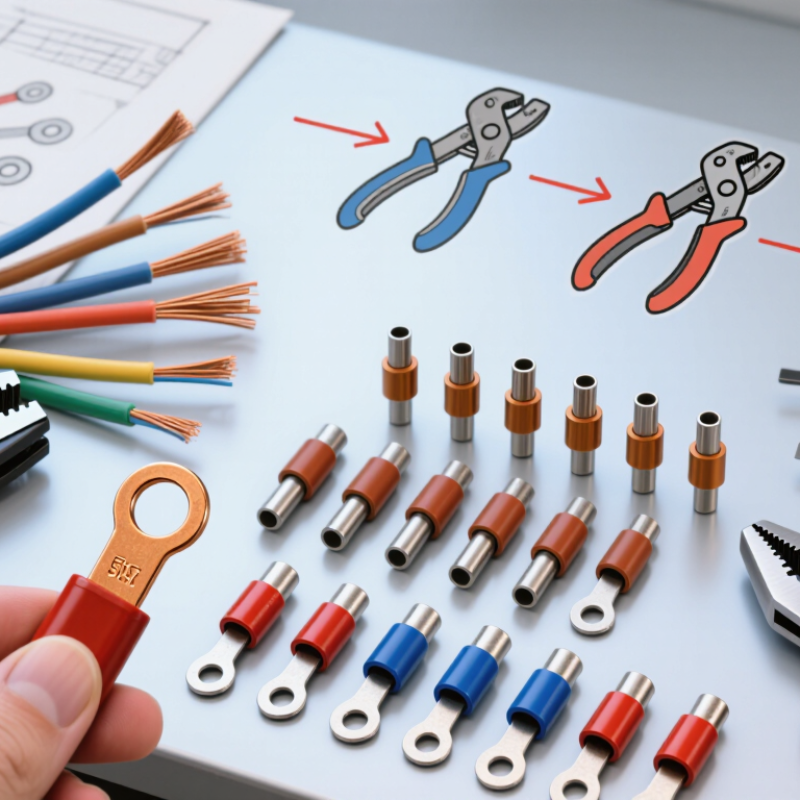
7 Tips for Choosing the Best Ring Terminal Lugs

Define Circuit Voltage, Current, and Cable Type Using ISO 6722-1

Before selecting a ring terminal lug, write down the circuit’s nominal voltage, peak current, and cable construction. ISO 6722-1:2011 covers single-core road-vehicle cables rated for 60 V or 600 V systems. Use its cable requirements to check that the insulation and conductor type suit the application; do not treat the voltage class as proof that a cable can carry a particular current. Current capacity also depends on conductor area, ambient heat, bundling, and operating time. Heat changes everything.

Match the lug barrel to the cable’s actual conductor size and type, then confirm the stud diameter and available space. A loose barrel fit can raise resistance; a poor crimp can loosen under vibration. The IEA’s Global EV Outlook 2024 reports nearly 14 million electric-car sales worldwide in 2023, highlighting the growing need for carefully specified vehicle wiring. Still, higher-voltage systems are only part of the picture. It is easy to over-trust a printed ampacity, so check the vehicle maker’s wiring specification and the lug maker’s crimp guidance before installation. I would recheck the cable insulation temperature rating, too; that detail is easy to overlook.

Match Lug Barrel Capacity to AWG and mm² Conductor Sizes

A ring terminal lug should match the conductor’s cross-sectional area, not just its outside diameter. AWG and mm² are different sizing systems, so check a reliable conversion chart or the lug maker’s sizing table. A 10 AWG wire and a 6 mm² wire are close in size, but they are not always interchangeable for every lug. Stranding matters, too. Fine-stranded cable may fit differently from solid wire. Check the specified wire range and strip length before crimping.

Tip: Match both the conductor size and the barrel capacity. If a lug lists AWG sizes but your wire is marked in mm², confirm the fit with the manufacturer’s chart. Don’t force an oversized conductor into a small barrel, or cut strands to make it fit. That shortcut can weaken the connection. Easy to miss.

Use the recommended crimping die for the lug and conductor combination. The wire should fill the barrel without loose strands or excessive gaps. After crimping, inspect the joint and give the wire a firm pull. A secure-looking crimp can still be poor. If the barrel capacity is unclear, pause and verify it; guessing here is tempting, but not worth the uncertainty.

Choose Ring-Hole Diameter to Fit M4, M5, M6, or SAE Studs

7 Tips for Choosing the Best Ring Terminal Lugs

A ring terminal must fit the stud, not just the wire. M4, M5, and M6 refer to metric stud diameters of about 4, 5, and 6 millimeters. The lug hole needs a little clearance to slide over the stud, but excessive movement can reduce contact stability. A caliper check is useful when the hardware label is unclear.

Tip: Match the opening to the measured stud. For an M5 stud, choose a lug listed for M5 rather than guessing from appearance. SAE sizes use inch measurements, and their labels can be easy to confuse. Measure the stud’s shank, then check the lug maker’s fit specifications. It takes a moment.

Before crimping, confirm that the barrel suits the wire gauge and that the ring sits flat against the connection surface. A hole that is too small may bind; one that is much too large can shift during installation. I would recheck the fit before applying the specified tightening torque. It is easy to overlook a washer or nearby obstruction, so check the full stack-up too. A neat-looking connection is not proof of a secure one.

Compare Copper and Tin-Plated Lugs Against UL 486A-486B Ratings

Copper and tin-plated ring terminals solve different problems. Copper conducts well and suits many electrical connections, while tin plating adds a protective surface that can help resist oxidation. That matters in damp or corrosive settings. But plating does not make every lug suitable for every environment.

UL 486A-486B references requirements for wire connectors, but a standard number alone is not enough. Check that the exact terminal is certified for its conductor material, wire size, and intended application. Confirm the permitted temperature and the specified crimping tool, too. A lug that fits the wire may still be a poor match for the installation.

It is easy to overvalue “tin-plated” as a sign of higher quality; it is not automatically the better choice. Compare the certification details and manufacturer instructions, then select the material and finish for the actual conditions.

Small details count.

A loose crimp or mismatched conductor can undermine an otherwise suitable terminal.

Verify Crimp Tool and Die Compatibility With the Lug Manufacturer’s Specifications

A crimp can look neat and still be electrically weak. The tool and die must match the lug’s specified conductor range, material, and barrel design. NASA-STD-8739.4, a workmanship standard for crimped interconnections, emphasizes controlled tooling and inspection. IEC 61238-1 also evaluates compression and mechanical performance in cable connectors. These references are useful because a visual check alone cannot confirm a reliable crimp. Small details matter.

Tips: Check the lug maker’s tool-and-die chart before crimping. Confirm the die code, wire size, and lug series—not just the tool’s general capacity. Inspect the die faces for wear or damage. Make a sample crimp, then check its shape and pull strength against the maker’s instructions. I still double-check the chart when changing lug sizes; assumptions are easy to make.

Keep the tool calibrated where the manufacturer requires it, and record the tool ID for repeat work. UL 486A-486B covers safety and performance requirements for wire connectors, including connection testing. Its test requirements vary with connector type and conductor size, so do not substitute a generic pull-force target. A slightly flattened barrel may be normal for one die profile and wrong for another. Match the specification, then inspect the finished connection.


Powder Coat Booths

For those larger-sized parts, or smaller quantity runs, we have 2 independent powder coat booths and ovens. The quality, durability and affordability of today’s powder coating finishes make this the process of choice for world-class companies.

Powder coating advantages over other forms of coating are many. Materials used in the Powder coating process can be metals and non-metals that come in a multitude of thicknesses, textures, colors, etc. Another of Powder coating’s biggest advantages over conventional coatings is its ability to create finishes in many different textures. Powder Coating Booths allow us the ability to apply these advantages to large products.

Wet Paint Line

Tri-State Fabricators runs a full-service conveyor line for painting. Wet painting can provide protection or decoration to many different part styles. From start to finish, every project is easier to undergo random and point-based inspection by our skilled painting team.

Advantages to our Wet Paint Line are these lines start with product prep and ends with a thorough inspection of a high quality finished product. Our ability to complete large and small projects with a superior finish and doing so in a timely and economical fashion. This passes along the savings in production to our customers. When powder coating ins not an option, our Wet Paint Line gets the job done right the first time.

Wet Paint Booths

When the parts get big and heavy we roll-out our custom paint racks and oversize booth. By utilizing our partnerships with all the major paint brands, we can match virtually any color with wet paint.

The advantages of having access to a Wet Paint Booth are many. Large projects of many different shapes can be loaded into the booth. The Wet Paint Booth offers an environment that is much more controlled than a typical parts painting operation.

Not only are they used because of their controlled environment, but they’re are also advantageous when it comes to applying paint to parts that are needed in industries that require specialty coatings such as medical, aerospace, etc.

Military CARC

Our military forces have some very high standards when it comes to the finish of their vehicles and equipment. From the first pre-treatment step to final coat, it takes a great deal of knowledge and experience to protect the men and women of our armed forces. They deserve only the best, and Tri-State Fabricators provides it.

All of our processes are closely monitored by our staff and management teams. Both of which are highly trained in the processes of metal fabrication and finishing. Tri-State Fabricators’ goal is to always fully satisfy each and every customer, including the military. We will always put a 110% into what we do.

Glass-Bead Blasting

Abrasive media blasting is an excellent way to remove old paint, rust, and increase the paint/powder adhesion. Glass beads produce a much smoother and brighter finish than angular abrasives; leaving the part clean yet without any dimensional change. Chemically inert and environmentally friendly, we can recycle our beads approximately 30 times; making them a more preferred method of metal cleaning or surface finishing.

Advantages to Glass Bead Blasting are many. Glass bead blast media is used when a project is needing rough surfaces need to become smooth for applications of coatings such as paint. It is typically used to clean paint and rust from a product surface without deforming the surface it is being used on. Overall, compared to many other blasting media, Glass Bead Blasting is a very economical choice and those savings are always passed on to our customers.

Part Washing

Tri-State Fabricators utilize a zinc phosphate wash to clean and etch the material to ensure the best paint adhesion possible. The unique design of our 3-stage wash system does the work like a 5-stage. From Cleaning and rinsing to conversion coating and post-treatment, Our Part Washing process is a complete service and works throughout the fabrication service and the finishing service.

Along with the previously mentioned benefits, Curing is a vital chemical reaction that leaves the product finish hard and relatively safe from mild abrasion and aggressive corrosion. This process can be done in more than one way; ambient air-dry or in curing ovens at temps that exceed 240°.

Burn-Off Oven

From fixing paint mistakes (someone else’s of course) to simply cleaning our paint line hooks, our burn-off oven is put to good use. After a quick burn-off, a little clean up, and a fresh coat of paint, your parts will look better than new.

Why does our Burn-Off Oven work so well? Because super heating the air around parts turns the materials into ashes. From paint and powder coatings to rubber and machining oils, high temps do the job without degrading the integrity of the part.

Masking

Masking is a vital part of producing high quality products. We have die-cut masking patterns to protect machined surfaces as well as a wide range of plugs and caps to protect threaded holes and bolts. We provide permanent and temporary masking.

Masking allows the selected sections of a product to be protected from a fabrication or finishing service. This can be with both chemicals when etching and tapes, paints when only finishing just a section of the product. Masking is great in aiding the customization process of a project.

Screen Printing

Screen printing is a photographic process that transfers artwork onto a porous nylon screen which allows colored ink to flow through the screen and be deposited on an aluminum or plastic component. We can generally have just about any design created onto a screen for your parts.

Some of the advantages of Screen Printing are, brand recognition for your business displaying on your products, assembly instructions, product warnings/hazards, etc. Tri-State Fabricators produces Screen Printing of the highest quality so you know it’s durable.

Metal Finishing

Metal Finishing is the art of treating the exterior portion of product, often metal but can also be made of other materials, so that the surface is clean and free of any debris. Then the process of applying coats or either paint of powder coat takes place. This coating process improves the quality of the product in both appearance and resistance to wear and corrosion.

Tri-State Fabricators, Inc., understands that a project typically isn’t complete until a high-quality finish has been added to your product. This is why our painting and powder coating teams continuously inspect the products throughout the Metal Finishing process.



