What are Stair-Climbing Robot Tracks Advantages and Uses?
Stair-Climbing Robots Tracks are revolutionizing mobility solutions across various industries. These advanced tracks enable robots to ascend and descend stairs with ease, a feat not possible with traditional wheels. According to a report by MarketsandMarkets, the global market for robotic systems, including these innovative solutions, is projected to reach $74 billion by 2026. This growth indicates a significant demand for versatile robots that can navigate complex environments.
The advantages of Stair-Climbing Robots Tracks include enhanced accessibility. They are particularly valuable in healthcare settings, allowing for seamless transport of patients and medical equipment. Additionally, these robots play a vital role in logistics, improving efficiency in warehouses and distribution centers. However, the technology is still evolving. Manufacturers face challenges in optimizing battery life and weight distribution for increased load capacity.
By understanding the benefits and limitations of Stair-Climbing Robots Tracks, businesses can make informed decisions. Integrating these robots into operations can drastically improve performance. Nonetheless, continuous innovation is essential. As the industry progresses, refining these technologies will be crucial for maximizing their potential.
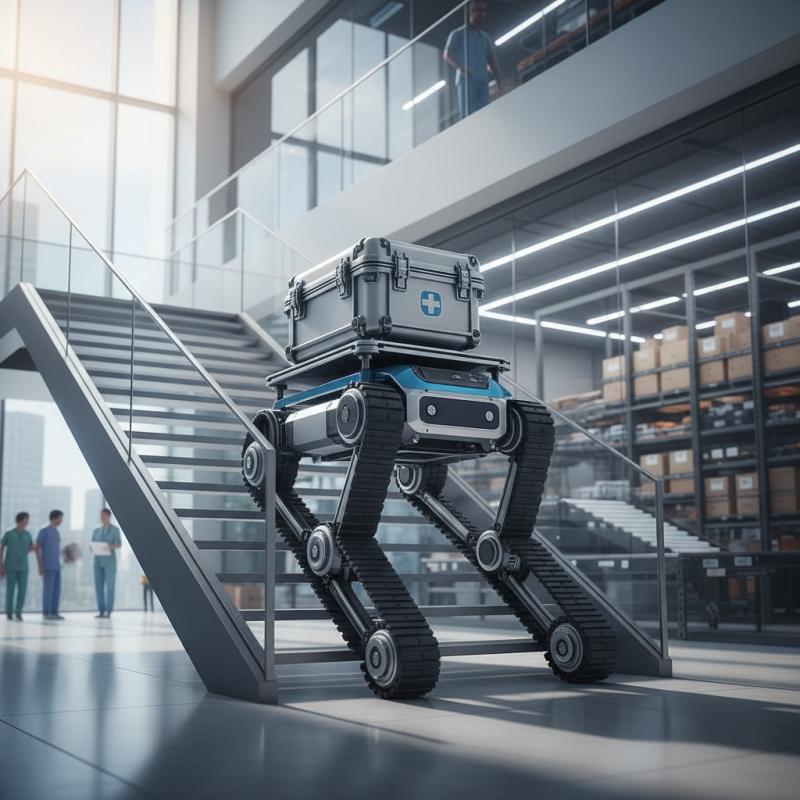
Advantages of Stair-Climbing Robot Tracks in Various Environments
Stair-climbing robot tracks offer notable advantages across diverse environments. These robots enhance mobility in settings where traditional wheeled vehicles struggle. For instance, staircases often hinder accessibility. According to industry reports, over 50% of building entries have steps, complicating transport and logistics. Stair-climbing robots effectively navigate these obstacles, providing essential support in various sectors.
In healthcare facilities, these robots are invaluable. They transport supplies and assist patients who require movement between floors. A report from the Robotics Industry Association highlights that these robots can reduce labor costs by up to 30%. Their efficiency translates into quicker response times, benefiting both staff and patients.
However, not all stair-climbing robots are perfect. Their reliance on precision sensors can lead to occasional miscalculations. This might result in delays or minor accidents. Continuous improvements in sensor technology and software are essential. Observing robotic behavior in real-life situations can shed light on potential shortcomings and opportunities for enhancement.
Key Features of Stair-Climbing Robots: Technical Aspects and Innovations
Stair-climbing robots have become a significant advancement in robotics. Their design incorporates specialized tracks that allow for smooth navigation over stairs and uneven surfaces. These tracks facilitate better grip and stability, which is essential for carrying out various tasks. The robots can be programmed for multiple environments, from construction sites to elderly care facilities.
One critical feature of these robots is their adaptability. They can detect different stair types and adjust their movements accordingly. This capability is vital for ensuring safety during operation. User feedback from various applications has shown that these robots greatly improve efficiency. However, users have noted limitations in battery life and terrain adaptability. These are areas needing further innovation.
The technology behind stair-climbing robots includes sensors, computer vision, and advanced algorithms. These elements work together to ensure precision in navigation. Despite their effectiveness, some users report issues with weight and size restrictions. Continuous improvements are necessary for broader applications. The evolving field of robotics promises exciting possibilities for more versatile stair-climbing devices.
Common Applications of Stair-Climbing Robots in Industries and Services
Stair-climbing robots are becoming essential across various industries. Their ability to traverse stairs can enhance efficiency in sectors like healthcare, logistics, and emergency services. In healthcare, these robots transport medical supplies or support patient movement in hospitals. A report from the International Federation of Robotics noted that the healthcare sector is expected to see a 24% increase in automation technologies by 2025.
In logistics, businesses are integrating stair-climbing robots to improve delivery systems. These robots can manage heavy loads in multi-level warehouses, reducing human labor and injury risks. According to a study from robotics.org, 60% of logistics companies are exploring automation, making it essential for competitiveness. However, scalability remains a challenge. Many organizations struggle to implement systems effectively across their networks due to varying infrastructure.
Emergency services also benefit from these robots. They can assist during evacuations or deliver supplies in inaccessible areas. Despite their advantages, there are concerns regarding their reliability and maintenance. The technology is still evolving, and not all stair-climbing robots perform equally well in different environments. Many users report needing regular updates, which can be resource-intensive. Balancing efficiency with practical limitations is crucial for the future of stair-climbing robots.
Comparison of Stair-Climbing Robot Tracks with Conventional Mobility Solutions
Stair-climbing robot tracks provide distinct advantages over conventional mobility solutions, particularly when navigating challenging terrains. Traditional wheel-based systems struggle on stairs and steep surfaces. In contrast, tracked systems distribute weight better, allowing for stability across uneven surfaces. According to the International Journal of Robotics Research, tracked robots exhibit a success rate of 90% in navigating stairs compared to just 60% for wheeled counterparts.
Moreover, stair-climbing robots can enhance accessibility in various settings. They are valuable in emergency response scenarios, ensuring swift transport of supplies or even injured individuals in multi-level spaces. The ability to ascend or descend stairs autonomously can save critical time. However, users should consider the limitations, like battery life and weight capacity. Some reports indicate that heavier robots can lose efficiency on steep inclines, necessitating ongoing adjustments and improvements in design.
Lastly, the practical application of these robots often leads to an increased operational cost. This can raise concerns for budget-conscious organizations. While the effectiveness of stair-climbing robots is clear, there is still room for enhancement in terms of materials and power systems. Continuous research is crucial for addressing these gaps and maximizing their potential in various sectors.
What are Stair-Climbing Robot Tracks Advantages and Uses? - Comparison of Stair-Climbing Robot Tracks with Conventional Mobility Solutions
| Feature | Stair-Climbing Robot Tracks | Conventional Mobility Solutions |
| Terrain Adaptability | Excellent, can navigate uneven surfaces and stairs | Limited, primarily designed for flat surfaces |
| Weight Capacity | Variable, can support heavy loads depending on design | Generally lower, limited by vehicle design |
| Energy Efficiency | High, optimized for climbing movements | Moderate, less efficient on inclines |
| Maneuverability | High, can navigate tight spaces and obstacles | Limited, usually requires more space to operate |
| Use Cases | Search and rescue, delivery, elderly assistance | Transportation, personal vehicles, basic logistics |
Future Trends and Developments in Stair-Climbing Robot Technology
The evolution of stair-climbing robot technology is reshaping industries like healthcare and logistics. Current advancements focus on enhancing mobility on uneven surfaces. Reports indicate that the global market for such robots may reach $4.3 billion by 2027, driven by aging populations and the need for efficient transport systems.
Research emphasizes the importance of stability and speed in robotic design. Recent prototypes have showcased capabilities to navigate complex staircases with ease. However, many still face challenges with terrain variations. Data from a 2022 study suggests that 35% of robots encountered difficulties on steep or irregular steps. This calls for ongoing innovation in adaptive navigation systems.
Looking ahead, integrating AI could revolutionize stair-climbing robots. These systems can learn from their environments for better performance. Yet, ethical considerations arise around safety and autonomy. Can these robots reliably assist in emergency situations? As development continues, industry experts urge careful evaluation of these technologies.





