


Smt Assembly is the process of mounting electronic components directly onto a printed circuit board, often using automated equipment. It enables manufacturers to place tiny resistors, capacitors, and integrated circuits with speed and repeatability. The global context is expanding: the WSTS Spring 2024 Forecast projected semiconductor sales of $611.2 billion in 2024, rising to $687.4 billion in 2025. These figures describe chip sales, not SMT production, but they show the scale of the component ecosystem that assembly lines serve.
A typical line begins with solder paste printed through a stencil onto copper pads. A placement machine then positions components, sometimes smaller than a grain of rice. The board passes through a reflow oven, where controlled heat melts the paste and forms electrical joints. Inspection systems check alignment and solder quality. The details matter. IPC J-STD-001 and IPC-A-610 provide widely used requirements and acceptance criteria for soldered assemblies. Yet no standard replaces process control: paste condition, board design, component handling, and oven settings can all affect results. A fast line can still produce defects. That is an easy point to overlook. Understanding what happens at each stage makes it easier to assess quality, troubleshoot failures, and choose suitable manufacturing controls.
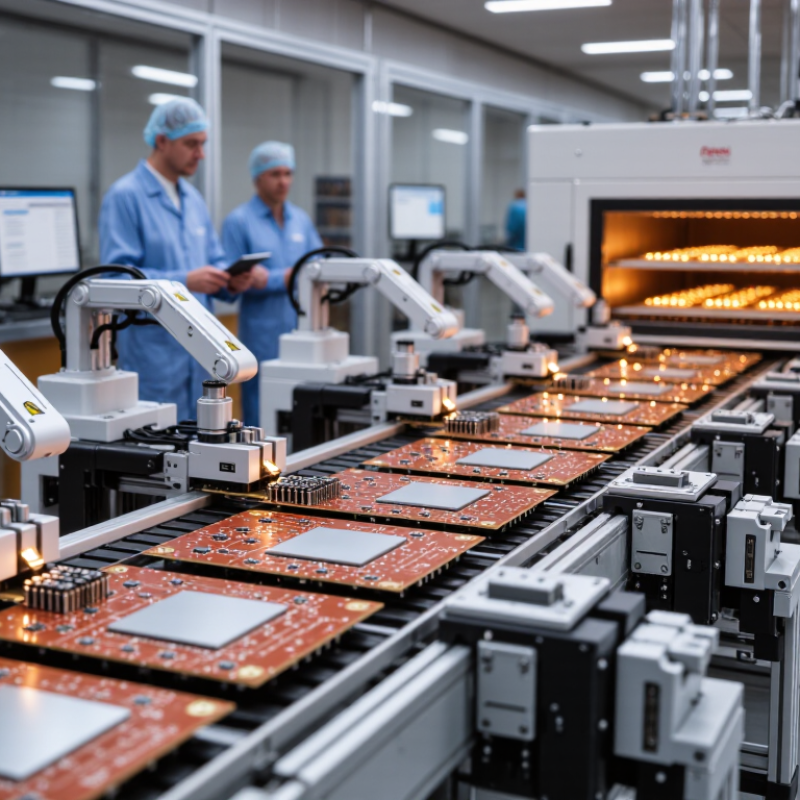
Surface-mount technology (SMT) assembly is the process of attaching electronic components directly to conductive pads on a circuit board. Unlike traditional through-hole assembly, most SMT components do not need leads inserted through drilled holes. This allows compact layouts and supports automated production. Small parts, tight spacing.
A typical line begins with solder paste, a mix of fine solder particles and flux, applied through a stencil onto board pads. A placement machine then positions components, sometimes smaller than a grain of rice. The board passes through a reflow oven, where controlled heat melts the paste and forms solder joints. Temperature profiles matter: too much heat can damage parts, while too little may leave weak connections.
After cooling, inspection checks component position and solder quality. Cameras can identify misalignment or visible defects; X-ray inspection can help examine joints hidden beneath certain components. SMT is efficient, but it is not foolproof. Board cleanliness, paste volume, component handling, and oven settings all affect results. A board may look tidy and still contain a weak joint, so inspection methods should match the design and its reliability needs.

SMT assembly depends on a small set of materials working together. Solder paste joins component terminals to copper pads on the printed circuit board. Its metal powder, flux, and particle size affect print quality and joint formation. For lead-free assemblies, SAC305 contains 96.5% tin, 3.0% silver, and 0.5% copper, as designated in IPC J-STD-006. The exact paste choice still depends on component pitch, board finish, and thermal limits. Small details matter.
The core equipment follows the paste from deposition to inspection. A stencil printer presses paste through a thin metal stencil; IPC-7525 provides guidance for stencil design. Solder paste inspection checks deposit area, height, and volume before components are placed. A pick-and-place machine positions parts, then a reflow oven heats the board according to the paste supplier’s profile. Automated optical inspection can flag shifted components or visible solder defects. It cannot confirm every hidden joint. That limitation is easy to overlook. Board material, stencils, feeders, and maintenance also influence results, so a stable process needs careful checks, not just fast machines.
Solder paste combines metal powder with flux and is applied using a stencil printer. Finer powder can support printing for smaller component features, while the suitable type depends on the stencil aperture, component pitch, and process requirements. Particle-size ranges shown are commonly used specifications; check the solder paste supplier’s datasheet for the exact range.
Before SMT assembly, the bare PCB needs a clean, stable surface. Dust, skin oils, and moisture can interfere with solder wetting. Operators inspect pads, check board support, and align stencil fiducials with PCB marks. Small alignment errors matter. A fine-pitch pad can be partly blocked by a misplaced stencil. Board warpage deserves attention, too; a board may look flat but lift during printing.
Solder paste is pressed through stencil apertures onto the pads, usually with a controlled squeegee pass. IPC J-STD-005 classifies solder-powder sizes: Type 3 particles measure 25–45 micrometers, while Type 4 measures 20–38 micrometers. These are specification ranges, not guarantees of print quality. Smaller particles can suit tighter apertures, but paste choice must match the stencil and component pitch. After printing, solder paste inspection measures deposit area, height, and volume. A clean-looking board can still have uneven deposits. That step is easy to rush. Process records should note actual inspection results, not only printer settings; otherwise, a recurring defect can hide in plain sight.
| Step | Preparation or Process | What Happens | Typical Quality Check |
|---|---|---|---|
| 1 | PCB and assembly data review | The board layout, component locations, solder-mask openings, and manufacturing files are checked before production. | Confirm that the board data, component list, and stencil data correspond to the same design revision. |
| 2 | Bare-board inspection | The PCB is checked for visible damage, contamination, and issues that could affect component placement or soldering. | Inspect board edges, pads, solder-mask openings, and fiducial marks. |
| 3 | Board cleaning and handling | Dust, fingerprints, and other contaminants are controlled because they can interfere with solder paste or solder-joint formation. | Keep the board surface clean and dry; use handling procedures suited to the board and process. |
| 4 | Panel loading and alignment | A single PCB or production panel is secured in the printer. Fiducials help the machine align the stencil apertures with the PCB pads. | Check that the board is seated securely and that the alignment system can detect the fiducials. |
| 5 | Stencil selection and setup | A metal stencil with openings corresponding to the PCB pads is positioned over the board. Stencil thickness and aperture design influence the amount of paste deposited. | Verify stencil identity, orientation, alignment, and condition before printing. |
| 6 | Solder paste preparation | Solder paste is brought to the condition specified by its supplier and handled according to its storage and use instructions. | Check the paste type, usable life, and handling requirements; avoid introducing moisture or contamination. |
| 7 | Solder paste printing | A squeegee moves paste across the stencil, forcing it through the apertures onto the corresponding PCB pads. The stencil is then separated from the board. | Look for consistent deposits, correct pad coverage, and minimal smearing or bridging between adjacent pads. |
| 8 | Post-print inspection | The printed board is inspected before component placement. Automated solder paste inspection may measure deposit area, height, volume, and position. | Detect missing, insufficient, excessive, or misaligned paste deposits and correct printing problems early. |
| 9 | Component placement and reflow | After printing is accepted, surface-mount components are placed onto the paste. The board is later heated in a reflow oven so the paste melts and forms solder joints. | Check placement accuracy and use a reflow profile appropriate for the board, components, and solder paste. |
SMT assembly starts with solder paste, a gray mixture of tiny solder particles and flux. A metal stencil is aligned over the circuit board, and a blade spreads paste through openings onto the component pads. The stencil must sit flat. Small shifts can leave paste misplaced or uneven, creating weak joints or shorts.
A pick-and-place machine then uses programmed coordinates and a camera to position components. Its nozzle lifts each part from a feeder and sets it onto the paste. Tiny resistors may be smaller than a grain of rice, while chips have marked orientations that must match the board layout. Placement is precise, not infallible. A skewed part or reversed polarity can still slip through, especially when setup data or board references are wrong.
The populated board travels through a reflow oven, where controlled heating melts the solder and bonds each component to its pads. Heat matters. The temperature profile must suit the board and components; too much heat can damage parts, while too little may leave unreliable joints. After cooling, optical inspection checks alignment, solder shape, and missing parts. Some defects are difficult to see, so inspection results may call for process adjustments. A stable line helps, but it does not remove the need to question its settings.
After reflow, inspection checks whether solder joints, component positions, and polarity match the assembly requirements. Automated optical inspection (AOI) uses cameras to flag shifted parts, missing components, and visible solder defects. A bright image helps, but it cannot reveal every hidden joint.
For components with concealed connections, such as bottom-terminated packages, X-ray inspection can show solder-ball shape and bridging beneath the package. IPC-A-610 sets acceptance criteria across three product classes, so inspectors must apply the class specified for the assembly. That detail matters. A visually neat board is not automatically acceptable. IPC-9261 also uses defects per million opportunities (DPMO) to track process performance; this metric can help teams compare defect trends over time, but it does not replace inspection of the actual board.
Electrical checks add another layer. In-circuit testing can find opens, shorts, and incorrect component values, while functional testing checks whether the powered assembly behaves as intended. Test results should link to board identity and inspection records, making recurring faults easier to trace. Still, no single test catches everything. A test fixture can miss a fault outside its coverage, and that limitation deserves review. Teams should use failure data to refine inspection points, not just rerun the same checks.


For those larger-sized parts, or smaller quantity runs, we have 2 independent powder coat booths and ovens. The quality, durability and affordability of today’s powder coating finishes make this the process of choice for world-class companies.
Powder coating advantages over other forms of coating are many. Materials used in the Powder coating process can be metals and non-metals that come in a multitude of thicknesses, textures, colors, etc. Another of Powder coating’s biggest advantages over conventional coatings is its ability to create finishes in many different textures. Powder Coating Booths allow us the ability to apply these advantages to large products.
Tri-State Fabricators runs a full-service conveyor line for painting. Wet painting can provide protection or decoration to many different part styles. From start to finish, every project is easier to undergo random and point-based inspection by our skilled painting team.
Advantages to our Wet Paint Line are these lines start with product prep and ends with a thorough inspection of a high quality finished product. Our ability to complete large and small projects with a superior finish and doing so in a timely and economical fashion. This passes along the savings in production to our customers. When powder coating ins not an option, our Wet Paint Line gets the job done right the first time.
When the parts get big and heavy we roll-out our custom paint racks and oversize booth. By utilizing our partnerships with all the major paint brands, we can match virtually any color with wet paint.
The advantages of having access to a Wet Paint Booth are many. Large projects of many different shapes can be loaded into the booth. The Wet Paint Booth offers an environment that is much more controlled than a typical parts painting operation.
Not only are they used because of their controlled environment, but they’re are also advantageous when it comes to applying paint to parts that are needed in industries that require specialty coatings such as medical, aerospace, etc.
Our military forces have some very high standards when it comes to the finish of their vehicles and equipment. From the first pre-treatment step to final coat, it takes a great deal of knowledge and experience to protect the men and women of our armed forces. They deserve only the best, and Tri-State Fabricators provides it.
All of our processes are closely monitored by our staff and management teams. Both of which are highly trained in the processes of metal fabrication and finishing. Tri-State Fabricators’ goal is to always fully satisfy each and every customer, including the military. We will always put a 110% into what we do.
Abrasive media blasting is an excellent way to remove old paint, rust, and increase the paint/powder adhesion. Glass beads produce a much smoother and brighter finish than angular abrasives; leaving the part clean yet without any dimensional change. Chemically inert and environmentally friendly, we can recycle our beads approximately 30 times; making them a more preferred method of metal cleaning or surface finishing.
Advantages to Glass Bead Blasting are many. Glass bead blast media is used when a project is needing rough surfaces need to become smooth for applications of coatings such as paint. It is typically used to clean paint and rust from a product surface without deforming the surface it is being used on. Overall, compared to many other blasting media, Glass Bead Blasting is a very economical choice and those savings are always passed on to our customers.
Tri-State Fabricators utilize a zinc phosphate wash to clean and etch the material to ensure the best paint adhesion possible. The unique design of our 3-stage wash system does the work like a 5-stage. From Cleaning and rinsing to conversion coating and post-treatment, Our Part Washing process is a complete service and works throughout the fabrication service and the finishing service.
Along with the previously mentioned benefits, Curing is a vital chemical reaction that leaves the product finish hard and relatively safe from mild abrasion and aggressive corrosion. This process can be done in more than one way; ambient air-dry or in curing ovens at temps that exceed 240°.
From fixing paint mistakes (someone else’s of course) to simply cleaning our paint line hooks, our burn-off oven is put to good use. After a quick burn-off, a little clean up, and a fresh coat of paint, your parts will look better than new.
Why does our Burn-Off Oven work so well? Because super heating the air around parts turns the materials into ashes. From paint and powder coatings to rubber and machining oils, high temps do the job without degrading the integrity of the part.
Masking is a vital part of producing high quality products. We have die-cut masking patterns to protect machined surfaces as well as a wide range of plugs and caps to protect threaded holes and bolts. We provide permanent and temporary masking.
Masking allows the selected sections of a product to be protected from a fabrication or finishing service. This can be with both chemicals when etching and tapes, paints when only finishing just a section of the product. Masking is great in aiding the customization process of a project.
Screen printing is a photographic process that transfers artwork onto a porous nylon screen which allows colored ink to flow through the screen and be deposited on an aluminum or plastic component. We can generally have just about any design created onto a screen for your parts.
Some of the advantages of Screen Printing are, brand recognition for your business displaying on your products, assembly instructions, product warnings/hazards, etc. Tri-State Fabricators produces Screen Printing of the highest quality so you know it’s durable.
Metal Finishing is the art of treating the exterior portion of product, often metal but can also be made of other materials, so that the surface is clean and free of any debris. Then the process of applying coats or either paint of powder coat takes place. This coating process improves the quality of the product in both appearance and resistance to wear and corrosion.
Tri-State Fabricators, Inc., understands that a project typically isn’t complete until a high-quality finish has been added to your product. This is why our painting and powder coating teams continuously inspect the products throughout the Metal Finishing process.

