7 Safety Guard Gate Buying Tips for Global Buyers
A Safety Guard Gate is more than a steel panel beside a machine. It controls access to hazards while allowing work, inspection, and maintenance to continue. For global buyers, the right choice depends on the machine, operating cycle, environment, and people who use it—not just the catalog price. A gate that looks sturdy in a photograph may still be awkward to open with gloves or difficult to clean around.
The International Labour Organization’s 2023 global estimates report 2.93 million work-related deaths and 395 million non-fatal work injuries each year. These figures cover many occupational hazards, not safety gates alone. Still, they underline why buyers should examine the full safeguarding system. OSHA’s machine-guarding guidance offers a useful U.S. reference, while ISO 14120 and ISO 14119 address guard design and interlocking devices. Requirements vary by market, so confirm applicable standards with qualified local professionals. Small details matter. Check opening direction, hinge clearance, latch access, cleaning needs, and how the gate behaves during routine maintenance.
Safety scientist Erik Hollnagel describes safety as “the ability to succeed under varying conditions.” That idea is useful when assessing a Safety Guard Gate: consider ordinary production, changeovers, and foreseeable disruptions—not only an ideal operating day. Ask suppliers for drawings, material specifications, test evidence, and clear instructions for installation and inspection. Not just steel. A transparent supplier should explain limitations as well as features. No gate is perfect. Even a careful specification can miss something on the factory floor, so involve operators and maintenance staff before ordering. This guide introduces seven practical buying considerations for comparing options with clearer questions and fewer assumptions.
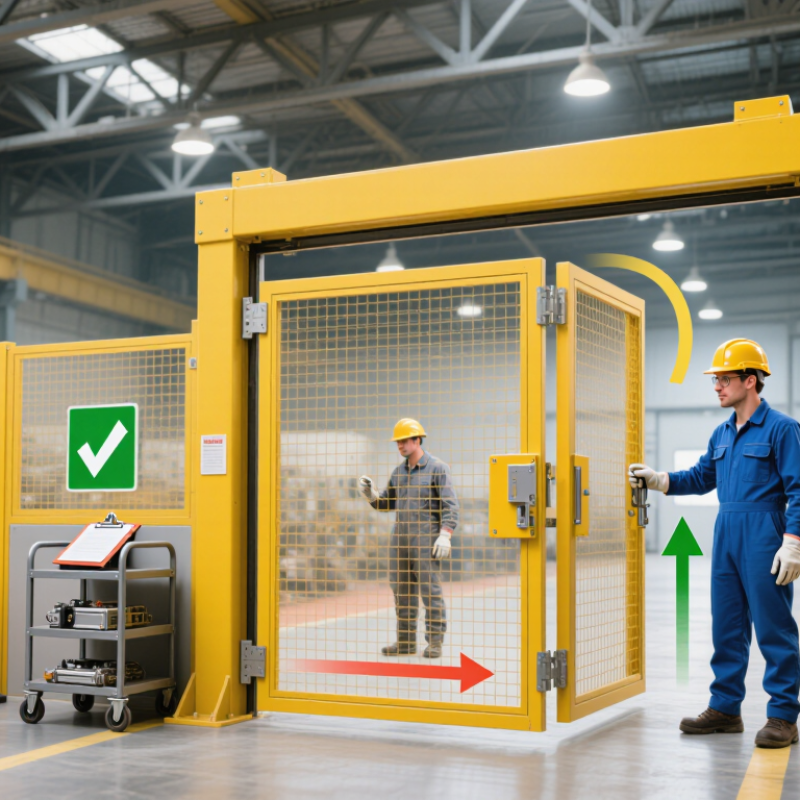
Define the Safety Risks and Access Points the Gate Must Address
Start with the hazard, not the catalog. Watch the equipment through a full operating cycle, including setup, cleaning, and maintenance. Note where hands could reach a pinch point, where materials might fall, and where moving vehicles cross a pedestrian route. A brief observation may miss an awkward task. Ask operators what they actually do, not only what the procedure says.
Map every access point the gate must control. Record who uses it, how often, and what they carry. A technician entering with tools may need a different opening than an operator passing through repeatedly. Check the approach space, sightlines, floor level, and direction of travel. A gate that swings into a busy aisle can create another hazard. Small detail. Measure it.
Then match the gate and its controls to the risk. If a person can reach moving parts before motion stops, consider whether an interlocked gate and suitable stopping control are needed; confirm this with a qualified safety professional. Check that routine access does not encourage workers to bypass the guard. Test the planned layout against real tasks, including jam clearing and awkward loads. Risk maps are useful, but they can still miss the one reach nobody mentioned. Revisit them before ordering.
Choose a Gate Type That Fits the Site and Its Traffic
A safety gate should match both the opening and the way people move through it. For a fixed ladder platform with limited space, a self-closing swing gate may work well if it opens away from the hazard. Check the hinge position and clear opening with a tape measure. A gate that blocks a handrail or clips a nearby pipe can create a new problem. Small detail, big difference.
Busy loading areas need a different choice. Where carts or forklifts pass, consider the traffic path, turning room, and how often the gate must open. A sliding gate may avoid a wide swing, but its track needs space and regular cleaning. For pedestrian-only access, a lighter gate can be easier to use, provided it closes reliably after each passage. Watch the site during a shift change; actual traffic can differ from the plan. This step is easy to skip. It shouldn’t be. Ask workers which direction they approach from, and check whether gloves, tools, or bulky loads affect one-handed operation. The “best” type on paper may feel awkward at the site. That deserves a second look.
Choosing a Safety Guard Gate for Site Traffic
This qualitative planning guide compares common gate types against light, steady, and heavy traffic. Ratings indicate general suitability, not measured performance: confirm cycle-duty ratings, clearance, and applicable safeguarding requirements for your site.
Check Materials, Dimensions, and Compatibility With Existing Equipment
A safety gate must fit the machine, not just the purchase order. Measure the opening, mounting points, hinge swing, and clearance around moving parts. Check the fully open and closed positions; a gate that clears a frame may still hit a cable tray or block an operator’s route. Small mismatches matter. A 10-millimeter gap can affect alignment, so confirm measurements on site rather than relying only on an old drawing.
Check the frame and mesh materials against the workplace conditions. Moisture, washdown, dust, and impact can change what will last. Compare the gate’s mounting method and safety-switch interface with the existing equipment, including control voltage and connector type. Ask for drawings and installation instructions before ordering. Compatibility is more than matching bolt holes.
The U.S. Bureau of Labor Statistics reported 2,569,000 nonfatal workplace injury and illness cases in private industry for 2023. This figure covers many causes, not gate-related incidents alone, but it shows why practical risk checks deserve attention.
A review can still miss something; walk the installation with maintenance and operators before final approval.
Verify Safety Standards, Testing Records, and Supplier Qualifications
A safety gate is only as dependable as its evidence. The ILO’s 2023 report, A Call for Safer and Healthier Working Environments, estimates nearly 3 million work-related deaths and 395 million non-fatal injuries each year. These figures cover many hazards, not gates alone, but they show why documented risk controls matter. Ask suppliers for the gate’s risk assessment, test results, and the exact standards and editions used. ISO 14120 addresses guard design; ISO 14119 covers interlocking devices. ISO 13857 provides safety-distance guidance. Check that the proposed design suits your machine, access frequency, and stopping time. A certificate by itself is not enough.
Request test records identifying the tested model, methods, results, and laboratory. Confirm the laboratory’s accreditation scope, and compare its reports with the supplied gate’s drawings and components. Check supplier qualifications through quality-system certificates, relevant project references, and staff competence records. Ask how changes to hinges, switches, or fixings are controlled. Small substitutions can matter. A neat PDF may still leave gaps; I would verify one report against the physical product before approving a large order. Also confirm that instructions, inspection intervals, and replacement-part details are available in a language your maintenance team can use. Local requirements differ, so have a qualified safety professional review the installation before purchase.
Compare Installation, Maintenance, Lead Time, and Total Cost
Compare a safety gate as a working system, not just a steel panel. Measure opening width, guard height, hinge clearance, and operator reach at the actual machine. Installation time depends on floor condition, anchoring, interlocks, and production shutdown windows. Ask for drawings, fixing details, and a realistic installation sequence. Small details matter.
Check whether hinges, latches, mesh panels, and switches can be replaced without removing the full frame. Request inspection intervals, spare-part availability, and response times. The U.S. Bureau of Labor Statistics recorded 2.6 million nonfatal workplace injuries and illnesses in private industry in 2023, in its Survey of Occupational Injuries and Illnesses. That figure is not gate-specific, but it makes dependable guarding and routine checks worth considering.
Compare total cost, not just the quoted gate price. Include freight, installation labor, downtime, inspection, and likely replacement parts. Ask suppliers to confirm the ship date and flag any custom components that may extend lead time. A low quote can still mislead; delivery delays or difficult maintenance may quietly add cost. Leave room for uncertainty, especially when site measurements or shutdown dates are not final.





