


High extrusion pressure, uneven filler dispersion, rough cable surfaces, and recurring die deposits can make rubber cable compound production difficult to control. For manufacturers, these problems may lead to repeated line adjustments, cleaning interruptions, inconsistent output, and higher production costs.
The challenge becomes more complex when highly filled formulations must also meet specific requirements for dimensional accuracy, vulcanization, mechanical properties, and electrical performance.
Conventional adjustments—such as increasing lubricant levels, raising processing temperatures, or reducing line speed—may relieve certain symptoms. However, they do not always address the underlying cause and can introduce new formulation or processing concerns.
Improving rubber cable extrusion is not simply about reducing viscosity. It is about achieving more consistent processing without compromising the finished cable’s performance.
For formulation-related processing challenges, SILIKE offers modified silicone-based additive technologies, including SILIMER 6560, for evaluation in compatible rubber cable compounds.
Rubber cable compounds typically contain elastomers, fillers, processing ingredients, and a curing package. Their combined effects on compound rheology, dispersion, and thermal history influence extrusion behavior and finished-cable properties.
When these factors are not adequately balanced, several processing challenges may occur.
High compound viscosity or inconsistent flow can contribute to elevated extrusion pressure, output fluctuations, and difficulty maintaining stable production conditions.
Possible causes include elastomer characteristics, filler loading, mixing history, compound temperature, and extrusion equipment settings.
Changing the screw speed or increasing temperature may provide short-term improvement. However, when the formulation operates outside its suitable processing window, these adjustments may not resolve the underlying limitation.
Fillers and functional powders are incorporated into rubber cable compounds to achieve specific mechanical, electrical, thermal, flame-performance, or cost requirements.
Insufficient dispersion can create agglomerates, increase processing resistance, and contribute to inconsistent compound behavior or surface defects.
Importantly, lower mixing torque or extrusion pressure does not automatically demonstrate better filler dispersion. Dispersion quality should be evaluated independently using suitable methods.
Surface roughness, visible extrusion lines, and die deposits can affect cable appearance and increase equipment-cleaning requirements.
These problems may be associated with compound flow, filler dispersion, die condition, temperature, shear, contamination, or material residence time.
A formulation change may be useful when the problem is linked to compound behavior. However, additives cannot correct a damaged die or unsuitable equipment settings.
Rubber cable extrusion also requires control of diameter, wall thickness, ovality, and concentricity. These parameters may be influenced by compound rheology, die alignment, haul-off speed, cooling, and conductor positioning.
In addition, many rubber cable compounds undergo vulcanization.
Any processing improvement must therefore be considered alongside scorch safety, cure characteristics, and the mechanical or electrical requirements of the finished cable.
When extrusion problems occur, manufacturers often begin with familiar corrective actions.
Increasing conventional lubricants may reduce processing resistance, but excessive addition can introduce compatibility or surface-performance concerns.
Raising processing temperatures may improve flow while potentially narrowing the scorch-safety window.
Reducing filler loading can make a compound easier to process but may affect mechanical, electrical, flame-performance, or cost requirements.
Frequent die cleaning removes existing deposits without necessarily preventing them from forming again.
These measures may be appropriate in certain situations, but they should follow a diagnosis of the underlying problem.
Before changing the additive system, manufacturers should establish whether the main limitation originates from:
• Raw materials or filler characteristics.
• Mixing and filler dispersion.
• Compound rheology and formulation design.
• Extrusion equipment or operating conditions.
• The curing system and thermal history.
This distinction helps prevent repeated adjustments that improve one parameter while introducing problems elsewhere.
A structured evaluation can help identify the most relevant corrective action.
| Production Problem | Possible Contributing Factors | Recommended Evaluation |
|---|---|---|
| High extrusion pressure | Compound viscosity, filler loading, mixing conditions, temperature | Pressure, output, compound rheology |
| Unstable extrusion output | Compound consistency, feeding, temperature, equipment settings | Output stability and process parameters |
| Poor filler dispersion | Mixing sequence, mixing energy, filler characteristics | Dispersion quality and compound uniformity |
| Rough cable surface | Compound flow, dispersion, die condition, extrusion settings | Surface appearance and defect frequency |
| Recurring die deposits | Formulation, residence time, temperature, die condition | Deposit development and cleaning frequency |
| Dimensional variation | Die alignment, haul-off, cooling, compound flow | Diameter, ovality, wall thickness |
| Scorch or curing variation | Curing package, mixing history, thermal exposure | Scorch behavior, cure characteristics, final properties |
The most effective corrective action depends on the actual source of the defect.
For example, rough cable surfaces caused by insufficient filler dispersion may require a different approach from defects caused by damaged tooling or unstable temperature control.
Once formulation-related processing resistance, dispersion, or surface quality has been identified as a relevant concern, evaluating a suitable processing additive may be worthwhile.
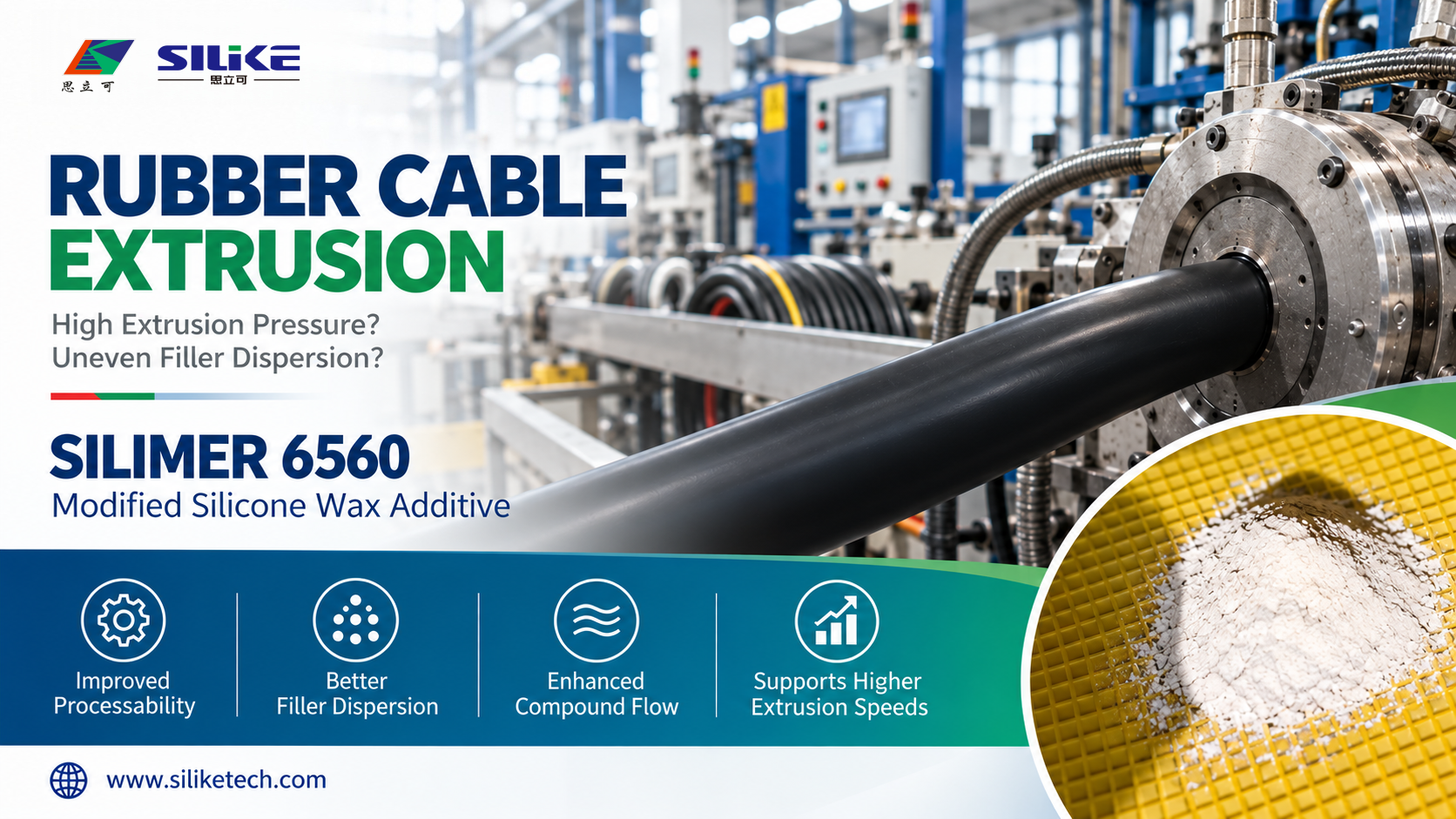
SILIKE SILIMER 6560 is a modified silicone wax additive designed for rubber cable compounds and other compatible polymer systems. In suitable rubber formulations, such as CPE- and SBR-based compounds, it can help improve processability and filler dispersion, enhance compound flow and mold-release performance, and support higher cable extrusion line speeds under appropriate processing conditions.
These potential benefits make SILIMER 6560 a candidate for manufacturers seeking to address formulation-related processing challenges while maintaining the performance requirements of their rubber compounds.
In suitable rubber formulations, processing resistance can limit extrusion efficiency and the line speed achievable while maintaining acceptable product quality.
Modified silicone wax additive SILIMER 6560 is designed to enhance lubricity and compound flow, potentially helping manufacturers maintain more consistent processing conditions.
Where formulation-related flow resistance is a limiting factor, improved processability may also support higher extrusion line speeds.
However, the achievable line speed depends on the complete production system, including compound rheology, extrusion equipment, curing capacity, cooling conditions, and dimensional requirements.
Any increase should therefore be evaluated against stable output, acceptable surface quality, and finished-cable specifications.
In rubber compounds containing fillers or functional powders, uneven dispersion can contribute to inconsistent processing behavior and surface defects.
Modified Silicone Wax Co-Polysilicone Additive SILIMER 6560 is designed to support filler dispersion in compatible systems, including suitable CPE- and SBR-based formulations.
The objective is to improve compound uniformity while supporting the processing and performance requirements of the intended application.
Actual dispersion improvement should be confirmed through appropriate evaluation methods rather than inferred from reduced torque or extrusion pressure alone.
When surface defects are associated with compound flow or filler dispersion, SILIMER 6560 may be evaluated to help improve surface uniformity and reduce visible extrusion defects.
For recurring die deposits, comparative trials may also include observations of deposit formation and cleaning frequency over a representative production period.
However, the additive should not be expected to eliminate defects originating from unrelated equipment, contamination, or process-control problems.
Beyond extrusion processing, SILIMER 6560 may also be used as a silicone-based mold release agent for improved mold-release behavior in compatible rubber formulations where molding or demolding is part of the manufacturing process.
For rubber cable manufacturers, improved processing efficiency must be balanced with the requirements of vulcanization and finished-cable performance.
Before adopting SILIMER 6560, manufacturers should evaluate its compatibility with the elastomer, filler package, and curing system.
The objective is not simply faster extrusion, but a more stable and efficient production process that continues to meet the intended cable specifications.
Learn more about SILIKE SILIMER 6560 modified silicone wax for rubber cable compounds.
A controlled comparison is essential to determine whether SILIMER 6560 addresses the actual processing limitation.
Record the elastomer type, filler system and loading, curing package, mixing procedure, and extrusion conditions.
Define the main production problem using measurable parameters, such as extrusion pressure, output stability, surface defects, or die-cleaning frequency.
Before changing the formulation, review filler dispersion, mixing consistency, temperature control, die condition, feeding, cooling, and haul-off settings.
This helps distinguish formulation-related problems from equipment or process-control issues.
Compare the existing formulation with selected SILIMER 6560 formulations under consistent processing conditions.
The appropriate addition level should be determined according to the specific rubber compound, filler system, and processing objective.
SILIKE’s product information provides general addition guidance, but the dosage basis and suitable starting range for a particular rubber cable formulation should be confirmed before testing.
Depending on the target problem, evaluate:
• Extrusion pressure and pressure stability.
• Output consistency and achievable line speed.
• Compound temperature and flow behavior.
• Filler dispersion.
• Extruded surface appearance.
• Die deposits and cleaning requirements.
• Dimensional consistency where relevant.
• Mold-release performance where the formulation is used in molding applications.
Measurements should be taken under comparable conditions and over a representative trial period.
Improved extrusion behavior must not come at the expense of required cable performance.
Depending on the formulation and application, compare scorch behavior, cure characteristics, tensile strength, elongation, hardness, aging resistance, electrical properties, and applicable flame-performance requirements.
A favorable laboratory result or short extrusion run is a starting point, not proof of long-term production stability.
Repeat the evaluation under representative operating conditions and confirm that the final formulation continues to meet the required specifications.
Common causes include high compound viscosity, excessive or poorly dispersed fillers, inconsistent mixing, unsuitable processing conditions, and die-related problems. Identifying the primary cause is essential before changing the additive system.
SILIMER 6560 can be considered for evaluation in suitable CPE- and SBR-based formulations. Its compatibility and performance depend on the specific elastomer grade, filler system, curing package, and processing conditions.
SILIMER 6560 is designed to support filler and functional-powder dispersion in compatible formulations. The actual effect should be verified through appropriate dispersion and compound-performance evaluations.
Potentially. Where compound flow is a limiting factor, improved processability may allow higher operating speeds. However, the achievable increase depends on the formulation, equipment, curing process, and final cable requirements. Comparative production trials are recommended.
It may be considered when die deposits are related to compound processing behavior. However, deposit formation can have several causes, so any improvement should be confirmed through representative trials.
High extrusion resistance, uneven filler dispersion, rough cable surfaces, and recurring die deposits can limit production efficiency and make rubber cable processing difficult to control.
SILIKE provides modified silicone-based processing and dispersion technologies, including SILIMER 6560, for suitable rubber and other polymer applications.
Whether you are seeking improved compound flow, more consistent filler dispersion, better surface quality, or higher extrusion line speeds, SILIKE can help assess whether SILIMER 6560 is appropriate for your formulation.
Share your rubber type, filler system, curing method, and main processing challenge to discuss a suitable additive and comparative trial.
For technical information, formulation evaluation, or sample inquiries of rubber cable compound processing aids, contact SILIKE.
Email: sale@levvymetal.com
Contact Us: www.siliketech.com
Related Solutions: SILIKE Wire & Cable Processing Aids and Surface Modifiers


