


In pumps, valve assemblies, and laboratory equipment, small material choices can affect uptime, maintenance, and product quality. That is one reason engineers consider PTFE rod and sheet for demanding industrial components. The material is valued for chemical resistance, low friction, and useful performance across a broad temperature range. But those qualities do not make every design simple. Details matter.
Ptfe Rod Sheet can be machined into seals, bushings, guides, liners, and insulating parts, depending on the grade and operating conditions. A rod may suit a turned component, while sheet can provide a flat lining or gasket blank. For example, a chemical transfer pump may need a low-friction bushing, while a storage tank may call for a sheet liner. The right choice depends on concentration, temperature, pressure, and movement. In practice, designers still need to check load, creep, dimensional tolerance, and chemical exposure. A part that looks right on a drawing may deform under sustained pressure. That deserves attention. Selection should account for installation, surface finish, and the supplier’s technical data, rather than relying on a generic label. This guide examines why PTFE rod and sheet remain useful, where their limits appear, and what questions help buyers choose responsibly. No material is perfect. Thoughtful selection begins with actual service conditions, not a broad claim of universal resistance.
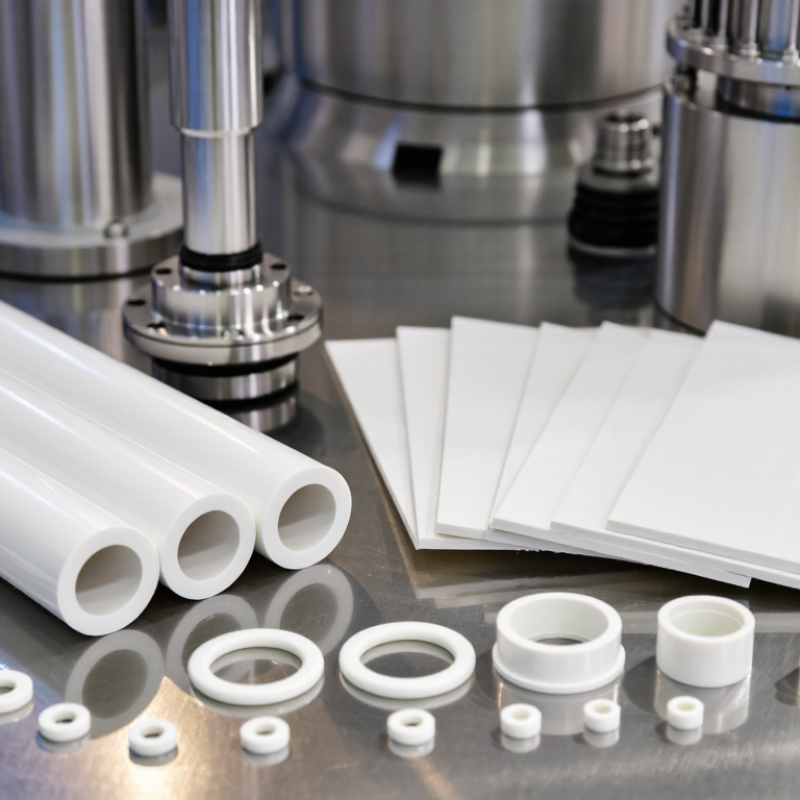
PTFE rod and sheet are solid, semi-finished forms of polytetrafluoroethylene, a fluoropolymer valued for low friction and resistance to many chemicals. A rod has a round cross-section, while a sheet is flat stock supplied in different thicknesses. Both can be cut or machined into components; they are not necessarily ready to install as supplied.
In industrial settings, rod stock is often machined into bushings, rollers, or small valve parts. Sheet can become liners, seals, or sliding surfaces. PTFE’s properties can help parts move smoothly and resist corrosive exposure, but performance depends on temperature, load, fit, and the specific grade. Not quite that simple. Under sustained pressure, PTFE can deform over time, so a low-friction material is not automatically the right choice for every bearing or seal. A tidy specification can still miss how the part will behave in real service.
Tips: Match the stock shape to the finished component and machining plan. Check operating temperature, chemical contact, and compressive load with a qualified materials supplier. If dimensions are critical, allow for machining tolerances and inspect the finished part; small fit differences can matter.
| Dimension | PTFE Rod | PTFE Sheet | Industrial Relevance |
|---|---|---|---|
| What it is | Solid cylindrical semi-finished stock made from polytetrafluoroethylene (PTFE). | Flat, solid semi-finished stock made from polytetrafluoroethylene (PTFE). | Both forms are commonly cut or machined into components; they are stock shapes, not finished parts. |
| Typical manufacturing routes | Often produced by extrusion or molding, depending on diameter, grade, and process. | Often produced by molding or skiving, depending on thickness and product specification. | Manufacturing route can affect dimensions and properties, so confirm the material specification for the intended use. |
| Chemical resistance | PTFE resists attack by many industrial chemicals, including many acids and solvents. Compatibility depends on the chemical, concentration, temperature, and exposure conditions. | Useful for components in chemical-handling equipment. Compatibility should be checked for the actual service environment. | |
| Temperature capability | Unfilled PTFE is commonly used across a broad temperature range, often cited as approximately −200°C to +260°C; limits vary by grade, load, and application. | Check continuous and intermittent operating temperatures, as well as mechanical loading and installation conditions. | |
| Friction and release | PTFE has a low coefficient of friction and non-stick characteristics. Actual performance varies with surface finish, counterface, load, speed, and test method. | Can be useful for sliding interfaces, guides, liners, and release surfaces. It is not automatically suitable for every wear application. | |
| Electrical properties | PTFE is a strong electrical insulator with low dielectric loss over a broad range of conditions. | May be selected for insulating parts and electrical components, subject to voltage, frequency, temperature, and design requirements. | |
| Typical density | Unfilled PTFE commonly has a density of about 2.1–2.3 g/cm³. Filled grades can have different values. | Use the supplier’s grade-specific data when calculating component mass or checking material specifications. | |
| Mechanical considerations | PTFE is relatively soft compared with many engineering plastics and can deform or creep under sustained load. Fillers may improve selected properties but can change others. | Consider load, dimensional tolerances, support, creep, and whether a filled PTFE grade is required. | |
| Common machined parts | Often used as a starting shape for bushings, spacers, rollers, valve components, and insulators. | Often used as a starting shape for gaskets, seals, liners, wear pads, and insulation parts. | Choose the form that best matches the component geometry and machining or fabrication plan. |
| Stock size availability | Available in a range of diameters and lengths, which varies by producer, grade, and manufacturing method. | Available in a range of thicknesses and sheet sizes, which varies by producer, grade, and manufacturing method. | Confirm available dimensions, tolerances, and grade before designing a part around a stock size. |
Note: Property ranges are representative of unfilled PTFE and are provided for general comparison, not as design guarantees. Verify grade-specific data, test methods, chemical compatibility, and operating conditions before use.

PTFE rod and sheet production starts with resin selection. ASTM D4894 covers granular PTFE used in molding and ram extrusion. For molded stock, operators compact the powder into a preform, then heat it in a controlled cycle. The resin sinters rather than flowing like ordinary plastics. NIST Chemistry WebBook data places PTFE’s melting point near 600 K, or 327°C. Cooling matters: uneven temperature changes can leave internal stress. The billet may then be machined into rods or sheets. Some sheets are skived from a larger billet, leaving fine, curled ribbons at the cutting edge.
Manufacturing is precise, but not flawless. Small differences in powder packing, pressure, or cooling can affect dimensions and consistency. ASTM material specifications help buyers compare resin types, while inspection can verify thickness, diameter, and surface condition. A smooth surface alone does not prove uniform internal quality. That distinction is easy to miss.
Tips: Ask how the stock was formed and cooled. Check tolerances against your drawing, not just nominal size. For critical seals or sliding parts, request documented inspection results before machining.
PTFE’s high service-temperature capability and sintering process help explain its suitability for demanding applications. The chart compares typical PTFE temperatures; the sintering bar shows the midpoint of its usual range.
Typical values: PTFE melts at about 327°C, is commonly sintered at approximately 360–380°C, and has a maximum continuous-use temperature around 260°C. Actual values can vary by grade and processing conditions.
PTFE rod and sheet are valued for properties that solve practical problems on factory floors. Their low-friction surfaces help moving parts slide with less resistance, especially in guides, wear strips, and seals. Chemical resistance also makes PTFE useful around many acids, solvents, and process fluids. Compatibility still depends on the exact chemical, its concentration, temperature, and exposure time. Check these conditions before specifying a component.
PTFE absorbs very little moisture and provides reliable electrical insulation, useful in damp or electrically sensitive equipment. It also performs across a broad temperature range, though load and heat affect real service life. A machined rod can become a bushing; sheet can be cut into gaskets or liners. Simple to shape. But PTFE is relatively soft and can deform under sustained pressure, a behavior often called creep. Its relatively high thermal expansion can also affect fit when temperatures change. For a tightly fitted part, allow for movement and review the operating load, not just the material’s chemical resistance. A sample tested under actual conditions may reveal issues a datasheet cannot. That extra check can feel slow, but replacing a distorted part is slower.
PTFE rod and sheet are often machined into components for equipment exposed to chemicals, moisture, or friction. In pumps and valves, rods can become bushings, seats, and wear rings, while sheet is commonly cut into gaskets and seals. A pale, smooth gasket can help contain corrosive process fluids, but correct sizing and surface finish still matter. Fit matters.
In electrical equipment, PTFE forms may serve as insulating supports or sleeves around conductors. Their low friction also suits sliding parts in packaging machinery and conveyor systems. In food-processing equipment, PTFE components can reduce sticking on guides and contact surfaces; suitability depends on the specific material grade and application requirements. PTFE can deform under sustained pressure, and its thermal expansion can complicate tight fits. That detail is easy to overlook during replacement work.
Tips: Check chemical exposure, operating temperature, load, and movement before selecting a form. Leave room for expansion, and inspect sealing surfaces for scratches or uneven wear. A quick material check can prevent a neat-looking part from failing early.
Choosing between PTFE rod and sheet starts with the part’s shape and machining plan. Rod suits pins, bushings, spacers, and turned components. Sheet works better for flat gaskets, liners, wear pads, and cut profiles. If a part needs a deep bore, rod can reduce machining waste. For a broad, thin part, sheet avoids carving away a large block.
MatWeb’s compiled material-property records put typical unfilled PTFE density near 2.16 g/cm³; ASTM D792 describes a standard method for measuring density. Treat this as a reference, not a guaranteed value: grade and processing can change properties. Check the drawing, too. Confirm stock dimensions, tolerances, load direction, temperature, and chemical exposure before ordering. PTFE expands noticeably with heat, so a tight-fitting rod insert may bind after a temperature change. A useful but imperfect rule is to choose the stock closest to the finished geometry. It can fail when machining access or internal stresses matter. For thin sheets, ask about flatness and thickness variation; for rods, inspect straightness and diameter consistency. A small trial piece can reveal machining behavior before a full production run.


For those larger-sized parts, or smaller quantity runs, we have 2 independent powder coat booths and ovens. The quality, durability and affordability of today’s powder coating finishes make this the process of choice for world-class companies.
Powder coating advantages over other forms of coating are many. Materials used in the Powder coating process can be metals and non-metals that come in a multitude of thicknesses, textures, colors, etc. Another of Powder coating’s biggest advantages over conventional coatings is its ability to create finishes in many different textures. Powder Coating Booths allow us the ability to apply these advantages to large products.
Tri-State Fabricators runs a full-service conveyor line for painting. Wet painting can provide protection or decoration to many different part styles. From start to finish, every project is easier to undergo random and point-based inspection by our skilled painting team.
Advantages to our Wet Paint Line are these lines start with product prep and ends with a thorough inspection of a high quality finished product. Our ability to complete large and small projects with a superior finish and doing so in a timely and economical fashion. This passes along the savings in production to our customers. When powder coating ins not an option, our Wet Paint Line gets the job done right the first time.
When the parts get big and heavy we roll-out our custom paint racks and oversize booth. By utilizing our partnerships with all the major paint brands, we can match virtually any color with wet paint.
The advantages of having access to a Wet Paint Booth are many. Large projects of many different shapes can be loaded into the booth. The Wet Paint Booth offers an environment that is much more controlled than a typical parts painting operation.
Not only are they used because of their controlled environment, but they’re are also advantageous when it comes to applying paint to parts that are needed in industries that require specialty coatings such as medical, aerospace, etc.
Our military forces have some very high standards when it comes to the finish of their vehicles and equipment. From the first pre-treatment step to final coat, it takes a great deal of knowledge and experience to protect the men and women of our armed forces. They deserve only the best, and Tri-State Fabricators provides it.
All of our processes are closely monitored by our staff and management teams. Both of which are highly trained in the processes of metal fabrication and finishing. Tri-State Fabricators’ goal is to always fully satisfy each and every customer, including the military. We will always put a 110% into what we do.
Abrasive media blasting is an excellent way to remove old paint, rust, and increase the paint/powder adhesion. Glass beads produce a much smoother and brighter finish than angular abrasives; leaving the part clean yet without any dimensional change. Chemically inert and environmentally friendly, we can recycle our beads approximately 30 times; making them a more preferred method of metal cleaning or surface finishing.
Advantages to Glass Bead Blasting are many. Glass bead blast media is used when a project is needing rough surfaces need to become smooth for applications of coatings such as paint. It is typically used to clean paint and rust from a product surface without deforming the surface it is being used on. Overall, compared to many other blasting media, Glass Bead Blasting is a very economical choice and those savings are always passed on to our customers.
Tri-State Fabricators utilize a zinc phosphate wash to clean and etch the material to ensure the best paint adhesion possible. The unique design of our 3-stage wash system does the work like a 5-stage. From Cleaning and rinsing to conversion coating and post-treatment, Our Part Washing process is a complete service and works throughout the fabrication service and the finishing service.
Along with the previously mentioned benefits, Curing is a vital chemical reaction that leaves the product finish hard and relatively safe from mild abrasion and aggressive corrosion. This process can be done in more than one way; ambient air-dry or in curing ovens at temps that exceed 240°.
From fixing paint mistakes (someone else’s of course) to simply cleaning our paint line hooks, our burn-off oven is put to good use. After a quick burn-off, a little clean up, and a fresh coat of paint, your parts will look better than new.
Why does our Burn-Off Oven work so well? Because super heating the air around parts turns the materials into ashes. From paint and powder coatings to rubber and machining oils, high temps do the job without degrading the integrity of the part.
Masking is a vital part of producing high quality products. We have die-cut masking patterns to protect machined surfaces as well as a wide range of plugs and caps to protect threaded holes and bolts. We provide permanent and temporary masking.
Masking allows the selected sections of a product to be protected from a fabrication or finishing service. This can be with both chemicals when etching and tapes, paints when only finishing just a section of the product. Masking is great in aiding the customization process of a project.
Screen printing is a photographic process that transfers artwork onto a porous nylon screen which allows colored ink to flow through the screen and be deposited on an aluminum or plastic component. We can generally have just about any design created onto a screen for your parts.
Some of the advantages of Screen Printing are, brand recognition for your business displaying on your products, assembly instructions, product warnings/hazards, etc. Tri-State Fabricators produces Screen Printing of the highest quality so you know it’s durable.
Metal Finishing is the art of treating the exterior portion of product, often metal but can also be made of other materials, so that the surface is clean and free of any debris. Then the process of applying coats or either paint of powder coat takes place. This coating process improves the quality of the product in both appearance and resistance to wear and corrosion.
Tri-State Fabricators, Inc., understands that a project typically isn’t complete until a high-quality finish has been added to your product. This is why our painting and powder coating teams continuously inspect the products throughout the Metal Finishing process.

