


A plaza musical fountain is more than water rising to music. It is a coordinated public installation combining hydraulic engineering, lighting, sound, automation, and architectural design. In a busy square, pumps push water through carefully sized nozzles. LED fixtures color each stream. Speakers shape the atmosphere. Control software synchronizes every movement with rhythm and timing.
Mark Fuller, founder of WET Design, has described water as “a powerful medium.” That simple observation explains the appeal of Plaza Musical Fountains. Water can suggest movement, celebration, calm, or even cultural identity. A narrow jet may pulse like a drumbeat. A fan-shaped spray can spread across a shallow basin. At night, blue and amber light can make the same structure feel completely different.
Still, the visual effect is only one part of the design. A reliable fountain needs balanced flow, accessible maintenance areas, effective filtration, safe electrical systems, and controlled splash zones. It must also consider wind, evaporation, noise, drainage, and seasonal use. A beautiful sequence can fail when nozzles clog or music becomes too loud. That is an uncomfortable reality.
This guide examines what a plaza musical fountain is, how its systems work, and why planning matters. It also considers visitor experience, operating costs, and long-term maintenance. The technology is impressive, but it is not magic. Good results depend on details that visitors may never notice.
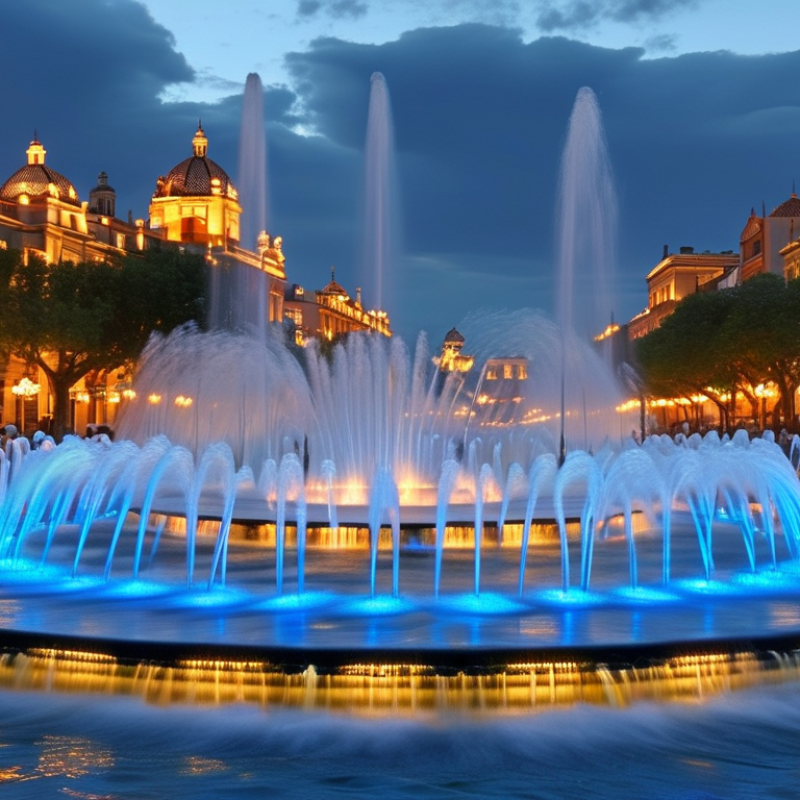
What Is a Plaza Musical Fountain?
A plaza musical fountain is a public water installation that combines programmed jets, lighting, and music. It turns an open civic space into a timed sensory experience. Unlike a simple decorative pool, its nozzles respond to rhythm, musical cues, or preset sequences. The core system includes pumps, valves, controllers, speakers, lighting, drainage, and water-treatment equipment.
Its strongest feature is coordination. Jets may rise, pause, or cross in patterns that follow a musical arrangement. Reliable designs also manage splash, slip risks, water quality, and maintenance access. During site inspections, professionals often notice small details, such as hidden drains and service panels. These features affect safety and long-term operating costs. The fountain should also fit the plaza’s scale, pedestrian flow, climate, and daily noise levels. Still, perfect synchronization is not guaranteed. Wind, blocked nozzles, or aging equipment can change the performance.
Tips: Watch one complete show cycle before judging the design. Check whether visitors can walk safely around wet areas. Ask how often filters, pumps, and lights require inspection. A quieter schedule may serve nearby residents better than constant music. That choice deserves careful review.
| Data Dimension | Typical Data or Specification | Description |
|---|---|---|
| Definition | Interactive architectural water feature | A plaza musical fountain combines programmed water movement, lighting, and synchronized music to create a public-space performance or interactive attraction. |
| Primary Purpose | Public entertainment and placemaking | The fountain improves visual interest, encourages visitors to gather, and can serve as a landmark within a civic, commercial, residential, or recreational plaza. |
| Common Installation Area | Approximately 50–2,000 m² | The required area depends on the number of water effects, visitor circulation, technical rooms, drainage zones, and surrounding landscape design. |
| Water Display Type | Vertical jets, arcs, sheets, sprays, and cascades | Multiple water effects are combined to produce changing shapes, heights, rhythms, and movement patterns during a programmed performance. |
| Jet Height | Approximately 0.3–15 m for many plaza installations | Jet height is selected according to the plaza scale, wind exposure, viewing distance, safety requirements, and the desired visual effect. |
| Nozzle System | Fixed, adjustable, fan, foaming, laminar, or mist nozzles | Nozzles shape the water and determine the appearance, spray direction, flow pattern, and performance variety of the fountain. |
| Pump and Flow Control | Variable-speed pumps with individually controlled circuits | Independent control of pump speed and water circuits allows the system to match jet height and flow changes to musical timing. |
| Lighting System | Submersible LED lighting, commonly RGB or RGBW | Underwater lighting highlights jets and water surfaces. Color-changing fixtures can be programmed to fade, pulse, or change color with the music. |
| Music and Audio | Outdoor loudspeakers with scheduled audio playback | Music provides the timing reference for water and lighting cues. Audio equipment normally requires weather protection and appropriate sound distribution. |
| Control Method | Programmable controller, touchscreen, or remote monitoring system | The control system stores show sequences, schedules operating hours, adjusts individual devices, and records alarms or equipment status. |
| Synchronization Accuracy | Typically controlled by time-coded sequences | Time-coded programming coordinates pumps, valves, lights, and audio so that changes occur at predetermined points in the musical track. |
| Water Circulation | Recirculating closed-loop system | Most plaza fountains collect water in a basin or underground reservoir, filter it, treat it, and reuse it rather than continuously consuming fresh water. |
| Water Treatment | Filtration, disinfection, and water-quality monitoring | Treatment helps control suspended particles, biological growth, odors, and scale. The exact treatment method depends on local regulations and whether public contact is permitted. |
| Interactive Operation | Optional sensor-based or user-activated control | Sensors, push buttons, or programmed zones can allow the fountain to respond to movement, touch, time of day, or visitor activity. |
| Safety Features | Drainage, anti-slip surfaces, electrical protection, and emergency shutoff | Design should address slip hazards, electrical isolation, safe water depth, overflow control, access to equipment, and rapid shutdown during faults or maintenance. |
| Accessibility | Flush or low-profile plaza integration | Many interactive fountains are designed without raised edges so that pedestrians, wheelchair users, and maintenance staff can move around the space more easily. |
| Typical Operating Modes | Show mode, ambient mode, interactive mode, and maintenance mode | Different modes support scheduled musical performances, quiet background operation, public interaction, cleaning, inspection, and emergency servicing. |
| Energy Considerations | Pump power varies with flow, pressure, jet height, and operating schedule | Variable-speed drives, efficient LED fixtures, timed operation, and well-designed hydraulic circuits can reduce energy consumption. |
| Maintenance Requirements | Routine inspection, cleaning, water testing, and equipment servicing | Regular maintenance protects pumps, filters, valves, lights, nozzles, drainage components, and control equipment while preserving water quality and show performance. |
| Common Applications | Civic plazas, shopping areas, hotels, parks, resorts, and mixed-use developments | Plaza musical fountains are used where a visually prominent, programmable public feature is intended to support social activity and visitor engagement. |

A plaza musical fountain combines programmed water jets, lighting, and sound in an open civic setting. Its history began with gravity-fed ornamental fountains, where stone basins and fixed spouts shaped public squares. Later, pumps and electric controls enabled taller, timed displays. By the late twentieth century, digital sequencing linked valves, lights, and music with greater precision. The history is not perfectly linear. Water became a scheduled public performance.
Today, these fountains serve more than visual spectacle. In a hot plaza, fine spray can soften perceived heat, although designers must assess humidity and wind. Flush, walkable jets can invite children and adults into shared play. Raised edges can provide seating, while clear routes support wheelchair users and older visitors. Civic spaces may use shows during festivals, evenings, or quiet daytime intervals. Good design protects conversation, not just excitement. Noise, slippery paving, splash drift, and maintenance access need measured planning. Not every fountain improved public life.
Tips: Study seasonal weather before selecting nozzle heights. Use durable, slip-resistant paving around wet zones. Include visible drainage and protected maintenance access. Test sound levels near homes and offices. Review water treatment, filtration, and shutdown procedures with qualified engineers. A smaller sequence may feel more welcoming than a larger one. I would also question whether every performance needs music. Sometimes moving water, footsteps, and a few quiet lights are enough.
What Is a Plaza Musical Fountain?
A plaza musical fountain combines water, lighting, sound, and control systems in one coordinated attraction. Pumps push water through carefully selected nozzles, creating vertical jets, arches, or soft mist. Lighting adds color and depth, especially after sunset. Sound gives the movement rhythm and emotional direction. Without accurate timing, however, the fountain can feel mechanical rather than engaging.
The control system acts as the fountain’s operating brain. It synchronizes pump speeds, valve responses, lighting scenes, and audio cues. Reliable systems also monitor water levels, equipment temperature, and unexpected pressure changes. In practical installations, technicians test each sequence from several viewing angles. A jet may look perfect from the control room but appear too weak across the plaza. One lesson is clear: visual drama should not replace maintenance planning. Filters, drains, electrical protection, and water treatment need regular inspection. Small faults become obvious during public performances.
Tips: Keep musical arrangements short and readable. Use lighting to clarify movement, not hide it. Leave access space around pumps and control cabinets. Test the fountain in daylight, rain, and crowded conditions. Not every effect deserves inclusion. A simpler sequence may feel more precise, safer, and easier to maintain. Record every adjustment, even the unsuccessful ones. Those notes can prevent repeated mistakes during future programming.
Design, Construction, and Operational Considerations
A plaza musical fountain combines water, lighting, sound, and public movement in one engineered space. Its design must begin with the plaza, not the nozzles. Designers study pedestrian routes, viewing angles, wind direction, noise levels, and nearby buildings. Clear sightlines matter. A fountain that looks impressive from one corner may disappear behind crowds elsewhere. Hydraulic calculations should match the intended water height, rhythm, and spray pattern. Experienced engineers also consider drought restrictions, evaporation, and safe water management.
Construction requires close coordination between civil, electrical, structural, and landscape teams. The basin needs durable waterproofing and carefully sloped surfaces for drainage. Hidden pipes and conduits should remain accessible for inspection. Pump rooms require ventilation, lighting, and enough working space for technicians. Non-slip paving is essential around wet edges. Waterproofing failures are expensive. Small installation errors can create uneven jets, vibration, or unwanted leaks. Site testing should happen before final paving, although schedules often make this difficult.
Daily operation determines whether the fountain remains reliable. Operators need clear procedures for water treatment, filter cleaning, nozzle inspection, and emergency shutdowns. Control systems should allow manual operation during faults or public events. Energy use also deserves attention, especially when pumps run for long hours. Sound levels must suit the surrounding plaza rather than overpower it. Seasonal adjustments may reduce operating costs. Even careful planning can miss a practical issue, such as glare on evening viewing areas. Regular feedback from maintenance staff can reveal these weaknesses early.
What Is a Plaza Musical Fountain?
A plaza musical fountain combines programmed water jets, lighting, sound, and architectural design. It turns an open public space into an active gathering point. Visitors may watch a short performance, cool down nearby, or take photographs. Well-designed fountains can increase foot traffic and support nearby shops, restaurants, and community events. They also give large plazas a stronger visual identity.
The benefits are attractive, but the challenges are practical. Pumps require steady electricity and careful hydraulic balancing. Uneven pressure can make one jet weak while another sprays too far. Wind may scatter water onto walkways, creating slippery surfaces. Poor acoustic planning can produce harsh echoes between buildings. Accessibility also matters. Wet zones should remain separated from pedestrian routes. A beautiful design can still fail if visitors cannot move safely around it.
Maintenance must be scheduled, not improvised. Operators should inspect pumps, nozzles, lights, sensors, and control panels regularly. Water quality needs testing because algae, minerals, and debris can block narrow nozzles. Filters require cleaning after busy weekends or dusty weather. Drainage systems should be checked before heavy rain. Electrical components need qualified inspection and weather protection. Keep clear records.
It looks simple. It is not.
A realistic maintenance plan should include spare nozzles, water-level checks, seasonal shutdown procedures, and emergency response steps. Some designs underestimate cleaning time. That mistake becomes expensive. Surface stains, uneven jets, or delayed lighting often reveal neglected routine work. Regular observation remains essential, even when automated controls appear reliable.


For those larger-sized parts, or smaller quantity runs, we have 2 independent powder coat booths and ovens. The quality, durability and affordability of today’s powder coating finishes make this the process of choice for world-class companies.
Powder coating advantages over other forms of coating are many. Materials used in the Powder coating process can be metals and non-metals that come in a multitude of thicknesses, textures, colors, etc. Another of Powder coating’s biggest advantages over conventional coatings is its ability to create finishes in many different textures. Powder Coating Booths allow us the ability to apply these advantages to large products.
Tri-State Fabricators runs a full-service conveyor line for painting. Wet painting can provide protection or decoration to many different part styles. From start to finish, every project is easier to undergo random and point-based inspection by our skilled painting team.
Advantages to our Wet Paint Line are these lines start with product prep and ends with a thorough inspection of a high quality finished product. Our ability to complete large and small projects with a superior finish and doing so in a timely and economical fashion. This passes along the savings in production to our customers. When powder coating ins not an option, our Wet Paint Line gets the job done right the first time.
When the parts get big and heavy we roll-out our custom paint racks and oversize booth. By utilizing our partnerships with all the major paint brands, we can match virtually any color with wet paint.
The advantages of having access to a Wet Paint Booth are many. Large projects of many different shapes can be loaded into the booth. The Wet Paint Booth offers an environment that is much more controlled than a typical parts painting operation.
Not only are they used because of their controlled environment, but they’re are also advantageous when it comes to applying paint to parts that are needed in industries that require specialty coatings such as medical, aerospace, etc.
Our military forces have some very high standards when it comes to the finish of their vehicles and equipment. From the first pre-treatment step to final coat, it takes a great deal of knowledge and experience to protect the men and women of our armed forces. They deserve only the best, and Tri-State Fabricators provides it.
All of our processes are closely monitored by our staff and management teams. Both of which are highly trained in the processes of metal fabrication and finishing. Tri-State Fabricators’ goal is to always fully satisfy each and every customer, including the military. We will always put a 110% into what we do.
Abrasive media blasting is an excellent way to remove old paint, rust, and increase the paint/powder adhesion. Glass beads produce a much smoother and brighter finish than angular abrasives; leaving the part clean yet without any dimensional change. Chemically inert and environmentally friendly, we can recycle our beads approximately 30 times; making them a more preferred method of metal cleaning or surface finishing.
Advantages to Glass Bead Blasting are many. Glass bead blast media is used when a project is needing rough surfaces need to become smooth for applications of coatings such as paint. It is typically used to clean paint and rust from a product surface without deforming the surface it is being used on. Overall, compared to many other blasting media, Glass Bead Blasting is a very economical choice and those savings are always passed on to our customers.
Tri-State Fabricators utilize a zinc phosphate wash to clean and etch the material to ensure the best paint adhesion possible. The unique design of our 3-stage wash system does the work like a 5-stage. From Cleaning and rinsing to conversion coating and post-treatment, Our Part Washing process is a complete service and works throughout the fabrication service and the finishing service.
Along with the previously mentioned benefits, Curing is a vital chemical reaction that leaves the product finish hard and relatively safe from mild abrasion and aggressive corrosion. This process can be done in more than one way; ambient air-dry or in curing ovens at temps that exceed 240°.
From fixing paint mistakes (someone else’s of course) to simply cleaning our paint line hooks, our burn-off oven is put to good use. After a quick burn-off, a little clean up, and a fresh coat of paint, your parts will look better than new.
Why does our Burn-Off Oven work so well? Because super heating the air around parts turns the materials into ashes. From paint and powder coatings to rubber and machining oils, high temps do the job without degrading the integrity of the part.
Masking is a vital part of producing high quality products. We have die-cut masking patterns to protect machined surfaces as well as a wide range of plugs and caps to protect threaded holes and bolts. We provide permanent and temporary masking.
Masking allows the selected sections of a product to be protected from a fabrication or finishing service. This can be with both chemicals when etching and tapes, paints when only finishing just a section of the product. Masking is great in aiding the customization process of a project.
Screen printing is a photographic process that transfers artwork onto a porous nylon screen which allows colored ink to flow through the screen and be deposited on an aluminum or plastic component. We can generally have just about any design created onto a screen for your parts.
Some of the advantages of Screen Printing are, brand recognition for your business displaying on your products, assembly instructions, product warnings/hazards, etc. Tri-State Fabricators produces Screen Printing of the highest quality so you know it’s durable.
Metal Finishing is the art of treating the exterior portion of product, often metal but can also be made of other materials, so that the surface is clean and free of any debris. Then the process of applying coats or either paint of powder coat takes place. This coating process improves the quality of the product in both appearance and resistance to wear and corrosion.
Tri-State Fabricators, Inc., understands that a project typically isn’t complete until a high-quality finish has been added to your product. This is why our painting and powder coating teams continuously inspect the products throughout the Metal Finishing process.

