


What Is a Mud Pump Piston Used For?

A mud pump works through steady, forceful reciprocation, pushing drilling fluid down the drill string and back toward the surface. The Mud Pump Piston is the moving component that helps create this flow. Inside the pump, it travels through a liner, drawing fluid into the chamber on one stroke and forcing it out on the next. The pressure is not abstract: it moves dense mud through pipes, carries drilled cuttings upward, and supports circulation around the drill bit. Small part. Essential job.

A piston’s seal against the liner matters. If it wears, fluid can leak past it, reducing pressure and making pump performance less consistent. Pistons may use rubber or polyurethane sealing elements, but the right choice depends on fluid chemistry, temperature, pressure, and operating conditions. There is no single option for every rig. During inspection, technicians can look for damaged sealing surfaces, uneven wear, or signs of leakage, while also checking the liner and related components. It is tempting to blame the piston whenever pressure drops, but that can miss other causes, such as valve or liner wear. A careful diagnosis is more reliable. This overview explains what a Mud Pump Piston does, how it contributes to fluid circulation, and why material selection and routine inspection matter. One detail can change the picture: service life depends on the whole pump system, not the piston alone.
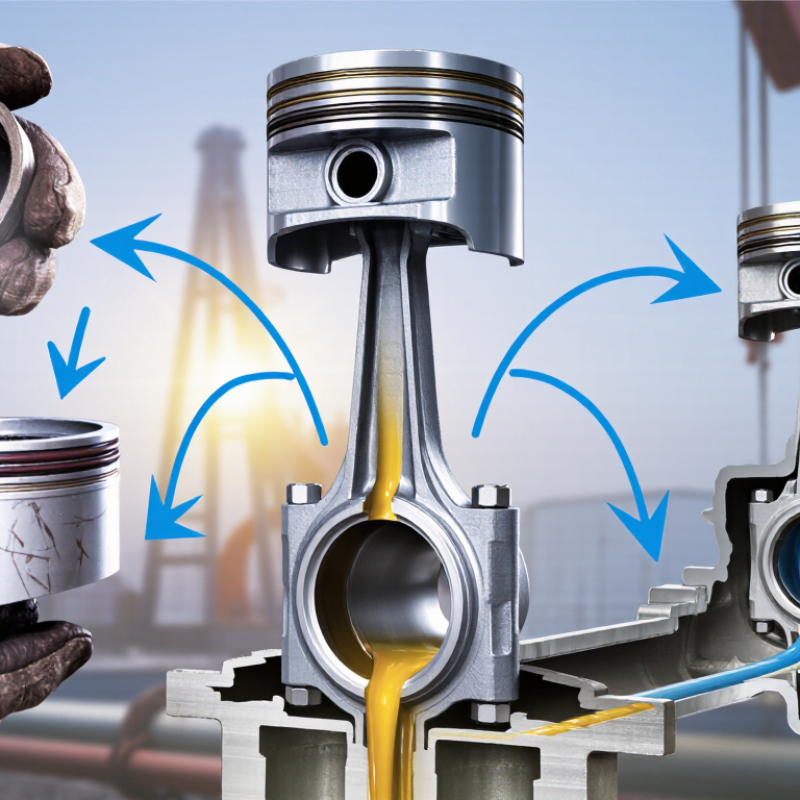
What Is a Mud Pump Piston Used For?

What a Mud Pump Piston Is

A mud pump piston is the reciprocating part that helps move drilling fluid through a rig’s circulation system. It sits inside a replaceable liner in the pump’s fluid end. As the piston moves back, inlet valves open and fluid enters the chamber. On the forward stroke, those valves close and discharge valves open, sending fluid into the drill string. The piston’s seal matters: worn or damaged sealing surfaces can reduce pressure and allow leakage. Abrasive solids in drilling mud make wear a practical concern, not just a maintenance detail.

API Specification 7K covers drilling and well-servicing equipment, including mud pumps; API Recommended Practice 13D addresses drilling-fluid hydraulics. Together, they provide useful context for understanding the piston’s operating environment. Pump displacement can be estimated from piston area multiplied by stroke length. For example, a single-acting piston with a six-inch diameter and a 12-inch stroke displaces about 339 cubic inches per stroke, before leakage and other losses. That figure is a geometry-based example, not a guaranteed pump output. Actual delivery also depends on pump configuration, speed, valve condition, and fluid properties. The number can look precise. It still needs context. A technician checking a unit should compare measured pressure and fluid output with its service records and operating limits.


Where the Piston Fits in a Mud Pump

In a reciprocating mud pump, the piston sits inside the fluid end, moving within a replaceable liner. It connects to the piston rod, which carries motion from the pump’s power end. The crankshaft and connecting rods turn rotation into a steady back-and-forth stroke. That small movement does the hard work.

As the piston retracts, pressure falls and the inlet valve opens, drawing drilling fluid into the chamber. As it advances, the inlet valve closes and the outlet valve opens, pushing fluid into the discharge line. The piston does not work alone: the liner provides its running surface, while the valves direct flow. Not glamorous, but essential.

A close fit between piston and liner helps maintain pressure. Wear, grit, or heat can damage the sealing surface, causing leakage and reduced output. During inspection, crews check for uneven wear and follow the pump maker’s clearance and replacement guidance. Details vary between pump designs, so a familiar repair routine may not fit every unit. That is easy to overlook.

What Is a Mud Pump Piston Used For? - Where the Piston Fits in a Mud Pump

Component or detail Where it fits Role in pumping Practical note
Mud pump piston Inside the fluid-end cylinder, moving within the pump liner. Reciprocates in the liner to displace drilling fluid and create the pressure and flow needed to circulate mud. Its sealing surfaces wear over time; fluid leakage or reduced pressure can indicate wear or damage.
Pump liner Sleeve fitted in the fluid-end cylinder around the piston. Provides the surface against which the piston moves and seals, forming the working chamber. The liner and piston must be compatible in size and condition for effective sealing and service life.
Piston rod and rod connection Connect the piston to the pump’s mechanical drive through the rod assembly. Transmit the drive’s reciprocating motion to the piston. A secure connection and correctly aligned moving parts help prevent abnormal wear.
Suction valve In the fluid end, between the inlet manifold and the pumping chamber. Opens to admit drilling fluid as the piston moves away and chamber pressure falls; closes as pressure rises. A valve that does not seat properly can reduce pump performance and cause fluid to flow backward.
Discharge valve In the fluid end, between the pumping chamber and the discharge manifold. Opens when chamber pressure exceeds discharge pressure, allowing fluid to leave the pump. Together, the suction and discharge valves direct flow through the pump in one direction.
Suction stroke One half of the piston’s reciprocating cycle. The piston moves away from the fluid end, chamber volume increases, and fluid enters through the suction valve. The discharge valve remains closed during normal operation on this stroke.
Discharge stroke The return half of the piston’s reciprocating cycle. The piston moves toward the fluid end, chamber volume decreases, and fluid is forced through the discharge valve. The suction valve remains closed during normal operation on this stroke.
Piston material and service The piston’s sealing element contacts the liner while the pump is operating. The sealing element helps limit fluid bypass around the piston so the pump can build pressure. Material selection depends on the drilling fluid and operating conditions; inspect and replace parts according to service requirements.

How the Piston Moves Drilling Fluid

A mud pump piston converts a rotating crank’s motion into a repeated push-pull movement. On the return stroke, it draws drilling fluid through the suction valve. On the power stroke, it drives fluid through the discharge valve and into the drill string. That is the push. The fluid carries cuttings upward through the annulus while helping cool the bit and balance underground pressure. The piston’s seals matter: worn rubber can let fluid slip past, reducing flow and making pressure less steady.

The volume moved depends on piston area and stroke length. For example, a six-inch piston with a 12-inch stroke displaces about 339 cubic inches, or 1.47 gallons, per power stroke before losses. This is a geometric estimate, not a guaranteed field rate. Valve response, fluid compressibility, and seal wear reduce actual delivery. API Recommended Practice 13D provides the rheology and hydraulics framework used to assess how drilling-fluid properties affect circulation. API Specification 7K addresses drilling equipment, including mud pumps. Together, these references explain why piston movement alone does not determine flow: fluid properties and equipment condition matter, too. The estimate is imperfect, but useful for understanding the mechanism.

What Is a Mud Pump Piston Used For?

The piston reciprocates inside the pump cylinder, changing its volume to move drilling fluid. Suction and discharge valves direct fluid into and out of the cylinder.

This idealized waveform uses a simple-harmonic approximation: the piston travels from one end of its stroke to the other and back during one 360° crankshaft revolution. Actual motion depends on the pump’s crank and connecting-rod geometry.

What the Piston Does During Each Pumping Cycle

A mud-pump piston moves drilling fluid by sliding inside a close-fitting liner. On the suction stroke, the piston pulls back, pressure in the cylinder drops, and the inlet valve opens. Fluid enters the chamber. On the power stroke, the piston advances, the inlet valve closes, and the outlet valve opens. The piston then pushes fluid into the discharge line. Small changes in seal condition matter: worn rubber can let fluid slip past the piston and reduce pressure.

A common triplex, single-acting pump has three pistons, producing three discharge strokes per crankshaft revolution. Pump output depends on piston area, stroke length, and strokes per minute; crews monitor these values alongside discharge pressure. API Specification 7K covers drilling and well-servicing equipment, including mud-pump equipment, while the IADC Drilling Manual provides practical drilling-equipment guidance. Neither gives every rig a universal piston-life figure, because abrasive solids, pressure, and operating practice vary. That limitation is easy to overlook. A rising liner temperature or uneven pressure reading may signal trouble, but neither proves piston failure alone. Check valve condition and fluid properties before changing the piston.

How Piston Design Affects Pressure and Wear

A mud pump piston moves inside a liner to push drilling fluid through the pump and into the circulation system. Its seal must hold against high pressure while sliding repeatedly across the liner. Small design details matter. The piston’s lip shape, rubber compound, and fit all affect how well it seals and how quickly it wears.

A tight fit can reduce leakage and help maintain steady pressure, but it may also increase friction and heat. A flexible sealing lip can follow minor liner irregularities, while a tougher compound may better resist abrasive particles. Neither choice is perfect. Hard solids can score the liner, and heat can weaken some elastomers over time. Pressure changes add another strain: each stroke flexes the sealing edge, sometimes unevenly. That trade-off is easy to underestimate.

In the field, wear often shows up as falling discharge pressure, fluid leakage, or a roughened piston surface. Check the piston and liner together; replacing one without examining the other can shorten service life. Match the piston design to the fluid, operating pressure, temperature, and liner condition, using equipment specifications as the guide. A clean-looking piston may still have lost its sealing shape. Inspection tells part of the story, not all of it.

Article Source:

Powder Coat Booths

For those larger-sized parts, or smaller quantity runs, we have 2 independent powder coat booths and ovens. The quality, durability and affordability of today’s powder coating finishes make this the process of choice for world-class companies.

Powder coating advantages over other forms of coating are many. Materials used in the Powder coating process can be metals and non-metals that come in a multitude of thicknesses, textures, colors, etc. Another of Powder coating’s biggest advantages over conventional coatings is its ability to create finishes in many different textures. Powder Coating Booths allow us the ability to apply these advantages to large products.

Wet Paint Line

Tri-State Fabricators runs a full-service conveyor line for painting. Wet painting can provide protection or decoration to many different part styles. From start to finish, every project is easier to undergo random and point-based inspection by our skilled painting team.

Advantages to our Wet Paint Line are these lines start with product prep and ends with a thorough inspection of a high quality finished product. Our ability to complete large and small projects with a superior finish and doing so in a timely and economical fashion. This passes along the savings in production to our customers. When powder coating ins not an option, our Wet Paint Line gets the job done right the first time.

Wet Paint Booths

When the parts get big and heavy we roll-out our custom paint racks and oversize booth. By utilizing our partnerships with all the major paint brands, we can match virtually any color with wet paint.

The advantages of having access to a Wet Paint Booth are many. Large projects of many different shapes can be loaded into the booth. The Wet Paint Booth offers an environment that is much more controlled than a typical parts painting operation.

Not only are they used because of their controlled environment, but they’re are also advantageous when it comes to applying paint to parts that are needed in industries that require specialty coatings such as medical, aerospace, etc.

Military CARC

Our military forces have some very high standards when it comes to the finish of their vehicles and equipment. From the first pre-treatment step to final coat, it takes a great deal of knowledge and experience to protect the men and women of our armed forces. They deserve only the best, and Tri-State Fabricators provides it.

All of our processes are closely monitored by our staff and management teams. Both of which are highly trained in the processes of metal fabrication and finishing. Tri-State Fabricators’ goal is to always fully satisfy each and every customer, including the military. We will always put a 110% into what we do.

Glass-Bead Blasting

Abrasive media blasting is an excellent way to remove old paint, rust, and increase the paint/powder adhesion. Glass beads produce a much smoother and brighter finish than angular abrasives; leaving the part clean yet without any dimensional change. Chemically inert and environmentally friendly, we can recycle our beads approximately 30 times; making them a more preferred method of metal cleaning or surface finishing.

Advantages to Glass Bead Blasting are many. Glass bead blast media is used when a project is needing rough surfaces need to become smooth for applications of coatings such as paint. It is typically used to clean paint and rust from a product surface without deforming the surface it is being used on. Overall, compared to many other blasting media, Glass Bead Blasting is a very economical choice and those savings are always passed on to our customers.

Part Washing

Tri-State Fabricators utilize a zinc phosphate wash to clean and etch the material to ensure the best paint adhesion possible. The unique design of our 3-stage wash system does the work like a 5-stage. From Cleaning and rinsing to conversion coating and post-treatment, Our Part Washing process is a complete service and works throughout the fabrication service and the finishing service.

Along with the previously mentioned benefits, Curing is a vital chemical reaction that leaves the product finish hard and relatively safe from mild abrasion and aggressive corrosion. This process can be done in more than one way; ambient air-dry or in curing ovens at temps that exceed 240°.

Burn-Off Oven

From fixing paint mistakes (someone else’s of course) to simply cleaning our paint line hooks, our burn-off oven is put to good use. After a quick burn-off, a little clean up, and a fresh coat of paint, your parts will look better than new.

Why does our Burn-Off Oven work so well? Because super heating the air around parts turns the materials into ashes. From paint and powder coatings to rubber and machining oils, high temps do the job without degrading the integrity of the part.

Masking

Masking is a vital part of producing high quality products. We have die-cut masking patterns to protect machined surfaces as well as a wide range of plugs and caps to protect threaded holes and bolts. We provide permanent and temporary masking.

Masking allows the selected sections of a product to be protected from a fabrication or finishing service. This can be with both chemicals when etching and tapes, paints when only finishing just a section of the product. Masking is great in aiding the customization process of a project.

Screen Printing

Screen printing is a photographic process that transfers artwork onto a porous nylon screen which allows colored ink to flow through the screen and be deposited on an aluminum or plastic component. We can generally have just about any design created onto a screen for your parts.

Some of the advantages of Screen Printing are, brand recognition for your business displaying on your products, assembly instructions, product warnings/hazards, etc. Tri-State Fabricators produces Screen Printing of the highest quality so you know it’s durable.

Metal Finishing

Metal Finishing is the art of treating the exterior portion of product, often metal but can also be made of other materials, so that the surface is clean and free of any debris. Then the process of applying coats or either paint of powder coat takes place. This coating process improves the quality of the product in both appearance and resistance to wear and corrosion.

Tri-State Fabricators, Inc., understands that a project typically isn’t complete until a high-quality finish has been added to your product. This is why our painting and powder coating teams continuously inspect the products throughout the Metal Finishing process.
