


Your PE film meets its friction specification before shipment. At the converter, however, it handles differently. Another formulation provides the required slip but creates concerns about surface residue, film opening, or printing.
Should you adjust the existing amide slip package—or evaluate a different slip technology?
Conventional migrating slip agents can be an economical choice when their aging behavior fits the production and conversion schedule. A non-migrating or low-migration slip additive technology becomes worth evaluating when dependence on conventional blooming creates a documented application problem. Choose by performance across the film’s intended use conditions, not by the additive label or the lowest initial COF.
Conventional slip agents such as erucamide and oleamide migrate from the polymer matrix toward the film surface after extrusion. This surface enrichment helps reduce friction between contacting surfaces.
The resulting coefficient of friction, or COF, develops over time. Resin composition, additive concentration, cooling history, film structure, and storage conditions influence that development.
For manufacturers with a predictable aging period before conversion, this behavior can be manageable. An established amide formulation may meet both performance and cost requirements without a technology change.
The difficulty arises when the conversion schedule or application requirements no longer match the formulation’s slip-development profile. Examples include earlier conversion, different storage conditions, or stricter surface-appearance requirements.
In these situations, the relevant question is whether the existing system still fits the job.
“Non-migrating” and “low-migration” are product descriptions that need to be supported by the specific chemistry and evaluation conditions. They should not automatically be treated as equivalent.
Some silicone-based slip systems provide surface modification with less reliance on conventional fatty-acid-amide blooming. Their suitability depends on how the selected grade behaves in the intended film.
When reviewing supplier claims, distinguish three types of evidence:
• COF measurements: show friction behavior at defined time points.
• Bloom or transfer assessments: examine visible surface deposits or transfer under stated contact conditions.
• Migration measurements: investigate movement of specified substances using an appropriate analytical procedure.
A stable COF does not, by itself, establish an absence of migration. Likewise, no visible residue does not prove that no material transferred.
Each claimed benefit should be evaluated with a measurement that actually addresses it.
| Decision point | Conventional migrating slip system | Candidate non-migrating or low-migration system |
|---|---|---|
| Time to required slip | Does the target COF develop before conversion? | Does the candidate meet the target at the required early time point? |
| Storage behavior | Does aging keep COF within the accepted range? | Does the candidate provide a useful difference over the same storage period? |
| Surface condition | Is bloom or transfer an actual application concern? | Is the claimed reduction supported by a relevant assessment? |
| Converting performance | Does the existing film meet printing, lamination, and sealing requirements? | Does the candidate maintain those same requirements? |
| Optical appearance | Are haze and clarity acceptable? | Are the optical specifications maintained at the selected dosage? |
| Commercial value | Does the established system meet requirements economically? | Do verified benefits justify the formulation change and qualification effort? |
The goal is to establish which formulation meets the application’s acceptance criteria.
Define both the required friction range and the point at which it matters.
A film may need to meet its specification shortly after extrusion, during bag making, after shipment, or on the final packaging line. A formulation that performs well after several days of aging may not meet an immediate-conversion requirement.
Also identify the contacting surfaces. Film-to-film friction and film-to-metal friction answer different application questions.
Start the trial with a practical specification: the required COF range, contact configuration, and relevant film age.
A technology change should address a defined problem, such as:
• COF falling outside the customer’s range during storage
• Delays while waiting for slip to develop
• Visible surface residue or transfer
• Inconsistent handling at the converter
• A formulation change that disrupts previously acceptable performance
If the current system meets requirements consistently, replacement may offer little operational value.
If it does not, record the frequency and impact of the problem. That creates a baseline for deciding whether an alternative delivers a meaningful improvement.
Slip performance is only one part of film qualification.
For printed or laminated packaging, include the actual surface treatment, ink, adhesive, and converting process. For clear apparel packaging, optical appearance and contact with dark fabric may be especially important. For sealant films, retain the applicable sealing criteria.
The candidate formulation must satisfy the complete application specification, including adhesion, appearance, and sealing requirements where relevant.
Slip and antiblocking perform different functions.
COF describes resistance to sliding under specified conditions. Blocking concerns adhesion between contacting film layers and the effort required to separate them.
A film can slide easily after separation yet remain difficult to open. If opening is the main complaint, investigate the antiblock package, winding conditions, and storage history alongside the slip additive.
This helps identify the part of the formulation or process that actually needs adjustment.
Use the current production formulation as the control. Select candidate grades and dosage levels with the technical team, then define the acceptance criteria before running the trial.
Keep the resin blend, film thickness, layer structure, antiblock package, processing conditions, treatment, and storage conditions consistent wherever practical. Record any unavoidable differences.
For multilayer films, specify the additive-containing layer and distinguish dosage in that layer from dosage across the whole film. When products have different active contents, distinguish masterbatch loading from active-additive loading.
Report static and dynamic COF separately. State:
• Test method and contact configuration
• Film sides and test direction
• Time elapsed since extrusion
• Storage and sample-conditioning conditions
• Number of specimens and measurement variation, where available
Select time points that represent how the customer handles the film.
Interpret the results against the target range. Less variation is useful only if the film remains suitable for the intended operation; a consistently unsuitable COF is not a successful result.
Alongside COF, evaluate the application-specific requirements:
• Film opening and blocking
• Haze and surface appearance
• Bloom or contact transfer
• Print adhesion or lamination bond strength
• Heat-sealing performance
• Handling on the intended equipment
These results should be reported separately. A friction result cannot substitute for an adhesion test or a surface-transfer assessment.
SILIKE SILIMER Series: Super-Slip and Anti-Blocking Masterbatches for PE Film
SILIKE Internal Evaluation: COF Development, Optical Properties, and Visible Surface Blooming in PE Film
SILIKE evaluated COF development, transmittance, and haze in PE blown films containing SILIMER 5064MB1 or SILIMER 5064MB2 super-slip masterbatch, using a PE blend as the control.
In a separate cloth-wipe evaluation of surface blooming, films containing SILIKE slip additives left less visible white residue on the black cloths than films containing amide slip agents under the evaluated conditions.


Figure 1. SILIKE internal PE blown-film evaluation: dynamic COF development, transmittance, and haze.
Surface blooming evaluation: cloth-wipe comparison
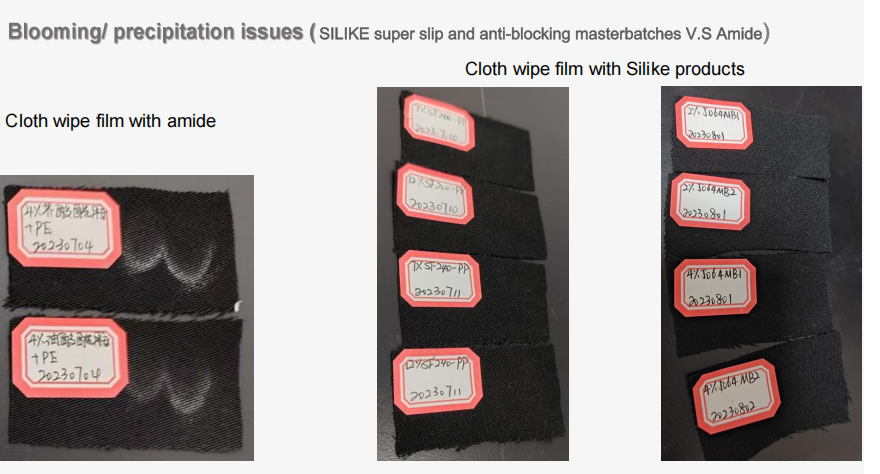
Figure 2. Separate cloth-wipe comparison of visible residue from films containing amide slip agents and SILIKE slip additives.
The photographed cloths show less visible white residue for the SILIKE samples than for the amide samples. This is a qualitative visual observation, not a quantitative migration result.
Data note: These are selected findings from SILIKE’s internal PE film evaluation. Results apply to the tested formulations and conditions. COF data describe friction behavior; migration, surface transfer, printing, and lamination require separate evaluation. Contact SILIKE for detailed test information and application-specific guidance.
The lowest additive price does not necessarily produce the lowest operating cost. Equally, a higher-priced technology is not justified simply because it is described as non-migrating.
Where records are available, compare:
• Additive cost at the qualified dosage
• Time required before film can be converted
• Converting interruptions associated with the existing problem
• Scrap, rework, or rejected rolls
• Qualification effort and ongoing quality-control requirements
Use measured production outcomes rather than assumed savings. This gives technical procurement and production teams a shared basis for deciding whether to retain, optimize, or replace the current slip system.

SILIKE’s SILIMER slip and anti-blocking masterbatch range includes silicone-based slip masterbatches and combined slip and anti-blocking formulations. These products use specially modified silicone polymers to help manufacturers adjust film friction and, for grades with an anti-blocking function, improve film opening.
For manufacturers evaluating alternatives to amide slip agents, relevant application goals include controlled COF development, reduced surface blooming, and less visible powder transfer. Product selection should reflect the specific PE formulation, storage conditions, and converting requirements.
SILIMER 5064MB1 slip masterbatch and SILIMER 5064MB2 slip additive are candidate grades for PE film projects requiring lower friction and controlled slip performance. They can be evaluated against the existing additive package by measuring static and dynamic COF at the time of production and at application-relevant aging intervals.
For PE blown film and multilayer packaging film, the comparison should account for resin composition, film thickness, functional-layer allocation, and the existing antiblock system. The objective is to maintain the required friction range throughout storage and conversion.
Evaluate haze and transmittance alongside a defined cloth-wipe or contact-transfer assessment. These measurements address different aspects of film performance and help establish whether the formulation meets the packaging requirement.
Whether the project concerns COF stability, surface powdering, or difficult film opening, the technical review should identify:
• PE resin grades, film structure, and thickness
• Current slip and antiblock additives and their dosage
• Target COF range and the time at which it must be achieved
• Storage conditions and the main reason for changing the formulation
• Printing, lamination, heat-sealing, and optical requirements
Transparency and downstream converting performance should be confirmed in the actual film system. A slip-only grade should also be distinguished from a combined slip and anti-blocking formulation when planning a replacement.
Share these details with SILIKE to explore a suitable slip and anti-blocking additive solution and plan a comparative trial for your PE film application.
No. An amide system may remain the better choice when it meets the application requirements economically. An alternative becomes valuable when it addresses a verified limitation without creating unacceptable trade-offs.
Not automatically. Product chemistry, carrier, active content, and functional-layer allocation can differ. Establish evaluation levels using the relevant technical guidance.
Only if the specific product and film evaluation support both functions. In many formulations, friction and film opening need to be addressed separately.
That must be established in the intended converting system. Qualify the treated film with the actual ink or adhesive and the relevant adhesion or bond-strength criteria.
Migrating slip agents remain practical where their slip-development behavior matches the film’s production and conversion schedule. Non-migrating or low-migration technologies are worth comparing when the application calls for a different surface-performance profile.
A reliable selection combines a clear target, a controlled film trial, and an assessment of the operational value. Together, these provide a sound basis for formulation approval.
Comparing alternatives to your current migrating slip agent?
Share your PE resin, film structure, current slip system, target COF, and main application problem. SILIKE’s technical team can discuss a candidate SILIMER grade and the next steps for a formulation-specific trial.
Website: www.siliketech.com Email: sale@levvymetal.com Mobile / WhatsApp: +86-15108280799


