


What Is a Meat Mixer and How Does It Work?

What Is a Meat Mixer and How Does It Work? This question matters wherever meat must remain uniform, safe, and commercially consistent. A Meat Mixer combines ground meat with salt, seasonings, water, fat, or functional ingredients. Its paddles, ribbons, or arms move the batch through a controlled mixing pattern. The goal is simple: distribute every ingredient evenly without damaging the product.

The scale is significant. FAOSTAT reports that global meat production has remained above 350 million tonnes annually in recent years. Meanwhile, the OECD-FAO Agricultural Outlook 2024–2033 expects continued growth in global meat demand, especially in developing markets. These figures explain why processors need repeatable equipment, not improvised handling. A mixer can support that repeatability by controlling batch size, mixing time, temperature, and discharge.

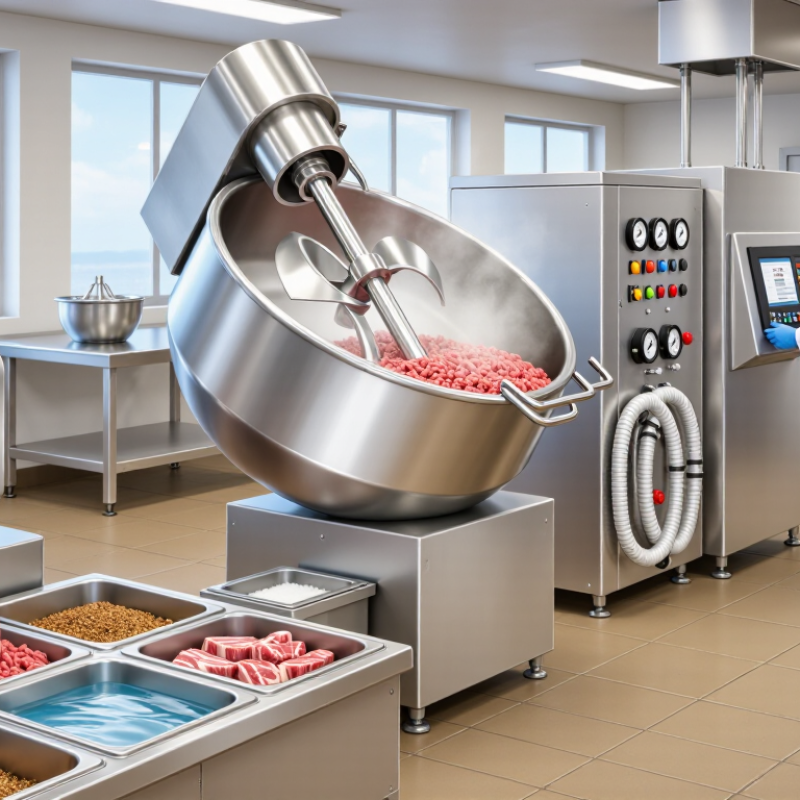
A typical cycle begins when operators load chilled meat into the stainless-steel vessel. The mixing tools then rotate at a selected speed. Some machines use vacuum pressure to reduce air pockets and improve texture. Others include cooling jackets, weighing systems, or programmable controls. Small details matter. A warm batch can affect binding, appearance, and shelf-life performance.

Hygiene is equally important. USDA FSIS guidance and EHEDG hygienic-design principles emphasize cleanable surfaces, drainage, and contamination control. These principles do not replace site validation or operator training. That part is often underestimated.

In practice, the best mixer is not always the largest one. It must match the recipe, throughput, cleaning method, and available floor space. Manufacturer claims can sound impressive, but production trials reveal more. A careful evaluation should measure mixing uniformity, product temperature, cleaning time, and maintenance access before purchase.
What Is a Meat Mixer and How Does It Work?

What Is a Meat Mixer?

A meat mixer is a food-processing machine designed to combine ground meat with seasonings, fat, brine, or other approved ingredients. It replaces repetitive hand mixing with controlled mechanical movement. The main parts include a stainless-steel tub, mixing paddles, drive motor, cover, and discharge opening. Some models use a fixed tub, while others tilt for unloading. Capacity ranges from small kitchen batches to large production loads. The machine’s value is consistency, not simply speed. Each portion should contain a similar distribution of salt, herbs, and moisture.

During operation, the paddles rotate through the mixture and lift, fold, and press it against the tub. This movement helps ingredients contact the meat without crushing it excessively. Paddle shape and rotation direction affect texture. A slow cycle may protect delicate pieces, while a faster cycle can create a tighter bind. Operators usually load chilled ingredients, close the cover, and select a timed cycle. They then inspect the texture before unloading. A mixer cannot correct poor raw material or inaccurate measurements. That point is easy to overlook.

Tips: Keep the meat cold, and never overfill the tub. Leave space for ingredients to turn freely. Weigh seasonings instead of guessing. Check the batch midway, because a short cycle may leave dry pockets. Clean and sanitize food-contact surfaces promptly, following the equipment instructions. Inspect paddles, seals, and guards regularly.


Main Components and Their Functions

A meat mixer combines ground meat, fat, water, spices, and functional ingredients into a consistent batch. The main components are the mixing tank, paddles, drive shaft, motor, gearbox, and control panel. The tank holds the product, while paddles move it through folding, lifting, and pressing actions. This creates a more even texture than hand mixing.

The motor supplies rotation, and the gearbox reduces speed while increasing torque. That matters when the batch becomes cold and dense. A stainless-steel shaft transfers power to the paddles. Many mixers also include a hinged lid, safety interlock, emergency stop, and discharge gate. These details support hygienic operation and safer cleaning. USDA FSIS sanitation standards emphasize cleanable food-contact surfaces and controlled equipment conditions. FAO’s 2023 statistical yearbook reported global meat production at roughly 360 million tonnes, showing why repeatable processing remains important. Still, “uniform” can be overstated; poor loading order or excessive speed may damage texture.

Tips: Load lean meat and liquid before adding dry ingredients. Keep the product cold, and check the batch temperature with a calibrated probe. Inspect seals, welds, and paddle clearance daily. A practical test is simple: sample from the top, center, and bottom. If color or fat distribution differs, the mixer needs adjustment. Shorter mixing is not always better. Follow the equipment manual and verify results through documented checks.

What Is a Meat Mixer and How Does It Work?

Typical shaft-speed ranges by mixer design

A meat mixer combines ground meat, fat, seasonings, and other ingredients by rotating paddles, ribbons, or tumbling vessels. The shaft speed affects mixing intensity, heat generation, and product handling.

  • Mixing vessel: Holds the ingredients and provides the working chamber.
  • Paddles or ribbons: Move the meat through the vessel and distribute ingredients evenly.
  • Shaft and bearings: Transfer rotational force while supporting the mixing assembly.
  • Motor and gearbox: Supply controlled torque and reduce motor speed to a suitable mixing speed.
  • Discharge gate: Allows the finished mixture to leave the vessel efficiently.

How a Meat Mixer Works Step by Step

A meat mixer combines ground meat, fat, water, salt, and seasonings evenly. Its working process is simple, but timing matters. The operator first checks the bowl, paddles, and safety guards. All food-contact surfaces should be clean, dry, and free from residue. The meat then enters the chilled mixing chamber, usually below 4°C. Cold meat keeps fat firm and helps maintain a stable texture.

As the paddles rotate, they lift and fold the mixture instead of cutting it aggressively. This movement spreads ingredients through the batch. Mixing time depends on the recipe, particle size, and desired binding. The operator may inspect color, consistency, and temperature during the cycle. A 2022 report from the U.S. Department of Agriculture recommends cooking ground meats to 71.1°C, or 160°F. The mixer does not make meat safe by itself. Heating comes later.

When the blend looks uniform, the operator stops the paddles and unloads the batch through the discharge opening. The mixture should move without large dry pockets or visible fat clumps. A 2023 FAO report placed global meat production above 350 million tonnes, showing why repeatable processing matters across large facilities. Still, bigger output can hide small errors. An operator may mix too long, warming the product and weakening its texture. That mistake is easy to miss. Temperature checks, batch records, and sanitation inspections provide practical control. Consistency improves when people measure, observe, and question each cycle.

Different Types of Meat Mixers

A meat mixer combines ground meat, fat, salt, spices, and other ingredients into an even mixture. Its rotating paddles or ribbons move the mass through a sturdy mixing chamber. The goal is consistent texture, seasoning, and protein extraction without damaging the meat.

Paddle mixers are suitable for coarse products, such as fresh sausage and seasoned ground meat. Their wide paddles lift and fold ingredients gently. Ribbon mixers use helical blades and handle larger batches efficiently. They work well with marinades, dry seasoning, and meat mixtures requiring strong circulation. However, excessive mixing can warm the meat and create a sticky texture. Temperature matters more than many beginners expect.

Vacuum mixers remove trapped air while the paddles turn. This can improve density, color stability, and binding in cooked sausage products. They also reduce air pockets that may appear during stuffing. Vertical mixers use an upright chamber and often suit smaller workshops with limited floor space. Their compact design is useful, but some corners may mix less evenly. That weakness deserves attention.

An experienced operator checks the batch visually and records mixing time, meat temperature, and ingredient weight. Cleanable surfaces and removable parts support reliable sanitation between batches. I have found that longer mixing is not always better. A short pause for inspection can prevent overworking the meat. Even skilled operators sometimes misjudge moisture absorption. Calibration and repeatable procedures help correct that uncertainty.

What Is a Meat Mixer and How Does It Work? - Different Types of Meat Mixers

Meat Mixer Type How It Works Typical Capacity Range Common Applications Key Advantages Important Considerations
Manual Batch Mixer The operator turns a hand crank or manually moves the mixing paddles through the meat mixture. Ingredients are blended in a stationary tank. Approximately 5–25 kg per batch Small butcher shops, restaurants, test kitchens, farm processing, and occasional sausage production.
  • Low purchase and operating cost
  • Simple construction
  • No electrical connection required
Requires more physical effort and provides lower output and consistency than powered equipment.
Paddle Mixer One or more flat paddles rotate inside a horizontal or vertical vessel, lifting and folding meat, fat, seasonings, and other ingredients together. Approximately 20–500 kg per batch Sausage fillings, meatballs, burgers, seasoned minced meat, and general food-processing operations.
  • Gentle mixing action
  • Good control of texture
  • Suitable for many minced-meat formulations
Mixing time depends on batch size, ingredient temperature, moisture, and the formulation being processed.
Ribbon Mixer Inner and outer helical ribbons rotate in a trough, moving material in opposite directions to create axial and radial circulation. Approximately 50–1,000 kg per batch Large-volume mixing of minced meat with spices, curing ingredients, breadcrumbs, vegetables, or other dry and wet components.
  • Efficient bulk mixing
  • Good distribution of dry seasonings
  • Available in many industrial sizes
Overmixing or excessive shear may affect product texture, especially when the formulation is temperature-sensitive.
Vacuum Meat Mixer A sealed mixing chamber removes air during agitation. The paddles or arms blend the ingredients while reduced pressure limits air incorporation. Approximately 50–1,500 kg per batch Premium sausages, emulsified products, deli meats, cured products, and formulations where reduced air content is important.
  • Helps reduce air pockets and oxidation
  • Can improve product density and appearance
  • Supports consistent seasoning distribution
Higher equipment cost and more complex sealing, cleaning, and vacuum-system maintenance.
Vacuum Tumbler Mixer A rotating drum or vessel gently lifts and drops meat under vacuum. The action promotes contact between the meat and marinade or curing solution. Approximately 50–2,000 kg per batch Marinated cuts, cured whole-muscle products, cooked ham, poultry, and products requiring improved brine absorption.
  • Gentle treatment of larger meat pieces
  • Improves contact with marinades and brines
  • Vacuum can support more uniform ingredient uptake
It is designed primarily for tumbling and marination rather than intensive mixing of finely minced formulations.
Emulsifying Mixer High-speed knives, rotors, or cutting heads reduce particle size while mixing meat, fat, water, and functional ingredients into a fine emulsion. Approximately 20–500 kg per batch Frankfurter-style sausages, pâtés, luncheon meats, spreads, and other finely textured products.
  • Produces a smooth, fine texture
  • Combines cutting and mixing in one process
  • Suitable for stable meat emulsions
Generates more heat and shear; temperature control is essential to help protect emulsion stability and product quality.
Continuous Meat Mixer Ingredients enter continuously through an inlet, move through a mixing chamber with rotating elements, and exit as a steady stream. Approximately 500–5,000 kg per hour, depending on design and formulation High-volume production of sausage mixtures, burger meat, prepared foods, and standardized formulations.
  • High throughput
  • Reduced batch-to-batch interruption
  • Can integrate with automated production lines
Requires accurate ingredient feeding, process control, and careful cleaning to prevent carryover between formulations.
Tilting or Discharge Mixer The mixing vessel tilts or uses a bottom or side discharge mechanism to release the finished mixture into bins, conveyors, or filling equipment. Approximately 100–2,000 kg per batch Medium- and large-scale sausage, burger, meatball, and prepared-meat production.
  • Faster unloading
  • Reduces manual handling
  • Can improve line efficiency
Requires adequate floor space, discharge clearance, and compatible downstream handling equipment.
Basic operating principle: A meat mixer combines meat and additional ingredients through controlled mechanical movement. Paddles, ribbons, screws, blades, or tumbling action circulate the materials until the desired distribution, texture, and seasoning consistency are achieved.

Common Uses, Benefits, and Safety Practices

A meat mixer combines ground meat, seasonings, and other ingredients evenly. Its rotating paddles move the mixture through a stainless-steel tank. As the paddles turn, they lift, fold, and press the meat. This process creates a more consistent texture than hand mixing. It also reduces labor during sausage, patty, meatball, and prepared-meat production. Different paddle speeds can protect delicate ingredients from excessive crushing.

Consistency matters. Each portion should contain similar seasoning and fat distribution. A mixer can improve batch control, reduce preparation time, and support cleaner handling. However, it does not guarantee quality by itself. Overmixing may create a dense, rubbery texture. Poorly chilled meat can also smear against the paddles and affect the final result. Experience still matters, especially when adjusting mixing time for different recipes.

Tips: Keep the meat and equipment cold. Check the internal temperature with a calibrated thermometer. Clean and sanitize every food-contact surface before and after use. Disconnect power before removing stuck material or reaching near the paddles. Inspect seals, guards, and emergency stops regularly. Never overload the tank, because uneven mixing and motor strain may follow. Wear close-fitting clothing and avoid loose gloves near moving parts. A small test batch can reveal texture problems early.

Powder Coat Booths

For those larger-sized parts, or smaller quantity runs, we have 2 independent powder coat booths and ovens. The quality, durability and affordability of today’s powder coating finishes make this the process of choice for world-class companies.

Powder coating advantages over other forms of coating are many. Materials used in the Powder coating process can be metals and non-metals that come in a multitude of thicknesses, textures, colors, etc. Another of Powder coating’s biggest advantages over conventional coatings is its ability to create finishes in many different textures. Powder Coating Booths allow us the ability to apply these advantages to large products.

Wet Paint Line

Tri-State Fabricators runs a full-service conveyor line for painting. Wet painting can provide protection or decoration to many different part styles. From start to finish, every project is easier to undergo random and point-based inspection by our skilled painting team.

Advantages to our Wet Paint Line are these lines start with product prep and ends with a thorough inspection of a high quality finished product. Our ability to complete large and small projects with a superior finish and doing so in a timely and economical fashion. This passes along the savings in production to our customers. When powder coating ins not an option, our Wet Paint Line gets the job done right the first time.

Wet Paint Booths

When the parts get big and heavy we roll-out our custom paint racks and oversize booth. By utilizing our partnerships with all the major paint brands, we can match virtually any color with wet paint.

The advantages of having access to a Wet Paint Booth are many. Large projects of many different shapes can be loaded into the booth. The Wet Paint Booth offers an environment that is much more controlled than a typical parts painting operation.

Not only are they used because of their controlled environment, but they’re are also advantageous when it comes to applying paint to parts that are needed in industries that require specialty coatings such as medical, aerospace, etc.

Military CARC

Our military forces have some very high standards when it comes to the finish of their vehicles and equipment. From the first pre-treatment step to final coat, it takes a great deal of knowledge and experience to protect the men and women of our armed forces. They deserve only the best, and Tri-State Fabricators provides it.

All of our processes are closely monitored by our staff and management teams. Both of which are highly trained in the processes of metal fabrication and finishing. Tri-State Fabricators’ goal is to always fully satisfy each and every customer, including the military. We will always put a 110% into what we do.

Glass-Bead Blasting

Abrasive media blasting is an excellent way to remove old paint, rust, and increase the paint/powder adhesion. Glass beads produce a much smoother and brighter finish than angular abrasives; leaving the part clean yet without any dimensional change. Chemically inert and environmentally friendly, we can recycle our beads approximately 30 times; making them a more preferred method of metal cleaning or surface finishing.

Advantages to Glass Bead Blasting are many. Glass bead blast media is used when a project is needing rough surfaces need to become smooth for applications of coatings such as paint. It is typically used to clean paint and rust from a product surface without deforming the surface it is being used on. Overall, compared to many other blasting media, Glass Bead Blasting is a very economical choice and those savings are always passed on to our customers.

Part Washing

Tri-State Fabricators utilize a zinc phosphate wash to clean and etch the material to ensure the best paint adhesion possible. The unique design of our 3-stage wash system does the work like a 5-stage. From Cleaning and rinsing to conversion coating and post-treatment, Our Part Washing process is a complete service and works throughout the fabrication service and the finishing service.

Along with the previously mentioned benefits, Curing is a vital chemical reaction that leaves the product finish hard and relatively safe from mild abrasion and aggressive corrosion. This process can be done in more than one way; ambient air-dry or in curing ovens at temps that exceed 240°.

Burn-Off Oven

From fixing paint mistakes (someone else’s of course) to simply cleaning our paint line hooks, our burn-off oven is put to good use. After a quick burn-off, a little clean up, and a fresh coat of paint, your parts will look better than new.

Why does our Burn-Off Oven work so well? Because super heating the air around parts turns the materials into ashes. From paint and powder coatings to rubber and machining oils, high temps do the job without degrading the integrity of the part.

Masking

Masking is a vital part of producing high quality products. We have die-cut masking patterns to protect machined surfaces as well as a wide range of plugs and caps to protect threaded holes and bolts. We provide permanent and temporary masking.

Masking allows the selected sections of a product to be protected from a fabrication or finishing service. This can be with both chemicals when etching and tapes, paints when only finishing just a section of the product. Masking is great in aiding the customization process of a project.

Screen Printing

Screen printing is a photographic process that transfers artwork onto a porous nylon screen which allows colored ink to flow through the screen and be deposited on an aluminum or plastic component. We can generally have just about any design created onto a screen for your parts.

Some of the advantages of Screen Printing are, brand recognition for your business displaying on your products, assembly instructions, product warnings/hazards, etc. Tri-State Fabricators produces Screen Printing of the highest quality so you know it’s durable.

Metal Finishing

Metal Finishing is the art of treating the exterior portion of product, often metal but can also be made of other materials, so that the surface is clean and free of any debris. Then the process of applying coats or either paint of powder coat takes place. This coating process improves the quality of the product in both appearance and resistance to wear and corrosion.

Tri-State Fabricators, Inc., understands that a project typically isn’t complete until a high-quality finish has been added to your product. This is why our painting and powder coating teams continuously inspect the products throughout the Metal Finishing process.
