Why Choose a Mattress Display Rack for Your Store?
A mattress store needs more than comfortable products; it needs a clear way to present them. A Mattress Display Rack can lift models off the floor, separate sizes, and make firmness labels easier to read. Customers can compare two mattresses without stepping around crowded corners. Details matter. The right height also lets shoppers sit on an edge or examine a fabric cover without straining. In a busy showroom, stable frames and tidy spacing can make the space feel calmer and easier to browse.
Choosing a rack involves practical checks, not just appearance. Measure aisles, ceiling height, and the footprint of each mattress before ordering. Check the frame’s stated capacity, the finish, and whether the rack suits the store’s preferred layout. Ask suppliers for dimensions and care guidance, and confirm how the display handles heavier models. For stores with changing collections, modular racks may make rearranging simpler. Still, a rack is not a cure-all. A layout that looks orderly on paper may feel cramped once customers begin testing mattresses. Mattress sizes and customer needs also vary, so leave enough room for movement and accessible product information. Review the display after opening: notice where visitors pause, which labels they miss, and whether staff can reset the area quickly. Small adjustments may be needed. A thoughtful setup helps shoppers compare products while giving staff a practical, maintainable showroom.
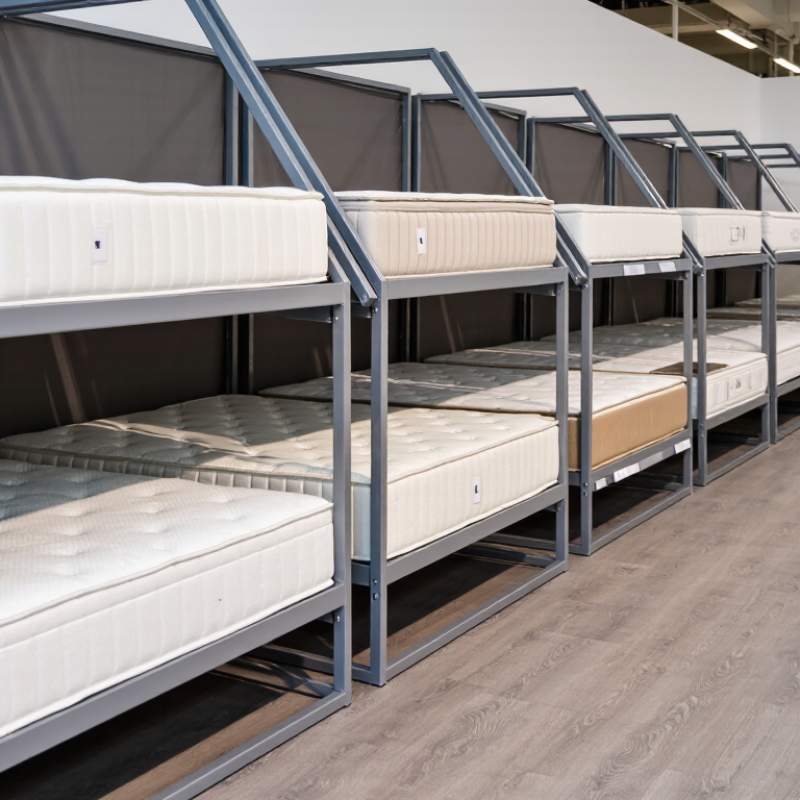
What a Mattress Display Rack Is and How It Works
A mattress display rack is a purpose-built frame that supports mattresses upright, tilted, or in a raised position. Unlike a bed frame, it is designed for showroom viewing and product comparison. Its base holds the mattress steady, while side supports or braces help limit shifting. Some racks display one mattress; others hold several models in a compact footprint. A simple example: a customer can compare two mattress heights without lifting either one. Clear space around each display also makes it easier to inspect the edges and feel the surface.
In daily use, staff place each mattress on a rack sized for its dimensions and weight. They can add a product card nearby, then reposition or replace the mattress when the selection changes. A well-organized layout keeps walkways open and helps customers see differences in profile, firmness, or construction. Check that the supports are secure and that the mattress sits evenly; a slight tilt can make a display look careless. There is a trade-off: fitting more models into a small area may reduce room to move. That detail is easy to miss. A rack works best when it supports both the product and a comfortable viewing distance.
How Display Racks Improve Mattress Visibility and Store Layout
A mattress display rack can make a bulky product easier to see without letting it dominate the whole store. Place beds where shoppers can view them from the entrance and main aisle. Upright positioning can show the mattress profile, fabric, and edge details at a glance. Keep price and comfort information near eye level. Clear labels save shoppers from searching for basic facts. Leave enough room to walk around each sample and compare options comfortably. Narrow paths can make even a spacious store feel cramped.
Tips: Stand at the entrance and check which mattresses disappear behind taller displays. Move those racks, then walk the aisle with a basket-sized space in mind. Small adjustments help. Check from both ends. Don’t assume the first layout is the best one.
Racks can also create a calmer layout by grouping models by size, feel, or price range. Consistent spacing lets customers scan one option at a time. Yet rigid rows may look neat but feel cold. A slight angle or open corner can invite closer browsing, though it may reduce floor capacity. Check the arrangement during busy hours; a layout that works when empty may bottleneck near the end of an aisle.
Why Choose a Mattress Display Rack for Your Store? - How Display Racks Improve Mattress Visibility and Store Layout
A practical planning guide showing how display racks can help shoppers compare mattress sizes while making better use of showroom space.
| Mattress Size | Typical U.S. Nominal Dimensions | Display Rack Approach | Visibility and Shopping Benefit | Store Layout Consideration |
| Twin | 38 × 75 in (about 97 × 191 cm) | Use a clearly labeled rack position alongside other common sizes. | Helps shoppers quickly identify a compact option and compare its size with larger models. | Useful near a youth, guest-room, or space-saving display area; keep the mattress label visible from the main aisle. |
| Full | 54 × 75 in (about 137 × 191 cm) | Group with Twin and Queen displays to make size comparisons straightforward. | A consistent rack arrangement makes size and comfort information easier to scan. | Arrange neighboring displays so shoppers can move between sizes without blocking the surrounding walkway. |
| Queen | 60 × 80 in (about 152 × 203 cm) | Give this common size a prominent, easy-to-reach display position. | Clear front-facing labels and an uncluttered presentation help shoppers compare models and specifications. | Place where customers can view the full display and access product information without interrupting traffic flow. |
| King | 76 × 80 in (about 193 × 203 cm) | Use a rack configuration suited to the larger mattress and the store’s handling requirements. | A dedicated, clearly marked display makes the larger size easier to distinguish from Queen models. | Check turning and handling space before placement; avoid narrowing routes or obstructing nearby displays. |
Planning note: Mattress dimensions shown are typical U.S. nominal sizes; actual products may vary by manufacturer. Rack capacity, footprint, and clearance depend on the rack design, mattress construction, and local accessibility and safety requirements. Confirm product and rack specifications before finalizing a store layout.
Which Rack Features Support Safe and Flexible Displays
A mattress display rack must do more than hold a bed upright. It should resist tipping, protect fabric, and let staff move stock without awkward lifting.
The U.S. Bureau of Labor Statistics reported 2.8 million nonfatal workplace injuries and illnesses in private industry in 2022, or 2.7 cases per 100 full-time workers. That figure does not isolate mattress handling, but it underscores the value of safer everyday work areas. OSHA’s 29 CFR 1910.176(b) requires stored materials to be secured against sliding or collapse.
Look for a wide, stable base, a clearly stated load capacity, and locking casters. Small details matter. Padded contact points help limit scuffs, while retaining straps or stops help prevent shifting. Adjustable supports should lock securely at each position, not simply slide into place. Keep walking paths clear and avoid corners that jut into aisles. Check the locks before loading. A rack can look sturdy and still wobble; inspect it within its rated capacity, since appearance alone is a poor test. Flexibility is useful, but not if adjustments weaken stability.
How to Choose a Rack for Your Store’s Space and Inventory
Why Choose a Mattress Display Rack for Your Store?
How to Choose a Rack for Your Store’s Space and Inventory
Start with the floor plan, not the rack catalog. Measure the available wall length, aisle width, ceiling height, and nearby door swings. Leave breathing room. Customers should be able to approach a mattress without blocking traffic or brushing against another display. A quick sketch with measurements can reveal awkward corners before you buy.
Match the rack to the mattresses you actually carry. Check how many sizes and models need to be shown, and whether each mattress must be easy to remove for comparison. Confirm the rack’s stated load capacity and follow its installation guidance. If you display mattresses upright or at an angle, check that the support points suit their size and construction. Small details matter. A display that looks neat but hides labels can slow down shopping.
Think about restocking, too. Staff need a clear route to move a mattress from storage to the display without twisting through a narrow aisle. Keep popular sizes within easy reach, and leave room for new arrivals if inventory changes by season. It is easy to overestimate how much a compact rack can hold. I would recheck the measurements against a full-size mattress outline on the floor; the result can be less tidy than the drawing.
How Proper Use and Maintenance Keep a Rack in Good Condition
A mattress display rack stays in good condition when staff use it within its stated load limits. Place mattresses evenly, with their weight supported across the frame. Avoid leaning heavy items against one side or pushing a stack beyond the rack’s safe capacity. A tilted display can strain joints and may become unstable. Keep the surrounding floor clear, too, so carts and shoppers do not bump the base.
Check the frame, fasteners, and support bars regularly for looseness, bends, or sharp edges. If the rack has wheels, make sure they roll smoothly and lock securely before loading it. Small checks matter. Wipe dust away with a soft cloth and use a mild cleaner when needed. Dry the surface afterward, especially around joints, where moisture may linger. Avoid abrasive pads and strong solvents, which can damage finishes. Staff may be tempted to postpone inspections during busy weeks; that is easy to miss. A simple dated checklist can help, though it is only useful when someone follows it. Record any change in stability and take the rack out of use until it has been assessed or repaired.
Why Choose a Mattress Display Rack for Your Store?
A well-maintained rack keeps mattresses organized and accessible. This example schedule shows suggested intervals for routine care; follow the rack manufacturer's instructions and load limits.
Good practice: Check the rack visually each day, clean it weekly, check fasteners monthly, and inspect its structure quarterly. Address damage promptly and never exceed the manufacturer's stated capacity.





