


A Mag Welding Machine feeds a continuous wire electrode into an electric arc while supplying an active shielding gas. The arc melts the wire and base metal, creating a joint as the molten pool cools. Its industrial relevance is substantial. Worldsteel’s World Steel in Figures 2024 reports global crude steel production of approximately 1.89 billion tonnes in 2023. That figure provides context for steel fabrication, although it does not measure MAG equipment demand.
MAG means metal active gas welding, a process within the broader gas metal arc welding family. Unlike MIG welding, MAG uses gases that influence arc behavior and weld chemistry, including carbon dioxide or argon-based mixtures. Gas selection matters. For example, an argon mixture containing 18% carbon dioxide is commonly used for welding carbon steel. A typical machine combines a power source, wire feeder, welding torch, and gas controls. Operators adjust voltage and wire feed speed to suit material thickness, joint geometry, and welding position.
Automation adds another reason to understand this equipment. The International Federation of Robotics’ World Robotics 2024 report recorded approximately 4.3 million industrial robots operating worldwide in 2023. These figures cover all industrial applications, so they should not be mistaken for welding-specific adoption data. Performance still needs scrutiny. A stable-looking arc can conceal inadequate fusion when settings, torch angle, or travel speed are unsuitable. This guide explains how MAG equipment works, where it fits, and which operating choices influence weld quality. Practical results depend on preparation and procedure, not simply the machine’s advertised output.
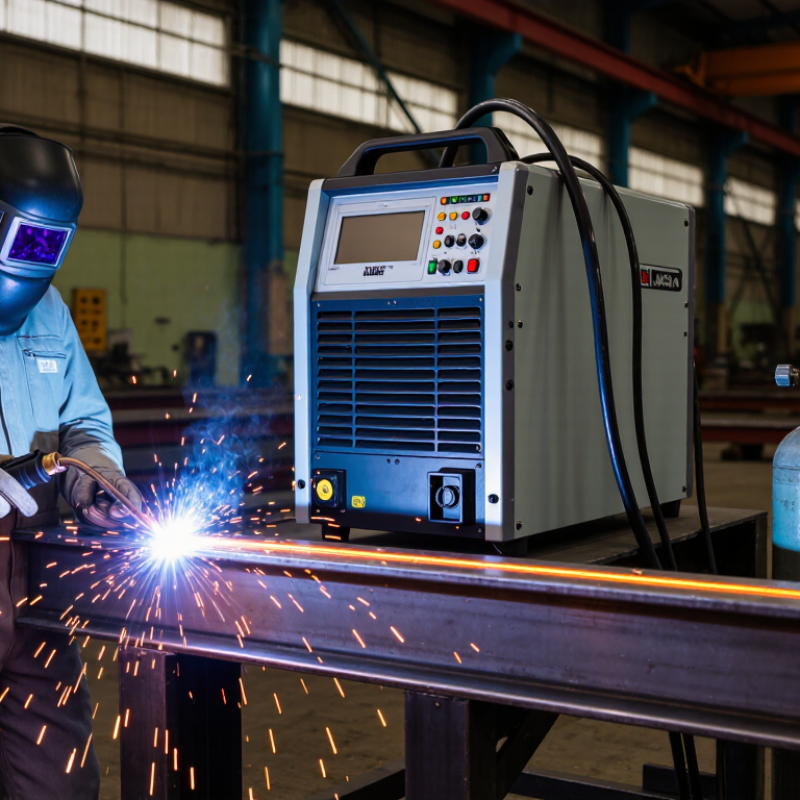
A MAG welding machine is a power source and wire-feeding system used for metal active gas welding. It continuously feeds a consumable wire electrode through a torch, where an electric arc melts the wire and the workpiece. Shielding gas flows around the arc and molten pool, reducing exposure to air. MAG commonly uses carbon dioxide or an argon–carbon dioxide blend.
In use, the operator sets voltage and wire-feed speed, then guides the torch along the joint. The gas composition, wire diameter, and travel speed affect arc stability, penetration, and spatter. A steady hand helps. So does clean metal.
Too much gas flow can create turbulence and disturb shielding; too little may leave the weld vulnerable to porosity. These details make setup and observation essential, not optional.
The American Welding Society’s 2023 workforce analysis projected that the United States would need about 330,000 new welding professionals by 2028, including replacements and additional workers. That figure is not specific to MAG welding, but it highlights why practical process knowledge matters.
A MAG machine can produce consistent welds, yet it does not correct poor fit-up or unsuitable settings. The operator still has to inspect the bead and adjust. Not magic.

A MAG welding machine uses a continuous wire electrode and an active shielding gas to join metal. Its power source controls the welding current and voltage, which affect heat, penetration, and bead shape. Too much heat can burn through thin sheet; too little may leave a weak joint. Settings need to suit the material thickness and wire size.
The wire feeder pushes electrode wire through a cable to the welding torch. Inside the torch, the contact tip transfers current to the wire, while the nozzle directs shielding gas around the arc. The gas system typically includes a cylinder, regulator, and hose. Check the flow at the torch, not just the regulator. Small leaks or drafts can disrupt shielding and leave pores in the weld.
A work clamp completes the electrical circuit by connecting the workpiece to the machine. Controls let the operator adjust wire speed, voltage, and sometimes inductance or operating mode. The torch, feeder, and power source must work together; changing one setting can alter the arc’s sound and feel. It takes practice. Even a clean-looking bead may hide poor fusion, so inspect the joint and test settings on scrap of similar thickness.
| Component | Main Function | How It Works in MAG Welding | Practical Notes |
|---|---|---|---|
| Power source | Provides electrical power for the welding arc. | In common wire-feed MAG systems, it supplies direct current and typically uses a constant-voltage output. The arc melts the continuously fed wire and part of the workpiece. | Output settings must suit the material, wire diameter, joint, and welding procedure. |
| Wire feeder and drive rolls | Feeds electrode wire from the spool to the welding torch. | Motor-driven rolls push the wire through the torch liner. Wire-feed speed influences the rate at which wire enters the arc and is one of the main process settings. | Rolls, liner, and contact tip should be suitable for the wire type and diameter to support smooth feeding. |
| Welding wire (consumable electrode) | Conducts welding current and supplies filler metal. | The wire travels through the torch, becomes electrically energized at the contact tip, and melts into the weld pool. | Wire composition and diameter should be selected for the base material and welding requirements. |
| Welding torch and contact tip | Guides the wire and delivers current to it. | The contact tip transfers current to the moving wire. The torch also directs shielding gas toward the arc and weld pool. | A worn or incorrectly sized contact tip can contribute to unstable feeding or an inconsistent arc. |
| Gas nozzle | Directs shielding gas around the arc and weld area. | Gas flows through the torch and exits the nozzle to help shield the molten metal from atmospheric contamination. | Spatter or blockage inside the nozzle can disturb gas coverage. |
| Shielding-gas supply | Protects the arc and molten weld pool from the surrounding air. | MAG uses an active shielding gas, commonly carbon dioxide or an argon–carbon dioxide mixture. The gas can influence arc behavior, penetration, and spatter. | Gas selection and flow should follow the applicable welding procedure and equipment guidance. |
| Gas regulator and flowmeter | Reduces cylinder pressure and allows gas flow to be set and monitored. | The regulator lowers the high pressure from the gas cylinder; the flowmeter indicates the gas flow supplied to the torch. | Check connections for leaks and use a flow setting appropriate to the torch, nozzle, and working conditions. |
| Work lead and work clamp | Completes the welding circuit through the workpiece. | The clamp connects the workpiece to the power source return circuit, allowing current to flow through the arc and back to the machine. | Attach it to clean, secure metal with good electrical contact. |
| Control panel | Allows the operator to adjust and monitor welding settings. | Depending on the machine, controls may include voltage, wire-feed speed, operating mode, and gas or wire-feed functions. | Use settings specified by the welding procedure where one is available. |
A MAG welding machine joins metal with a continuously fed wire electrode and an electric arc. The process uses an active shielding gas, commonly a mixture containing argon and carbon dioxide. The gas flows around the arc and molten weld pool, helping protect them from air. The wire melts and becomes part of the joint.
Start by matching the wire and gas to the metal and its thickness. Connect the work clamp to clean metal, then check the torch, wire feed, and gas flow. Set voltage and wire speed according to the machine’s guidance.
A short test bead helps. Listen to the arc. A steady crackle can indicate a stable setup, though sound alone is not enough. Hold the torch at a consistent angle and move it evenly along the joint.
Press the trigger to feed wire and start the arc; keep the nozzle close enough for shielding gas to protect the pool. Watch the puddle’s edges as they fuse with the base metal.
If the bead looks uneven, pause and inspect your travel speed, settings, and surface preparation. Even experienced welders sometimes need another test.
Let the work cool, then check the bead for gaps, excessive spatter, or poor fusion.
In MAG welding, shielding gas is an active part of the process, not just a barrier against air. Carbon dioxide can produce a forceful arc and deeper penetration, while argon-rich blends generally give a smoother arc and less spatter. The AWS Welding Handbook discusses these effects as practical trade-offs in gas metal arc welding. ISO 14175:2008 classifies argon mixtures containing 5–25% carbon dioxide as M21. That range is useful, but it does not identify one perfect mixture for every joint.
Settings must match the gas, wire, material thickness, and joint position. Wire-feed speed largely controls current; voltage influences arc length and bead shape. Travel speed then changes how much heat stays in the workpiece. For a small steel fillet, a shop might begin near 12–18 L/min of gas flow, then check coverage for drafts and nozzle distance. Too little flow invites porosity; too much can disturb the shielding. Small changes matter. A tidy chart can still mislead. AWS guidance supports testing settings on similar scrap, then inspecting the bead and weld root before production. I would not treat a stable-looking arc as proof of sound fusion.
MAG (Metal Active Gas) welding uses a wire electrode and an active shielding gas to protect the weld pool. This chart compares common shielding-gas mixtures by volume. Argon is the balance gas in the blends; carbon dioxide and oxygen are the active components.
Key settings: Voltage mainly affects arc length, while wire-feed speed strongly influences welding current. Choose these settings for the wire diameter, material thickness, joint, and transfer mode; then match the gas blend to the process and desired weld characteristics.
A MAG welding machine feeds a continuous wire electrode through a torch while shielding gas protects the molten weld pool. The gas is active, often carbon dioxide or an argon–carbon dioxide blend. This makes the process well suited to carbon steel and many low-alloy steels. Stainless steel can also be welded with suitable wire and gas, but settings and gas composition need careful selection. Fit matters.
MAG is common in vehicle repair, steel fabrication, machinery production, and workshop assembly. A steady wire feed suits long seams and repeated parts, such as brackets or frame joints. On a bench, a welder can often maintain a consistent bead at useful production speeds. Yet speed alone is not a quality check; joint preparation and operator technique still matter.
The process has limits. Wind can disturb shielding gas, so outdoor welds may become porous unless the work area is protected. Thin sheet can burn through, while poor settings may leave spatter around the bead. Rust, paint, oil, or mill scale can also undermine weld quality, even when the machine sounds steady. The name can mislead: MAG is not a universal metal process, and aluminum usually calls for inert-gas shielding. Real work is less tidy than a chart suggests.


For those larger-sized parts, or smaller quantity runs, we have 2 independent powder coat booths and ovens. The quality, durability and affordability of today’s powder coating finishes make this the process of choice for world-class companies.
Powder coating advantages over other forms of coating are many. Materials used in the Powder coating process can be metals and non-metals that come in a multitude of thicknesses, textures, colors, etc. Another of Powder coating’s biggest advantages over conventional coatings is its ability to create finishes in many different textures. Powder Coating Booths allow us the ability to apply these advantages to large products.
Tri-State Fabricators runs a full-service conveyor line for painting. Wet painting can provide protection or decoration to many different part styles. From start to finish, every project is easier to undergo random and point-based inspection by our skilled painting team.
Advantages to our Wet Paint Line are these lines start with product prep and ends with a thorough inspection of a high quality finished product. Our ability to complete large and small projects with a superior finish and doing so in a timely and economical fashion. This passes along the savings in production to our customers. When powder coating ins not an option, our Wet Paint Line gets the job done right the first time.
When the parts get big and heavy we roll-out our custom paint racks and oversize booth. By utilizing our partnerships with all the major paint brands, we can match virtually any color with wet paint.
The advantages of having access to a Wet Paint Booth are many. Large projects of many different shapes can be loaded into the booth. The Wet Paint Booth offers an environment that is much more controlled than a typical parts painting operation.
Not only are they used because of their controlled environment, but they’re are also advantageous when it comes to applying paint to parts that are needed in industries that require specialty coatings such as medical, aerospace, etc.
Our military forces have some very high standards when it comes to the finish of their vehicles and equipment. From the first pre-treatment step to final coat, it takes a great deal of knowledge and experience to protect the men and women of our armed forces. They deserve only the best, and Tri-State Fabricators provides it.
All of our processes are closely monitored by our staff and management teams. Both of which are highly trained in the processes of metal fabrication and finishing. Tri-State Fabricators’ goal is to always fully satisfy each and every customer, including the military. We will always put a 110% into what we do.
Abrasive media blasting is an excellent way to remove old paint, rust, and increase the paint/powder adhesion. Glass beads produce a much smoother and brighter finish than angular abrasives; leaving the part clean yet without any dimensional change. Chemically inert and environmentally friendly, we can recycle our beads approximately 30 times; making them a more preferred method of metal cleaning or surface finishing.
Advantages to Glass Bead Blasting are many. Glass bead blast media is used when a project is needing rough surfaces need to become smooth for applications of coatings such as paint. It is typically used to clean paint and rust from a product surface without deforming the surface it is being used on. Overall, compared to many other blasting media, Glass Bead Blasting is a very economical choice and those savings are always passed on to our customers.
Tri-State Fabricators utilize a zinc phosphate wash to clean and etch the material to ensure the best paint adhesion possible. The unique design of our 3-stage wash system does the work like a 5-stage. From Cleaning and rinsing to conversion coating and post-treatment, Our Part Washing process is a complete service and works throughout the fabrication service and the finishing service.
Along with the previously mentioned benefits, Curing is a vital chemical reaction that leaves the product finish hard and relatively safe from mild abrasion and aggressive corrosion. This process can be done in more than one way; ambient air-dry or in curing ovens at temps that exceed 240°.
From fixing paint mistakes (someone else’s of course) to simply cleaning our paint line hooks, our burn-off oven is put to good use. After a quick burn-off, a little clean up, and a fresh coat of paint, your parts will look better than new.
Why does our Burn-Off Oven work so well? Because super heating the air around parts turns the materials into ashes. From paint and powder coatings to rubber and machining oils, high temps do the job without degrading the integrity of the part.
Masking is a vital part of producing high quality products. We have die-cut masking patterns to protect machined surfaces as well as a wide range of plugs and caps to protect threaded holes and bolts. We provide permanent and temporary masking.
Masking allows the selected sections of a product to be protected from a fabrication or finishing service. This can be with both chemicals when etching and tapes, paints when only finishing just a section of the product. Masking is great in aiding the customization process of a project.
Screen printing is a photographic process that transfers artwork onto a porous nylon screen which allows colored ink to flow through the screen and be deposited on an aluminum or plastic component. We can generally have just about any design created onto a screen for your parts.
Some of the advantages of Screen Printing are, brand recognition for your business displaying on your products, assembly instructions, product warnings/hazards, etc. Tri-State Fabricators produces Screen Printing of the highest quality so you know it’s durable.
Metal Finishing is the art of treating the exterior portion of product, often metal but can also be made of other materials, so that the surface is clean and free of any debris. Then the process of applying coats or either paint of powder coat takes place. This coating process improves the quality of the product in both appearance and resistance to wear and corrosion.
Tri-State Fabricators, Inc., understands that a project typically isn’t complete until a high-quality finish has been added to your product. This is why our painting and powder coating teams continuously inspect the products throughout the Metal Finishing process.

