


What Is a Lithium RV Battery and How Does It Work?

A lithium RV battery stores electrical energy in rechargeable lithium-ion cells, commonly lithium iron phosphate (LiFePO4) in recreational vehicles. It can power lights, a refrigerator, and other 12-volt equipment without an engine running. The battery’s chemistry is only part of the story. A battery management system (BMS) monitors cell voltage and temperature, and can limit charging or discharging when conditions move outside safe operating ranges. When a charger supplies power, ions move within the cells; when appliances draw power, that stored energy becomes usable electricity. The details matter.

BloombergNEF’s 2024 Battery Price Survey reported an average lithium-ion pack price of $115 per kilowatt-hour, down 20% from 2023. That figure describes a broad global market, not the installed cost of an RV battery. RV systems also require compatible chargers, wiring, and protection, which affect the final price and performance. A useful perspective, paraphrased from Argonne battery scientist Dr. Venkat Srinivasan’s work, is that cell chemistry, controls, and operating conditions must be considered together.

In this guide, we’ll look at how a lithium RV battery works, what its BMS does, and how charging differs from simply connecting a battery to a load. We’ll also separate common claims from practical limits: cold temperatures can restrict charging, and a larger capacity does not automatically solve every power problem. That distinction matters. Real-world use depends on the whole system, including appliances, solar input, and charging habits. A lithium battery can make camping power quieter and more convenient, but it still needs careful sizing and compatible equipment.
What Is a Lithium RV Battery and How Does It Work?

What a Lithium RV Battery Is

A lithium RV battery is a rechargeable energy-storage unit built from lithium-based cells. It supplies electricity to lights, fans, pumps, and other onboard equipment when shore power is unavailable. Many deep-cycle RV models use lithium iron phosphate chemistry, often called LiFePO4, though not every lithium battery has the same chemistry or specifications.

Compared with a lead-acid battery of similar capacity, a lithium model is often lighter and can provide more usable energy. The exact difference depends on the battery’s design and operating limits. That distinction matters. A battery’s rated capacity does not always equal the energy an RV owner should plan to use.

Most RV lithium batteries include a battery management system, or BMS. It monitors conditions such as voltage and temperature, and may limit charging or discharging when readings move beyond safe operating ranges. In practical terms, it is a safeguard, not a substitute for a compatible charger or correct installation. Cold weather deserves attention: some batteries restrict charging below certain temperatures. Check the specific battery’s manual before choosing equipment or changing a system. Not every setup fits. A heavier battery bank, existing charger, and available mounting space can all affect whether a lithium replacement is suitable.


The Main Components Inside a Lithium RV Battery

What Is a Lithium RV Battery and How Does It Work?

The Main Components Inside a Lithium RV Battery

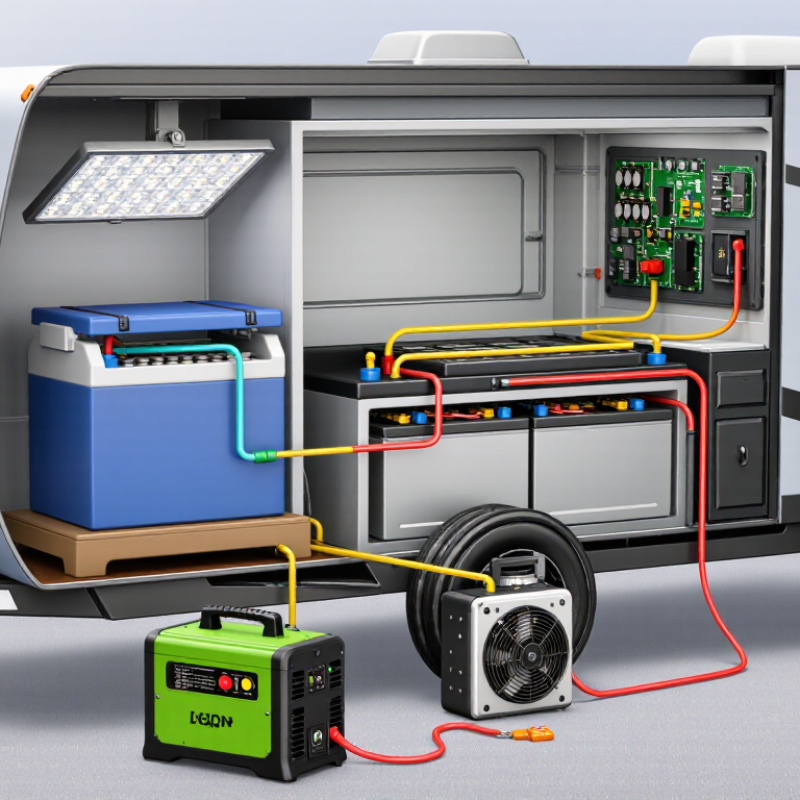
Inside a common 12.8-volt LiFePO4 RV battery, four cells are connected in series. Each cell contains a cathode, an anode, an electrolyte, and a thin separator. During discharge, lithium ions move through the electrolyte while electrons travel through the RV’s wiring to power lights or a refrigerator. The separator keeps the electrodes apart. Small part, important job.

Metal busbars link the cells, and terminals connect the pack to the RV. A battery management system (BMS) monitors cell voltage, current, and temperature. It can interrupt charging or discharging when readings exceed its limits, and may balance cells to reduce differences between them. A fuse and protective casing add safeguards, though exact designs vary. The wiring and sensor layout can look less tidy than expected; that does not automatically mean a fault, but it does make clear documentation useful.

Tips: Check the battery’s manual for its BMS limits before pairing it with a charger or inverter. NREL’s 2024 Annual Technology Baseline uses 85% round-trip efficiency for utility-scale lithium-ion storage. That is a grid-storage benchmark, not a guaranteed RV battery result; real performance depends on the pack and conditions.

What Is a Lithium RV Battery and How Does It Work? - The Main Components Inside a Lithium RV Battery

Component What It Does How It Works Typical Details
Lithium cells Store and release electrical energy. Lithium ions move between the electrodes through an electrolyte during charging and discharging. Many RV batteries use lithium iron phosphate (LiFePO₄) cells. A common 12 V-class LiFePO₄ battery has four cells connected in series, with a nominal pack voltage of about 12.8 V.
Battery Management System (BMS) Monitors and protects the battery. The BMS measures cell voltages, current, and often temperature. It can disconnect charging or loads if operating limits are exceeded and may balance cell voltages. Protection features and current limits vary by battery design; the battery specifications determine the applicable limits.
Electrical connections and bus bars Connect the cells and carry current to the battery terminals. Conductive links join cells in the intended series or parallel arrangement. External cables connect the battery to the RV electrical system. Connection design and cable sizing should match the battery’s current rating and installation instructions.
Positive and negative terminals Provide the battery’s external connection points. The positive terminal supplies current to the RV circuit, while the negative terminal completes the circuit back to the battery. Polarity must be observed when connecting cables; terminal type and size vary among battery designs.
Temperature sensors and protection Help keep the battery within its permitted temperature range. Where fitted, sensors report temperature to the BMS, which may limit or stop charging or discharging when conditions are outside specified limits. Charging below freezing is generally restricted for LiFePO₄ cells unless the battery has an appropriate low-temperature charging solution.
Enclosure and insulation Hold and protect the internal components. The case secures the cells and electronics and helps shield them from everyday handling and environmental exposure. Ingress protection, mounting requirements, and operating-temperature limits are model-specific.
Charging source and charge control Restore energy to the cells. A compatible converter, solar charge controller, or alternator charging system regulates voltage and current supplied to the battery. Charging settings should follow the battery manufacturer’s specifications; lead-acid equalization settings are generally not appropriate for LiFePO₄ batteries.
RV loads Use the stored energy to operate onboard equipment. When a load is switched on, current flows from the battery through the RV circuit and back to the battery. An inverter can convert battery DC power to AC power when needed. Available runtime depends on usable battery capacity, load power, temperature, and system efficiency.

Note: Component layouts, ratings, and protection features differ between batteries. Always follow the specifications and installation instructions for the specific battery and RV system.

How Lithium-Ion Cells Store and Release Energy

A lithium RV battery stores energy through reversible chemical reactions inside sealed cells. During charging, lithium ions move from the positive electrode through the electrolyte to the negative electrode. Electrons travel through the charger’s circuit, balancing the movement. When an RV powers a light or refrigerator, the process reverses: ions move back, while electrons flow through the appliance. That’s the basic loop. In many RV batteries, a battery management system monitors cell voltage and temperature, then limits charging or discharging when needed.

Efficiency is not perfect. NREL’s 2024 Annual Technology Baseline uses 85% round-trip efficiency for utility-scale lithium-ion storage; an RV installation can differ because of its cells, wiring, inverter, and operating conditions. This figure is a useful reference, not a promise for a particular battery. On a cold morning, a battery may also accept charge differently than it does in a warm garage. The chemistry sounds tidy, but real performance depends on the whole system.

Tips: Check the battery maker’s temperature limits and charge settings before connecting solar or shore power. Keep terminals clean, and watch for unexpected voltage drops under load. Small details matter. I’d also track energy use for a few trips; estimates can be wrong, and actual refrigerator cycles often surprise owners.

How the Battery Management System Monitors and Protects the Battery

A lithium RV battery stores energy in multiple cells, while its battery management system (BMS) watches each cell, not just the pack’s total voltage. It tracks voltage, current, and temperature, then estimates the state of charge. When one cell approaches its safe limit, the BMS can reduce charging or disconnect the battery. It may also balance cells, helping prevent one weak cell from limiting the whole pack.

Small sensors matter.

For context, the U.S. Department of Energy’s 2022 Grid Energy Storage Technology Cost and Performance Assessment models lithium-ion storage at about 85% round-trip efficiency. NREL’s 2024 Annual Technology Baseline also uses an 85% efficiency assumption. These are system-level modeling figures, not promises for an RV battery; wiring, temperature, and charging equipment affect real results. A BMS cannot fix an incompatible charger or a damaged connection. Sensors can drift. Check that the battery’s BMS specifications match the charger’s voltage settings, and treat low-temperature charging limits seriously. A display showing remaining charge is useful, but it is an estimate, not a fuel gauge with perfect accuracy.

How an RV Charges and Uses Lithium Battery Power

A lithium RV battery stores energy for the lights, water pump, refrigerator controls, and other onboard loads. Its battery management system monitors conditions and can limit charging or output when needed. Charging usually comes from shore power through a compatible converter, rooftop solar through a charge controller, or the vehicle alternator through suitable charging equipment. Each source needs settings designed for the battery chemistry. A mismatched charger may leave the battery undercharged or create avoidable stress.

When the RV is parked, solar can replace some of the energy used during the day. At a campground, shore power can recharge the battery while also supplying household-style outlets through the RV’s electrical system. On the road, alternator charging can help, but the wiring and charger must be sized for the setup. Not every alternator connection is appropriate. An inverter changes battery power into household-style AC power, while many lights and pumps use DC directly. That distinction matters. It is easy to misjudge remaining capacity by watching voltage alone, because lithium voltage can stay fairly steady as charge falls. A compatible monitor gives a clearer estimate. Check the manufacturer’s temperature limits too; some batteries should not be charged below freezing unless protected.

Powder Coat Booths

For those larger-sized parts, or smaller quantity runs, we have 2 independent powder coat booths and ovens. The quality, durability and affordability of today’s powder coating finishes make this the process of choice for world-class companies.

Powder coating advantages over other forms of coating are many. Materials used in the Powder coating process can be metals and non-metals that come in a multitude of thicknesses, textures, colors, etc. Another of Powder coating’s biggest advantages over conventional coatings is its ability to create finishes in many different textures. Powder Coating Booths allow us the ability to apply these advantages to large products.

Wet Paint Line

Tri-State Fabricators runs a full-service conveyor line for painting. Wet painting can provide protection or decoration to many different part styles. From start to finish, every project is easier to undergo random and point-based inspection by our skilled painting team.

Advantages to our Wet Paint Line are these lines start with product prep and ends with a thorough inspection of a high quality finished product. Our ability to complete large and small projects with a superior finish and doing so in a timely and economical fashion. This passes along the savings in production to our customers. When powder coating ins not an option, our Wet Paint Line gets the job done right the first time.

Wet Paint Booths

When the parts get big and heavy we roll-out our custom paint racks and oversize booth. By utilizing our partnerships with all the major paint brands, we can match virtually any color with wet paint.

The advantages of having access to a Wet Paint Booth are many. Large projects of many different shapes can be loaded into the booth. The Wet Paint Booth offers an environment that is much more controlled than a typical parts painting operation.

Not only are they used because of their controlled environment, but they’re are also advantageous when it comes to applying paint to parts that are needed in industries that require specialty coatings such as medical, aerospace, etc.

Military CARC

Our military forces have some very high standards when it comes to the finish of their vehicles and equipment. From the first pre-treatment step to final coat, it takes a great deal of knowledge and experience to protect the men and women of our armed forces. They deserve only the best, and Tri-State Fabricators provides it.

All of our processes are closely monitored by our staff and management teams. Both of which are highly trained in the processes of metal fabrication and finishing. Tri-State Fabricators’ goal is to always fully satisfy each and every customer, including the military. We will always put a 110% into what we do.

Glass-Bead Blasting

Abrasive media blasting is an excellent way to remove old paint, rust, and increase the paint/powder adhesion. Glass beads produce a much smoother and brighter finish than angular abrasives; leaving the part clean yet without any dimensional change. Chemically inert and environmentally friendly, we can recycle our beads approximately 30 times; making them a more preferred method of metal cleaning or surface finishing.

Advantages to Glass Bead Blasting are many. Glass bead blast media is used when a project is needing rough surfaces need to become smooth for applications of coatings such as paint. It is typically used to clean paint and rust from a product surface without deforming the surface it is being used on. Overall, compared to many other blasting media, Glass Bead Blasting is a very economical choice and those savings are always passed on to our customers.

Part Washing

Tri-State Fabricators utilize a zinc phosphate wash to clean and etch the material to ensure the best paint adhesion possible. The unique design of our 3-stage wash system does the work like a 5-stage. From Cleaning and rinsing to conversion coating and post-treatment, Our Part Washing process is a complete service and works throughout the fabrication service and the finishing service.

Along with the previously mentioned benefits, Curing is a vital chemical reaction that leaves the product finish hard and relatively safe from mild abrasion and aggressive corrosion. This process can be done in more than one way; ambient air-dry or in curing ovens at temps that exceed 240°.

Burn-Off Oven

From fixing paint mistakes (someone else’s of course) to simply cleaning our paint line hooks, our burn-off oven is put to good use. After a quick burn-off, a little clean up, and a fresh coat of paint, your parts will look better than new.

Why does our Burn-Off Oven work so well? Because super heating the air around parts turns the materials into ashes. From paint and powder coatings to rubber and machining oils, high temps do the job without degrading the integrity of the part.

Masking

Masking is a vital part of producing high quality products. We have die-cut masking patterns to protect machined surfaces as well as a wide range of plugs and caps to protect threaded holes and bolts. We provide permanent and temporary masking.

Masking allows the selected sections of a product to be protected from a fabrication or finishing service. This can be with both chemicals when etching and tapes, paints when only finishing just a section of the product. Masking is great in aiding the customization process of a project.

Screen Printing

Screen printing is a photographic process that transfers artwork onto a porous nylon screen which allows colored ink to flow through the screen and be deposited on an aluminum or plastic component. We can generally have just about any design created onto a screen for your parts.

Some of the advantages of Screen Printing are, brand recognition for your business displaying on your products, assembly instructions, product warnings/hazards, etc. Tri-State Fabricators produces Screen Printing of the highest quality so you know it’s durable.

Metal Finishing

Metal Finishing is the art of treating the exterior portion of product, often metal but can also be made of other materials, so that the surface is clean and free of any debris. Then the process of applying coats or either paint of powder coat takes place. This coating process improves the quality of the product in both appearance and resistance to wear and corrosion.

Tri-State Fabricators, Inc., understands that a project typically isn’t complete until a high-quality finish has been added to your product. This is why our painting and powder coating teams continuously inspect the products throughout the Metal Finishing process.
