


Choosing among the Top China Polyethylene Boards Manufacturers requires more than comparing prices. Product quality can vary between similar-looking sheets. Resin grade, board density, thickness tolerance, surface finish, and production consistency all deserve attention.
This guide examines manufacturers through practical purchasing criteria. It considers factory experience, processing equipment, quality-control procedures, export capability, and customer support. Reliable suppliers should explain their material specifications clearly. They should also provide samples, technical data, and inspection records when requested. A workshop visit, video audit, or third-party inspection can reveal details that catalogs often miss.
Look closely.
For example, a high-quality Polyethylene Boards supplier should control cutting accuracy and prevent visible warping. Edges should remain clean after machining. Boards used for marine liners, industrial wear plates, food-processing areas, or fabrication projects may require different polyethylene grades. Ultra-high-molecular-weight polyethylene is not automatically the best choice for every application. Cost, impact resistance, friction, temperature, and chemical exposure must be evaluated together.
This overview does not treat one company as universally superior. Manufacturing strengths can differ by product, batch size, and destination market. That limitation matters. Some supplier information may change, and promotional claims require verification. Buyers should confirm certificates, production capacity, lead times, packaging methods, and after-sales responsibilities before placing an order.
The goal is practical guidance, not a polished ranking without evidence. By comparing technical competence, communication quality, and documented performance, readers can build a more dependable shortlist of Chinese manufacturers.
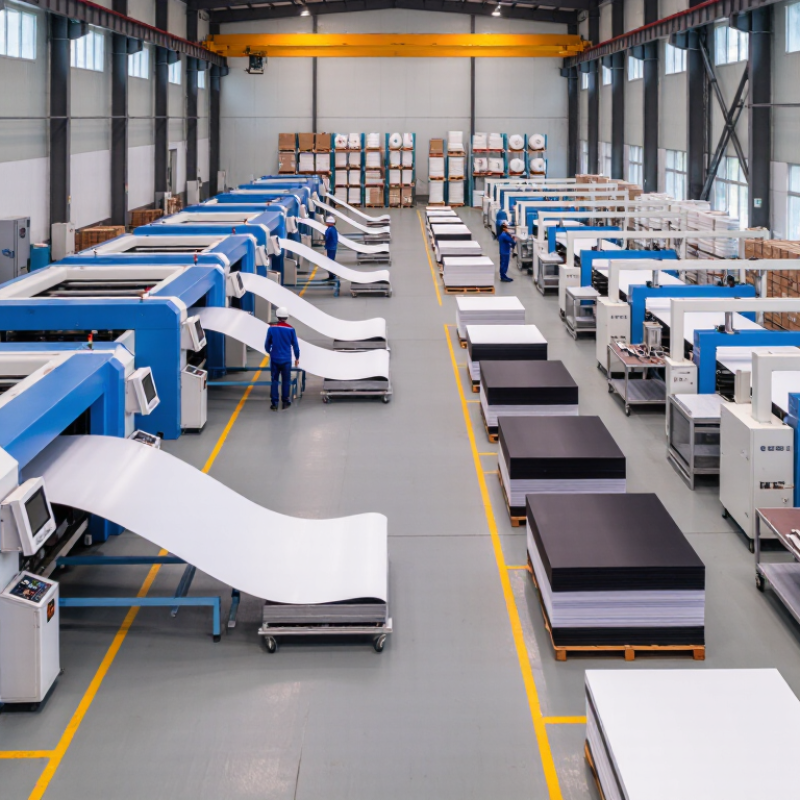
“Top” China PE board manufacturers should be judged by measurable capacity, not factory size alone. The PlasticsEurope 2024 report recorded global plastics production at about 414 million tonnes in 2023. China represented roughly one-third of that volume. This scale supports stable resin supply, but it does not prove consistent board production. Buyers should request annual PE board output, extrusion-line capacity, and production records for similar thicknesses.
Quality needs clearer evidence. ASTM D4976 and ISO 1872 provide useful references for polyethylene material classification. A reliable supplier should disclose density, melt flow rate, tensile strength, impact performance, and thickness tolerance. For example, a board advertised as 10 millimetres should include measured results, not only “±0.5 mm.” Independent laboratory testing is stronger than a self-issued certificate. Still, even laboratory data can represent one batch only. That limitation deserves attention.
Export performance offers another practical filter. UN Comtrade data under HS 3920.10 tracks plastic plates, sheets, and film made from ethylene polymers. It is a useful export proxy, although it does not isolate PE boards. Compare three years of shipment value, destination markets, and repeat-order patterns. China Customs data can verify the trend. A manufacturer with high capacity but irregular exports may have weak packaging, documentation, or quality control. The better choice combines documented output, repeatable test results, and traceable international shipments. Price alone is a poor ranking tool.
| Evaluation Dimension | Verified Data Point | Top-Tier Benchmark | Qualified Benchmark | Recommended Evidence | Weight |
|---|---|---|---|---|---|
| Production Capacity | Annual PE board output | 10,000+ metric tons/year | 3,000–9,999 metric tons/year | Audited production records, equipment list, and capacity statement | 25% |
| Product Range | Available thickness, width, length, and custom formats | Thickness from 1–100 mm with custom dimensions | Standard thicknesses with limited customization | Technical catalogue, dimensional tolerance sheet, and sample approval record | 10% |
| Material Consistency | Polymer type, recycled content, density, and batch uniformity | Clearly specified HDPE or UHMW-PE grade with batch traceability | Material grade declared with basic batch records | Certificate of analysis, resin documentation, and lot identification | 10% |
| Quality Management | Quality-system certification and process control | Valid ISO 9001:2015 certification plus documented incoming, in-process, and final inspection | Documented internal inspection system | Current certificate issued by an accredited certification body and inspection plan | 15% |
| Technical Performance | Mechanical, thermal, and dimensional test data | Third-party or accredited-lab reports covering tensile strength, density, hardness, and dimensional tolerance | In-house test reports for principal properties | Reports referencing ISO 527, ISO 1183, ASTM D638, ASTM D792, or ASTM D2240 where applicable | 15% |
| Export Experience | Verified export history and destination coverage | 5+ years of regular exports to 20+ countries or territories | 3+ years of exports to 5–19 countries or territories | Bills of lading, customs records, export invoices, or independently verifiable shipment data | 15% |
| Export Classification | Consistency of customs product classification | Regularly documented under HS 3920.10 when applicable to non-cellular polyethylene sheets and plates | Correct classification provided upon request | Commercial invoice, packing list, customs declaration, and product description consistency | 5% |
| Delivery Capability | Lead time, repeat-order reliability, and shipment handling | Stable repeat-order lead time with documented on-time delivery above 95% | Predictable lead time with basic delivery records | Purchase-order history, production schedule, packaging specification, and delivery performance data | 10% |
| Recommended Definition of “Top” | A manufacturer should normally achieve at least 80/100 points, meet the top-tier capacity or export benchmark, provide verifiable quality evidence, and pass sample approval before being classified as a top China PE board manufacturer. | 100% | |||

When evaluating China polyethylene board manufacturers, start with density and molecular weight, not catalog claims. HDPE boards usually measure about 0.94–0.97 g/cm³. They offer strong stiffness, low moisture absorption, and reliable impact resistance. These properties suit liners, tanks, cutting surfaces, and fabricated machine parts.
LDPE boards normally fall near 0.91–0.94 g/cm³. Their lower density creates a softer, more flexible sheet with better conformability. They can work well for protective layers, seals, and lightweight fabrication. However, lower density often reduces stiffness and load-bearing performance. The difference matters. A supplier should provide density results from a recognized test method, not only a nominal grade.
UHMW-PE boards require a different reading. Their density may overlap with HDPE, often around 0.93–0.94 g/cm³, but their molecular weight is dramatically higher, commonly above one million g/mol. This structure improves abrasion resistance, impact absorption, and sliding performance. It also makes machining more demanding. Numbers need context. When comparing manufacturers, request molecular-weight data, thickness tolerance, hardness, water absorption, and wear-test results. Review sample edges, surface uniformity, and warpage after machining. I would not rely on density alone; that shortcut can produce a costly mismatch. A credible manufacturer explains test conditions, accepts reasonable technical questions, and connects each board grade with a specific operating environment. Supplier documentation is useful, but independent sample testing remains the more dependable check.
Top China Polyethylene Boards Manufacturers?
When comparing polyethylene board manufacturers, density and molecular weight deserve more attention than catalogue photos. Boards at 0.93–0.97 g/cm³ usually balance low weight, impact resistance, and sliding performance. Grades near 3 million g/mol may machine more easily. Grades near 9 million g/mol often offer stronger abrasion resistance, but processing can become less forgiving. A larger number is not automatically better.
Reliable manufacturers should provide batch-specific test data, not only a general product sheet. Check density tolerance, molecular weight testing method, moisture condition, thickness variation, and surface flatness. In practical equipment trials, a small thickness error can change bolt alignment or create uneven wear. Ask for samples cut from production material. Laboratory figures may not match workshop behavior. That gap deserves attention.
Tips: Compare equal board thicknesses and identical test conditions. Record cutting speed, tool wear, impact marks, and sliding noise during trials. Ask whether additives or recycled content affect the stated values. Confirm operating temperature and load before choosing a high-molecular-weight grade. A supplier’s response time also matters; slow technical support can delay adjustments. Keep photographs and measurements from each sample, even when the differences look minor.
Anonymous reference points for polyethylene board specifications within the commonly published range of 0.93–0.97 g/cm³ density and 3–9 million g/mol molecular weight. This comparison focuses on material specifications rather than company or brand names.
Higher molecular weight is generally associated with improved abrasion resistance and impact performance, while density can affect stiffness, weight, and processing behavior. Actual board performance should be verified against each supplier’s technical datasheet.
Selecting a polyethylene board manufacturer requires more than comparing prices or surface appearance. A documented ISO 9001 system can reveal how consistently the factory controls materials, production steps, inspections, and corrective actions. Ask for current certificates, audit records, and traceability examples. A certificate alone proves little.
ASTM D638 tensile data provides useful evidence about strength, elongation, and specimen preparation. Request the test method, sample thickness, test speed, conditioning, and laboratory details. Compare results from several production batches, not one attractive report. A high tensile value may not predict performance under repeated impact or edge loading. Numbers need context.
Wear resistance deserves practical testing. Ask whether the board has been evaluated with sliding contact, abrasive particles, moisture, or temperature changes. Review mass loss, thickness reduction, and surface damage after a defined cycle count. If possible, inspect samples after cutting and drilling. Rough edges, hidden voids, or inconsistent density can appear only during machining. My experience is that supplier communication often exposes quality faster than polished brochures. Vague answers create risk. Even experienced buyers can overvalue laboratory results while ignoring installation conditions. A stronger assessment combines ISO 9001 controls, ASTM D638 tensile evidence, and wear testing that resembles the board’s actual service environment. One weakness remains: test conditions rarely match every field application. Ask for limitations, not just strengths.
Rank One represents suppliers with broad custom-size capacity, including 2,000-millimeter sheets, tight thickness control, and CNC cutting. Their technical teams should provide material data, batch records, and sample approvals. Verify certifications directly. Documents can age quickly.
Rank Two includes manufacturers with dependable standard sizes and shorter quoted lead times. These suppliers may ship common boards within 10 to 20 working days. Custom colors, textures, or oversized panels often require longer planning. Ask for a written production schedule. Get it in writing. Global shipment experience also matters, especially for moisture protection, pallet strength, and export packaging.
Rank Three covers capable factories serving smaller orders or regional projects. Their pricing may look attractive, but tooling fees and minimum quantities can change the final cost. Review recent shipment references, not only claimed destinations. Check whether inspection reports match the delivered batch. A useful trial order should test flatness, surface finish, impact resistance, and dimensional accuracy.
This ranking is practical, not permanent. Factory performance can shift after equipment changes or busy seasons. Even strong suppliers may miss a deadline. That is the uncomfortable part. Buyers should compare current samples, certifications, response speed, and shipment records before approval.


For those larger-sized parts, or smaller quantity runs, we have 2 independent powder coat booths and ovens. The quality, durability and affordability of today’s powder coating finishes make this the process of choice for world-class companies.
Powder coating advantages over other forms of coating are many. Materials used in the Powder coating process can be metals and non-metals that come in a multitude of thicknesses, textures, colors, etc. Another of Powder coating’s biggest advantages over conventional coatings is its ability to create finishes in many different textures. Powder Coating Booths allow us the ability to apply these advantages to large products.
Tri-State Fabricators runs a full-service conveyor line for painting. Wet painting can provide protection or decoration to many different part styles. From start to finish, every project is easier to undergo random and point-based inspection by our skilled painting team.
Advantages to our Wet Paint Line are these lines start with product prep and ends with a thorough inspection of a high quality finished product. Our ability to complete large and small projects with a superior finish and doing so in a timely and economical fashion. This passes along the savings in production to our customers. When powder coating ins not an option, our Wet Paint Line gets the job done right the first time.
When the parts get big and heavy we roll-out our custom paint racks and oversize booth. By utilizing our partnerships with all the major paint brands, we can match virtually any color with wet paint.
The advantages of having access to a Wet Paint Booth are many. Large projects of many different shapes can be loaded into the booth. The Wet Paint Booth offers an environment that is much more controlled than a typical parts painting operation.
Not only are they used because of their controlled environment, but they’re are also advantageous when it comes to applying paint to parts that are needed in industries that require specialty coatings such as medical, aerospace, etc.
Our military forces have some very high standards when it comes to the finish of their vehicles and equipment. From the first pre-treatment step to final coat, it takes a great deal of knowledge and experience to protect the men and women of our armed forces. They deserve only the best, and Tri-State Fabricators provides it.
All of our processes are closely monitored by our staff and management teams. Both of which are highly trained in the processes of metal fabrication and finishing. Tri-State Fabricators’ goal is to always fully satisfy each and every customer, including the military. We will always put a 110% into what we do.
Abrasive media blasting is an excellent way to remove old paint, rust, and increase the paint/powder adhesion. Glass beads produce a much smoother and brighter finish than angular abrasives; leaving the part clean yet without any dimensional change. Chemically inert and environmentally friendly, we can recycle our beads approximately 30 times; making them a more preferred method of metal cleaning or surface finishing.
Advantages to Glass Bead Blasting are many. Glass bead blast media is used when a project is needing rough surfaces need to become smooth for applications of coatings such as paint. It is typically used to clean paint and rust from a product surface without deforming the surface it is being used on. Overall, compared to many other blasting media, Glass Bead Blasting is a very economical choice and those savings are always passed on to our customers.
Tri-State Fabricators utilize a zinc phosphate wash to clean and etch the material to ensure the best paint adhesion possible. The unique design of our 3-stage wash system does the work like a 5-stage. From Cleaning and rinsing to conversion coating and post-treatment, Our Part Washing process is a complete service and works throughout the fabrication service and the finishing service.
Along with the previously mentioned benefits, Curing is a vital chemical reaction that leaves the product finish hard and relatively safe from mild abrasion and aggressive corrosion. This process can be done in more than one way; ambient air-dry or in curing ovens at temps that exceed 240°.
From fixing paint mistakes (someone else’s of course) to simply cleaning our paint line hooks, our burn-off oven is put to good use. After a quick burn-off, a little clean up, and a fresh coat of paint, your parts will look better than new.
Why does our Burn-Off Oven work so well? Because super heating the air around parts turns the materials into ashes. From paint and powder coatings to rubber and machining oils, high temps do the job without degrading the integrity of the part.
Masking is a vital part of producing high quality products. We have die-cut masking patterns to protect machined surfaces as well as a wide range of plugs and caps to protect threaded holes and bolts. We provide permanent and temporary masking.
Masking allows the selected sections of a product to be protected from a fabrication or finishing service. This can be with both chemicals when etching and tapes, paints when only finishing just a section of the product. Masking is great in aiding the customization process of a project.
Screen printing is a photographic process that transfers artwork onto a porous nylon screen which allows colored ink to flow through the screen and be deposited on an aluminum or plastic component. We can generally have just about any design created onto a screen for your parts.
Some of the advantages of Screen Printing are, brand recognition for your business displaying on your products, assembly instructions, product warnings/hazards, etc. Tri-State Fabricators produces Screen Printing of the highest quality so you know it’s durable.
Metal Finishing is the art of treating the exterior portion of product, often metal but can also be made of other materials, so that the surface is clean and free of any debris. Then the process of applying coats or either paint of powder coat takes place. This coating process improves the quality of the product in both appearance and resistance to wear and corrosion.
Tri-State Fabricators, Inc., understands that a project typically isn’t complete until a high-quality finish has been added to your product. This is why our painting and powder coating teams continuously inspect the products throughout the Metal Finishing process.

