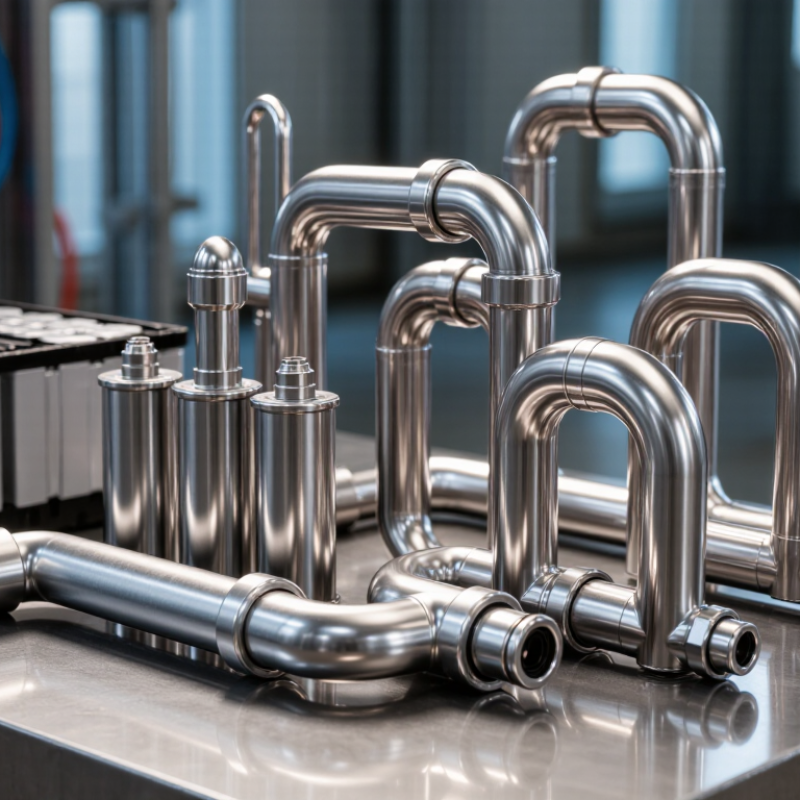
The global battery industry is moving toward higher energy density, faster charging, and tighter thermal control. The International Energy Agency’s Global EV Outlook 2024 reported nearly 14 million electric car sales in 2023, with electric models representing about 18% of global car sales. Each vehicle places greater demands on its cooling architecture. Small temperature differences can affect charging speed, cell aging, and operating safety.
This is where Battery Liquid Cooling Pipe technology becomes important. These pipes guide coolant through battery packs, cold plates, inverters, and related thermal components. Their design influences pressure drop, heat transfer, vibration resistance, and service life. Manufacturers commonly evaluate aluminum tubes, formed stainless steel sections, polymer hoses, brazed joints, and quick-connect fittings. Tests may include leak detection, burst pressure, thermal cycling, salt spray, and coolant compatibility. Details matter. A weak connector can compromise an otherwise advanced battery system.
Industry forecasts from BloombergNEF and market studies from IDTechEx continue to show strong growth in electric vehicles and battery manufacturing. However, supplier comparisons remain difficult. Public reports often combine pipes with broader thermal-management markets. No ranking is perfect. Production scale does not always equal engineering quality. This overview therefore considers manufacturing capability, material control, dimensional accuracy, validation experience, and global customer support. It also recognizes a practical concern: some suppliers publish limited test data. Buyers should verify certifications, application records, and real-world durability before selecting leading Battery Liquid Cooling Pipe manufacturers worldwide.
Top Battery Liquid Cooling Pipe Manufacturers Worldwide
Definition and Role of Battery Liquid Cooling Pipes
A battery liquid cooling pipe is a sealed passage that moves coolant around battery modules or cold plates. It removes heat generated during charging, acceleration, and fast discharge. The pipe must resist vibration, pressure changes, corrosion, and repeated thermal expansion. In practice, its geometry affects flow resistance and cooling uniformity.
The International Energy Agency reported that global electric vehicle battery demand exceeded 750 GWh in 2023, rising by about 40% year on year. This growth increases pressure on thermal management systems. A poorly balanced pipe network can leave hot spots near high-load cells. That may accelerate degradation and reduce usable power. Small details matter.
Liquid cooling usually transfers heat more consistently than passive air cooling. Coolant travels through narrow channels while sensors monitor temperature differences across modules. Engineers often design around a restricted temperature range specified by the cell supplier. The exact target varies by chemistry and pack architecture. There is no universal pipe design.
Manufacturers also consider bending radius, connector sealing, and assembly tolerance. A pipe that performs well in testing may still fail after years of vibration. That assumption deserves more testing. The IEA’s Global EV Outlook 2024 shows how quickly battery deployment is expanding, but field reliability remains harder to measure than production volume. Practical validation is still essential.
Battery liquid cooling pipes circulate a coolant through or around battery modules to remove heat, reduce temperature differences between cells, and support safer, more consistent charging and discharging performance. Material selection affects thermal transfer, weight, corrosion resistance, and packaging flexibility.
Material selection shapes every cooling pipe’s service life. Copper offers high thermal conductivity, but aluminum usually reduces mass and cost. Polymer hoses provide flexibility near moving connections, yet they may absorb moisture or lose strength under heat. The IEA’s Global EV Outlook 2024 reported nearly 14 million electric car sales in 2023. That scale increases demand for reliable thermal-management components.
Manufacturers commonly form aluminum tubes through extrusion, bending, and controlled expansion. Some designs use brazed joints, while others rely on laser welding or mechanical fittings. Each method affects pressure resistance and production speed. A typical line needs dimensional inspection, surface cleaning, and helium or air-pressure leak testing. Small particles can restrict narrow channels. They matter.
The U.S. Department of Energy highlights battery temperature uniformity as a major factor in performance and durability. Therefore, engineers examine wall thickness, coolant turbulence, corrosion resistance, and contact quality with cooling plates. In production reviews, a recurring lesson is that thinner tubing is not automatically better. It saves material, but it can reduce impact tolerance and complicate joining. BloombergNEF reported that average lithium-ion battery pack prices fell to 139 dollars per kilowatt-hour in 2023. That cost pressure encourages leaner pipe designs, although excessive savings can create expensive warranty risks.
Evaluating battery liquid cooling pipe manufacturers requires more than comparing prices or polished brochures. Engineers should examine thermal resistance, burst pressure, flow stability, and dimensional accuracy. These figures must come from controlled tests, not unsupported claims. A reliable supplier can provide test conditions, sampling methods, and repeatability records. Ask for results at low and high temperatures. Real battery packs experience both.
Material selection matters. Aluminum alloys, polymers, and sealing compounds must resist corrosion, vibration, coolant exposure, and repeated thermal cycling. Inspectors should review wall thickness, connector tolerances, weld quality, and surface finish. Small defects can restrict flow or create leakage after thousands of operating hours. Traceability is essential. Each production batch should connect to raw material records, inspection data, and final pressure tests.
Factory experience also deserves close attention. During site audits, observe cleanliness, automated inspection, operator training, and equipment calibration. A capable manufacturer should explain how rejected parts are isolated and investigated. Field feedback can reveal weaknesses that laboratory testing misses. No scorecard is perfect. A supplier may achieve excellent burst strength but show inconsistent bending accuracy. That gap deserves careful discussion. Request pilot samples, measure them independently, and compare results with production parts. Transparent communication often proves more valuable than a flawless presentation.
Leading battery liquid cooling pipe manufacturers worldwide are responding to rapidly expanding thermal-management demand. The IEA Global EV Outlook 2024 reported that electric vehicle battery demand reached about 750 GWh in 2023, rising roughly 40% year on year. This growth increases pressure on suppliers to deliver stable cooling performance, not merely attractive pricing.
Experienced manufacturers typically combine aluminum or coated steel tubing with formed channels, welded joints, and tested connectors. Their production systems should control wall thickness, bending radius, and internal cleanliness. Small leaks matter.
Engineers often evaluate flow resistance, burst pressure, vibration durability, and coolant compatibility before approving a pipe assembly. The U.S. Department of Energy also emphasizes thermal uniformity as a key factor in battery safety, usable capacity, and service life.
Reliable suppliers provide traceable materials, pressure-test records, and repeatable dimensional inspection. They should also support prototype changes without weakening production discipline. However, supplier comparisons are not always straightforward. Published specifications may omit long-term corrosion data or performance after repeated thermal cycling. That gap deserves attention. A strong manufacturer can explain test conditions, failure limits, and field experience clearly. Yet even mature production lines can produce occasional defects, so independent validation remains necessary. This is where professional judgment matters more than a polished catalogue.
Selecting battery liquid cooling pipe manufacturers requires more than comparing unit prices. The right supplier must understand cell temperature control, pack geometry, and production risks. The IEA Global EV Outlook 2024 reported nearly 14 million electric car sales in 2023. That scale increases pressure on thermal management reliability.
Start with thermal performance. Ask for measured flow resistance, heat transfer data, and coolant compatibility at real operating temperatures. A pipe may pass laboratory tests yet restrict flow inside a compact battery tray. Target temperature uniformity matters too. Uneven cooling can accelerate cell ageing and reduce usable capacity. It is not only about lower temperature.
Material selection needs careful review. Aluminum, stainless steel, and engineered polymers offer different weight, corrosion, and forming advantages. Verify burst pressure, vibration endurance, weld quality, and sealing performance under cycling. ISO 16750 testing can help assess mechanical and environmental durability in road vehicles. Request traceability for raw materials and every production batch. Small leaks become expensive problems.
Manufacturing experience is visible in details. Check bending radius, connector consistency, clean-room controls, and automated leak inspection. In pilot projects, suppliers often underestimate assembly variation. That mistake deserves attention. The U.S. Department of Energy’s Vehicle Technologies Office repeatedly emphasizes thermal management as a route to improved battery life, safety, and fast-charging performance. Supplier audits should therefore include prototype evidence, validation reports, and field-failure feedback, not polished claims alone.
| Selection Dimension | Recommended Technical Benchmark | Suitable Pipe or Tube Options | Why It Matters in Battery Cooling Systems | Manufacturer Verification Method |
|---|---|---|---|---|
| Coolant Compatibility | Compatible with water-glycol coolant, deionized water mixtures, corrosion inhibitors, and approved dielectric fluids where required. | Aluminum, stainless steel, EPDM-compatible polymer hose, PA12, multilayer polymer, or fluoropolymer-lined constructions. | Prevents swelling, embrittlement, corrosion, extractables, and coolant contamination during long-term operation. | Request immersion testing, chemical compatibility data, coolant concentration limits, and seal-material specifications. |
| Operating Temperature | Typical liquid-cooling loop design range: approximately −40°C to +85°C; confirm the exact battery-pack duty cycle. | Temperature-stabilized aluminum tubes, stainless steel tubes, or reinforced polymer hoses with suitable elastomers. | Battery packs can experience cold-start conditions, elevated ambient temperatures, and repeated thermal cycling. | Review continuous-temperature rating, short-term peak rating, thermal-cycle results, and low-temperature flexibility data. |
| Pressure Capability | Design pressure commonly falls around 1–3 bar in many low-pressure battery coolant loops; burst capability should include a substantial safety margin. | Formed metal tubing, brazed or welded assemblies, crimped hose assemblies, and reinforced thermoplastic tubing. | Improves resistance to pump pressure, pressure surges, vibration, and blockage-related events. | Verify working pressure, proof pressure, burst pressure, impulse-cycle results, and temperature derating curves. |
| Leak Tightness | Use a documented leak-test specification appropriate for the pack, often based on pressure decay, helium, or tracer-gas testing. | Seamless or welded metal tubes, molded polymer channels, and qualified quick-connect assemblies. | A coolant leak can reduce thermal performance and may create electrical-safety risks around high-voltage components. | Ask for leak-test sensitivity, test pressure, test medium, sampling plan, and traceability records. |
| Material Selection | Select materials based on corrosion resistance, galvanic compatibility, thermal conductivity, weight, and forming requirements. | Aluminum for low mass and high thermal conductivity; stainless steel for strength and corrosion resistance; polymers for flexibility and electrical isolation. | The material affects heat transfer, durability, packaging space, mass, and compatibility with adjoining components. | Review material grade, temper, wall thickness, surface treatment, certificates, and galvanic-corrosion controls. |
| Thermal Performance | Maintain the required coolant flow and pressure drop while supporting the battery system's specified heat-rejection load. | Low-roughness tubing, optimized internal diameters, formed manifolds, and compact plate or channel assemblies. | Insufficient flow or excessive pressure loss can create temperature gradients between battery cells and modules. | Request flow-versus-pressure-drop curves, thermal-resistance data, and test results using the intended coolant. |
| Dimensional Accuracy | Control outside diameter, inside diameter, wall thickness, bend radius, connector position, and flatness according to the approved drawing. | CNC-formed metal tubing, precision drawn tube, hydroformed sections, and molded polymer cooling channels. | Accurate geometry supports reliable assembly, consistent flow distribution, and clearance from cells and electrical components. | Check capability studies, dimensional inspection reports, gauge plans, and first-article inspection documentation. |
| Vibration and Fatigue Resistance | The assembly should withstand vehicle vibration, thermal expansion, pump pulsation, and repeated pressure cycling. | Flexible hose sections, vibration-isolated clamps, formed tubes with controlled bends, and reinforced connection areas. | Fatigue cracks and connector loosening are common risks where rigid cooling pipes are exposed to continuous movement. | Review vibration profiles, pressure-pulse testing, bend-fatigue results, clamp validation, and vehicle-level test evidence. |
| Joining and Connectors | Use validated brazed, welded, crimped, or quick-connect joints with seals rated for the selected coolant and temperature range. | Aluminum brazed joints, stainless steel welded joints, EPDM-sealed quick connectors, and crimped polymer hose ends. | Joints are frequent sources of leakage, assembly variation, and service issues. | Verify joining process controls, seal specifications, insertion-force limits, retention tests, and end-of-line inspection. |
| Electrical Safety | Prevent unintended electrical conduction or provide controlled bonding and insulation where the battery architecture requires it. | Polymer tubing, electrically isolated fittings, coated metal tubes, or deliberately grounded metallic assemblies. | Cooling components are routed close to high-voltage cells, busbars, connectors, and battery-management hardware. | Request dielectric-strength, insulation-resistance, grounding, and coolant-conductivity requirements for the complete system. |
| Fire and Flammability | Select hose, insulation, and protective materials to meet the applicable vehicle or industrial flammability requirement. | Low-flammability polymer compounds, aluminum or stainless steel tubes, and certified protective sleeves. | Material behavior during thermal events can influence fire propagation and occupant or equipment protection. | Obtain flammability classification, smoke or toxicity information where applicable, and test reports for the finished assembly. |
| Manufacturing Scalability | Production capability should match the required annual volume, takt time, automation level, and change-control process. | Roll-formed or drawn tubing for high volume; formed hoses and welded assemblies for flexible or medium-volume applications. | Stable process capability reduces dimensional variation, leakage risk, and supply interruptions during vehicle production. | Evaluate installed capacity, equipment redundancy, process capability indices, inspection automation, and business-continuity plans. |
| Quality Management | Prefer suppliers operating a certified automotive or industrial quality system appropriate to the application. | Applies to metal tubes, polymer hoses, connectors, manifolds, and complete cooling-pipe assemblies. | Documented controls support traceability, nonconformance management, corrective action, and consistent field performance. | Review current certificates, process audits, control plans, PFMEA, PPAP or equivalent approval documents, and traceability procedures. |
| Global Supply and Logistics | Assess regional production, export capability, lead time, packaging protection, and availability of qualified alternate sites. | Local or regional supply of standard tubes; dual-region production for safety-critical or high-volume battery programs. | Cooling-pipe geometry is often application-specific, so interruptions can directly affect battery-pack production. | Compare production locations, capacity commitments, lead-time history, logistics routes, and contingency plans. |
| Validation and Service Life | Require validation for thermal cycling, pressure cycling, vibration, corrosion, coolant aging, and environmental exposure. | Complete pipe assemblies tested with production-intent connectors, clamps, seals, and protective coverings. | Component-level material data alone may not reveal failures caused by the complete installed assembly. | Request a validation plan, test matrix, service-life assumptions, failure criteria, and production-intent sample results. |



For those larger-sized parts, or smaller quantity runs, we have 2 independent powder coat booths and ovens. The quality, durability and affordability of today’s powder coating finishes make this the process of choice for world-class companies.
Powder coating advantages over other forms of coating are many. Materials used in the Powder coating process can be metals and non-metals that come in a multitude of thicknesses, textures, colors, etc. Another of Powder coating’s biggest advantages over conventional coatings is its ability to create finishes in many different textures. Powder Coating Booths allow us the ability to apply these advantages to large products.
Tri-State Fabricators runs a full-service conveyor line for painting. Wet painting can provide protection or decoration to many different part styles. From start to finish, every project is easier to undergo random and point-based inspection by our skilled painting team.
Advantages to our Wet Paint Line are these lines start with product prep and ends with a thorough inspection of a high quality finished product. Our ability to complete large and small projects with a superior finish and doing so in a timely and economical fashion. This passes along the savings in production to our customers. When powder coating ins not an option, our Wet Paint Line gets the job done right the first time.
When the parts get big and heavy we roll-out our custom paint racks and oversize booth. By utilizing our partnerships with all the major paint brands, we can match virtually any color with wet paint.
The advantages of having access to a Wet Paint Booth are many. Large projects of many different shapes can be loaded into the booth. The Wet Paint Booth offers an environment that is much more controlled than a typical parts painting operation.
Not only are they used because of their controlled environment, but they’re are also advantageous when it comes to applying paint to parts that are needed in industries that require specialty coatings such as medical, aerospace, etc.
Our military forces have some very high standards when it comes to the finish of their vehicles and equipment. From the first pre-treatment step to final coat, it takes a great deal of knowledge and experience to protect the men and women of our armed forces. They deserve only the best, and Tri-State Fabricators provides it.
All of our processes are closely monitored by our staff and management teams. Both of which are highly trained in the processes of metal fabrication and finishing. Tri-State Fabricators’ goal is to always fully satisfy each and every customer, including the military. We will always put a 110% into what we do.
Abrasive media blasting is an excellent way to remove old paint, rust, and increase the paint/powder adhesion. Glass beads produce a much smoother and brighter finish than angular abrasives; leaving the part clean yet without any dimensional change. Chemically inert and environmentally friendly, we can recycle our beads approximately 30 times; making them a more preferred method of metal cleaning or surface finishing.
Advantages to Glass Bead Blasting are many. Glass bead blast media is used when a project is needing rough surfaces need to become smooth for applications of coatings such as paint. It is typically used to clean paint and rust from a product surface without deforming the surface it is being used on. Overall, compared to many other blasting media, Glass Bead Blasting is a very economical choice and those savings are always passed on to our customers.
Tri-State Fabricators utilize a zinc phosphate wash to clean and etch the material to ensure the best paint adhesion possible. The unique design of our 3-stage wash system does the work like a 5-stage. From Cleaning and rinsing to conversion coating and post-treatment, Our Part Washing process is a complete service and works throughout the fabrication service and the finishing service.
Along with the previously mentioned benefits, Curing is a vital chemical reaction that leaves the product finish hard and relatively safe from mild abrasion and aggressive corrosion. This process can be done in more than one way; ambient air-dry or in curing ovens at temps that exceed 240°.
From fixing paint mistakes (someone else’s of course) to simply cleaning our paint line hooks, our burn-off oven is put to good use. After a quick burn-off, a little clean up, and a fresh coat of paint, your parts will look better than new.
Why does our Burn-Off Oven work so well? Because super heating the air around parts turns the materials into ashes. From paint and powder coatings to rubber and machining oils, high temps do the job without degrading the integrity of the part.
Masking is a vital part of producing high quality products. We have die-cut masking patterns to protect machined surfaces as well as a wide range of plugs and caps to protect threaded holes and bolts. We provide permanent and temporary masking.
Masking allows the selected sections of a product to be protected from a fabrication or finishing service. This can be with both chemicals when etching and tapes, paints when only finishing just a section of the product. Masking is great in aiding the customization process of a project.
Screen printing is a photographic process that transfers artwork onto a porous nylon screen which allows colored ink to flow through the screen and be deposited on an aluminum or plastic component. We can generally have just about any design created onto a screen for your parts.
Some of the advantages of Screen Printing are, brand recognition for your business displaying on your products, assembly instructions, product warnings/hazards, etc. Tri-State Fabricators produces Screen Printing of the highest quality so you know it’s durable.
Metal Finishing is the art of treating the exterior portion of product, often metal but can also be made of other materials, so that the surface is clean and free of any debris. Then the process of applying coats or either paint of powder coat takes place. This coating process improves the quality of the product in both appearance and resistance to wear and corrosion.
Tri-State Fabricators, Inc., understands that a project typically isn’t complete until a high-quality finish has been added to your product. This is why our painting and powder coating teams continuously inspect the products throughout the Metal Finishing process.