


7 Hydraulic Forging Press Buying Tips for Global Buyers

Buying a Hydraulic Forging Press is a major production decision, not just a search for the highest tonnage. A press that looks right on a specification sheet may still struggle with your actual die size, stroke, or production rhythm. The consequences show up on the shop floor: uneven parts, long changeovers, excess heat, or an idle line awaiting service. Small details matter.

Energy deserves attention, too. The International Energy Agency’s Energy Efficiency 2023 report estimates that industry accounts for roughly 37% of global final energy consumption. That figure is not specific to forging presses, but it underscores why buyers should compare motor power, hydraulic system efficiency, cooling needs, and expected operating hours. A lower purchase price can be misleading if the machine runs continuously.

Demand conditions also vary by region and end market. The World Steel Association’s Short Range Outlook reports track changing steel demand, a useful reminder that forecasts and production plans can shift. Seven practical buying tips can help global buyers assess press capacity, frame design, control systems, safety features, installation requirements, supplier support, and lifecycle costs. And, honestly, buyers sometimes focus too heavily on headline force. A careful review should also ask whether the supplier can provide documented performance data, clear maintenance guidance, and realistic spare-parts lead times. Those questions are less exciting, but they prevent expensive surprises.
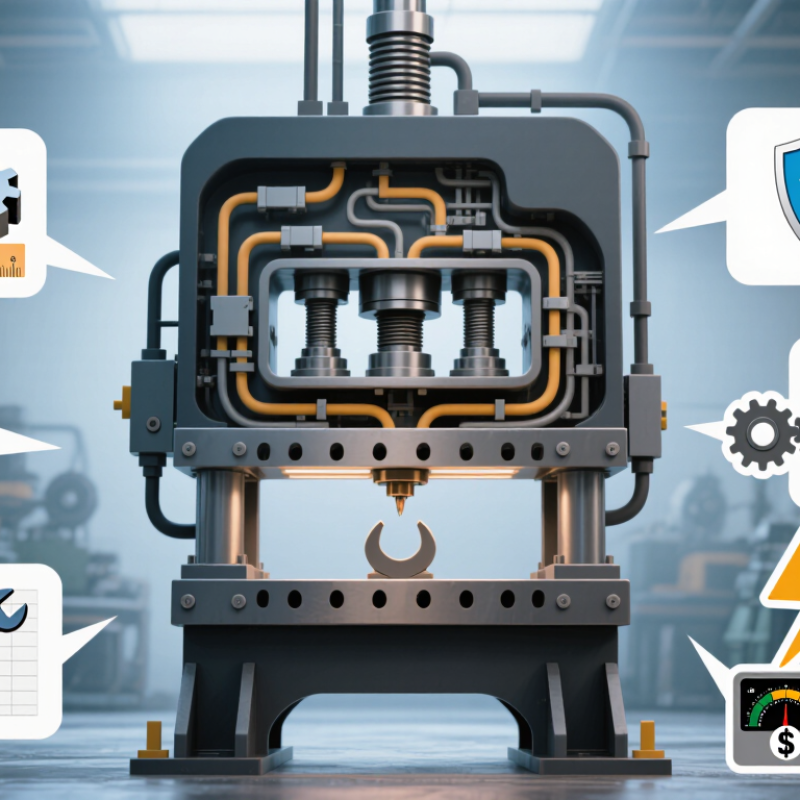
7 Hydraulic Forging Press Buying Tips for Global Buyers

Define Production Needs and Forging Requirements

Define the part before comparing press tonnage. Record the alloy, billet dimensions, target temperature, die layout, and finished-part tolerances. These details shape forming load and stroke requirements. Measure the largest part, too. A press sized only for average jobs may struggle with occasional large forgings.

Scale and material demand matter, but they are not sizing formulas. worldsteel’s World Steel in Figures 2024 reports 1,888.2 million tonnes of crude steel production in 2023. That figure signals the scale of the metal supply chain, not the force your press needs. For each part family, ask a forging engineer to estimate load using material strength at working temperature, contact area, and process stages. Small batches matter. They may not justify the same automation or die-change speed as continuous production.

Check the shop floor against the production plan. Note available daylight, bed size, foundation limits, and operator access around the dies. Compare required strokes per minute with actual cycle time, including loading and inspection. A spreadsheet can hide awkward changeovers. I would leave room for future parts, but not pay for capacity without a likely use. Recheck assumptions against trial data; calculated loads can miss friction, temperature loss, or uneven billet placement.

7 Hydraulic Forging Press Buying Tips for Global Buyers - Define Production Needs and Forging Requirements

Buying Tip Requirement to Define Information to Collect Why It Matters
1. Define the part and process Part geometry, forging method, and process stages Part drawings, CAD files, material grade, billet dimensions, and whether the process is open-die, closed-die, or another forming operation Press selection depends on the workpiece, tooling, and forming process—not tonnage alone.
2. Establish material and temperature conditions Workpiece material and forming temperature range Alloy or steel grade, hot or cold forming, billet temperature at pressing, and expected temperature variation Material strength and temperature affect deformation resistance, tooling, and the required press force.
3. Size the force for the actual operation Required forming force, with an engineering margin Projected contact area, material and temperature data, die design, process sequence, and force estimates from a qualified process engineer A suitable rated capacity should be confirmed against the load profile and the machine’s permitted operating conditions.
4. Check stroke, daylight, and bed space Working envelope for the part, dies, and handling equipment Required stroke, maximum open height, shut height, bolster dimensions, die height, and access for loading and removal Adequate force does not guarantee that the tooling and workpiece will fit or can be handled safely.
5. Set output and duty-cycle targets Required parts per shift and operating schedule Target good parts per hour, shifts per day, changeover frequency, expected cycle time, and planned maintenance downtime Production targets help determine whether cycle speed, automation, and the planned duty cycle are appropriate.
6. Specify control and process monitoring Required control functions and production records Pressure or force control, ram position settings, recipe storage, alarms, data logging, and interfaces required by the plant Clearly defined controls support repeatable operation and make process monitoring easier.
7. Confirm site and safety requirements Installation conditions, utilities, and safeguarding Available floor space, foundation and floor loading, electrical supply, hydraulic system needs, guarding, operator access, and applicable local regulations Early site checks can prevent installation delays and help ensure safe integration into the production line.

Note: Final press capacity, machine configuration, and safety provisions should be validated by the equipment supplier and qualified process and safety professionals using the actual part, tooling, and site data.


Match Press Capacity, Stroke, and Operating Speed to Your Work

A hydraulic forging press should be matched to the parts you actually make, not just the largest part on your drawing. Check the required forming force for your material, billet temperature, and die shape. A press rated at a certain capacity may not deliver that force throughout its full stroke, so review the machine’s force curve and operating conditions. Extra capacity can be useful, but an oversized press may add cost without improving the process.

Stroke matters when parts vary in height or require several forming steps. Compare the press travel with your die height, billet dimensions, and loading space. Leave room for safe handling and tool changes. Too little stroke can limit production; too much may slow each cycle. Measure your real setup. It is easy to overlook a small clearance issue on paper.

Operating speed also affects output and control. Fast approach and return speeds can shorten idle time, while a slower working speed may help maintain forming quality. Ask for speeds under load, not only maximum figures. If possible, test a representative part and record cycle time, pressure, and temperature. Numbers rarely tell the whole story. A first estimate may be wrong, and that deserves a second look.

Check Safety Features, Controls, and Applicable Standards

When comparing hydraulic forging presses, inspect the safety system in operation, not only on paper. Ask how guards, interlocks, emergency stops, and pressure-relief devices respond during setup and production. The ram should not descend when a guard is open or a safety circuit is interrupted. Small details matter. Check that controls are clearly labeled and reachable without leaning near the die space. A light curtain can help, but only when its placement and stopping distance suit the machine’s actual cycle.

Review the control system’s fault detection, restart behavior, and protection against unexpected ram movement. Request wiring diagrams, safety-function documentation, and a demonstration of fault recovery. The U.S. Bureau of Labor Statistics’ 2023 Census of Fatal Occupational Injuries recorded 5,283 fatal work injuries across U.S. industries. This figure is not press-specific, but it underlines why safety controls deserve close review.

Check the applicable editions of ISO 16092-3 for hydraulic press safety, ISO 13849-1 for safety-related control systems, and IEC 60204-1 for machine electrical equipment. Requirements can vary by destination and installation, so confirm local adoption with a qualified safety professional. Ask for risk-assessment records and evidence that the supplied configuration matches them. A certificate alone may not reveal a poorly positioned sensor or an awkward maintenance procedure. That deserves a second look.

Evaluate Supplier Expertise, Service, and Spare Parts Support

A hydraulic forging press is a long-term production asset, so evaluate the people behind it as carefully as its rated force. Ask suppliers for references from plants running comparable press capacities, materials, and duty cycles. Request commissioning records and examples of troubleshooting difficult pressure or temperature fluctuations. The 2024 True Cost of Downtime report estimated that downtime cost the world’s 500 largest companies about 11% of annual revenue. That broad, cross-industry figure is not a forging-press forecast, but it shows why service readiness deserves serious attention.

Set expectations before ordering. Ask who handles installation, operator training, and urgent technical calls, including time-zone coverage. Request realistic response targets in writing, then check whether service engineers can access hydraulic diagrams and control-system documentation. Ask for evidence. A polished presentation is not proof of field experience; speak with existing customers and ask how long faults took to diagnose.

Spare-parts support should be specific, not reassuringly vague. Obtain a recommended inventory for seals, filters, valves, sensors, and other wear-prone components, with part numbers and typical lead times. Confirm which items are stocked locally and which require overseas shipment. Ask how replacements are verified for compatibility and whether obsolete components have an approved substitute. A small seal can stop a large press. I would also check packaging and storage guidance; these details are easy to overlook, and sometimes the buyer does too.

Compare Total Cost, Shipping, and Installation Requirements

A hydraulic forging press quote is only the starting figure. Compare the press price with crating, inland haulage, ocean freight, insurance, customs handling, unloading, and commissioning. Ask for packed dimensions and gross weight, not just machine dimensions. A wide frame may require a flat rack or other out-of-gauge handling. Get the assumed port, route, and delivery terms in writing.

Shipping schedules can shift. UNCTAD’s Review of Maritime Transport 2024 reported that weekly container-ship transits through the Suez Canal fell 67% by June 2024 from peak levels. That disruption is a useful reminder: request a valid quote period, likely surcharges, and a schedule buffer. Cheap freight can become expensive if storage or missed installation dates follow. A spreadsheet helps, but estimates are not guarantees.

Installation needs its own checklist. Confirm the site’s floor-loading capacity, foundation drawings, crane reach, doorway clearance, electrical supply, and hydraulic-oil requirements before shipment. Ask who provides riggers, electricians, levelling, and test materials. Request the press’s lifting points and installation sequence; a large frame cannot be improvised safely at the dock. I have seen purchase plans overlook floor access. That detail deserves a second look. Compare supplier estimates with local contractor quotes, and budget for commissioning travel, spare seals, and operator training.

Powder Coat Booths

For those larger-sized parts, or smaller quantity runs, we have 2 independent powder coat booths and ovens. The quality, durability and affordability of today’s powder coating finishes make this the process of choice for world-class companies.

Powder coating advantages over other forms of coating are many. Materials used in the Powder coating process can be metals and non-metals that come in a multitude of thicknesses, textures, colors, etc. Another of Powder coating’s biggest advantages over conventional coatings is its ability to create finishes in many different textures. Powder Coating Booths allow us the ability to apply these advantages to large products.

Wet Paint Line

Tri-State Fabricators runs a full-service conveyor line for painting. Wet painting can provide protection or decoration to many different part styles. From start to finish, every project is easier to undergo random and point-based inspection by our skilled painting team.

Advantages to our Wet Paint Line are these lines start with product prep and ends with a thorough inspection of a high quality finished product. Our ability to complete large and small projects with a superior finish and doing so in a timely and economical fashion. This passes along the savings in production to our customers. When powder coating ins not an option, our Wet Paint Line gets the job done right the first time.

Wet Paint Booths

When the parts get big and heavy we roll-out our custom paint racks and oversize booth. By utilizing our partnerships with all the major paint brands, we can match virtually any color with wet paint.

The advantages of having access to a Wet Paint Booth are many. Large projects of many different shapes can be loaded into the booth. The Wet Paint Booth offers an environment that is much more controlled than a typical parts painting operation.

Not only are they used because of their controlled environment, but they’re are also advantageous when it comes to applying paint to parts that are needed in industries that require specialty coatings such as medical, aerospace, etc.

Military CARC

Our military forces have some very high standards when it comes to the finish of their vehicles and equipment. From the first pre-treatment step to final coat, it takes a great deal of knowledge and experience to protect the men and women of our armed forces. They deserve only the best, and Tri-State Fabricators provides it.

All of our processes are closely monitored by our staff and management teams. Both of which are highly trained in the processes of metal fabrication and finishing. Tri-State Fabricators’ goal is to always fully satisfy each and every customer, including the military. We will always put a 110% into what we do.

Glass-Bead Blasting

Abrasive media blasting is an excellent way to remove old paint, rust, and increase the paint/powder adhesion. Glass beads produce a much smoother and brighter finish than angular abrasives; leaving the part clean yet without any dimensional change. Chemically inert and environmentally friendly, we can recycle our beads approximately 30 times; making them a more preferred method of metal cleaning or surface finishing.

Advantages to Glass Bead Blasting are many. Glass bead blast media is used when a project is needing rough surfaces need to become smooth for applications of coatings such as paint. It is typically used to clean paint and rust from a product surface without deforming the surface it is being used on. Overall, compared to many other blasting media, Glass Bead Blasting is a very economical choice and those savings are always passed on to our customers.

Part Washing

Tri-State Fabricators utilize a zinc phosphate wash to clean and etch the material to ensure the best paint adhesion possible. The unique design of our 3-stage wash system does the work like a 5-stage. From Cleaning and rinsing to conversion coating and post-treatment, Our Part Washing process is a complete service and works throughout the fabrication service and the finishing service.

Along with the previously mentioned benefits, Curing is a vital chemical reaction that leaves the product finish hard and relatively safe from mild abrasion and aggressive corrosion. This process can be done in more than one way; ambient air-dry or in curing ovens at temps that exceed 240°.

Burn-Off Oven

From fixing paint mistakes (someone else’s of course) to simply cleaning our paint line hooks, our burn-off oven is put to good use. After a quick burn-off, a little clean up, and a fresh coat of paint, your parts will look better than new.

Why does our Burn-Off Oven work so well? Because super heating the air around parts turns the materials into ashes. From paint and powder coatings to rubber and machining oils, high temps do the job without degrading the integrity of the part.

Masking

Masking is a vital part of producing high quality products. We have die-cut masking patterns to protect machined surfaces as well as a wide range of plugs and caps to protect threaded holes and bolts. We provide permanent and temporary masking.

Masking allows the selected sections of a product to be protected from a fabrication or finishing service. This can be with both chemicals when etching and tapes, paints when only finishing just a section of the product. Masking is great in aiding the customization process of a project.

Screen Printing

Screen printing is a photographic process that transfers artwork onto a porous nylon screen which allows colored ink to flow through the screen and be deposited on an aluminum or plastic component. We can generally have just about any design created onto a screen for your parts.

Some of the advantages of Screen Printing are, brand recognition for your business displaying on your products, assembly instructions, product warnings/hazards, etc. Tri-State Fabricators produces Screen Printing of the highest quality so you know it’s durable.

Metal Finishing

Metal Finishing is the art of treating the exterior portion of product, often metal but can also be made of other materials, so that the surface is clean and free of any debris. Then the process of applying coats or either paint of powder coat takes place. This coating process improves the quality of the product in both appearance and resistance to wear and corrosion.

Tri-State Fabricators, Inc., understands that a project typically isn’t complete until a high-quality finish has been added to your product. This is why our painting and powder coating teams continuously inspect the products throughout the Metal Finishing process.
