


Technical Guide | Silicone-Based Processing and Surface Modification Additives
Silicone masterbatches are widely used in thermoplastic compounding and processing to improve extrusion behavior, reduce friction, support mold release, and modify the surface properties of finished plastic components.
However, selecting an appropriate silicone masterbatch requires more than comparing silicone content or additive dosage.
The carrier resin, polymer compatibility, processing conditions, and required surface performance all influence the final results.
For manufacturers processing highly filled LSZH/HFFR cable compounds, PP/TPO automotive interiors, or PC/ABS engineering plastics, the technical requirements can differ significantly.
Silicone masterbatch is a pelletized additive containing silicone polymer dispersed in a thermoplastic carrier resin.
High-molecular-weight silicone masterbatches are designed to introduce silicone functionality into compatible thermoplastic compounds through conventional melt-processing equipment.
Depending on formulation and processing conditions, they can help improve:
• Melt processing and flow behavior
• Extrusion torque and die build-up
• Mold filling and demolding
• Surface friction and lubricity
• Scratch, mar, and abrasion performance
Unlike adding liquid silicone oil directly, pelletized silicone masterbatches can offer convenient handling, controlled dosing, and improved incorporation into compatible polymer systems.
The effectiveness of a silicone masterbatch depends on the silicone polymer, carrier resin, dispersion quality, dosage, and application conditions.
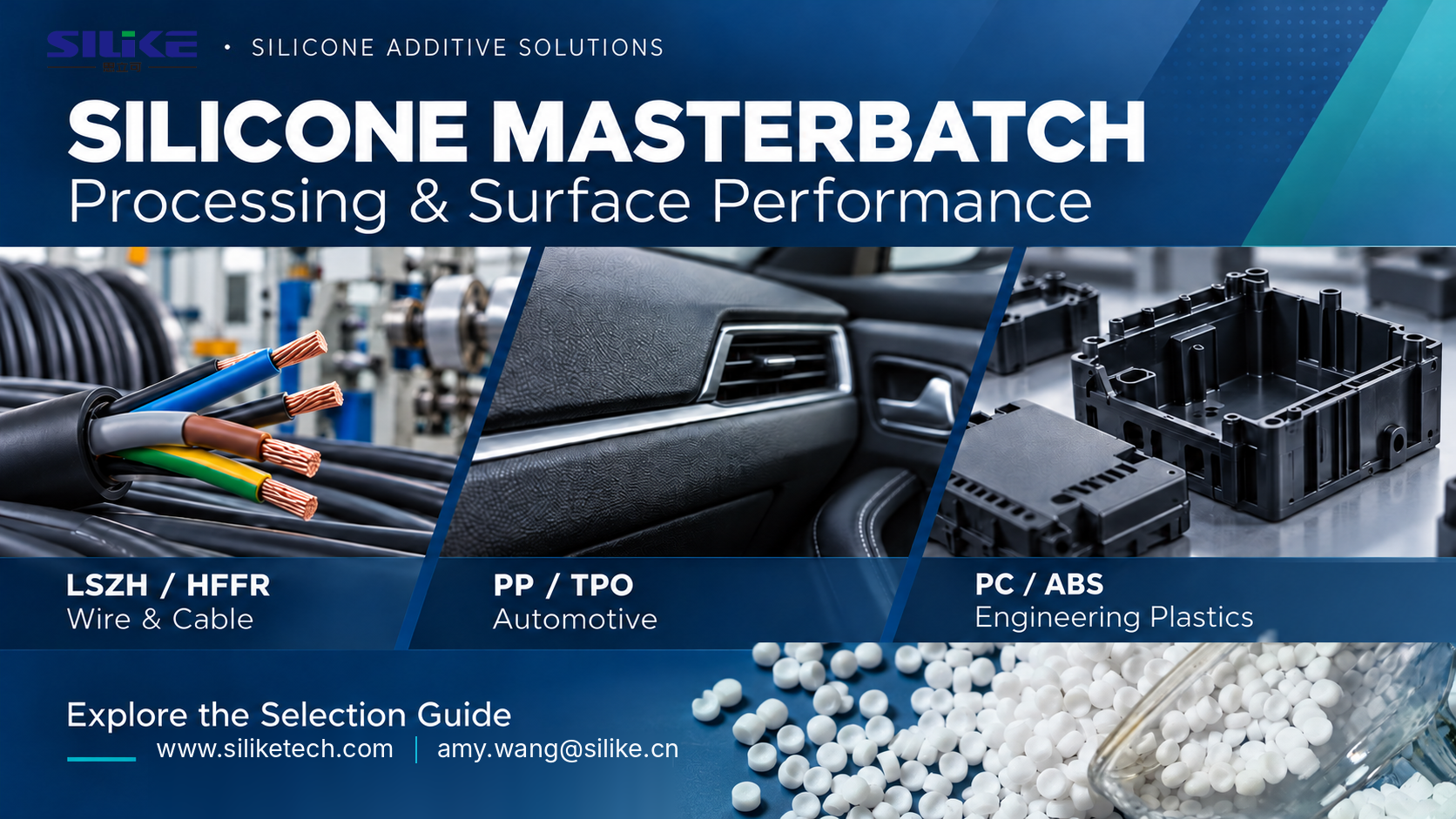
Silicone Masterbatch for LSZH/HFFR Wire and Cable Compounds
Highly filled low-smoke zero-halogen (LSZH) and halogen-free flame-retardant (HFFR) cable compounds can present processing difficulties due to high mineral filler loading.
Common challenges include high extrusion torque, elevated die pressure, surface roughness, die build-up, and unstable processing.
Silicone-based processing additives can be evaluated to reduce processing resistance and improve the surface quality of extruded cable compounds.
SILIKE Silicone masterbatch LYSI-401 is a polyethylene-carried silicone masterbatch containing approximately 50% ultra-high-molecular-weight siloxane polymer.
It is designed for PE-compatible systems, including highly filled LSZH/HFFR wire and cable compounds.
Potential processing benefits include reduced extrusion resistance, lower die drool, improved flow behavior, and better surface smoothness.
The appropriate addition level should be established through production trials, taking into account filler loading, polymer composition, extrusion equipment, and cable performance requirements.
Explore SILIKE Siloxane Masterbatch LYSI-401 for LSZH/HFFR Cable Compounds
Silicone Anti-Scratch Masterbatch for Automotive PP/TPO Compounds
Automotive interior components made from PP/TPO compounds are exposed to repeated contact, abrasion, and scratching throughout their service life.
For black or dark-colored interior parts, surface damage may produce visible scratch whitening, affecting appearance quality.
Silicone-based anti-scratch masterbatches can help reduce friction and improve scratch appearance when incorporated into suitable polypropylene formulations.
SILIKE Anti-scratch Masterbatches, including anti-scratch additives LYSI-306C and LYSI-306H, have been developed for PP-based compounds used in automotive interior applications.
These materials can be evaluated for door panels, dashboards, center consoles, and other molded-in-color interior components.
In selected SILIKE internal evaluations, silicone-based plastic additive LYSI-306C demonstrated a scratch-related color change of ΔL below 1.5 under a specified 10 N test condition.
These results are formulation- and test-dependent and should not be interpreted as a universal performance guarantee.
Material selection should consider the PP matrix, talc loading, pigment system, surface texture, aging requirements, and the applicable automotive testing procedures, including PV3952 and GMW14688 where required.
Explore SILIKE Anti-Scratch MasterbatchLYSI-306C for Automotive PP/TPO
Silicone Masterbatch for PC/ABS and Engineering Plastics
PC/ABS, ABS, and other engineering plastics are commonly used in automotive components, electrical housings, consumer electronics, and industrial molded parts.
Depending on the formulation, manufacturers may encounter processing resistance, demolding difficulties, visible surface scratches, or abrasion-related appearance changes.
Silicone additives with compatible carrier systems can be evaluated to modify surface friction and improve processing behavior.
SILIKE silicone-based processing aid LYSI-405 is an ABS-carried silicone masterbatch containing approximately 50% ultra-high-molecular-weight siloxane polymer.
It is designed for ABS-compatible resin systems and can be evaluated in selected PC/ABS formulations to improve processing and surface performance.
Other SILIKE silicone additive grades, including silicone masterbatch LYSI-4051 and silicone masterbatch LYSI-413, may be considered according to the resin system and technical requirements.
Because ABS, PC, and PC/ABS differ in composition and processing characteristics, additive compatibility and final material properties must be verified through application-specific testing.
Explore SILIKE silicone masterbatch LYSI-405 for ABS and PC/ABS
How to Choose a Suitable Silicone Masterbatch Manufacturer
When evaluating silicone masterbatch suppliers, purchasing teams, compounders, and process engineers should consider five factors.
1. Polymer compatibility
Identify the base polymer and confirm that the masterbatch carrier resin is suitable for the intended compound.
2. Active silicone content
Compare the silicone polymer concentration and recommended dosage. Equal addition rates do not necessarily deliver equal results across different products.
3. Application-specific performance
For cable compounds, prioritize extrusion stability and finished cable quality. For automotive PP/TPO, evaluate scratch appearance and aging behavior. For engineering plastics, consider processing and final surface requirements.
4. Technical validation
Request product data sheets, sample quantities, testing recommendations, and performance information relevant to the actual formulation.
5. Technical and supply support
Evaluate the supplier’s ability to assist with grade selection, processing trials, formulation adjustments, quality consistency, and ongoing commercial supply.
SILIKE Silicone Masterbatch Solutions for Thermoplastics
Chengdu SILIKE Technology Co., Ltd. develops and manufactures silicone-based additives for polymer processing and surface modification.
Its LYSI silicone masterbatch portfolio combines high-molecular-weight siloxane polymers with selected thermoplastic carriers to address processing and performance requirements across different resin systems.
The portfolio includes solutions for:
• LSZH/HFFR wire and cable compounds
• Automotive PP/TPO interior materials
• ABS and selected PC/ABS engineering plastic compounds
• Polyethylene and polypropylene processing
• Other compatible thermoplastic applications
Rather than treating silicone masterbatch as a universal additive, SILIKE recommends evaluating the polymer system, manufacturing process, and target performance before selecting a grade.
What is the difference between silicone masterbatch and silicone oil?
Silicone masterbatch incorporates silicone polymer into a thermoplastic carrier, allowing pelletized handling and incorporation during compounding or molding. Silicone oil is generally supplied in liquid form. Their processing behavior and final performance depend on molecular structure and formulation.
Which silicone masterbatch is suitable for LSZH/HFFR cable compounds?
PE-carried silicone masterbatches such as SILIKE silicone masterbatch LYSI-401, silicone masterbatch SC 920, and silicone masterbatch SC930 can be evaluated for PE-compatible, highly mineral-filled cable compounds. Final selection depends on the resin, flame-retardant package, and processing conditions.
Can silicone masterbatch improve scratch resistance in PP/TPO automotive interiors?
Certain high-molecular-weight silicone masterbatches can help reduce surface friction and visible scratch damage. SILIKE LYSI-306 Series is designed for selected PP-based automotive applications. Performance should be validated using the relevant automotive scratch and aging test methods.
Can the same silicone masterbatch be used for PE, PP, and PC/ABS?
Not necessarily. Different polymers require evaluation of carrier compatibility, processing temperature, dispersion, and performance targets. A product effective in PE may not be the most suitable option for PP or PC/ABS.
How do I evaluate silicone masterbatch suppliers?
Compare technical specifications, carrier resin compatibility, test results, application expertise, sample availability, and technical support. The most appropriate supplier is the one whose material meets the application requirements under validated processing conditions.
Evaluate the Right Silicone Masterbatch for Your Application
Whether your priority is reducing extrusion resistance in highly filled cable compounds, improving scratch appearance in automotive PP/TPO, or optimizing processing and surface quality in PC/ABS, choosing a compatible silicone masterbatch is essential.
Tell SILIKE about your resin system, processing conditions, and target performance. Our technical team can help identify suitable grades for evaluation.
Explore Silicone Masterbatch Solutions
Website: www.siliketech.com
Email: sale@levvymetal.com


