


Choosing Shelf Racking for a warehouse in 2026 is not simply a matter of adding more beams. The right system must suit the building, inventory, handling equipment, and daily picking patterns. A rack that looks efficient on a floor plan can still create awkward forklift turns or hard-to-reach stock. Small details matter.
The MHI 2024 Annual Industry Report found that 55% of surveyed supply-chain professionals planned to increase technology investment. That finding reflects a broader push for more responsive operations, though it does not prove every warehouse needs automation. Racking decisions should start with measured facts: clear building height, aisle width, pallet dimensions, load weights, SKU turnover, and expected growth. The Rack Manufacturers Institute’s ANSI MH16.1 standard provides engineering requirements for industrial steel storage racks. OSHA’s materials-handling guidance also emphasizes stable, secure storage. These references help frame the decision; they do not replace a site-specific review by qualified professionals.
This guide compares common rack types and explains how to match them to real warehouse conditions. It also covers capacity, access, safety checks, and future flexibility. A useful plan should leave room for change, not just today’s pallet count. That assumption can be wrong. Before choosing a layout, confirm actual loads and equipment clearances with your rack supplier and facility team. One overlooked beam level, sprinkler clearance, or turning radius can undermine an otherwise sensible design.
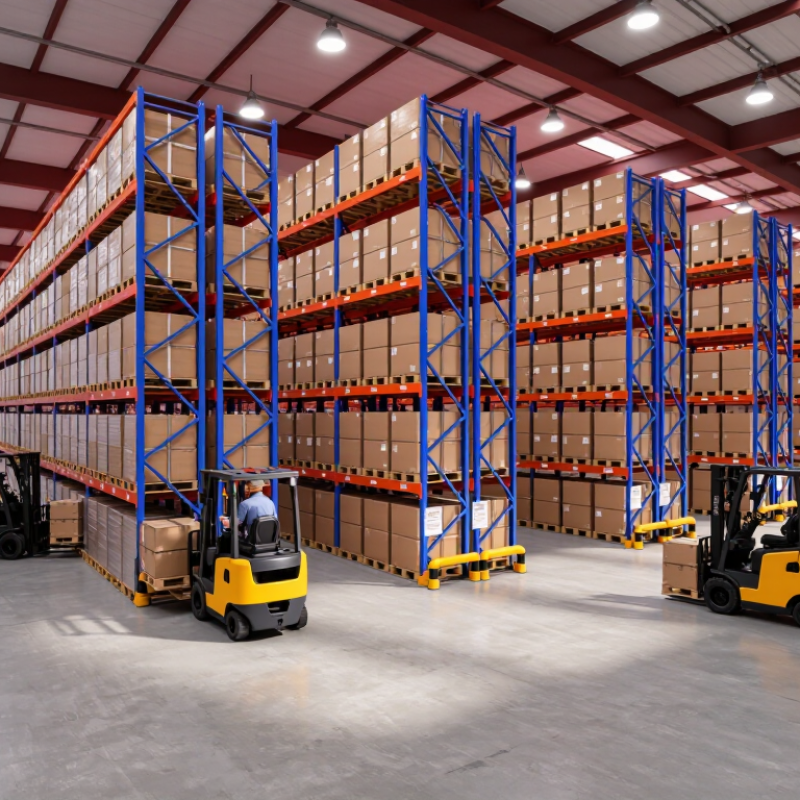
Before choosing shelf racking, map your SKU mix and the busiest inventory period, not an average week. Count each item’s storage units, dimensions, weight, and picking frequency. Measure usable floor space, aisle clearances, doorways, and sprinkler or lighting obstructions. Measure at the peak. A layout that fits today’s stock may become cramped after a seasonal delivery.
Separate fast-moving items from slow sellers, then estimate peak quantities for each group. Fast movers usually need clear access near picking areas, while slower stock can use denser storage farther away. Check whether cartons, bins, or pallets will sit on the shelves, and confirm their loaded weights. A density estimate can look excellent on a spreadsheet but still slow picking when workers need frequent access. Recheck the assumptions with warehouse staff; they often know where congestion actually forms.
Tips: Record peak stock by SKU, not just total pallet count. Leave room for replenishment and safe equipment movement. Review the plan with a sample aisle marked on the floor. It may feel conservative, but a little unused space is often less costly than constant reshuffling.

Choosing rack by pallet positions per aisle can be misleading. Selective racks provide direct access to every pallet, making them practical for warehouses with many SKUs or frequent picking. For a simple comparison, imagine ten bays on each side of an aisle, two pallet locations per bay, and five storage levels. That gives about 200 positions. Check the actual bay layout, beam spacing, and clearances before using this estimate.
Double-deep racks can roughly double those positions in the same bay arrangement, but rear pallets require a deep-reach truck. Selectivity drops. Drive-in racks can store more pallets in each lane, especially when a lane holds one SKU, but operators may need to move front pallets to reach those behind. That trade-off matters. A dense aisle is not automatically a faster aisle.
MHI’s 2024 Annual Industry Report found that 55% of surveyed supply-chain professionals were using or piloting robotics and automation. That is not a rack-capacity benchmark, but it signals why future equipment access deserves attention. A narrow aisle may suit guided vehicles, while conventional forklifts need more turning room. Numbers need context. Recheck the comparison using your SKU count, pallet dimensions, replenishment pattern, and usable building height; a small change in aisle width can alter total warehouse capacity.
When choosing warehouse shelving in 2026, verify the installed rack configuration against ANSI/RMI MH16.1-2023, the industrial steel storage rack design and evaluation standard. Capacity is not determined by beam thickness alone. Check beam span and connector type, upright-frame details, bracing, anchors, and the actual load layout. Calculate pallet weight with products and packaging included, then confirm the permitted load for each beam level and bay with a qualified rack professional. Small changes matter. A different beam height or uneven pallet loading can change how forces reach the uprights. A spreadsheet can look precise and still describe the wrong bay.
The U.S. Bureau of Labor Statistics reported 2.6 million nonfatal workplace injury and illness cases in private industry in 2023. That figure is not specific to rack failures, but it underlines why safe storage deserves careful attention. Keep the rack drawings, load calculations, and posted capacity information aligned with the warehouse’s real configuration. If records are missing, do not guess from a neighboring bay; verify before loading.
Tips: Photograph each bay, measure beam spans, and weigh a representative loaded pallet. Record changes after reconfiguration. If a frame is bent or a connector is damaged, isolate the affected area and arrange a competent inspection. One detail is easy to overlook: old drawings may no longer match the floor.
When planning shelf racking, set aisle widths from the lift truck you will actually use, not a generic warehouse diagram. Check its right-angle stacking dimensions, turning radius, and load capacity in the manufacturer’s specifications. Then account for pallet size, load overhang, and how the truck approaches each rack face. A wide pallet can change the clearance you need. So can a long load.
OSHA 1910.176(b) requires sufficient safe clearance in aisles and at turns, doorways, and loading docks; it does not prescribe one universal aisle width. Permanent aisles must also be appropriately marked and kept clear.
Measure the route with the truck carrying a typical load, including tight turns near end frames and cross aisles. Leave room for small tracking errors, but avoid guessing at a safety margin without testing the layout. A drawing can look tidy and still be wrong. If possible, mark the proposed aisle edges on the floor and conduct a controlled trial with trained operators. Watch for pallet corners nearing uprights, pedestrians entering the travel path, and loads that block sightlines. Record the truck model, load dimensions, and test conditions so future changes can be checked. Honestly, this step may expose a layout flaw late. Better to find it before racks are anchored and inventory fills the bays.
When choosing shelf racking for a 2026 warehouse, plan around the sprinkler system as well as the available floor space. NFPA 13’s 18-inch clearance is not a universal rule for every rack and sprinkler arrangement. Where the applicable code edition and approved design require it, maintain at least 18 inches between sprinkler deflectors and the top of stored goods. Measure from the deflectors, not the ceiling panels. A high carton can use up that gap.
Set rack heights and beam levels for the tallest expected loads, including seasonal cartons and pallet overhang. Keep a clear storage limit that workers can see from the aisle. Painted markers help, but they do not replace routine checks. Measure it twice. A slightly uneven pallet may be enough to cross the line.
Before installation, confirm the required clearance for your sprinkler type, storage arrangement, and adopted code edition with a qualified fire-protection professional. Ask the local authority having jurisdiction to verify the applicable requirements. Recheck after changing rack levels or storing different products. Drawings can look tidy; busy aisles are less predictable. That part is easy to underestimate.


For those larger-sized parts, or smaller quantity runs, we have 2 independent powder coat booths and ovens. The quality, durability and affordability of today’s powder coating finishes make this the process of choice for world-class companies.
Powder coating advantages over other forms of coating are many. Materials used in the Powder coating process can be metals and non-metals that come in a multitude of thicknesses, textures, colors, etc. Another of Powder coating’s biggest advantages over conventional coatings is its ability to create finishes in many different textures. Powder Coating Booths allow us the ability to apply these advantages to large products.
Tri-State Fabricators runs a full-service conveyor line for painting. Wet painting can provide protection or decoration to many different part styles. From start to finish, every project is easier to undergo random and point-based inspection by our skilled painting team.
Advantages to our Wet Paint Line are these lines start with product prep and ends with a thorough inspection of a high quality finished product. Our ability to complete large and small projects with a superior finish and doing so in a timely and economical fashion. This passes along the savings in production to our customers. When powder coating ins not an option, our Wet Paint Line gets the job done right the first time.
When the parts get big and heavy we roll-out our custom paint racks and oversize booth. By utilizing our partnerships with all the major paint brands, we can match virtually any color with wet paint.
The advantages of having access to a Wet Paint Booth are many. Large projects of many different shapes can be loaded into the booth. The Wet Paint Booth offers an environment that is much more controlled than a typical parts painting operation.
Not only are they used because of their controlled environment, but they’re are also advantageous when it comes to applying paint to parts that are needed in industries that require specialty coatings such as medical, aerospace, etc.
Our military forces have some very high standards when it comes to the finish of their vehicles and equipment. From the first pre-treatment step to final coat, it takes a great deal of knowledge and experience to protect the men and women of our armed forces. They deserve only the best, and Tri-State Fabricators provides it.
All of our processes are closely monitored by our staff and management teams. Both of which are highly trained in the processes of metal fabrication and finishing. Tri-State Fabricators’ goal is to always fully satisfy each and every customer, including the military. We will always put a 110% into what we do.
Abrasive media blasting is an excellent way to remove old paint, rust, and increase the paint/powder adhesion. Glass beads produce a much smoother and brighter finish than angular abrasives; leaving the part clean yet without any dimensional change. Chemically inert and environmentally friendly, we can recycle our beads approximately 30 times; making them a more preferred method of metal cleaning or surface finishing.
Advantages to Glass Bead Blasting are many. Glass bead blast media is used when a project is needing rough surfaces need to become smooth for applications of coatings such as paint. It is typically used to clean paint and rust from a product surface without deforming the surface it is being used on. Overall, compared to many other blasting media, Glass Bead Blasting is a very economical choice and those savings are always passed on to our customers.
Tri-State Fabricators utilize a zinc phosphate wash to clean and etch the material to ensure the best paint adhesion possible. The unique design of our 3-stage wash system does the work like a 5-stage. From Cleaning and rinsing to conversion coating and post-treatment, Our Part Washing process is a complete service and works throughout the fabrication service and the finishing service.
Along with the previously mentioned benefits, Curing is a vital chemical reaction that leaves the product finish hard and relatively safe from mild abrasion and aggressive corrosion. This process can be done in more than one way; ambient air-dry or in curing ovens at temps that exceed 240°.
From fixing paint mistakes (someone else’s of course) to simply cleaning our paint line hooks, our burn-off oven is put to good use. After a quick burn-off, a little clean up, and a fresh coat of paint, your parts will look better than new.
Why does our Burn-Off Oven work so well? Because super heating the air around parts turns the materials into ashes. From paint and powder coatings to rubber and machining oils, high temps do the job without degrading the integrity of the part.
Masking is a vital part of producing high quality products. We have die-cut masking patterns to protect machined surfaces as well as a wide range of plugs and caps to protect threaded holes and bolts. We provide permanent and temporary masking.
Masking allows the selected sections of a product to be protected from a fabrication or finishing service. This can be with both chemicals when etching and tapes, paints when only finishing just a section of the product. Masking is great in aiding the customization process of a project.
Screen printing is a photographic process that transfers artwork onto a porous nylon screen which allows colored ink to flow through the screen and be deposited on an aluminum or plastic component. We can generally have just about any design created onto a screen for your parts.
Some of the advantages of Screen Printing are, brand recognition for your business displaying on your products, assembly instructions, product warnings/hazards, etc. Tri-State Fabricators produces Screen Printing of the highest quality so you know it’s durable.
Metal Finishing is the art of treating the exterior portion of product, often metal but can also be made of other materials, so that the surface is clean and free of any debris. Then the process of applying coats or either paint of powder coat takes place. This coating process improves the quality of the product in both appearance and resistance to wear and corrosion.
Tri-State Fabricators, Inc., understands that a project typically isn’t complete until a high-quality finish has been added to your product. This is why our painting and powder coating teams continuously inspect the products throughout the Metal Finishing process.

