


Selecting a reliable air cooled uv lamp supplier in China requires more than comparing prices or catalog photographs. The buyer must evaluate spectral output, irradiance stability, cooling design, reflector quality, lamp life, and replacement support. A lamp may appear bright during testing yet cure unevenly across a wide production web. Small details matter, especially airflow around the quartz tube.
Grand View Research estimated the global UV curing system market at approximately USD 1.88 billion in 2023. Its report also forecasts strong growth through 2030, driven by printing, electronics, coatings, and industrial assembly. RadTech’s UV and EB technology publications similarly identify energy efficiency, process control, and lower emissions as major purchasing considerations. These figures describe the broader curing market, not every Air Cooled Uv Lamp segment. That distinction matters.
Photopolymerization researcher Professor Jacques Lalevée offers a useful principle: “The lamp and the formulation must be considered as one system.” Buyers should therefore request curing tests using their actual ink, coating, substrate, and conveyor speed. Ask suppliers for measured irradiance, wavelength data, cooling-air requirements, electrical specifications, and service records. ISO documentation helps, but it does not replace factory validation.
Some supplier claims remain difficult to compare. “Long life” may mean different operating conditions. “High intensity” may describe peak output, not usable exposure. Even experienced buyers miss this.
A practical supplier review should examine Chinese manufacturing experience, quality-control procedures, export support, spare-part availability, and technical communication. The best choice is rarely the cheapest quotation. It is the supplier that can prove consistent curing under real production conditions.
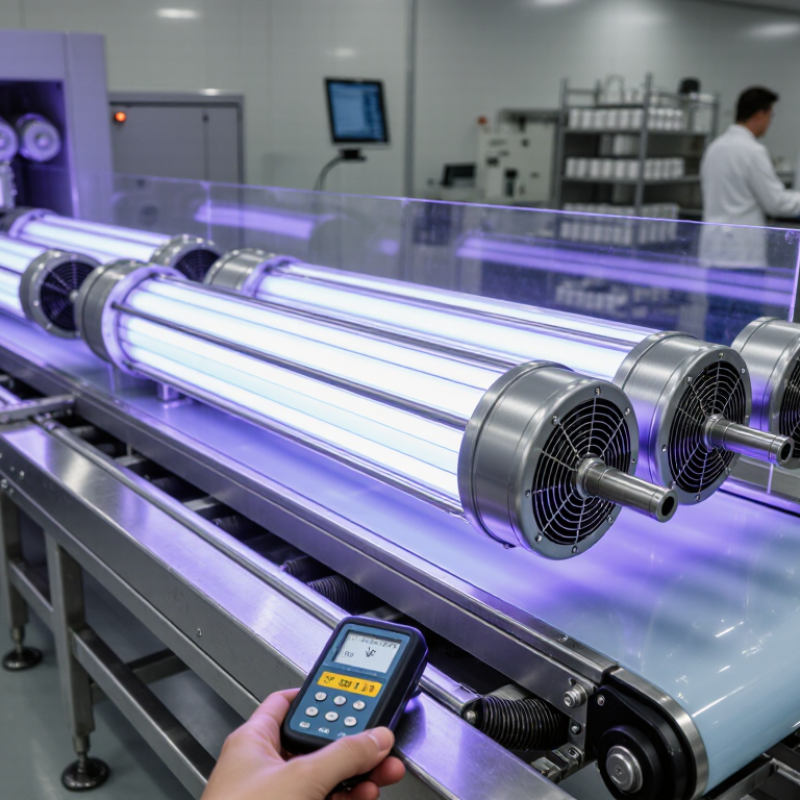
Air-cooled UV lamps generate ultraviolet radiation through an electrical arc inside a quartz tube. The arc excites mercury or another filling material, producing intense UV energy. Airflow then removes heat from the lamp housing, reflector, and nearby components. It is not simply blowing harder. Poor airflow can shorten lamp life and reduce curing consistency.
The output spectrum depends on the lamp design. ISO 21348 defines UV-A as 315–400 nanometers, UV-B as 280–315 nanometers, and UV-C as 100–280 nanometers. Many curing systems rely on strong peaks near 365 nanometers. According to IEC 62471, operators must also assess photobiological risks, not only electrical performance. A bright lamp may still be poorly matched to the coating.
When comparing air-cooled UV lamp suppliers, request measured irradiance, wavelength distribution, cooling-air volume, reflector temperature, and tested service life. Do not judge quality by wattage alone. A 2,000-watt lamp can underperform if the reflector is dirty or the airflow is uneven.
Industry curing reports from RadTech repeatedly emphasize dose control as a key factor in process reliability.
In practice, verify dose with a calibrated radiometer at the actual working distance. Results can drift. That small detail is often missed.

Air-cooled UV lamps suit industrial lines where stable curing matters more than laboratory perfection. They use forced air to remove heat from the lamp housing, reflector, and nearby components. This avoids chilled-water pipes, pumps, filters, and possible leaks. Installation can be simpler in narrow printing, coating, and bonding spaces. It is not always quieter, though.
The 2023 RadTech UV+EB Technology Report describes growing industrial adoption of energy-efficient curing systems, especially where production speed and lower process waste are important. Smithers’ 2024 market outlook also estimates continued expansion in UV curing applications through the decade. These findings support air-cooled designs when factories need modular equipment and fewer utility connections. A well-selected lamp can cure coatings within seconds, while conventional thermal systems may require long ovens and larger floor areas. The detail matters.
From practical maintenance experience, airflow is the weak point. Dust can cover filters and reduce cooling performance. Poor ventilation may shorten lamp life or distort curing results. Operators should check air volume, reflector temperature, lamp distance, and substrate sensitivity during commissioning. Energy savings are possible, but they should not be promised automatically. A 2022 U.S. Department of Energy industrial efficiency review stresses that auxiliary systems, including fans, can affect total equipment consumption. That is easy to overlook. Suppliers should provide measured irradiance, cooling requirements, replacement procedures, and test records, not vague claims.
Why choose air-cooled UV lamps for industrial applications? The correct UV band depends on the material, curing chemistry, coating, and required process result.
Selection guide: UVA is widely used for industrial curing, bonding, printing, and coating processes. UVB is used in specialized photochemical and surface-treatment applications, while UVC is commonly associated with disinfection and certain oxidation processes. Air-cooled systems are often preferred when the lamp power and process duty can be managed with forced airflow, because they avoid a liquid-cooling loop and can simplify installation and maintenance. When comparing suppliers, evaluate cooling capacity, airflow monitoring, lamp compatibility, irradiance stability, safety interlocks, replacement availability, and technical support.
When evaluating China-based UV lamp suppliers, inspect engineering evidence before comparing prices. Air-cooled lamps need stable airflow, reflector alignment, and controlled operating temperature. Ask for irradiance maps, lamp-life test records, electrical tolerances, and cooling specifications. A supplier should explain testing conditions clearly, not only provide attractive catalogue figures.
Fortune Business Insights estimated the global UV curing market at about USD 4.9 billion in 2023, with continued growth through 2030. This expansion increases supplier choices, but also increases quality differences. Check whether the supplier follows relevant IEC safety requirements and maintains traceable production records. Request sample testing with your own substrate, speed, and distance settings. In practical audits, small details matter: cable insulation, quartz cleanliness, spare-part availability, and response time after installation. Some suppliers claim long lamp life without defining output loss. That deserves questioning.
Tips: Compare measured irradiance, not wattage alone. Ask for a third-party test report when possible. Review at least three recent customer references from similar applications. Visit the factory if the project is large. A video tour helps, but it is not equal to an audit. Also, do not assume the cheapest quotation is efficient; unstable UV output can increase rejected products and maintenance hours. I would record every promise in the contract, because memory becomes unreliable after delivery.
When comparing China top air cooled UV lamp suppliers, technical data matters more than catalogue wattage. RadTech’s 2023 UV+EB Technology Roadmap describes UV curing as a process completed in seconds, but only when irradiance and dose match the coating. Ask for measured irradiance in W/cm², operating distance, wavelength, and dose in mJ/cm². A 5 kW lamp is not automatically stronger. Poor reflector design can waste power and create uneven curing across a 1.6-meter web.
Cooling performance deserves close inspection. Compare airflow volume, inlet temperature, noise, and lamp housing temperature under continuous operation. The U.S. Department of Energy’s 2023 industrial efficiency data shows that motors and fans can represent a meaningful share of auxiliary energy use. In practice, a smaller fan is not always cheaper. Restricted filters may raise temperature, shorten lamp life, and cause unstable output. Request test curves after 1,000 operating hours, not only new-lamp readings. This is where many comparisons become incomplete.
Tips:
Check spectral output with a calibrated radiometer. Confirm whether the supplier reports peak irradiance or integrated dose. Review warm-up time, replacement procedure, reflector material, ozone control, and electrical compatibility. IEC 62471 provides a useful framework for photobiological risk assessment. Also request factory test records and a sample run using your actual substrate. Numbers can look impressive. Your coating may still disagree. Be careful with unverified lifetime claims, because operating temperature, switching frequency, and contamination strongly affect results.
Choosing an air-cooled UV lamp supplier begins with system compatibility, not a low quotation. Ask for measured lamp output, operating temperature, airflow volume, reflector design, and electrical requirements. A reliable supplier should provide test records, material specifications, and a clear replacement procedure. The U.S. EPA’s Ultraviolet Disinfection Guidance Manual stresses validated UV dose delivery, sensor monitoring, and regular cleaning. These requirements also matter in curing, printing, and coating systems.
Check thermal performance under real production conditions. Request data from a test chamber close to your own installation, including ambient temperature, lamp distance, line speed, and cooling pressure. The IEA’s Energy Efficiency 2023 report states that buildings consume about 30% of global final energy. This figure is not a direct lamp benchmark, but it reinforces the value of efficient power control and reduced heat losses. Ask whether the supplier can offer dimming, standby control, and stable output over time.
Service quality is often harder to verify. Require documented response times, spare-part availability, calibration support, and technical training. A supplier that cannot explain airflow failure modes may create expensive downtime later. Lower price is not always lower cost. I have seen specifications look complete while omitting cable temperature limits and reflector maintenance. That deserves questioning. Small oversights matter. Compare total operating cost over lamp life, not only purchase price, and request independent performance evidence before approval.
| Evaluation Dimension | What to Check | Practical Reference Data | Why It Matters | Recommended Supplier Evidence | Suggested Weight |
|---|---|---|---|---|---|
| Wavelength Compatibility | Confirm the lamp spectrum matches the coating, adhesive, ink, resin, or disinfection process. | Common UV LED peak wavelengths include 365 nm, 385 nm, 395 nm, and 405 nm. Mercury UV lamps commonly provide strong output around 254 nm and 365 nm, depending on lamp design. | A wavelength mismatch can cause slow curing, incomplete curing, poor adhesion, or reduced treatment effectiveness. | Measured spectral distribution, wavelength tolerance, optical test report, and application trial results. | 20% |
| Irradiance and Dose | Evaluate irradiance at the work surface and the required UV dose over the exposure area. | Irradiance is normally expressed in W/cm² or mW/cm²; dose is expressed in J/cm². Dose is calculated as irradiance multiplied by exposure time. | Rated optical power alone does not confirm process performance. Working distance, reflector design, and uniformity also affect the delivered dose. | Irradiance map, dose verification method, calibrated meter information, and test data at the specified working distance. | 20% |
| Air-Cooling Performance | Check fan capacity, airflow direction, heat-sink design, ambient-temperature range, and ventilation requirements. | The supplier should specify allowable ambient temperature, airflow requirements, continuous-duty limits, and thermal protection settings. Air cooling is generally simpler than liquid cooling but may provide less heat-removal capacity. | Insufficient cooling can reduce UV output, shorten LED or lamp life, trigger thermal shutdown, or damage nearby components. | Thermal test report, temperature-rise data, fan specification, alarm logic, and installation clearance drawing. | 15% |
| Uniformity Across the Working Area | Compare the minimum, maximum, and average irradiance across the complete treatment or curing width. | Ask for a measurement grid and uniformity calculation. A practical project target should be defined according to the process; many industrial applications use a minimum-to-average ratio or a maximum-to-minimum ratio as the acceptance criterion. | Uneven UV exposure may produce partially cured areas, inconsistent color, or variable surface treatment. | Grid-based irradiance map measured at the actual conveyor speed, height, and operating temperature. | 10% |
| Electrical and Control Compatibility | Verify input voltage, frequency, current, power supply type, dimming method, communication interface, and machine interlocks. | Common industrial control requirements may include digital enable signals, emergency-stop integration, power regulation, fault output, and real-time status monitoring. | Electrical incompatibility can cause unstable output, nuisance trips, electromagnetic interference, or unsafe machine operation. | Wiring diagram, interface protocol, EMC test information, operating manual, and sample controller communication test. | 10% |
| Safety and Compliance | Review UV shielding, interlocks, warning labels, electrical protection, restricted-access controls, and applicable market requirements. | UV risk assessment should consider exposure to ultraviolet radiation. IEC 62471 is commonly used for photobiological safety assessment of lamps and lamp systems; other electrical and EMC requirements depend on the destination market. | UV-C and high-intensity UV-A exposure can harm eyes and skin. A compliant system reduces operational and regulatory risk. | Safety assessment, declaration of conformity where applicable, electrical test reports, risk-control drawings, and user safety instructions. | 10% |
| Service Life and Output Stability | Compare expected useful life, output-maintenance definition, operating cycle, and replacement recommendations. | For LED systems, useful life is often specified by an output-maintenance metric such as L70, meaning 70% of initial light output under defined conditions. For arc lamps, replacement intervals depend on lamp type, operating hours, and output requirements. | Stable output improves process consistency and reduces unplanned maintenance. | Aging test data, output-monitoring method, replacement schedule, warranty terms, and spare-parts availability. | 10% |
| Customization and Mechanical Fit | Check mounting dimensions, optical window, working distance, cable routing, cooling clearance, and integration with the existing machine. | The supplier should provide dimensional drawings, mounting tolerances, connector details, minimum ventilation clearance, and interface specifications before production. | A mechanically unsuitable unit may require costly redesign and can create thermal or safety problems. | 2D or 3D drawings, prototype sample, fit-check record, and documented engineering-change process. | 5% |
| Quality System and Traceability | Assess incoming inspection, production testing, calibration control, serial-number traceability, and final inspection procedures. | Relevant records may include spectral output, electrical power, irradiance, temperature, leakage current, functional testing, and final visual inspection. | Traceable records make it easier to identify process drift and manage warranty or replacement issues. | Quality manual, inspection plan, calibration certificates, batch records, corrective-action procedure, and sample test report. | 5% |
| Total Cost of Ownership | Compare purchase price, power consumption, cooling requirements, maintenance, consumables, downtime, shipping, and spare parts. | A lower purchase price does not necessarily mean a lower operating cost. Evaluate cost per operating hour and cost per treated unit where process data are available. | Lifecycle cost provides a more reliable comparison than initial price alone. | Five-year cost model, energy data, warranty coverage, spare-parts pricing, lead time, and service response terms. | 5% |
| Total Suggested Evaluation Weight | 100% | ||||


For those larger-sized parts, or smaller quantity runs, we have 2 independent powder coat booths and ovens. The quality, durability and affordability of today’s powder coating finishes make this the process of choice for world-class companies.
Powder coating advantages over other forms of coating are many. Materials used in the Powder coating process can be metals and non-metals that come in a multitude of thicknesses, textures, colors, etc. Another of Powder coating’s biggest advantages over conventional coatings is its ability to create finishes in many different textures. Powder Coating Booths allow us the ability to apply these advantages to large products.
Tri-State Fabricators runs a full-service conveyor line for painting. Wet painting can provide protection or decoration to many different part styles. From start to finish, every project is easier to undergo random and point-based inspection by our skilled painting team.
Advantages to our Wet Paint Line are these lines start with product prep and ends with a thorough inspection of a high quality finished product. Our ability to complete large and small projects with a superior finish and doing so in a timely and economical fashion. This passes along the savings in production to our customers. When powder coating ins not an option, our Wet Paint Line gets the job done right the first time.
When the parts get big and heavy we roll-out our custom paint racks and oversize booth. By utilizing our partnerships with all the major paint brands, we can match virtually any color with wet paint.
The advantages of having access to a Wet Paint Booth are many. Large projects of many different shapes can be loaded into the booth. The Wet Paint Booth offers an environment that is much more controlled than a typical parts painting operation.
Not only are they used because of their controlled environment, but they’re are also advantageous when it comes to applying paint to parts that are needed in industries that require specialty coatings such as medical, aerospace, etc.
Our military forces have some very high standards when it comes to the finish of their vehicles and equipment. From the first pre-treatment step to final coat, it takes a great deal of knowledge and experience to protect the men and women of our armed forces. They deserve only the best, and Tri-State Fabricators provides it.
All of our processes are closely monitored by our staff and management teams. Both of which are highly trained in the processes of metal fabrication and finishing. Tri-State Fabricators’ goal is to always fully satisfy each and every customer, including the military. We will always put a 110% into what we do.
Abrasive media blasting is an excellent way to remove old paint, rust, and increase the paint/powder adhesion. Glass beads produce a much smoother and brighter finish than angular abrasives; leaving the part clean yet without any dimensional change. Chemically inert and environmentally friendly, we can recycle our beads approximately 30 times; making them a more preferred method of metal cleaning or surface finishing.
Advantages to Glass Bead Blasting are many. Glass bead blast media is used when a project is needing rough surfaces need to become smooth for applications of coatings such as paint. It is typically used to clean paint and rust from a product surface without deforming the surface it is being used on. Overall, compared to many other blasting media, Glass Bead Blasting is a very economical choice and those savings are always passed on to our customers.
Tri-State Fabricators utilize a zinc phosphate wash to clean and etch the material to ensure the best paint adhesion possible. The unique design of our 3-stage wash system does the work like a 5-stage. From Cleaning and rinsing to conversion coating and post-treatment, Our Part Washing process is a complete service and works throughout the fabrication service and the finishing service.
Along with the previously mentioned benefits, Curing is a vital chemical reaction that leaves the product finish hard and relatively safe from mild abrasion and aggressive corrosion. This process can be done in more than one way; ambient air-dry or in curing ovens at temps that exceed 240°.
From fixing paint mistakes (someone else’s of course) to simply cleaning our paint line hooks, our burn-off oven is put to good use. After a quick burn-off, a little clean up, and a fresh coat of paint, your parts will look better than new.
Why does our Burn-Off Oven work so well? Because super heating the air around parts turns the materials into ashes. From paint and powder coatings to rubber and machining oils, high temps do the job without degrading the integrity of the part.
Masking is a vital part of producing high quality products. We have die-cut masking patterns to protect machined surfaces as well as a wide range of plugs and caps to protect threaded holes and bolts. We provide permanent and temporary masking.
Masking allows the selected sections of a product to be protected from a fabrication or finishing service. This can be with both chemicals when etching and tapes, paints when only finishing just a section of the product. Masking is great in aiding the customization process of a project.
Screen printing is a photographic process that transfers artwork onto a porous nylon screen which allows colored ink to flow through the screen and be deposited on an aluminum or plastic component. We can generally have just about any design created onto a screen for your parts.
Some of the advantages of Screen Printing are, brand recognition for your business displaying on your products, assembly instructions, product warnings/hazards, etc. Tri-State Fabricators produces Screen Printing of the highest quality so you know it’s durable.
Metal Finishing is the art of treating the exterior portion of product, often metal but can also be made of other materials, so that the surface is clean and free of any debris. Then the process of applying coats or either paint of powder coat takes place. This coating process improves the quality of the product in both appearance and resistance to wear and corrosion.
Tri-State Fabricators, Inc., understands that a project typically isn’t complete until a high-quality finish has been added to your product. This is why our painting and powder coating teams continuously inspect the products throughout the Metal Finishing process.

