Choosing the right Palletizing Machine starts with the work your line actually does, not the fastest number on a brochure. A case of bottled drinks behaves differently from a soft bag of grain or a mixed-SKU carton. Measure package dimensions, weight, pallet pattern, and hourly output across normal and peak shifts. Include awkward loads. They often reveal the real constraint.
Space matters, too. A compact robotic cell may fit around existing conveyors, while a conventional layer system may suit steady, high-volume production. Check floor space, ceiling height, access for operators, and how pallets enter and leave the area. Look closely at changeover time if products vary. Minutes add up. Also consider controls, guarding, upstream equipment, and the skills available for routine maintenance. A machine that runs quickly but stops often may not improve overall throughput.
Ask suppliers to test representative products and pallet patterns, then review the results with your production and maintenance teams. Confirm what the quoted capacity includes, and request details about service response, spare parts, training, and integration. Simple questions help. What happens when a carton is damaged? How easily can a recipe be changed? And, honestly, early estimates can be wrong when real packages behave differently from samples. Treat the decision as a process, not a single speed comparison. The best fit should meet your output needs, handle foreseeable product changes, and remain practical to operate on an ordinary shift.
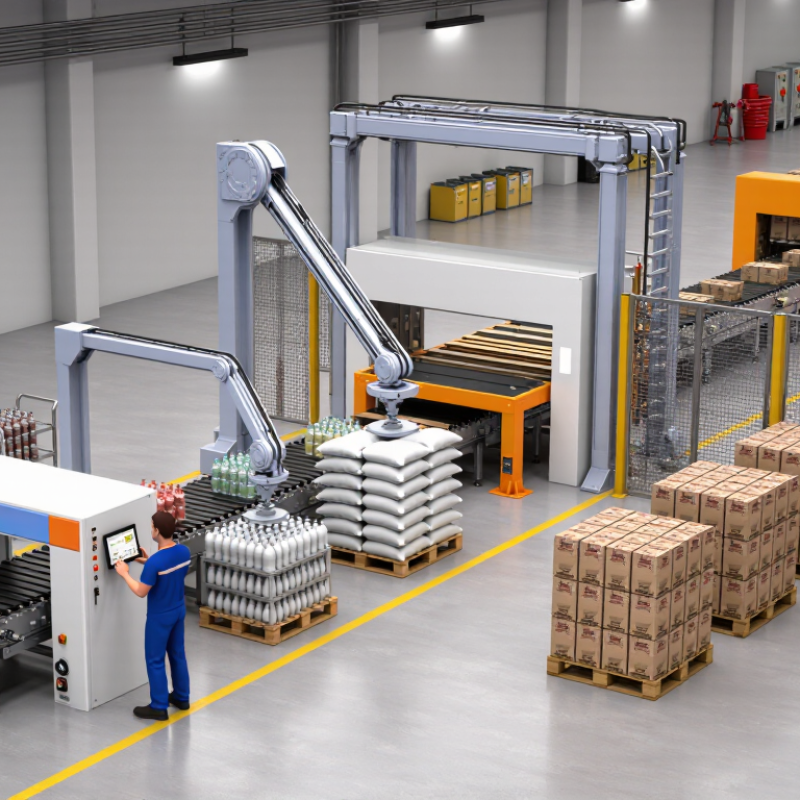
Start with the load, not the machine. Record each product’s dimensions, weight, packaging material, and daily volume. A carton that is slightly crushed may behave differently from a rigid box. Note the pallet size and required stacking pattern, too. If product sizes vary, measure the full range rather than relying on an average. Small differences matter.
Then examine the operating conditions. How many hours will the line run, and how often will products change? Measure available floor space, ceiling height, and access for maintenance. Check how cartons arrive at the palletizing station, including gaps or uneven spacing. Dust, cold rooms, and frequent washdowns can affect equipment choice. A tidy spreadsheet can still miss a real bottleneck; observe the line during a busy shift. Test proposed stacking patterns with actual loads, and confirm that completed pallets remain stable during handling.
Tips: Track peak output, not just the daily average. Photograph existing pallet patterns and note awkward cases, such as a short final layer. Ask for a trial using representative products and pallets. Keep one detail open to review: estimates of future volume are often wrong, and overbuilding can take space without solving today’s constraint.
A conventional layer palletizer arranges full product layers onto a pallet. It works well when cartons arrive in steady, uniform patterns. For example, a beverage line may need each layer aligned tightly to limit shifting during transport. These machines can be fast, but changing package sizes may require adjustments or new tooling. That matters.
Robotic palletizers use an articulated arm to pick and place cases, bags, or trays. They offer flexible layouts and can switch between patterns with suitable programming and end-of-arm tooling. A robot may suit a facility handling several carton sizes, especially where floor space is limited. However, actual output depends on payload, reach, product flow, and how often patterns change. I would not choose by advertised speed alone; it is an easy number to overvalue.
Low-level palletizers feed products near floor height, which can simplify access for operators and maintenance. High-level systems build loads above the conveyor, often supporting faster, continuous production, but they need more overhead clearance.
Tips: Compare each machine using your real products, pallet dimensions, shift schedule, and available space. Ask for a test with your heaviest and most awkward cases. A tidy sample load may not reveal every problem.
Payload is more than the weight printed on a carton. Include the end-of-arm tool, clamps, and any product layers the machine lifts together. Keep a margin for uneven loads and quick acceleration. A gripper that works on paper may struggle with a soft, shifting bag. That matters.
Throughput should reflect the full palletizing cycle, not just the robot’s fastest movement. Count picking, placing, pallet changes, and brief pauses for product flow. Then compare that figure with peak production, not only the daily average. Run a real test. A slower, steady cycle may be more useful than a quoted rate your line rarely reaches.
Product compatibility depends on shape, surface, and packaging strength. Tall cartons, slippery shrink-wrapped bundles, and mixed-size cases can need different gripping methods. Check whether the machine can handle your actual pallet pattern, including corner overhangs and layer sheets. Bring representative products for a trial, and watch for crushed edges or shifting stacks. One detail is easy to miss: packaging can change between suppliers, so leave room to retest when materials change. I would not choose from a specification sheet alone; it can hide awkward handling issues.
Choosing a palletizing machine starts with the floor, not the payload. Measure the full cell, including pallet staging, conveyor turns, operator access, and space for maintenance. A 2024 MHI Annual Industry Report found that 55% of surveyed supply chain professionals planned to increase technology investment. That wider trend makes integration planning essential, but it does not guarantee a system will fit your operation.
Map safety and controls around real tasks. Check where workers load empty pallets, clear jams, and change product recipes. Specify guarding, access points, and safe stop procedures with qualified safety professionals. For controls, confirm the machine can exchange clear signals with upstream conveyors, scanners, and warehouse software. Agree on who owns fault messages and recovery steps before installation. One uncomfortable truth: the neatest cell on paper may fail during a rushed changeover.
Tips: Tape the proposed footprint onto the floor and walk the route with operators. Test sample cartons, including the lightest and most awkward cases. Ask the integrator to document interface requirements, cycle assumptions, and maintenance clearances. Leave room for a future line change; forecasts can be wrong, and floor space is hard to reclaim.
Compare key planning considerations before selecting a palletizer.
Example planning scores on a 1–5 scale, not industry benchmarks. Rate each factor for your facility: check floor space and product flow, assess guarding and safe access, confirm control-system needs, and verify communication with upstream and downstream equipment.
Choosing the right palletizing machine means comparing more than the purchase price. Calculate total cost across installation, tooling, operator training, energy use, maintenance, and expected downtime. Ask for a clear estimate of replacement parts and service rates. A low-cost machine can become expensive if a routine repair stops a full shift.
Use your own production details when comparing suppliers. Share the number of cartons per minute, pallet sizes, product changes, and available floor space. Ask who handles commissioning and how quickly support can respond. Check whether technicians are nearby and spare parts are kept in stock. Request a live trial with your cartons, not just a polished demonstration. Watch how the machine handles uneven boxes and small production changes. Supplier claims are useful, but they need verification. Even a careful forecast can miss something.
Tips: Ask for a written service plan, a sample maintenance schedule, and references from similar operations. Clarify what training includes. Then review the figures with operators and maintenance staff; they may spot practical costs that a spreadsheet misses.



For those larger-sized parts, or smaller quantity runs, we have 2 independent powder coat booths and ovens. The quality, durability and affordability of today’s powder coating finishes make this the process of choice for world-class companies.
Powder coating advantages over other forms of coating are many. Materials used in the Powder coating process can be metals and non-metals that come in a multitude of thicknesses, textures, colors, etc. Another of Powder coating’s biggest advantages over conventional coatings is its ability to create finishes in many different textures. Powder Coating Booths allow us the ability to apply these advantages to large products.
Tri-State Fabricators runs a full-service conveyor line for painting. Wet painting can provide protection or decoration to many different part styles. From start to finish, every project is easier to undergo random and point-based inspection by our skilled painting team.
Advantages to our Wet Paint Line are these lines start with product prep and ends with a thorough inspection of a high quality finished product. Our ability to complete large and small projects with a superior finish and doing so in a timely and economical fashion. This passes along the savings in production to our customers. When powder coating ins not an option, our Wet Paint Line gets the job done right the first time.
When the parts get big and heavy we roll-out our custom paint racks and oversize booth. By utilizing our partnerships with all the major paint brands, we can match virtually any color with wet paint.
The advantages of having access to a Wet Paint Booth are many. Large projects of many different shapes can be loaded into the booth. The Wet Paint Booth offers an environment that is much more controlled than a typical parts painting operation.
Not only are they used because of their controlled environment, but they’re are also advantageous when it comes to applying paint to parts that are needed in industries that require specialty coatings such as medical, aerospace, etc.
Our military forces have some very high standards when it comes to the finish of their vehicles and equipment. From the first pre-treatment step to final coat, it takes a great deal of knowledge and experience to protect the men and women of our armed forces. They deserve only the best, and Tri-State Fabricators provides it.
All of our processes are closely monitored by our staff and management teams. Both of which are highly trained in the processes of metal fabrication and finishing. Tri-State Fabricators’ goal is to always fully satisfy each and every customer, including the military. We will always put a 110% into what we do.
Abrasive media blasting is an excellent way to remove old paint, rust, and increase the paint/powder adhesion. Glass beads produce a much smoother and brighter finish than angular abrasives; leaving the part clean yet without any dimensional change. Chemically inert and environmentally friendly, we can recycle our beads approximately 30 times; making them a more preferred method of metal cleaning or surface finishing.
Advantages to Glass Bead Blasting are many. Glass bead blast media is used when a project is needing rough surfaces need to become smooth for applications of coatings such as paint. It is typically used to clean paint and rust from a product surface without deforming the surface it is being used on. Overall, compared to many other blasting media, Glass Bead Blasting is a very economical choice and those savings are always passed on to our customers.
Tri-State Fabricators utilize a zinc phosphate wash to clean and etch the material to ensure the best paint adhesion possible. The unique design of our 3-stage wash system does the work like a 5-stage. From Cleaning and rinsing to conversion coating and post-treatment, Our Part Washing process is a complete service and works throughout the fabrication service and the finishing service.
Along with the previously mentioned benefits, Curing is a vital chemical reaction that leaves the product finish hard and relatively safe from mild abrasion and aggressive corrosion. This process can be done in more than one way; ambient air-dry or in curing ovens at temps that exceed 240°.
From fixing paint mistakes (someone else’s of course) to simply cleaning our paint line hooks, our burn-off oven is put to good use. After a quick burn-off, a little clean up, and a fresh coat of paint, your parts will look better than new.
Why does our Burn-Off Oven work so well? Because super heating the air around parts turns the materials into ashes. From paint and powder coatings to rubber and machining oils, high temps do the job without degrading the integrity of the part.
Masking is a vital part of producing high quality products. We have die-cut masking patterns to protect machined surfaces as well as a wide range of plugs and caps to protect threaded holes and bolts. We provide permanent and temporary masking.
Masking allows the selected sections of a product to be protected from a fabrication or finishing service. This can be with both chemicals when etching and tapes, paints when only finishing just a section of the product. Masking is great in aiding the customization process of a project.
Screen printing is a photographic process that transfers artwork onto a porous nylon screen which allows colored ink to flow through the screen and be deposited on an aluminum or plastic component. We can generally have just about any design created onto a screen for your parts.
Some of the advantages of Screen Printing are, brand recognition for your business displaying on your products, assembly instructions, product warnings/hazards, etc. Tri-State Fabricators produces Screen Printing of the highest quality so you know it’s durable.
Metal Finishing is the art of treating the exterior portion of product, often metal but can also be made of other materials, so that the surface is clean and free of any debris. Then the process of applying coats or either paint of powder coat takes place. This coating process improves the quality of the product in both appearance and resistance to wear and corrosion.
Tri-State Fabricators, Inc., understands that a project typically isn’t complete until a high-quality finish has been added to your product. This is why our painting and powder coating teams continuously inspect the products throughout the Metal Finishing process.


