


Choosing an Industrial Pipeline is not just a matter of selecting a diameter and material. The line must carry a specific fluid at defined pressures and temperatures, while withstanding corrosion, vibration, and cleaning demands. A carbon-steel pipe may suit a dry utility line but fail quickly in a corrosive process. Small details matter: fluid chemistry, start-up temperature, and the location of a low-point drain can change the decision.
Industry data underline why containment and maintenance deserve attention. The International Energy Agency’s Global Methane Tracker 2024 estimated that fossil-fuel operations emitted about 120 million tonnes of methane in 2023. These emissions do not come from pipelines alone, but they show why leak prevention and inspection belong in pipeline planning. For process facilities, ASME B31.3 provides a widely used framework for process-piping design, materials, fabrication, and examination. It is a starting point, not a substitute for project-specific engineering or qualified review.
A sound selection process compares operating conditions, material compatibility, pressure rating, installation constraints, and whole-life cost. Include the valves, joints, supports, and instruments—not only the pipe wall. Then check how the system will be inspected and repaired after commissioning. The answer may still involve trade-offs. A higher-grade alloy can resist corrosion, yet increase cost and lead time; a cheaper option may demand more monitoring. There is no universal best pipe. The right choice is the one supported by documented service conditions, credible standards, and a realistic maintenance plan.
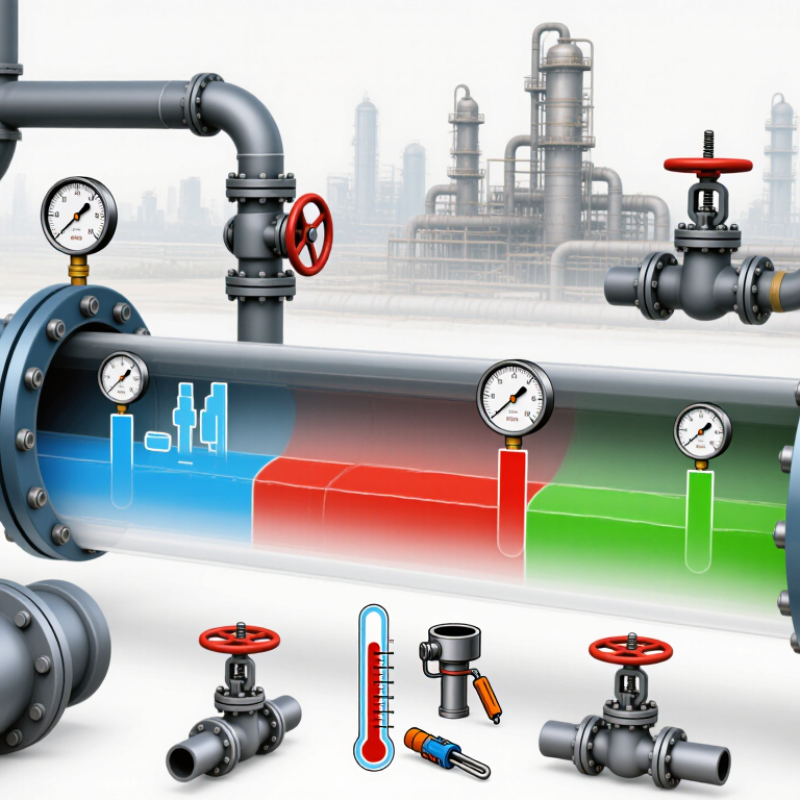
Under ASME B31.3, design pressure and temperature should reflect the most severe conditions expected to occur together during the piping system’s life. Normal operating readings alone are not enough. Check the process data, control limits, startup and shutdown conditions, and credible upset cases. A blocked outlet, pump shutoff, or pressure surge may change the design basis. Small details matter.
Define conditions at the relevant points in the line, not just at the equipment outlet. Account for elevation-related static head and pressure losses where they affect the local pressure. Design temperature should represent the expected pipe metal temperature, which may differ from the fluid temperature. Insulation, ambient exposure, heat tracing, and nearby hot equipment can all influence it. Be careful with assumptions here; a tidy process datasheet can still miss a real operating case.
These values guide material selection, wall-thickness calculations, and checks against component pressure-temperature ratings. Higher temperatures can reduce allowable stress, while low temperatures may raise toughness concerns. Record the source and reasoning for each design condition, then compare them with the latest process documents and operating experience. If field readings conflict with the original basis, investigate before accepting either number. The answer is not always obvious. A short review with process, piping, and operations personnel can expose gaps before drawings are issued.

Begin with the required flow rate, then choose a trial velocity suited to the fluid and service. The continuity equation gives internal bore: diameter = √(4 × flow rate ÷ π × velocity). For 12 m³/h of water at a trial velocity of 1.5 m/s, the calculated bore is about 53 mm. That is an internal diameter, not a nominal pipe size.
Check the result against viscosity, density, pipe length, roughness, fittings, and allowable pressure loss. These factors affect friction and pumping demand. Use the Darcy–Weisbach equation for liquid pressure loss, with a friction factor based on Reynolds number and pipe roughness. For gases, account for pressure and temperature changes; a simple constant-density estimate may mislead. Small details matter.
The U.S. Department of Energy’s 2006 Improving Pumping System Performance sourcebook reports that pumping systems can use 25–50% of electricity in some industrial facilities. That makes an undersized bore costly, while oversizing can add material expense and may affect flow control. Treat the first calculation as a starting point, not an answer. I would recheck the actual fluid temperature and operating range before specifying a nominal size.
How to Choose the Right Industrial Pipeline?
Select pipe material by chemistry, not by pressure rating alone. Chlorides can trigger pitting in stainless steel; acids, alkalis, and dissolved oxygen create different corrosion risks. Record the fluid’s full composition, concentration, temperature, and flow conditions. Small changes matter. A warm, concentrated solution may behave very differently from the same chemical at room temperature. ASTM A106/A106M covers carbon-steel pipe for high-temperature service, while ASTM A312/A312M covers austenitic stainless-steel pipe. These specifications define product requirements; they do not, by themselves, prove that a material suits a particular process. ASME B31.3 provides process-piping design requirements, including material considerations.
Check data against operating experience and qualified corrosion testing. ASTM G31 describes laboratory immersion testing, which can help compare candidate metals in a representative fluid. Test the actual fluid. Include contaminants and expected temperature swings where practical. A 2016 NACE International IMPACT study estimated corrosion costs at US$2.5 trillion annually, or 3.4% of global GDP, and reported potential savings of 15–35% through corrosion-management practices. That figure is broad, not a prediction for one plant. Still, it shows why material selection deserves careful review. A neat compatibility chart can miss deposits, weld effects, or changing chemistry. I would revisit assumptions with process and materials specialists before finalizing the pipe class.
For NPS 2 pipe, the outside diameter remains 60.3 mm across schedules. Schedule 40 has a nominal 3.91 mm wall, while Schedule 80 has a 5.54 mm wall. That 1.63 mm difference changes the internal bore: approximately 52.5 mm for Schedule 40 and 49.2 mm for Schedule 80. A smaller bore can increase flow resistance and affect pump demand. Small change. Real effect. Treat these dimensions as nominal, and confirm them against the selected material’s dimensional standard.
The thicker Schedule 80 wall may support higher pressure under the same material and temperature conditions, but wall thickness alone does not determine a safe pressure rating. Material grade, operating temperature, corrosion allowance, fittings, and the design basis all matter. Check the full line. It is tempting to specify Schedule 80 everywhere for extra margin, yet that can add weight and cost while reducing flow area. A drawing may make the choice look obvious; actual operating conditions often complicate it. Compare the required pressure capacity with flow needs, then verify that connected valves and fittings match the selected schedule.
Choosing an industrial pipeline means matching its material to the fluid, temperature, pressure, and cleaning regime. Corrosion is not a minor allowance: NACE International’s 2016 IMPACT study estimated global corrosion costs at US$2.5 trillion, or 3.4% of global GDP, based on 2013 data. The study also estimated that applying existing corrosion-control practices could save 15–35% of those costs. That estimate is dated, not a project budget. Still, it shows why lining, corrosion allowance, and fluid chemistry deserve early review. Small details matter. A dead leg, for example, can trap moisture and undermine an otherwise sound material choice.
Joining methods affect both uptime and inspection access. Welded joints suit many permanent, high-pressure services, but require qualified procedures and careful examination. Flanges make equipment easier to remove, while adding potential leak paths and maintenance points. Use ultrasonic testing or radiography where appropriate, and set inspection intervals from risk, operating history, and applicable engineering codes—not habit alone. A clean visual inspection cannot reveal every flaw.
Compare lifecycle costs, not just purchase prices. Include installation, inspection, corrosion protection, energy losses, planned shutdowns, and replacement. The NACE estimate is a useful warning, but actual savings vary by service and site. I would also challenge assumptions about maintenance frequency; real operating data may prove the original plan too optimistic. A pipe that costs less today may become expensive when a hard-to-reach joint needs repair.


For those larger-sized parts, or smaller quantity runs, we have 2 independent powder coat booths and ovens. The quality, durability and affordability of today’s powder coating finishes make this the process of choice for world-class companies.
Powder coating advantages over other forms of coating are many. Materials used in the Powder coating process can be metals and non-metals that come in a multitude of thicknesses, textures, colors, etc. Another of Powder coating’s biggest advantages over conventional coatings is its ability to create finishes in many different textures. Powder Coating Booths allow us the ability to apply these advantages to large products.
Tri-State Fabricators runs a full-service conveyor line for painting. Wet painting can provide protection or decoration to many different part styles. From start to finish, every project is easier to undergo random and point-based inspection by our skilled painting team.
Advantages to our Wet Paint Line are these lines start with product prep and ends with a thorough inspection of a high quality finished product. Our ability to complete large and small projects with a superior finish and doing so in a timely and economical fashion. This passes along the savings in production to our customers. When powder coating ins not an option, our Wet Paint Line gets the job done right the first time.
When the parts get big and heavy we roll-out our custom paint racks and oversize booth. By utilizing our partnerships with all the major paint brands, we can match virtually any color with wet paint.
The advantages of having access to a Wet Paint Booth are many. Large projects of many different shapes can be loaded into the booth. The Wet Paint Booth offers an environment that is much more controlled than a typical parts painting operation.
Not only are they used because of their controlled environment, but they’re are also advantageous when it comes to applying paint to parts that are needed in industries that require specialty coatings such as medical, aerospace, etc.
Our military forces have some very high standards when it comes to the finish of their vehicles and equipment. From the first pre-treatment step to final coat, it takes a great deal of knowledge and experience to protect the men and women of our armed forces. They deserve only the best, and Tri-State Fabricators provides it.
All of our processes are closely monitored by our staff and management teams. Both of which are highly trained in the processes of metal fabrication and finishing. Tri-State Fabricators’ goal is to always fully satisfy each and every customer, including the military. We will always put a 110% into what we do.
Abrasive media blasting is an excellent way to remove old paint, rust, and increase the paint/powder adhesion. Glass beads produce a much smoother and brighter finish than angular abrasives; leaving the part clean yet without any dimensional change. Chemically inert and environmentally friendly, we can recycle our beads approximately 30 times; making them a more preferred method of metal cleaning or surface finishing.
Advantages to Glass Bead Blasting are many. Glass bead blast media is used when a project is needing rough surfaces need to become smooth for applications of coatings such as paint. It is typically used to clean paint and rust from a product surface without deforming the surface it is being used on. Overall, compared to many other blasting media, Glass Bead Blasting is a very economical choice and those savings are always passed on to our customers.
Tri-State Fabricators utilize a zinc phosphate wash to clean and etch the material to ensure the best paint adhesion possible. The unique design of our 3-stage wash system does the work like a 5-stage. From Cleaning and rinsing to conversion coating and post-treatment, Our Part Washing process is a complete service and works throughout the fabrication service and the finishing service.
Along with the previously mentioned benefits, Curing is a vital chemical reaction that leaves the product finish hard and relatively safe from mild abrasion and aggressive corrosion. This process can be done in more than one way; ambient air-dry or in curing ovens at temps that exceed 240°.
From fixing paint mistakes (someone else’s of course) to simply cleaning our paint line hooks, our burn-off oven is put to good use. After a quick burn-off, a little clean up, and a fresh coat of paint, your parts will look better than new.
Why does our Burn-Off Oven work so well? Because super heating the air around parts turns the materials into ashes. From paint and powder coatings to rubber and machining oils, high temps do the job without degrading the integrity of the part.
Masking is a vital part of producing high quality products. We have die-cut masking patterns to protect machined surfaces as well as a wide range of plugs and caps to protect threaded holes and bolts. We provide permanent and temporary masking.
Masking allows the selected sections of a product to be protected from a fabrication or finishing service. This can be with both chemicals when etching and tapes, paints when only finishing just a section of the product. Masking is great in aiding the customization process of a project.
Screen printing is a photographic process that transfers artwork onto a porous nylon screen which allows colored ink to flow through the screen and be deposited on an aluminum or plastic component. We can generally have just about any design created onto a screen for your parts.
Some of the advantages of Screen Printing are, brand recognition for your business displaying on your products, assembly instructions, product warnings/hazards, etc. Tri-State Fabricators produces Screen Printing of the highest quality so you know it’s durable.
Metal Finishing is the art of treating the exterior portion of product, often metal but can also be made of other materials, so that the surface is clean and free of any debris. Then the process of applying coats or either paint of powder coat takes place. This coating process improves the quality of the product in both appearance and resistance to wear and corrosion.
Tri-State Fabricators, Inc., understands that a project typically isn’t complete until a high-quality finish has been added to your product. This is why our painting and powder coating teams continuously inspect the products throughout the Metal Finishing process.

